Author: David, TechFlow TechFlow
Original title: The more powerful AI becomes, the more valuable McDonald's becomes.
At the start of 2026, AI terrified the capital markets.
It's not that AI is ineffective; it's that AI is too effective. So effective that every time it launches a new product, the stock market of an entire industry crashes.
For example, throughout February, Claude 's parent company, Anthropic, released four updates to its AI products. When AI could automatically run enterprise workflows, SaaS software stocks crashed; when AI could automatically scan for code vulnerabilities, cybersecurity stocks crashed; when AI could help banks rewrite old code from the last century,IBM's stock price plummeted 13% in a single day, wiping out $31 billion in market value, setting a record since the dot-com bubble of 2000.
One month, several industries, named one by one.
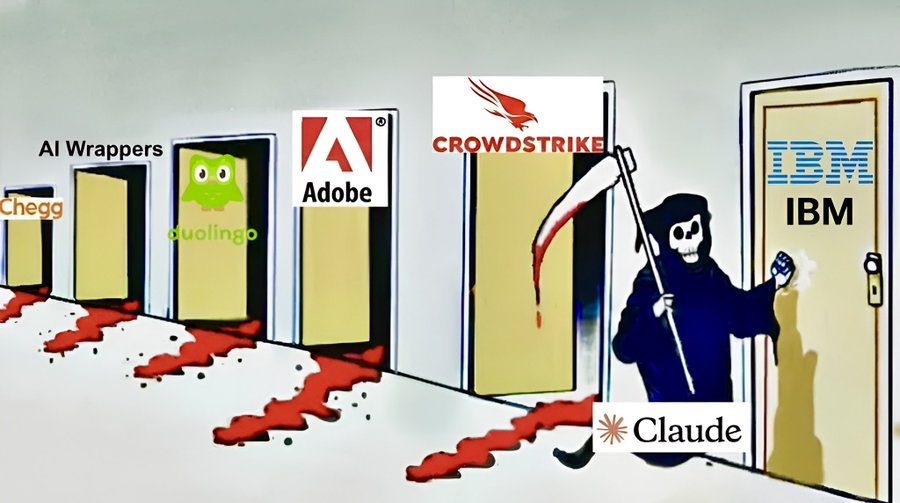
Panic is contagious.
Duolingo, an online education platform, saw its stock price plummet from an all-time high of $544 last May to below $85 by the end of February this year, wiping out more than 80% of its value. The iShares Software ETF is down 22% year-to-date and 30% from its peak…
One trader told Bloomberg that software stocks have been on the sell-off, with a headline like "AI will disrupt XX" triggering a mini flash crash.
The money has escaped from these companies, but it still needs to go somewhere.
Investing in AI is one approach, such as buying Nvidia, computing power, and infrastructure... But this path is already very crowded and becoming increasingly expensive.
Some people started to think about another question: Is there a type of company that AI can't kill no matter how it evolves?
HALO fires the first shot in the fight against AI anxiety.
In early February, a man named Josh Brown wrote an article on his blog.
This person is the CEO of an American asset management company and a frequent guest on CNBC; he's considered a celebrity in the financial world. He coined a term in his article:
HALO.
Heavy Assets, Low Obsolescence. This means assets are heavily invested in and have a low risk of obsolescence.
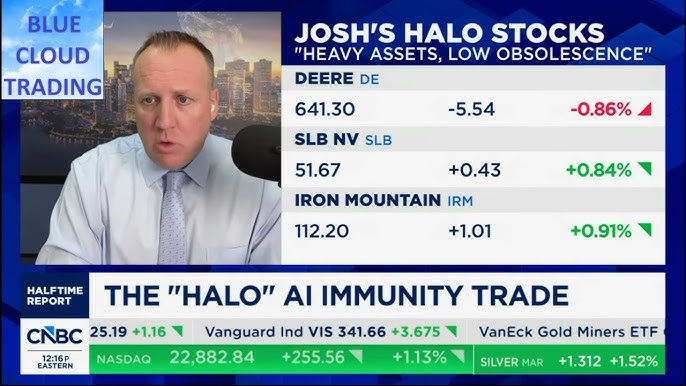
The meaning is simple: buy those companies that AI can't destroy no matter how it evolves.
This guy also provided a very simple way to identify HALO stock: "Can you type a few words into the input box and make the company's product? If not, then it's HALO stock."
He gave an example.
Delta Airlines and Expedia are both in the travel industry. This year, Delta rose 8.3%, while Expedia fell 6%. What's the difference?
AI can help you find the cheapest flight, but you still have to board the plane. Delta has planes, Expedia only has a search box.
He also stated that this was the simplest investment logic he had ever seen.
For the past 15 years, Wall Street has favored asset-light businesses. Software companies have no factories, no inventory, zero code copying costs, and incredibly high profit margins. But now AI has arrived, and what AI excels at replacing are precisely these companies that make money from code and information asymmetry.
Fortune changes, and now it's the "heavy" thing that's worth money.
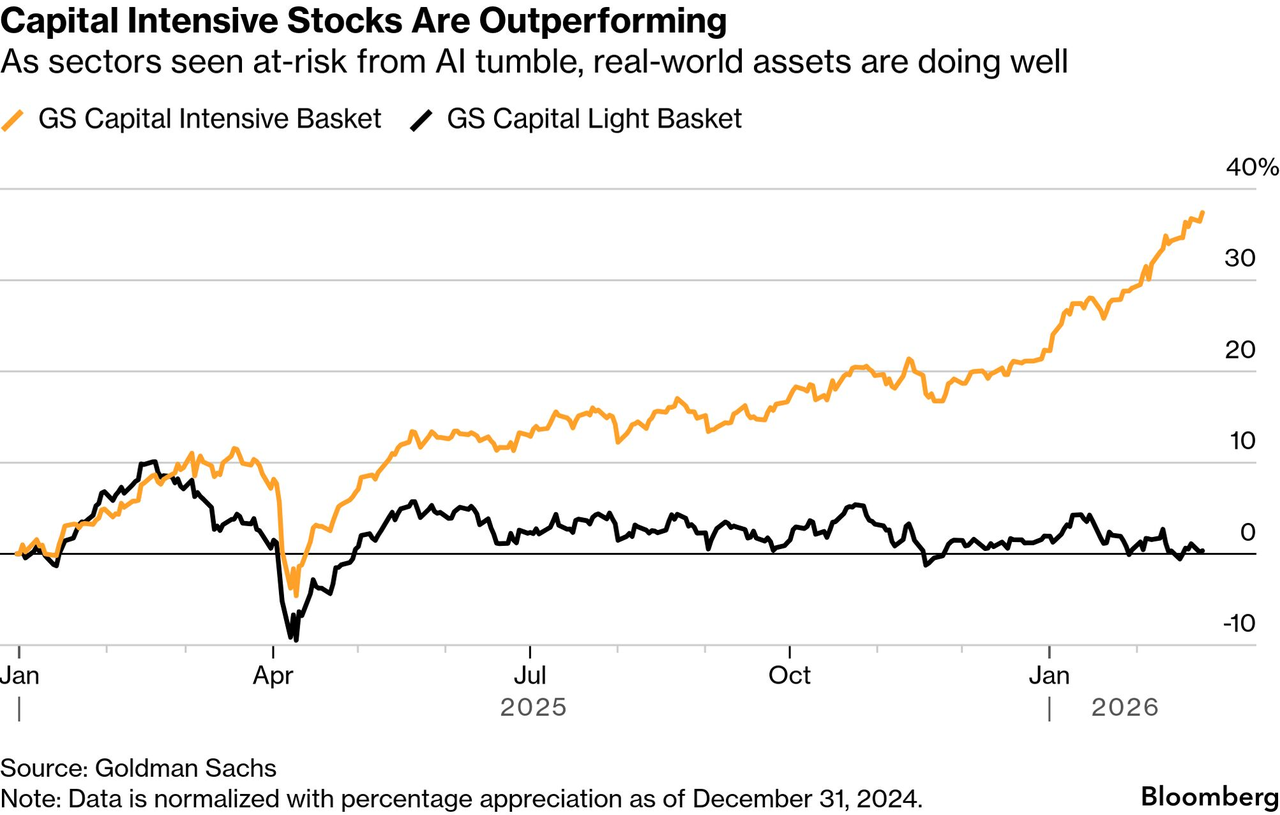
Within weeks of HALO's emergence, Goldman Sachs released a formal research report titled "The HALO Effect." The data showed that from the beginning of 2025 to the present, Goldman Sachs' portfolio of "heavy asset" stocks has outperformed the "light asset" portfolio by 35%.
Following this, Morgan Stanley's trading desk began using HALO to recommend investment targets to clients; the term also appeared in research notes from Barclays and Bank of America. Axios, the Wall Street Journal, and CNBC all reported on it extensively…
A word coined by a blogger has become the biggest trading theme on Wall Street in 2026.
What does this mean? It's not that Brown is so amazing, it's that everyone is genuinely panicked. So panicked that they need a single word to describe themselves:
Don't be afraid. AI has disrupted many things, but there is still a type of company that is safe.
The world is a huge asset
Do you think HALO is just a narrative? The capital market has already begun to vote.
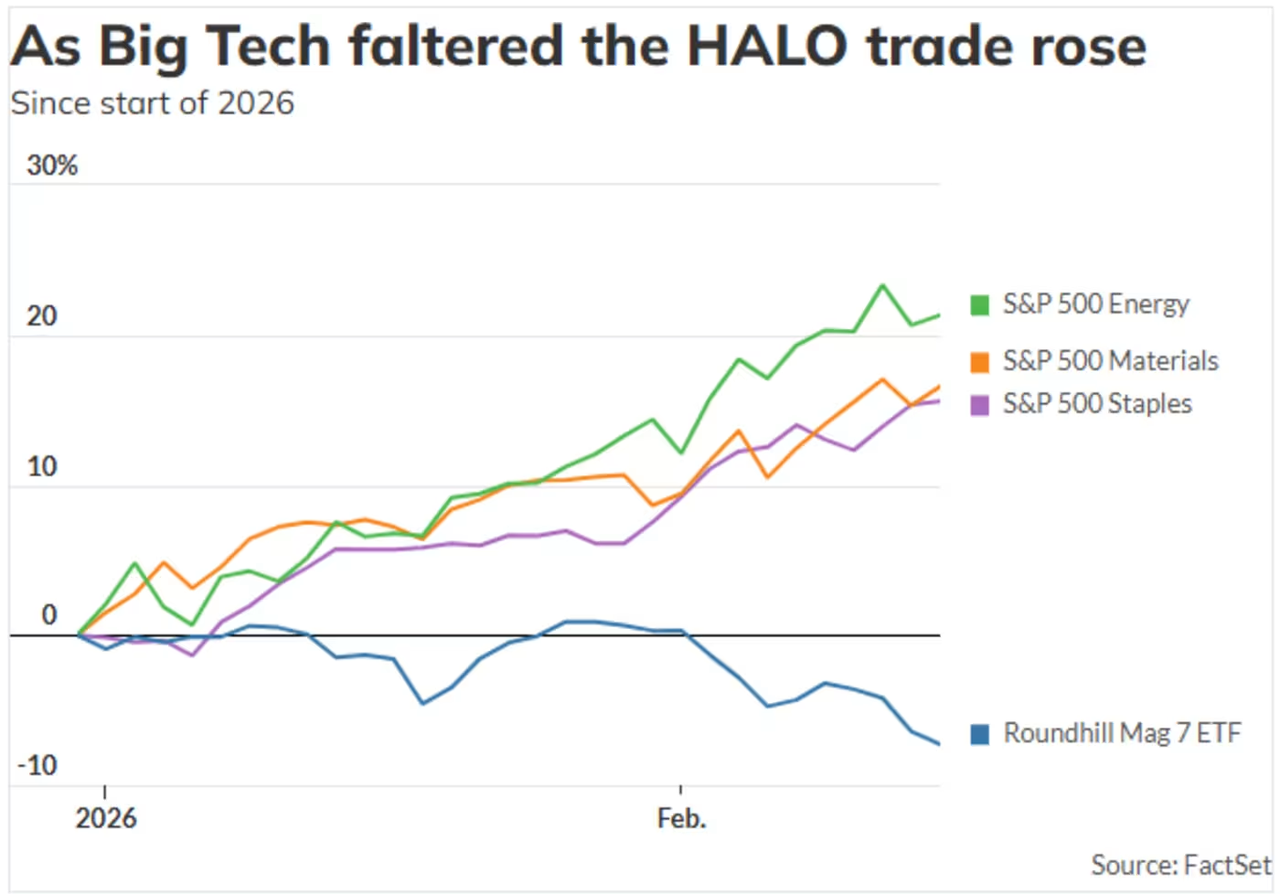
From the beginning of 2026 to the end of February, the S&P 500's energy sector rose by more than 23%, materials by 16%, consumer staples by 15%, and industrials by 13%.
At the same time, the information technology sector fell by nearly 4%, and the financial sector fell by nearly 5%.
Meanwhile, the seven major U.S. tech stocks collectively faltered. Of the seven—Alphabet, Amazon, Apple, Meta, Microsoft, Nvidia, and Tesla—only two have seen gains this year.
Investors are concerned about whether these companies, which burn through hundreds of billions of dollars annually to build computing power, can actually recoup their costs.
Which specific companies saw their stock prices rise?
McDonald's, Walmart, ExxonMobil... they sell hamburgers, run supermarkets, and refine oil. AI can write poetry, program, and litigate lawsuits, but it can't fry French fries or extract oil.
Budweiser beer has also increased by 48% since last year; after all, you can't drink AI.
Therefore, HALO represents a reversal in the valuation logic of the capital market amid AI anxiety. The last time such a reversal occurred was in 2000.
The same thing happened back then; investors fled tech stocks in a frenzy and flocked to "boring" sectors like energy, industrials, and consumer goods. The Nasdaq plummeted from 2000 to 2002, losing nearly 80% of its value, while the S&P energy sector rose by nearly 30% during the same period.
But there's a key difference. The dot-com bubble burst because the internet wasn't profitable; the story just fell apart. This time, things are a little different:
AI is so capable, it's frightening.
The panic doesn't stem from the failures of AI technology, but from its successes. This is unprecedented in the history of capital markets.
Ironically, AI companies themselves are becoming increasingly complex.
Goldman Sachs specifically mentioned in its report that companies that have most embraced the asset-light model in recent years are becoming the largest capital spenders in history.
The five tech giants are projected to spend $1.5 trillion in capital expenditures from 2023 to 2026, with over $450 billion in 2026 alone—more than all their previous investments before the AI era combined.
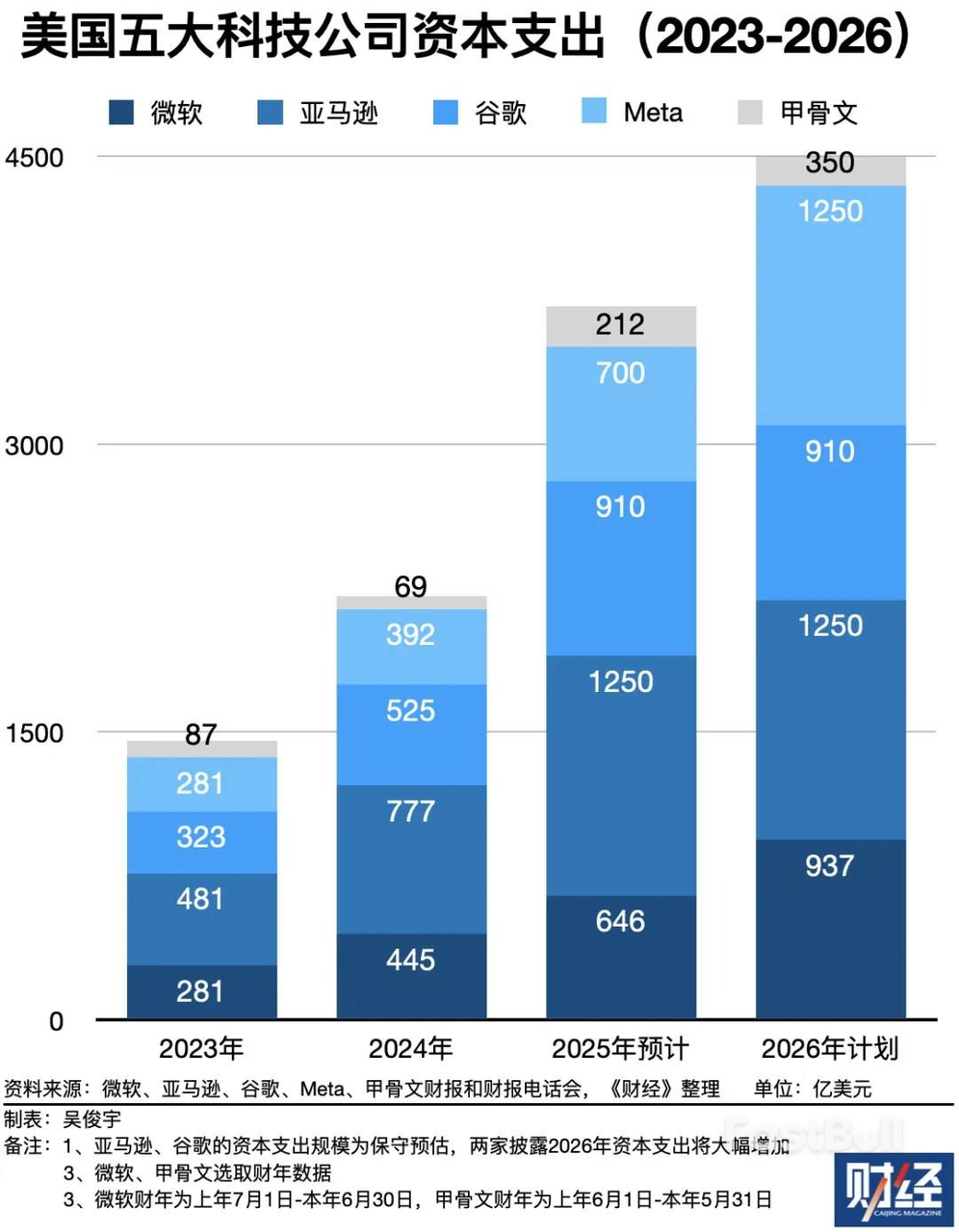
Image source: Finance
Where did all that money go? Data centers, chips, cables, cooling systems, power generation facilities—all heavy and expensive things in the physical world.
So you will see an absurd scene:
AI disrupted other people's asset-light models and then turned itself into an asset-heavy model.
Those companies that claimed to be disrupting the old world eventually found that they needed exactly the same things as the old world: factories, electricity, pipes…
Wall Street has been chasing "lightness" for 15 years, only to find that even AI itself cannot escape "heaviness".
Americans are hiding at McDonald's, while Chinese are using Qianwen to place orders.
At the same time, we on the other side of the strait gave a completely opposite answer.
Bloomberg published a report in late February with the headline: "Chinese Markets Are Resisting Global AI Panic Trading." One sentence in the article I found particularly insightful:
The US market is focused on what AI can take away, while the Chinese market is focused on what AI can help.
The same technology evokes two completely opposite emotions.
While American investors were coining the term HALO and hiding in McDonald's and Walmart, Chinese investors were snapping up AI application stocks.
In February of this year, JPMorgan Chase gave MiniMax and Zhipu both buy ratings, while Goldman Sachs gave Biren Technology and Muxi Integrated Circuit new buy recommendations at the same time; Bank of America analysts said that AI Agent and its commercialization may be the biggest investment theme in the Chinese market in 2026.
No one is worried that companies like Tencent and Alibaba will be killed by AI; what people care about is whether they can make more money using AI.
In a January report, Goldman Sachs said that Tencent is the biggest beneficiary of AI applications in China's internet sector, with every business line—gaming, advertising, fintech, and cloud—being accelerated by AI.
Why do the two sides react completely oppositely to the same wave?
US tech stocks have become too expensive over the past decade or so, so expensive that even a slight impact from AI on their profit margins would cause their valuations to collapse. Chinese tech stocks, on the other hand, have just emerged from a two- or three-year slump and are already cheap; for them, AI is an incremental factor, not a threat.
But stock prices alone cannot explain everything; the bigger difference lies in the environment.
Just as the HALO narrative was gaining traction in the US stock market, China had just experienced its most AI-intensive Spring Festival in history.
Volcano Engine secured exclusive AI cloud partnership with CCTV's Spring Festival Gala, and Doubao also achieved exclusive cooperation with CCTV's Spring Festival Gala; Qianwen secured title sponsorship for the Spring Festival Galas of four major satellite TV stations: Dragon TV, Zhejiang TV, Jiangsu TV, and Henan TV; Tencent Yuanbao distributed 1 billion yuan in red envelopes, and Baidu Wenxin distributed 500 million yuan. Alibaba went even further with a 3 billion yuan "Spring Festival Treat Plan," and Qianwen helped you order milk tea, delivering 1 million orders in 3 hours…
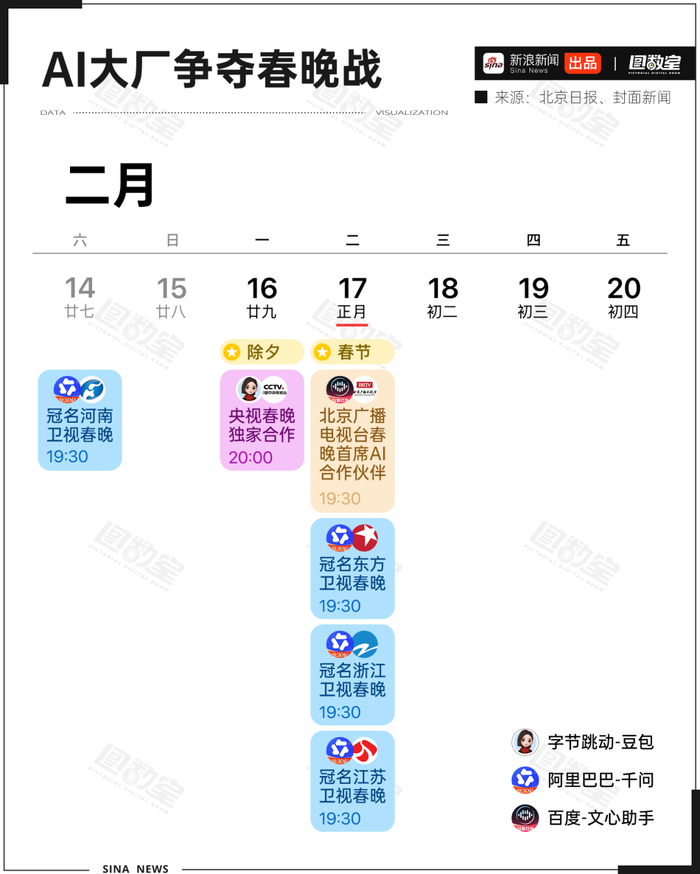
Image source: Sina News | Image Data Room
The four major companies spent a total of over 4.5 billion yuan on AI marketing during the Spring Festival.
Ten years ago, this spot was occupied by WeChat and Alipay giving away red envelopes during the Spring Festival Gala. Now it's Doubao and Qianwen. AI companies aren't using the Spring Festival Gala as an advertising platform; they're using it as a popular science stage to bring AI into the mass market.
The same fire can be a disaster on dry wood, but it can provide warmth on wet wood.
Amid the same AI wave, American capital is fleeing companies disrupted by AI and flocking to companies that "AI can't kill"; Chinese capital is chasing companies that can effectively utilize AI.
While one side is chasing and the other is fleeing, I feel that the side fleeing is overpriced.
The current situation is that AI's capabilities have been reasonably priced, but its destructive potential has been overpriced. The influx of funds into HALO stock reflects an imagination of who AI will kill, leading to a preemptive exit.
I went to McDonald's, Budweiser, and Walmart, etc. These companies are certainly good, but how much of their growth this year is due to performance, and how much is due to fear premium?
Wall Street's pendulum has always swung in extremes. In 2000, everything on .com seemed valuable; in 2002, everything on .com seemed like a scam. Now, even beer and tractors seem capable of keeping up with AI.
When this consensus becomes widespread enough, the next overcorrection will not be far off.
As for myself, this is how I see it:
AI is indeed getting stronger, there's no point in arguing about that. But the distance between "getting stronger" and "killing an industry" is much greater than most people think.
Every technological revolution follows the same script: first comes panic, then excessive exodus, and finally it is discovered that the things that were fled from did not die, but instead became cheaper because of the panic.
The internet didn't kill Walmart; Walmart learned e-commerce. Mobile payments didn't kill banks; banks learned to make apps.
What AI will truly kill are those companies that shouldn't exist in the first place—companies with no product barriers, whose growth depends entirely on financing, and whose survival depends entirely on information asymmetry.
These companies don't need AI to kill them; the economic cycle will kill them anyway.
Therefore, the question may never be "Will AI disrupt the world?" We should all ask ourselves: Does the company you invest in have the ability to turn AI into its own weapon, rather than its own obituary?
The person who can answer this question doesn't need HALO.
Twitter: https://twitter.com/BitpushNewsCN
BitPush Telegram Community Group: https://t.me/BitPushCommunity
Subscribe to Bitpush Telegram: https://t.me/bitpush