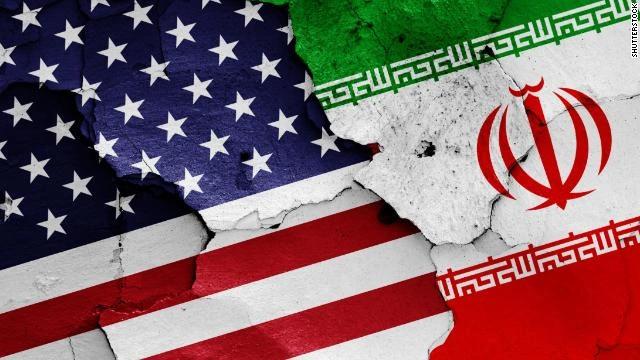
 The US military airstrike on Iran over the weekend has increased global tensions and investor anxiety. However, Matt Hougan, Chief Investment Officer (CIO) of Bitwise, argues that the event also highlights the crucial Vai of crypto and on-chain markets.
With major stock exchanges closing, on-chain markets have become the primary platform for price discovery globally.
The US attack on Iran exposed a structural void that only the crypto market can fill.
In a recent Mnemonics titled “A Financially Changing Weekend,” Hougan stated that when President Trump announced the airstrike on Iran at 2:30 a.m. (ET) on Sunday, global markets were closed. Stocks, Futures Contract, foreign exchange markets, and exchanges in Europe and Asia were all shut down due to the weekend.
The only remaining traditional markets are smaller exchanges in the Middle East such as Saudi Arabia and Qatar. Hougan argues that on-chain markets are the only ones that react in real time, thereby filling the structural void left by the closure of traditional exchanges.
“In previous years, if a major geopolitical shock occurred on Sunday morning, investors would have to wait until the US Futures Contract market opened at 6 p.m. (ET) on Sunday to see the impact. But this weekend showed they had another option: switching to crypto-based systems, trading 24/7/365 globally. And this weekend, they did just that,” he said.
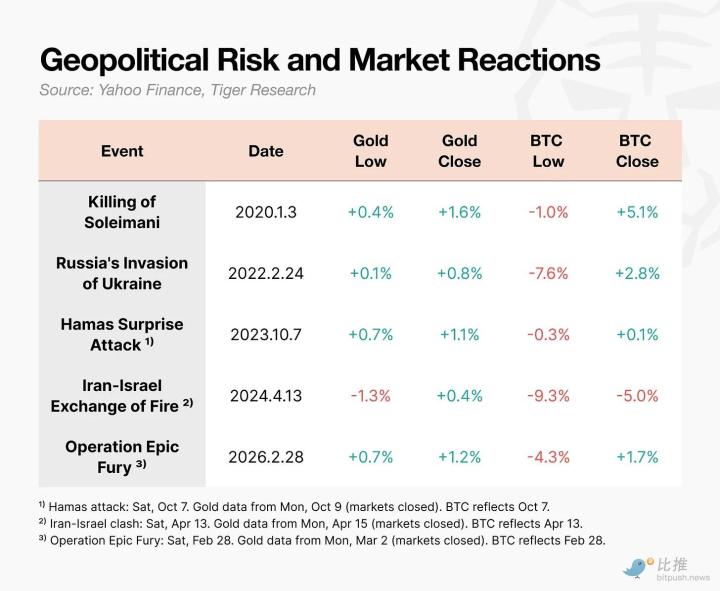
BeInCrypto also reported that the impact of the attacks was quickly felt in the crypto market, with Bitcoin (BTC) falling in price as soon as the news broke. According to Hougan, for much of that Sunday, “ on-chain finance was at the heart of the financial world.”
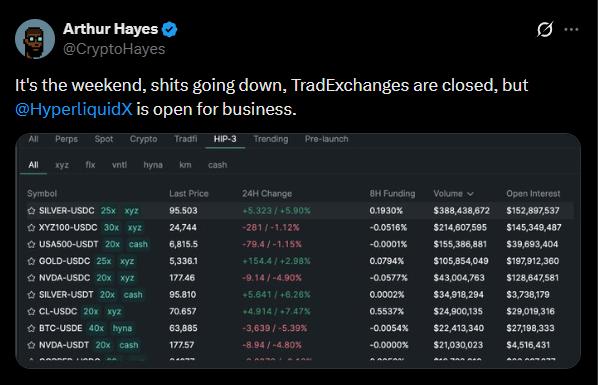
He stated that Hyperliquid – a decentralized perpetual contract exchange – has become a focal point. Hyperliquid's HIP-3 decentralized exchanges allow traders to buy and sell synthetic perpetual Futures Contract pegged to traditional assets.
BeInCrypto reports that the total open interest of HIP-3 has exceeded $1 billion. Overall, according to data from defillama, the platform recorded over $11.5 billion in volume over Saturday and Sunday.
Meanwhile, Tokenize gold also attracted strong investor interest. Tether 's XAUT recorded over $300 million in 24-hour volume as demand surged. Simultaneously, activity on prediction markets like Kalshi and Polymarket also increased significantly.
“The attacks on Sunday brought the markets that never close into the spotlight. Don’t expect traders to forget this,” Hougan observed. “This is the first time I’ve noticed that crypto-backed markets really become ‘markets,’ without exception.”
The leader also Chia that the weekend's activities led him to adjust his forecast regarding when finance would transition to on-chain.
“I used to think that crypto-backed markets would develop on the fringes – that in the next 5–10 years, they would primarily serve crypto natives and those who don’t fully fit into the traditional financial system… The shift to on-chain finance is inevitable. After this weekend, I believe that shift will come much sooner than we imagine,” he said.
In his analysis, Hougan also wrote that hedge funds, banks, or any investor for that matter must now adapt if they want to compete in real-time global markets.
“If you’re a hedge fund, a bank, or any investor looking to trade competitively, you have no choice: you have to set up a stablecoin wallet and learn how to trade on Hyperliquid. You need to understand XAUT. You need to learn about Tokenized Stocks. Because even if you don’t do it, others will,” he asserted.
Thus, the weekend of US-Iran attacks showed that continuously operating financial markets may be shifting from the periphery to the mainstream, and investors are now beginning to pay attention.