This article is machine translated
Show original
Among Wall Street heavyweights, Paul Tudor Jones's perspective on Bitcoin is perhaps the most unique and insightful. Five years ago, he discussed how portability would give Bitcoin a competitive edge in warfare. In a May 2020 letter to investors titled "The Age of Great Monetary Inflation," he mentioned the inevitable increase in national debt and the persistent problem of central banks printing money, emphasizing the need to find safe havens amidst massive monetary inflation. From an asset preservation perspective, the key is to find the best assets for the next decade.
The first step in financial assets is "store of value"—the ability to preserve value. Financial assets today constitute the largest share of global wealth reserves precisely because they preserve value and provide additional dividends, thus resisting the effects of inflation. So, how do we measure the ability to preserve value? Robert Tudor Jones scores assets based on four dimensions:
1) Purchasing power – how well the asset maintains its value over the long term
2) Creditworthiness – its long-term and widespread acceptance
3) Liquidity – the speed at which the asset is monetized
4) Portability – the ability to transfer the asset across regions. He scores financial assets, gold, cash, and Bitcoin based on these four dimensions, allocating 30% weight to purchasing power and creditworthiness out of 100, and 20% to liquidity and portability.
His analysis is as follows:
1) In terms of purchasing power, financial assets are naturally better, with most people giving cash a score of 0. Bitcoin is generally average.
However, he believes Bitcoin's creditworthiness lies in its design mechanism. From the supply side, Bitcoin's design mechanism leads to a decreasing supply. Bitcoin has a scarcity premium, making it almost the only globally tradable asset with a fixed maximum supply.
2) In terms of creditworthiness, Bitcoin undoubtedly ranks the worst, given that this asset has only been around for 11 years. The highest-ranking asset in this category is gold, with its millennia-long history.
3) Liquidity was something that wasn't important in the past, until now. We've realized its importance in the last few months. Based on the companies and individuals that will go bankrupt in the future, I believe more and more people will value liquidity metrics more. Cash certainly scores the highest in terms of liquidity, but Bitcoin is the only asset that can store value and is traded globally 24/7.
4) Portability, like liquidity, is something nobody cares about until something goes wrong. Imagine if war broke out; there's an asset that can quickly transfer wealth. The best example is Bitcoin, which can be stored within a phone's chip.
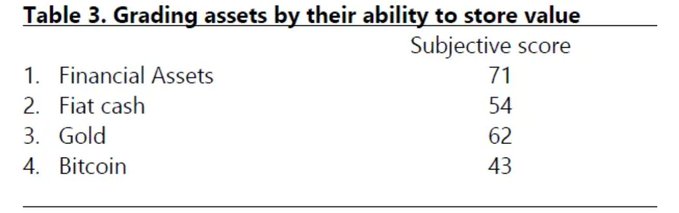
Based on the above four points, Paul Tudor Jones' team scored the four assets. What surprised him wasn't that Bitcoin scored the lowest, but that Bitcoin scored 60% of financial assets, yet its market capitalization at the time was only 1/1200th. He felt Bitcoin was undervalued.
This letter caused a great stir at the time. As a well-known macro hedge fund manager (who accurately predicted the 1987 stock market crash) and a true Wall Street heavyweight, he was one of the few who publicly supported Bitcoin with a complete and logical argument.

BITWU.ETH
@Bitwux
🧐 Dalio 说 $BTC 有三大硬伤|但其实他忽略了一个更大的趋势。
看了下很多人都在讨论的 Ray Dalio 关于 $BTC 的最新观点,总结一下其实就三点:
1️⃣比特币没有央行支持,央行不会买;
2️⃣隐私和监管存在不确定性,富豪不会买;
3️⃣量子计算可能威胁安全,人民不会买。 x.com/AltcoinDaily/s…
It has to be said that his judgment was much better than Dario's.
Yes, I think Paul is a truly thoughtful person.
Sector:

From Twitter
Disclaimer: The content above is only the author's opinion which does not represent any position of Followin, and is not intended as, and shall not be understood or construed as, investment advice from Followin.
Like
Add to Favorites
Comments
Share
Relevant content