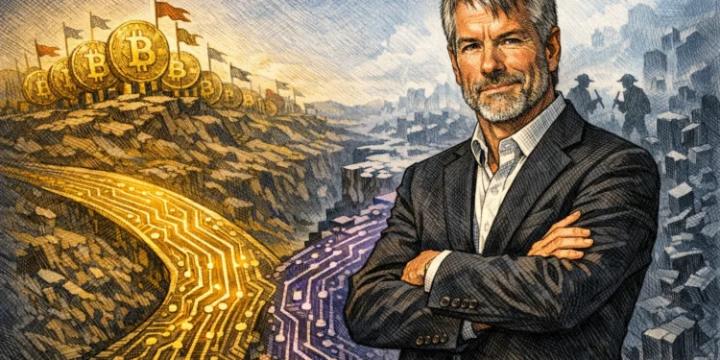
In turbulent times, five minutes of closed-eye reflection is more valuable than five hours of watching short videos. Only by avoiding being swayed by noise and not letting anxiety lead you astray can you preserve profits and seize opportunities amidst market volatility.
Article by: Qinglan Encryption Classroom
Article source: MarsBit
In today's world, noise and turmoil have become the norm. The sounds of gunfire, policy pronouncements, technological myths, and market anomalies intertwine to create a deafening background noise, with most people swept up by emotions and a few reaping profits in the gaps.
On March 4th, Trump publicly declared that the 15% global tariffs had taken effect , even threatening to sever diplomatic ties with Spain; however, the White House's actual implementation rate remained at 10% . At the height of tensions in the Middle East, a market prediction account, registered only eight days prior, accurately predicted key moments in the conflict, pocketing tens of thousands of dollars. Meanwhile, Apple, using the slogan of an eightfold increase in AI computing power from its M5 chip , attempted to entice users to max out their credit cards amidst the economic downturn.
If you only treat these things as news, you're destined to be part of the harvested denominator. This article doesn't preach grand theories; it simply dissects the truth hidden beneath the smoke and numbers—the more chaotic things are, the more important it is to think independently; blindly following orders only makes you more likely to fall behind.
I. Trump's "Tariff Rashomon": Who is afraid amidst the information smoke bomb?
Trump's tariff statements are a typical example of expectation management combined with psychological warfare .
- Poor words and actions are a window of opportunity
- The verbal 15% and actual 10% figure—these 5 percentage points are not a mistake, but a deliberately released misleading message . Novices panic and sell off their shares upon seeing "tariff increases," while experienced investors understand this is a gradual transitional phase.
- Trade as a guise, defense as the core
- The threat to sever diplomatic ties with Spain stems from Spain's refusal to allow US military bases to be used in attacks against Iran; it is essentially defense coercion , not a simple trade dispute.
- Uncertainty is the period of opportunity.
- The market's "certainty" has already been priced in. Only policy gaps and expectation discrepancies present opportunities for ordinary people to pick up bargains at low prices. Instead of following the crowd in panic, it's better to seek safe havens in domestic demand and supply chains that have been unfairly affected but have alternatives.
II. Predicting Market "Ghost Accounts": Insider information is not for copy trading, but for risk hedging.
New accounts appearing on platforms such as PolyBeats have been accurately betting on the pace of the Middle East conflict. On February 27, one account suddenly reversed course and went all in, "launching the attack that day." The situation subsequently materialized, and the account made a profit of over $70,000 in two days.
This isn't a "stock market guru," but rather the shadow of insider trading. Behind it lies an information gap and game of strategy inaccessible to ordinary people.
- Never follow someone else's trades: the "precision" you see is just a script designed by someone else.
- Treat odds as a disaster warning : When mainstream media are still talking about peace and predicting that the probability of market conflict has soared to over 75%, do not enter the market to gamble. Instead, immediately check your positions, logistics, raw materials, and risk exposure.
- The logic of wealth in turbulent times: Don't make money from predictions, only from hedging . Putting on a life jacket in advance is safer than gambling on where a bomb will land.
III. The "AI Myth" of Apple M5: A Productivity Revolution or a Consumer Trap?
Apple has just released its new M5 chip, which boasts up to 8 times the AI computing power of the M1. Tech bloggers are collectively touting that "if you don't buy it, you'll fall behind."
Back to reality: 90% of users only use the top-of-the-line M5 for light office work and short video editing .
- Are you paying for a sense of the future, or for output? Eight times the computing power is a marketing narrative from manufacturers, not a necessity for ordinary users. Hardware depreciates much faster than you imagine.
- True AI productivity lies not in hardware, but in people who skillfully use older M1 models to access cloud APIs, write helpful prompts, and produce high-efficiency output. These individuals are more competitive than those who pay a premium for the first release.
- Consumer guidelines are tools for generating more money, not for contributing profits to manufacturers. When budgets are limited, learn the key phrase: upgrade equipment ; pay for current output, not for future imagination.
Conclusion: Emotions are a fog, numbers are the truth.
Tariff pronouncements are driven by emotion, while actual tariff rates are simply numbers.
Ghost accounts are driven by emotions, while odds fluctuations are simply numbers.
M5 computing power is emotion, while return on investment is a number.
In turbulent times, five minutes of closed-eye reflection is more valuable than five hours of watching short videos. Only by avoiding being swayed by noise and not letting anxiety lead you astray can you preserve profits and seize opportunities amidst market volatility.