Table of Contents
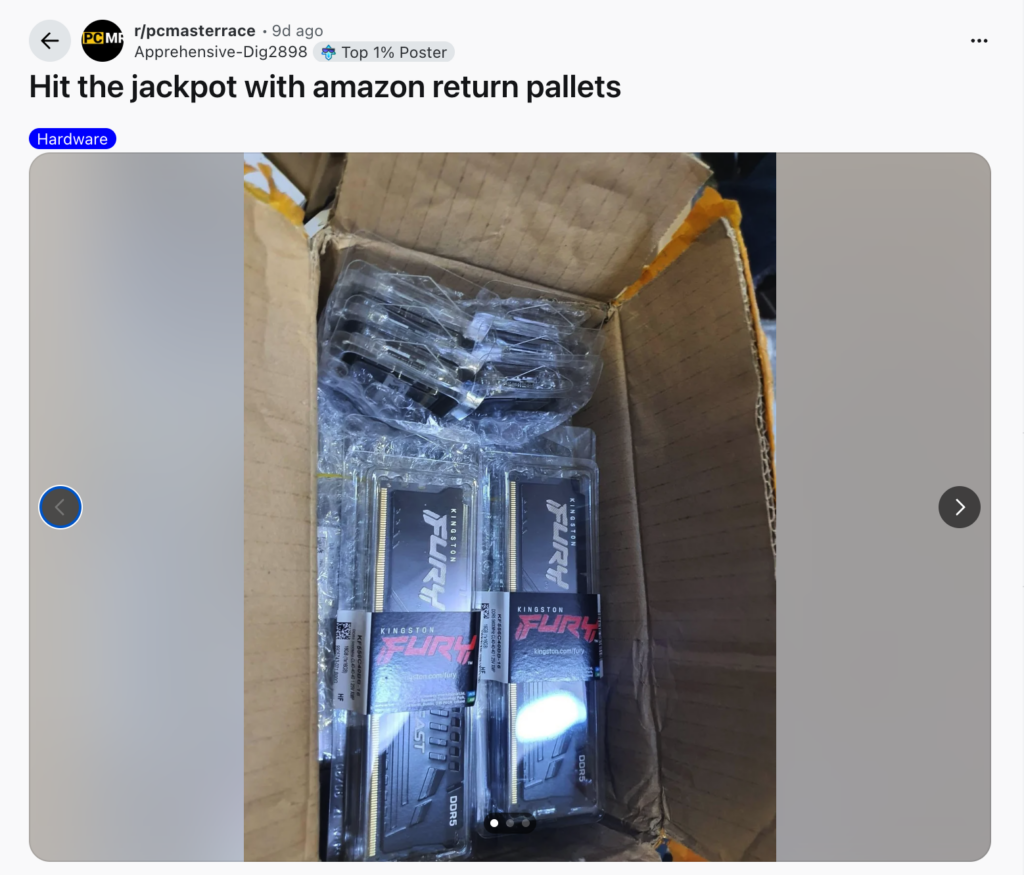
ToggleA user on the American online forum Reddit recently shared an incredibly lucky story: he spent $100 to buy 25 kilograms of Amazon return pallets (at $4 per kilogram).
Upon opening the box, he was surprised to find 40 Kingston Fury 16GB DDR5 memory modules, each worth approximately $175. The total was $7,000, representing a return on investment of 70 times.
What is a return pallet?
Amazon processes approximately 1.2 billion returns annually, roughly 13 million per week. These returns enter a complex sorting system: those in good condition are restocked, those in poor condition are sold at a discount, and those unusable are cleared out. The final form of "clearance" is to pack returned items into pallets and sell them to middlemen or individuals in the secondhand market at 10% to 30% of the original retail price.
These return pallets contain "anything," and sellers typically don't provide detailed lists, leaving buyers to accept uncertainty like opening a blind box.
The clearance industry had already surpassed $644 billion in size in 2022, and the market continues to expand as Amazon's returns continue to climb.
DDR5 appeared at the time when it shouldn't have been cheapest.
The timing of the discovery of these memories is partly what excited the finders.
The DDR5 market in 2026 is experiencing an unprecedented supply-demand imbalance. Soaring demand for high-performance memory from AI data centers is forcing major manufacturers such as Samsung, SK Hynix, and Micron to shift production capacity from consumer DDR5 to server DDR5 and HBM (High Bandwidth Memory), as the latter is more profitable.
The result is a reduction in DDR5 supply in the consumer market, leading to higher prices. Some analysts indicate that the retail price of a DDR5 32GB kit may peak at $550 to $600 in the first half of 2026, and the supply-demand imbalance is expected to continue until the end of 2027 or even later.
In other words, those 40 memory modules are exactly one of the most sought-after consumer products in the current memory market.
Blind spots in Amazon's system
Although in any normally functioning distribution system, they would be almost impossible to end up on clearance pallets. But they are there, and this has happened more than once at Amazon.
After all, Amazon's return processing system is designed for speed, not accuracy. With 13 million returns flooding into warehouses every week, employees need to quickly determine the fate of each item: restock, reduce price, clear out, recycle, or destroy. How do 40 DDR5 memory modules end up on a $100 pallet? The answer might be "misclassification," but the more honest answer is: at this scale, accuracy is a luxury.
It's worth noting that return fraud is also a common problem with this system. Surveys show that approximately 14% of returns are fraudulent, such as swapping (returning used or counterfeit products in their original packaging). This means that the authenticity of what's on the pallet cannot be guaranteed: you might be lucky to get DDR5 memory, or you might be unlucky to get an empty box filled with weight.
A certain essence of consumerism is compressed and displayed on this pallet: goods are produced, purchased, returned, repackaged, sold off cheaply, and unpacked at an astonishing rate... and then occasionally, someone opens the box and finds the system more chaotic and more generous than he expected.