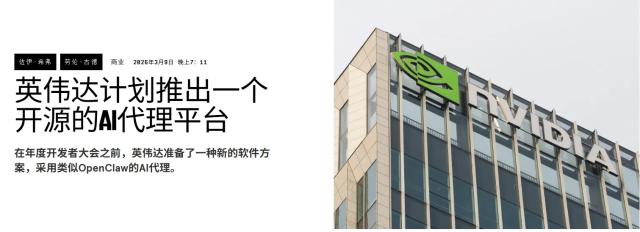
The surge in demand for AI applications, triggered by the "crayfish" craze (a type of AI application tool), is profoundly changing the profit distribution pattern of the artificial intelligence computing power industry chain. This article starts with the phenomenon, gradually analyzes the shift in profit logic, and points out new investment directions.
Article author and source: Yuanhe
In recent days, a nationwide craze called "raising lobsters" has swept from the technology sector to the capital market, becoming a phenomenal hot topic.
It is said that due to the surge in users installing and using "Xiaolongxia" (a Chinese computing platform), computing power is in short supply, and the computing power rental market has also seen accelerated price increases. The rental fees for high-end GPUs such as NVIDIA H200 and H100 have increased by 15%-30% month-on-month, and the delivery cycle has also been extended.
Other leading domestic manufacturers, such as UCloud and Senhua Yiteng, have also recently announced price increases of 20%-30% across their entire product line in March.
This technological frenzy has also triggered a sustained boom in the computing power industry chain in the stock market.
Yesterday, after Tencent's version of "crayfish" WorkBuddy was launched, the number of users accessing the service far exceeded expectations, causing excessive pressure on the core services. As a result, Tencent had to issue an emergency apology and expand the service capacity tenfold.
Tencent's stock price surged by 7.27% today as a result.
The A-share computing power sector continued its explosive growth, with over 40 AI and computing power-related stocks hitting their daily limit today, becoming the absolute driving force behind the rise.
MINIMAX, which has only been listed on the Hong Kong Stock Exchange for two months, has surged 51% in just two days, and has soared 6.4 times since its listing! Its market value has reached HK$382.635 billion.
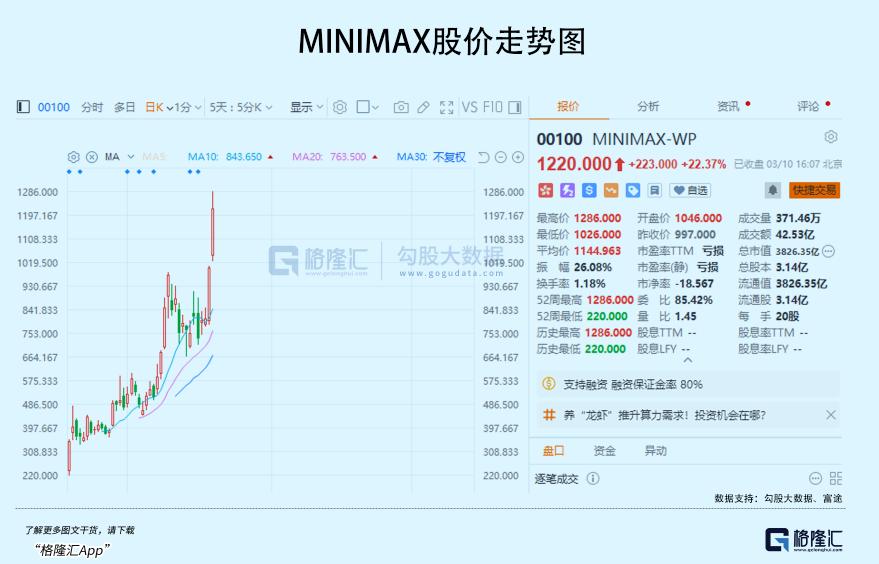
This clearly demonstrates the immense popularity of the "crayfish" app.
This phenomenon may well be the beginning of an accelerated surge in investment opportunities across China's AI industry chain.
01 The Shift in the Profit Logic of Computing Power Chain
In essence, the explosive popularity of application-level tools like "crayfish" has powerfully ignited the "fuse" for the demand for AI computing power, and the surge in demand has directly driven the entire computing power sector to undergo valuation restructuring.
Reports indicate that AI applications driven by crayfish will directly boost token consumption from "millions per day" to "hundreds of millions per day," potentially creating a 25% increase in computing power demand within two years and even propelling the AI industry into a true Agent era.
The business logic of cloud vendors has also begun to shift from simply "underlying computing power leasing" to "a provider of workstations for agent digital employees".
Consequently, the profit logic of the computing power industry chain will also shift.
The biggest expectation gap in 2026 is called "Token Inflation ".
The "deep thinking" model, represented by DeepSeekR1, consumes 5 to 10 times more tokens in the background for each question answered compared to previous models.
Data from Open Router, the world's largest AI model API aggregation platform, shows that from February 9 to 15, the number of Chinese model token calls reached 4.12 trillion, surpassing the 2.94 trillion of US models for the first time, marking that the activity of domestic AI applications has taken the lead in the world.
At the same time, the structure of computing power demand is also undergoing fundamental changes: according to industry data, AI inference workloads will account for more than 60% of the total AI computing power in 2026, and are still approaching 70%.
This shift will gradually rewrite the logic of monetizing computing power: whoever can meet this surge in demand for inference will be the real winner.
Prior to this, the profit center of the computing power industry chain was highly concentrated in the upstream, with the core logic being "whoever has more expensive GPUs and a larger computing power scale will be more profitable." As a result, chip giants such as Nvidia, Broadcom, and AMD have achieved a terrifying surge in market value in recent years, becoming the biggest beneficiaries of the computing power sector.
However, with the continuous improvement of downstream application functions and the expansion of application scenarios, this pattern is quietly changing.
The profits in the computing power industry chain are beginning to shift from upstream to downstream.
This scene is reminiscent of the explosive growth of the internet era, where the main profits gradually shifted from communication equipment manufacturers and service providers to downstream internet platforms that aggregate various application scenarios.
This situation is happening at an accelerated pace in China.
Although the demand for computing power in China remains enormous, and upstream computing power (such as chips/storage) and key intermediate links (such as communication modules) still enjoy huge industry dividends, the development path of China's computing power industry has gradually become very different from that of overseas countries. Instead of the involutionary model of "piling up computing power and renting out computing power", it has begun to place more emphasis on application implementation and industry penetration.
This means that the stronger a company's delivery capabilities are, the better it can capitalize on the core benefits of China's computing power.
Simply put, the future investment direction of computing power chains will gradually move away from the "selling cards" and "renting" mindset and towards the "delivery" and "platform" mindset.
The real gold mines are those companies that can handle uncertainty and deliver definite results.
The recent craze for "crayfish" actually falls under the MaaS and Agent platform sector. Its popularity has led to a surge in the stock prices of related companies, which is the most direct signal of profits shifting to the platform side.
02 Three Core Investment Themes
In the future, the profit-making logic of the computing power industry will gradually change. You will find that the investment methods of "blindly buying cards and following the trend to rent computing power" will gradually become unworkable.
Those who provide delivery and platform services are more likely to make money and may even gradually grow into industry giants.
The recent surge in the stock prices of related platform companies driven by crayfish is an early indication of this trend.
Based on the industry's development logic, future investment opportunities in the computing power chain are likely to focus on three main areas:
Main theme 1: Industry application delivery providers.
These companies are "money-making machines" in the computing power chain because customers never pay for GPUs or computing power, but for "definite results that can solve problems." The core advantage of these companies is that they understand the industry, can deliver, and can provide customers with full-process services from technology implementation to business closed loop, making money steadily and with growth potential.
For example, financial institutions are willing to pay high prices for AI risk control models not because they care about how many H100s are used, but because they care about whether they can reduce the bad debt rate; factories are willing to pay for intelligent quality inspection systems not because they care about the scale of computing power, but because they care about whether they can reduce defective products and improve efficiency.
These links that can directly create commercial value are the "money printing machines" of the computing power chain.
Leading companies in related industries such as financial AI, government big data models, industrial quality inspection/intelligent manufacturing, medical imaging, and energy dispatch (computing and power collaboration) are among the relevant sub-sectors.
The core advantage of these companies is "industry know-how + delivery capability". They have high barriers to entry, a favorable competitive landscape, and are not affected by the involution of computing power leasing, making them the first choice for long-term investment.
Main Theme 2: MaaS/Agent Platform.
As the fastest-growing segment in the industry, MaaS and Agent platforms have particularly obvious advantages: high gross margins, strong economies of scale, almost no additional costs, and huge potential for future growth.
As AI agent technology has become increasingly popular, customers are no longer satisfied with simply "using models" but want to "directly solve problems," which has further expanded the earning potential of this sector.
Focus on two types of targets:
One type is the general-purpose MaaS platform of large companies, such as Baidu (Wenxin Yiyan Qianfan platform), Alibaba (Tongyi Qianwen Bailian platform), Tencent (Hunyuan large model), ByteDance (Doubao), and Huawei (Pangu large model). These large companies have well-developed ecosystems and a large number of customers, occupying a dominant position in the market. Currently, they have all launched products adapted to OpenClaw, which has also driven the continuous rise of their own and related concept stocks.
Another category is vertical MaaS and Agent service providers. They focus on specific scenarios and have their own advantages. Many of these companies are backed by investors such as Alibaba and Tencent, and their potential for business cooperation with major companies is worth paying attention to.
These companies are in a high-growth phase of the industry. Once they achieve a breakthrough in scale, their profits will grow exponentially, making them suitable for investors seeking high returns.
In addition, some small and medium-sized enterprises that focus on the development of AI intelligent agents have also attracted capital attention due to the "crayfish" craze, and their stock prices have risen sharply in the short term.
Main theme three: Intelligent computing centers evolving towards delivery / domestic hardware.
While the days of simply renting computing power and selling hardware are tough, it doesn't mean there are no opportunities in the computing infrastructure and hardware sectors. Companies that can extend their reach, become involved in delivery processes, and are willing to transform are likely to see a valuation rebound, representing undervalued opportunities.
We will focus on two types of companies:
First, there are intelligent computing centers and cloud vendors that are transforming towards delivery, such as Tuowei Information (the core of Huawei Ascend ecosystem, providing both government and enterprise computing power and solutions), Sugon (national computing power + industry customization, leading in liquid-cooled server technology), China Mobile (the largest computing power in China, transforming into delivery by leveraging government and enterprise resources), and Baoxin Software (an industrial computing power hub, providing both computing power and applications). These companies have escaped the predicament of low gross profit by providing customized solutions.
Secondly, there are hardware companies that can both replace domestic products and deliver them collaboratively, particularly in the field of domestic AI chips. Companies like Hygon (widely used in finance and energy) and Cambricon (a core AI inference chip company) are leveraging the policy of self-reliance and control to break overseas monopolies. In the AI server field, companies like Inspur (the number one domestic market share), Foxconn Industrial Internet (manufactured by NVIDIA), and Tuowei Information (Huawei ecosystem servers) have good order predictability and can grow in tandem with computing power demand.
In the computing power supporting field, companies like Invic, Gaolan, and Kehua Data, which produce liquid cooling and power supplies, are becoming essential for intelligent computing centers as computing power density increases. Their industry growth rate is much faster than that of computing power as a whole. Recently, their stock prices have also risen significantly due to the demand for computing power driven by "crayfish".
03 Summary
Overall, computing power, as a core sector of new productivity, undoubtedly enjoys long-term prosperity.
The national investment plan for computing infrastructure in 2026 is massive, computing-electricity collaboration has risen to a national strategy, and intelligent agent technology is generating huge demand, creating a triple resonance of policy, funding, and demand. By the end of the 15th Five-Year Plan period, the scale of artificial intelligence-related industries will grow to over 10 trillion yuan.
In the coming years, with the continued restructuring of the profit logic of the computing power chain and the rapid development of the industry, the opportunity for "ten-bagger" stocks still exists.
Whether or not this opportunity can be seized depends on whether one can keep up with industry trends and identify high-quality targets with core competitiveness—say goodbye to the "card-selling mindset" and embrace the "delivery mindset" in order to gain an advantage in the new wave of computing power.