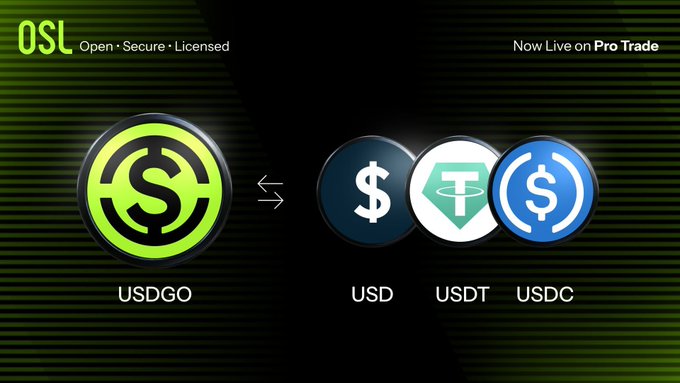
2025 was a year of rapid maturation for the stablecoin market. The total market capitalization of global stablecoins surpassed $300 billion for the first time, with total trading volume reaching a staggering $33 trillion, representing a year-on-year increase of over 70%. In this red ocean dominated by the two giants Tether and Circle, who together hold over 90% of the market share, there seems to be no room for new challengers. However, an unusual entrant emerged. Hong Kong-based compliant digital asset platform OSL Group announced the launch of a US dollar stablecoin called USDGO. It is not yet another imitator trying to grab a share of the exchange market, but a legitimate player that obtained US federal banking regulatory approval from its inception. When an unconventional entrant enters a mature market, the real upheaval may have only just begun. Everyone is asking: in a duopoly market, why is a new player needed? What overlooked battleground did USDGO reveal behind the scenes? The problem: Why can't stablecoins be exported to exchanges? Today's stablecoins are essentially designed for trading, not for commerce. As a universal unit of account and settlement within the crypto world, they have greatly facilitated the liquidity of digital assets, but when they try to move beyond exchanges and into real-world commercial applications, they expose three fatal flaws. The first weakness is the fragility of trust. From Tether's long-criticized lack of transparency in its reserves to the death spiral of UST in 2022, the foundation of trust in stablecoins has always been built on a fragile consensus. For individual speculators, this may be an acceptable risk, but for any company that needs to manage hundreds of millions of dollars in cash flow, entrusting its core assets to a tool that could be decoupled or face regulatory crackdowns at any time is nothing short of a gamble. The second shortcoming is the limitation of its functions. A modern enterprise needs far more than just a payment credential. It requires a complex account system to manage funds across different business lines, clear audit logs to meet compliance requirements, and programmable interfaces to automate payroll and supplier settlements. Today's stablecoins, however, are merely digital versions of coins and cannot meet the complex financial needs of enterprises, including fund management, financial auditing, and compliance reporting. The third shortcoming is the friction during scene transitions. A stark reality is that a significant gap still exists between the on-chain world of stablecoins and the traditional banking system. Businesses still face numerous challenges when exchanging fiat currency for stablecoins (on-ramp) or vice versa (off-ramp), including cumbersome processes, high costs, and slow processing times. The inability to seamlessly and efficiently transfer funds between on-chain and off-chain significantly limits the application of stablecoins in real-world business scenarios. This constitutes an Blockchain Trilemma that has long plagued the industry: absolute compliance, financial-grade functionality, and seamless connectivity. These three characteristics, which are crucial for enterprise-level applications, seem to be difficult to achieve simultaneously in past stablecoin products. The value of stablecoins should not be limited to exchange charts, but should extend to a company's balance sheet. So, how can a truly business-grade stablecoin designed for enterprises solve this problem? Solution Approach: From Cryptocurrency to Financial Infrastructure USDGO's solution is a complete and utterly devastating blow. In its self-introduction, it clearly declares that it is a brand-new "liquidity and settlement layer of global compliant on-chain financial infrastructure". This shift in positioning signifies a change in objectives and core competencies. Its target audience is no longer individual speculators on exchanges, but rather enterprises and institutions with genuine business needs for on-chain cross-border payments and global fund transfers. Its core competency is no longer minting, but rather the global financial liquidity and settlement capabilities achieved through its parent company, OSL Group, and its partner ecosystem. True disruption is not about creating a better product of its kind, but about redefining the product itself. What USDGO is trying to do is upgrade stablecoins from a payment product into a financial infrastructure. This shift in positioning from product to infrastructure sounds incredibly ambitious. But such a grand narrative requires solid capabilities. What toolkit does USDGO possess to transform this infrastructure from blueprint to reality? USDGO's three core capabilities USDGO's toolbox corresponds precisely to the three corners of the Blockchain Trilemma. First, to address the issue of absolute compliance, USDGO presented an impeccable birth certificate. Its issuing institution is Anchorage Digital Bank, the first and, to date, the only nationally chartered crypto bank in the United States to receive approval from the Office of the Comptroller of the Currency. This means that USDGO has been under US federal regulation since its inception, and its reserves, audits, anti-money laundering procedures, and KYC must strictly adhere to bank-level standards. More importantly, its assets are protected by bankruptcy remoteness, legally eliminating the risk of misappropriation of reserve assets or liquidation in extreme circumstances. Secondly, to unlock the potential of financial-grade functionality, USDGO launched a fund management system called BizPay. Unlike industry leader Circle, which primarily provides services to developers through APIs, BizPay offers businesses an intuitive and user-friendly interface. Corporate finance personnel can manage up to 50 sub-accounts without writing any code, just like using online banking. This covers complex scenarios ranging from marketing expense payments and global employee payroll to supplier payment settlements. This transforms on-chain funds management from a programmer-only activity into a tool accessible to finance professionals. Furthermore, USDGO offers a new management paradigm that makes funds visible, auditable, and programmable, ensuring clear and controllable flow of every penny and providing limitless possibilities for financial innovation. Only by allowing finance departments to forget about private keys can blockchain truly enter the enterprise. Finally, to solve the problem of seamless connectivity, USDGO is committed to building a global financial overpass. Launched on high-performance public chains such as Solana, it supports T+0 or near-real-time global payment settlements, completely eliminating the long wait times and high hidden costs associated with traditional cross-border payments. At the same time, it is working to break down the barriers between "fiat currency → stablecoins → crypto assets" and "on-chain → bank accounts," providing businesses with a unified global liquidity interface. Whether it's a multinational corporation that needs to repatriate fiat currency profits earned in Africa to its Asian headquarters, or a fintech platform that wants to provide instant deposit and withdrawal services to global users, they can find the fastest path on this interchange. When a project simultaneously possesses compliant status, powerful functionality, and seamless connectivity, what specific changes will it bring to the business world? In other words, what is the ultimate value proposition of this technology-driven financial revolution? As financial plumbers reshape world history, it has repeatedly proven that those who truly define the commercial boundaries of an era are often the infrastructure builders who lay the underground pipelines. What USDGO is doing is precisely becoming a financial plumber in the digital economy era. In the short term, the changes it brings are providing a more efficient, lower-cost, and safer payment and settlement tool for companies and multinational corporations that are venturing into the global market. Take a Chinese company that sells software services globally as an example. In the past, it needed to open bank accounts in multiple countries, enduring high exchange rates and long settlement cycles. Now, it only needs a single USDGO account to receive payments from all over the world at virtually zero cost and with zero time difference, and can exchange them into the required fiat currency at any time. In the long run, it is reshaping the underlying logic of global finance, creating a global value network that is intermediary-free, cleared in real time, and completely transparent. In this network, banks are no longer institutions defined by physical space, but rather a set of services available to everyone. The giants of the next era will emerge from those unseen channels. The entry of USDGO and the legitimate players it represents may not change who dominates in the short term, but it is fundamentally reshaping the industry's standards, rules, and future. This is perhaps the most noteworthy underlying variable in this final battle of stablecoins. What changes the world is often not the more dazzling applications, but the more solid foundations.
This article is machine translated
Show original

From Twitter
Disclaimer: The content above is only the author's opinion which does not represent any position of Followin, and is not intended as, and shall not be understood or construed as, investment advice from Followin.
Like
Add to Favorites
Comments
Share
Relevant content