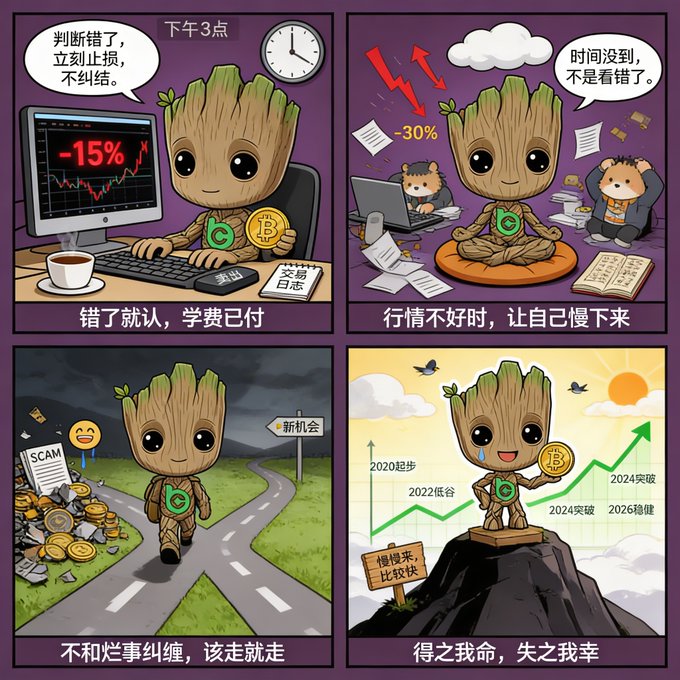
I know a guy who does on-chain trading. He has a really strange habit: as soon as he realizes he's made a mistake, he immediately cuts his losses, never dwells on it, and certainly doesn't complain to anyone. He says that since he's the one who clicked the buy button, losing money is his due tuition fee. The market has already given the result; constantly analyzing emotions will only make things more chaotic. If you're wrong, admit it, move on, and start the next trade. Later, I gradually discovered that he was remarkably calm when the market was down. Many people panic when the market drops, and panic leads to chaotic trading, but he remained largely still. He said the market is like life; many things aren't that you've misjudged, but rather that the time hasn't come yet. The more unfavorable the situation, the more you need to slow down, calm down, and give yourself time to think things through. Many problems, if you just slow down, often reveal better solutions. He also told me that, in reality, there are very few people in this world who truly care whether you've made money or not. A lot of people's internal conflicts are essentially creating drama for themselves, always feeling like everyone is watching them. But the market doesn't care about individual emotions; it only cares about results. Instead of constantly worrying about what others think of you, focus your energy on improving yourself and finding your own rhythm. Having been in the crypto for a while, you'll find that those who thrive in the long run share a common trait: they don't get entangled in things. They don't dwell on bad projects, past losses, or emotional turmoil. They know when to exit and when to cut their losses. Because they understand that bad people and bad situations will only waste your time and energy, slowing you down from your initial investment. Gradually, I've come to understand the saying: "What I gain is my fate, what I lose is my fortune." Some opportunities, though missed, may seem like regrets, but looking back a few years later, they might actually be helping you avoid bigger pitfalls. Many experiences that seemed like failures at the time were simply guiding you to a path that suits you better. Ultimately, I realized that investing and life are essentially the same. Those who truly go far aren't necessarily the smartest, but rather those with goals, strong execution skills, and an orderly lifestyle. They don't chase every opportunity; they only do what's worthwhile. Slowly, life becomes like a long-term upward curve—it may not lead to instant wealth, but it will definitely become increasingly stable. (This article is sponsored by @bcgame)
This article is machine translated
Show original
Sector:

From Twitter
Disclaimer: The content above is only the author's opinion which does not represent any position of Followin, and is not intended as, and shall not be understood or construed as, investment advice from Followin.
Like
Add to Favorites
Comments
Share