
Compiled & translated by: TechFlow TechFlow
Guest: Arthur Hayes, co-founder of BitMEX
Host: Natalie Brunell
Podcast source: Natalie Brunell
Original title: Arthur Hayes: The Fed Will Print Again — That's When Bitcoin Explodes
Broadcast date: March 10, 2026
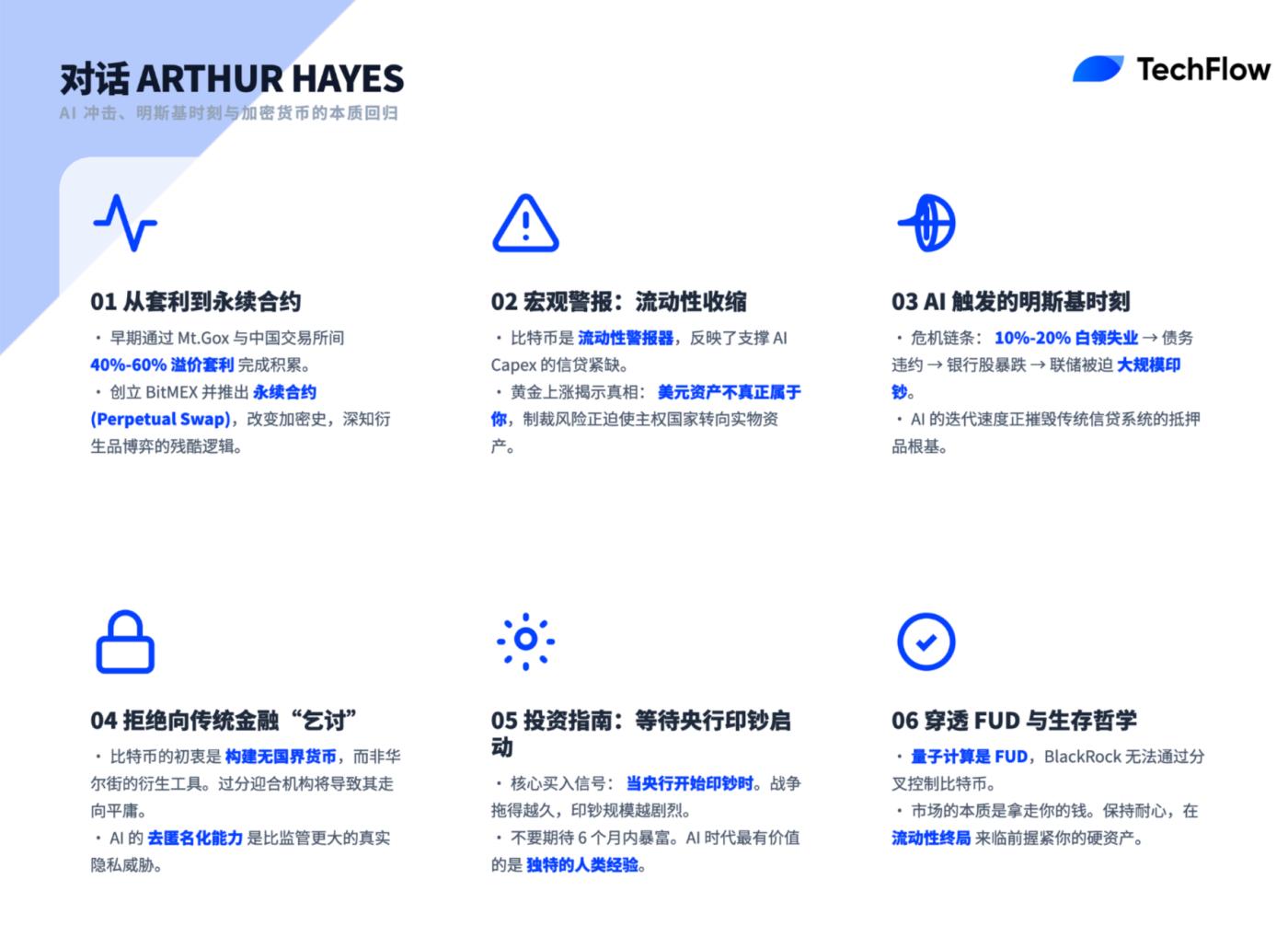
Key points summary
Arthur Hayes, co-founder of BitMEX and chief investment officer of Maelstrom, was a guest on Coin Stories, where he shared his unique insights on Bitcoin, the macroeconomy, the disruptive impact of AI, and the global liquidity cycle.
The core topics we discussed included:
- Why is Bitcoin called a "liquidity alarm" in global markets?
- How AI-induced job losses could trigger the next financial crisis
- Why might central banks need to print more money in the future than during the pandemic?
- Are institutional investors changing the market landscape for Bitcoin?
- Arthur Hayes' investment advice: Why wait until central banks start printing money before buying Bitcoin?
Summary of key viewpoints
"Fired by Citibank" and entered the crypto industry
- Being fired from Citibank in 2013 was probably the luckiest thing that ever happened to me.
- I was very disappointed with the mainstream financial industry at the time, especially after the 2008 financial crisis, when people could no longer earn the same amount of money as when I was in college.
- I realized two things: first, I'm not that smart; second, in the long run, trading is unlikely to be consistently profitable. If someone like me, without a technical background, can make this kind of money, then this kind of opportunity certainly won't last.
On the original intention of "institutionalization" and Bitcoin
- Some people may have forgotten our original intentions for entering this industry. Bitcoin was not created to gain the approval of large financial institutions.
- Why should we now spare no effort to gain acceptance from institutions that do not care about our interests?
- If cryptocurrency becomes just another ordinary fintech product, what's the appeal? Wouldn't it be simpler to just buy stocks directly through a securities account?
Regarding "liquidity alerts" and the macroeconomic situation
- Bitcoin is essentially a "liquidity alarm." Its performance tells us that there isn't enough dollar liquidity in the market to meet various liquidity demands. This also explains why Bitcoin has underperformed over the past six to nine months.
- The rise in gold prices is not due to "currency devaluation trades," but rather because sovereign nations are increasingly aware that the risks of holding dollar assets are increasing.
- Holding gold is clearly a safer bet. This trend became even more pronounced in 2022 after the US and EU froze Russian assets.
The "Minsky moment" triggered by AI
- The pace of AI advancement is far faster than the rate at which factory workers were laid off in the past.
- The replacement of just 10% to 20% of white-collar jobs would be enough to trigger a leverage effect in the banking system, leading to a chain reaction. This situation is similar to the "Minsky Moment": when the market suddenly realizes that certain assets are worthless, it triggers a panic sell-off.
Strategic Recommendations on "War and Money Printing"
- If you hear someone say "war is good for Bitcoin," what they really mean is "war means printing money, and printing money is good for Bitcoin." So my advice is to wait for the money printing to happen and not try to predict the market.
- If I only had $1 to invest right now, I would choose to hold off for the time being.
- The longer the war drags on, the more likely the Federal Reserve is to resort to printing money to support the situation. When the central bank starts printing money, that's when I'll choose to buy Bitcoin.
Threats to privacy and AI deanonymization
- I believe the real threat will come from AI tools that can deanonymize your transactions; these are the true "game changers."
- By simply inputting an address and a specific person into a large language model, it can provide a high-probability matching result.
- If you truly need a completely anonymous electronic cash system, Bitcoin may not be the right fit for you.
- This is why I have a very positive view of Zcash.
Psychological massage for investors
- The essence of the market is not to make you money; the essence of the market is to take your money away from you.
- It is unrealistic to expect the market or a certain asset to bring "life-changing" returns in just six months.
- You can see some people become rich overnight because of good luck, but I bet they will lose all their money within the next six months because they will continue to believe that they can make the same fortune through risky trading strategies.
Who is Arthur Hayes? His legendary story
Natalie Brunell: Hi everyone, welcome back to the show. This week we have Arthur Hayes with us. He is the Chief Investment Officer of Maelstrom and an OG (Original Guru).
I'd like to start with your background story. Your experience is very interesting; I remember reading that you grew up in Michigan and later entered the finance industry. You founded BitMEX, got involved with Bitcoin early on, but then embarked on a very exciting journey. Could you share your story with us?
Arthur Hayes:
Of course. I was born in Buffalo, New York, and spent most of my childhood in Detroit. I attended the University of Pennsylvania, where I studied undergraduate business at the Wharton School from 2004 to 2008. During that time, I developed a strong interest in China and took Chinese and business courses at the university . In 2006, I went to Hong Kong as an exchange student, which I loved. I then found a summer internship at Deutsche Bank's Hong Kong branch, eventually landing a full-time job in 2008 and moving to Asia, where I've lived ever since.
I've spent half my life in Hong Kong, Singapore, and other parts of Asia, never worked in the United States, and rarely returned. I worked in the financial services industry for five years, including three years as head of market makers for exchange-traded funds (ETFs) at Deutsche Bank, when ETFs were still a novelty in Asia.
Later, I left Deutsche Bank and went to Citibank, doing the same job. Looking back, being laid off from Citibank in 2013 was probably the luckiest thing that ever happened to me. At the time, I was very disillusioned with the mainstream financial industry, especially after the 2008 financial crisis, when people could no longer earn the same amount of money as they did when I was in college.
So, I felt that this industry might not offer much room for growth for me, so I decided to try something different. At that time, I saw a post about Bitcoin on Zero Hedge, and then I read the Bitcoin white paper and was deeply attracted by the philosophy behind it. Although I didn't have a technical background—I was a trader—I still wanted to know " how do I trade Bitcoin ?" So, I started searching for information on various forums, researching all the exchanges on the market at the time. I wanted to know how to long, how to short, and whether there were derivatives trading options.
Later, I found a small derivatives exchange run by two Russians in the Caribbean. I discovered a fantastic arbitrage opportunity: you could sell their futures contracts while simultaneously buying spot Bitcoin, with an annualized return of up to 200%. So, I bought my first Bitcoin on Mt. Gox and sold some futures contracts. A month later, I found I had earned my expected amount of Bitcoin, so I started doing this for several months.
By the fall of 2013, Mt.Gox was experiencing some problems, such as the inability to withdraw US dollars. I tried to transfer dollars to my bank account, but it took several weeks. So I started following discussions on forums and found that others were encountering similar issues. At that time, while dollar withdrawals were unavailable, Bitcoin could be withdrawn from Mt.Gox at any time, and in the fall of 2013, Bitcoin's premium in China skyrocketed, reaching as high as 40%, 50%, and 60%.
So I decided to use the USD I couldn't withdraw to buy Bitcoin on Mt. Gox, then transfer the Bitcoin to a Chinese exchange and settle in RMB. I would take a bus to China to open a bank account, withdraw the RMB, and then take another bus back to Hong Kong. I continued to arbitrage this way, taking advantage of the price difference between Bitcoin in China and Hong Kong.
I made some money this way, but as a trader, I realized two things: first, I wasn't that smart; second, trading is difficult to consistently profit from in the long run. If someone like me, without a technical background, can make this kind of money, then this opportunity certainly won't last. So, I started thinking about how to create something more sustainable to stay in the cryptocurrency space.
That's when I thought of derivatives . Although I had no technical background and couldn't code, I decided to build my own Bitcoin derivatives exchange. I looked for people in the Hong Kong community who could help me, and I proposed the idea of building a Bitcoin derivatives exchange to them. In 2014, we started developing BitMEX and launched our first futures contract in November of the same year.
Of course, our most well-known product is the Perpetual Swap, launched in May 2016. As your audience may know, it's arguably the most traded crypto financial product to date. We made a lot of money from it and were once an industry leader until Binance surpassed us in 2020. After that, I transitioned to managing my own family office, focusing on early-stage cryptocurrency investments and directional trading. Now, we're launching a private equity fund focused on acquiring cryptocurrency companies and optimizing their operations.
What's the future trend of Bitcoin: bullish or bearish?
Natalie Brunell: You've been in the cryptocurrency space for many years and witnessed the industry's evolution firsthand. From the early block size wars to the gradual entry of institutions, has your attitude towards Bitcoin become more bullish over time? Some early OGs have cashed out and left, while others have become increasingly enthusiastic, even predicting that Bitcoin will reach a million dollars per coin. What are your thoughts?
Arthur Hayes :
I personally love this field and the people here; they are among the most interesting people I've ever met. While I may be bullish or bearish on Bitcoin at times, I've always believed that the demand for stateless money is stronger than it was when the Genesis Block was first released in 2009. Therefore, I'm happy to be a part of this journey, whether it's Bitcoin or other cryptocurrencies.
While I may be short-term pessimistic about Bitcoin or other assets at certain points in time, I am very bullish on Bitcoin and the cryptocurrency space as a whole in the long run. In fact, I've devoted most of my career time, unrelated to fitness, to the cryptocurrency industry, among other things.
Are institutions dominating the Bitcoin market?
Natalie Brunell: Many viewers of my show were both confused and disappointed about the last Bitcoin bull market because they didn't see Bitcoin's price reach the expected levels. Retail investor participation was actually very low in the last bull market; the market was mainly driven by institutions. What are your thoughts?
Arthur Hayes :
I think some people may have forgotten why we entered this industry in the first place. Bitcoin wasn't created to gain the approval of large financial institutions. From its humble beginnings to its current value of $66,000, Bitcoin has never relied on government support, lacked a clear regulatory framework, and even faced obstacles from hostile banking systems and regulatory bodies. So why should we now be so desperately trying to gain acceptance from institutions that don't care about our interests?
Our focus should be on cultivating talent who aspire to build entirely new financial systems for a new era of human civilization, rather than trying to cater to the needs of the traditional financial system. Of course, I'm not saying institutional investors shouldn't hold cryptocurrencies, but we shouldn't change the very nature and purpose of the crypto ecosystem to cater to these institutions.
The true value of cryptocurrency lies in its potential as a transformative technology. If we simply cater to the demands of traditional financial institutions, cryptocurrency may ultimately degenerate into just another ordinary financial instrument. At that point, people might question the need to hold cryptocurrency at all. Wouldn't it be simpler to buy stocks directly through a securities account? In some ways, stock trading might even be safer. If cryptocurrency becomes just another ordinary fintech product, what appeal will it have?
Is the price of Bitcoin manipulated?
Natalie Brunell: There's been a lot of discussion on X lately about institutions manipulating and suppressing Bitcoin prices, like Jane Street which recently made the news. You have extensive experience in derivatives trading, trading firms, and traditional finance. What are your thoughts on these concerns and theories?
Arthur Hayes :
I don't agree with these views. I think many times it's someone posting on X, "Oh, I lost money, it must be someone else's fault." This is usually a sign of a bad trader. They'll say, "I made a trade, it didn't go well, and then I saw a news report about a company doing something shady, so it must be their fault." But that's not the case. The problem might lie with the trader themselves—maybe your trading strategy isn't mature enough, maybe you chose the wrong time, or maybe you underestimated the complexity of the market.
I don't believe in any so-called "evil conspiracy," such as Jane Street or other market makers colluding to deliberately suppress the price of Bitcoin. The market operates according to its own rules, and different institutions participate in it in their own ways . Indeed, liquidity in the derivatives market plays a significant role in short-term price fluctuations, but this does not mean the market is being manipulated.
I want to remind you that if you're not a professional cryptocurrency trader, you need to be constantly vigilant. The cryptocurrency market operates 24/7, which means you might need to keep your phone on at all times and set up various alerts. If there's a sharp market fluctuation at 2 AM and your phone rings, you'll need to get up immediately to handle it. If you're not mentally prepared for this and just want to try trading casually after get off work, then I suggest you don't use leverage in the cryptocurrency market and don't have a short-term profit mentality.
If you simply want to buy Bitcoin or other cryptocurrencies and hold them for the long term, then these short-term price fluctuations are not really important to you.
What factors are hindering the development of Bitcoin?
Natalie Brunell: What factors do you see currently hindering the development of Bitcoin, especially given the growing awareness of "currency devaluation trading"? It seems all assets are now in a bull market for gold, and while we hoped Bitcoin would remain unaffected, it hasn't escaped the trend either.
Arthur Hayes :
My view is that Bitcoin is actually a "liquidity alarm." Currently, the US, and particularly the US, is facing a massive deflationary time bomb, which is closely related to the disruptive impact of artificial intelligence (AI) on the labor market. Bitcoin and some tech stocks are sending us a signal: a massive credit collapse is possible in a highly leveraged Federal Reserve system, especially when some high-income jobs are replaced by cost-cutting measures by businesses, positions that are more easily taken over by AI in a faster and cheaper way.
Bitcoin's performance tells us that there isn't enough dollar liquidity in the market to meet various liquidity demands, especially those related to capital expenditures (capex) for hyperscale data centers. This is why Bitcoin has underperformed over the past 6 to 9 months. If you look at the market, the Nasdaq index has remained relatively stable, but Bitcoin's price has fallen by about 50%. Meanwhile, the price of gold has been steadily rising.
I believe the rise in gold prices is not due to "currency devaluation trading," but rather because sovereign nations are increasingly aware of the increasing risks of holding dollar assets. It has been proven time and again that these dollar assets do not entirely belong to the countries holding them. When you hold dollar assets, your economic sovereignty is effectively in the hands of figures like the US Treasury Secretary. They can dilute the value of your assets by issuing large amounts of bonds, or freeze or even confiscate them through sanctions. In this context, why would a country use its reserves to hold such assets?
In comparison, holding gold is clearly a safer bet. This is why central banks around the world have been continuously increasing their gold reserves since 2008. This trend became even more pronounced in 2022 after the US and the EU froze Russian assets.
How will the disruptive impact of artificial intelligence (AI) change the market?
Natalie Brunell: Returning to your earlier point about AI, you published a great article discussing the deflationary shocks caused by AI and the risks to white-collar jobs. Furthermore, you mentioned that private lending and the overall credit market will contract at some point, which would be a catalyst for the Federal Reserve to have to print money on a massive scale, thus driving up the price of Bitcoin.
Do you think this situation is imminent, or do you believe it's a slow and gradual process that will eventually drive Bitcoin's price up?
Arthur Hayes :
I'm not sure, but I think this could happen sooner than most people expect, mainly because the pace of AI advancement is exponential. If we look back at the 2008 subprime mortgage crisis, it actually brewed and erupted roughly seven years after China joined the World Trade Organization (WTO). At that time, China's accession led to the loss of about 35% of manufacturing jobs in the United States. These workers fell into poverty and had to apply for subprime loans, which they were unable to repay. Although the default rate only rose slightly to single digits, the leverage effect ultimately triggered a financial crisis.
The pace of AI advancement is far faster than the rate at which assembly line workers were laid off in the past. We've seen companies like The Block lay off 40% of their staff overnight. In the US, many companies, based on flexible labor agreements such as "casual hiring," are also discussing similar layoff plans. Once these companies discover that AI can perform tasks more efficiently, they may quickly lay off 10%, 20%, or even 30% of their workforce.
My point is not that all white-collar jobs will disappear, but that replacing just 10% to 20% of them would be enough to trigger a leverage effect in the banking system, leading to a chain reaction. This is similar to a "Minsky Moment": when the market suddenly realizes that certain assets are worthless, it triggers a panic sell-off. While the entire process may take two to three years to fully materialize, the market reaction could be almost immediate.
We cannot accurately predict when all this will happen, but once the market forms a certain "collective consensus," such as "AI disruption has arrived, and a large number of white-collar workers are being laid off," people may begin to question the value of financial stocks. At that time, bank stocks may plummet by 60% to 70% in just a few days, depositors will transfer their savings from small and medium-sized banks to large banks like JP Morgan and Citibank, and the Federal Reserve will have to intervene quickly.
Therefore, although the full impact may take two to three years to materialize, the market's perception of this change could be very rapid. A large-scale market reaction could be triggered simply by the formation of some kind of "collective consensus," such as "AI's disruptive impact on the economy has already had a significant effect."
The impact of social unrest and economic pressure on the crypto market
Natalie Brunell : Are you worried about the potential social impact of these things?
The problem of social division in the United States is becoming increasingly serious, with widespread public discontent and escalating social unrest. Politically, people are becoming increasingly tribalized and polarized. Moreover, with more people losing their jobs, some seem to be finding a solution in electing candidates who promise "free benefits." This core sense of frustration appears to have a ripple effect, and many are unaware that they need to own and accumulate hard assets like Bitcoin.
Arthur Hayes :
Indeed, the social contract between labor and capital differs across countries. In the United States, this contract appears very fragile because capital clearly holds a dominant position, while the rights of workers are relatively neglected. Elsewhere, the situation is more balanced. Therefore, I truly believe that we will face a highly divisive era in the future.
Many people who once considered themselves wealthy find themselves among those they once looked down upon, dependent on government assistance, after losing their jobs. How does this affect their self-esteem? How will they express their discontent? Through political means, or more direct methods like taking to the streets with weapons? Some might oppose the construction of data centers or target tech giants like Elon Musk, Sam Altman, and Mark Zuckerberg, arguing that they are robbing ordinary people of their American Dream by destroying jobs for excessive profits.
I cannot predict how all of this will ultimately unfold, but one thing is certain: future social evolution will not be linear, but rather fraught with uncertainty and fluctuations. This will inevitably be a period of division, as America's existing social contract needs to be redefined. As for how this contract will change, I cannot give a definitive answer, but there is no doubt that it will be a challenging and painful process.
Can Bitcoin solve the global affordability problem?
Natalie Brunell: Many people are very frustrated with the current situation because they feel they can't afford a house and can't participate in the capital and wealth accumulation of the past few decades. I think Bitcoin seems like an obvious solution because people can accumulate it little by little. However, there are still many people who are resistant to Bitcoin. Despite the great progress we've made, I'm very surprised that there are still so many people against Bitcoin.
Arthur Hayes :
I don't think buying some Bitcoin will truly solve your problems. If you earn $250,000 a year but suddenly lose your job and can't afford a $750,000 mortgage and $50,000 monthly credit card bills, then Bitcoin won't help you. Of course, for those who have been accumulating Bitcoin long-term, it is indeed a great asset, and I believe its price will continue to rise in the long run. But for those who once thought they were wealthy but now find themselves in trouble, Bitcoin won't immediately solve their financial problems. They might realize they're spending too much each month to maintain their so-called "ideal lifestyle."
I believe Bitcoin is more suitable for those with spare capital and who recognize it as a potential solution. If you belong to a group that might be displaced by AI or economic changes, you need to rethink your lifestyle and spending patterns. For example, reassess whether you really need those expensive consumer electronics or whether you need to live in a high-cost city or community. As the saying goes, "the first to sell sells best." When people start realizing they need to cut back on spending, who will buy those expensive properties? If your income drops from $250,000 to $75,000, you may find yourself having to make significant lifestyle adjustments.
Natalie Brunell: Even so, among all the possible solutions or "life rafts," don't you think people have very limited choices? If someone is living paycheck to paycheck, their job is no longer stable, they have no assets, and they even face the risk of being laid off, their future is very uncertain. In this situation, what else can help them?
Arthur Hayes :
To be honest, I've never experienced anything like this myself, so I can only try to analyze it from an external perspective. But I think the most important thing is to examine your cost of living and reduce unnecessary expenses as much as possible. For example, consider what things you really don't need. You might have been used to shopping indiscriminately on Amazon in the past, but now you may need to switch to more economical options. The key is to quickly adjust your finances so that when a crisis really hits, you're prepared for it and better able to find new solutions.
What do Bitcoin investors expect from the market?
Natalie Brunell : I've met some investors who got into Bitcoin at the peak of the last bull market. They entered when Bitcoin was at $50,000 or even $60,000. Now they're very frustrated because of the huge price fluctuations, even crashes, coupled with the overall collapse of the crypto market. They feel that their investment hasn't brought any life-changing returns.
These people often say, "Nothing has changed for me." Sometimes I wonder what I can say to them to get them back on track and continue accumulating Bitcoin slowly through dollar-cost averaging. After all, this investment hasn't brought them any substantial change in wealth. They might feel that all the opportunities are gone, and those who entered the market early, such as those who bought Bitcoin or participated in mining before 2017, were able to accumulate large amounts of Bitcoin through ordinary income. Now, that opportunity seems to have disappeared. They might wonder, what can they accumulate now?
Arthur Hayes :
I believe the first step is to adjust your expectations . Whether you're buying Bitcoin, stocks, or real estate, the market's essence isn't to make you money; it's to take your money away. If your investment horizon is too short while your expectations are too high, you'll take risks, even using leverage, because you're eager to profit quickly. You might think, "I need to use leverage to make money faster because this is a transformative asset."
But have you ever wondered how those people you see on TikTok who've made a fortune with Bitcoin survived the early days? How did they feel when Bitcoin plummeted from $250 to $70 in 2013? How did they hold on when Bitcoin dropped from $1300 to $135 in 2014? Many people only see how much money these people have made today, failing to realize that Bitcoin's volatility in its early days was three to four times higher than it is now. If you bought $10,000 worth of Bitcoin at $100 in the early days, you might have sold it when the price rose to $200, or sold it out of disappointment when the price dropped to $99, because it didn't meet your expectations for short-term price performance.
Therefore, what I'm trying to say is that Bitcoin won't instantly save your finances; its value lies more in long-term accumulation. Just as people often say, "Stocks are the best choice for long-term investment," this also applies to Bitcoin. Compound interest and time are the most powerful forces in the process of capital accumulation, but the key is time. If you can persist and invest consistently over the long term, Bitcoin can help you accumulate wealth exponentially.
However, it's unrealistic to expect the market or a particular asset to deliver "life-changing" returns in just six months. Of course, you might see some people become rich overnight through luck, but I bet they'll lose it all within the next six months because they'll continue to believe they can achieve the same wealth through risky trading strategies.
Bitcoin in China: Current Status and Future
Natalie Brunell: What is the adoption rate and investment mentality of Bitcoin in your region, or in places like China? Because I've heard different opinions.
Arthur Hayes :
In fact , the Chinese government and some local governments are still engaged in Bitcoin mining. If you look at the IP data of the Bitcoin network, you will find that China's contribution to global hashrate still accounts for 20% to 30%. As for why China has shut down most non-governmental mining farms, the main reason is the adjustment of its energy policy, especially against the backdrop of the current war between the United States, Israel, and Iran. China does not want to rely on imported oil or other hydrocarbon energy sources. The government hopes to use energy resources for things that are more in line with the country's long-term development goals, such as the production of electric vehicles (EVs), batteries, and humanoid robots, rather than for mining Bitcoin.
This is one of the key reasons why the Chinese Communist Party is pushing for the withdrawal of Bitcoin mining, as they believe that mining consumes a large amount of energy but does not directly contribute to the country's economic goals. However, despite this, China still has many idle energy resources, allowing some smaller local governments to continue Bitcoin mining "quietly" under the supervision of the central government. Therefore, many large mining farms still operate in China, and these farms are often linked to local or central governments.
So, in general, although China nominally bans Bitcoin mining, the reality is not entirely so.
How do governments around the world view Bitcoin?
Natalie Brunell: I suspect the Chinese government may have already accumulated a considerable amount of Bitcoin at the national level, which could be one reason why the US is reluctant to disclose how much Bitcoin we actually hold. Perhaps it's related to our adversarial relationship with China. What impact would it have on the situation if China held more Bitcoin than the US?
Arthur Hayes :
Perhaps, but I'm not sure. However, I don't think focusing on how much Bitcoin a sovereign nation holds is particularly meaningful. Even if we assume China holds 200,000 Bitcoins, the value of which might be billions of dollars, is still small compared to the gold market. And the gold market itself is still a small market compared to the dollar, stock, or real estate markets. Therefore, I don't think either the US or Chinese government would lose sleep over how much Bitcoin they hold; from the perspective of the overall scale of national wealth, Bitcoin's influence is far from sufficient.
Natalie Brunell: So, do you disagree with Max Kaiser's view? He believes that a so-called "computing power war" may break out in the future, in which governments will compete for Bitcoin mining power and try to accumulate as much Bitcoin as possible.
Arthur Hayes :
I disagree with this view. I believe sovereign nations aren't that concerned about Bitcoin. Even in the US, Bitcoin is more often used as a tool to attract voters, as evidenced by some of the policies of the Trump administration. They might promise to work for certain voter groups during campaigns, but the policies ultimately implemented often don't quite match those promises. Whether you agree or not, this suggests that Bitcoin in the US plays a significant role as a political tool for winning votes.
This is even less likely to happen in China. The Chinese government isn't concerned with Bitcoin itself; they're more interested in the internationalization of the RMB and how to use it for international trade. What people do with Bitcoin is irrelevant to them.
The Current Status and Challenges of Bitcoin Adoption
Natalie Brunell: Bitcoin is a revolutionary technology that could free us from the constraints of the traditional financial system and fiat currency. What do you foresee for Bitcoin's future over the next 5 to 10 years? From the perspective of adoption and growth, how do you anticipate its future development? Of course, rising prices certainly help drive adoption, right?
Arthur Hayes :
I believe that price increases are indeed a key factor driving Bitcoin's adoption; the "price surge" itself acts as a viral mechanism for Bitcoin's spread. Why did people hear about Bitcoin? Because its price surged in 2013, the media started reporting on it, I saw articles about it, and then I became interested in the technology and began to learn more about it. So, if the price of Bitcoin rises from its current $66,000 to $500,000 within the next five years, it will inevitably attract a large number of new users, while also causing some people to refocus on Bitcoin's technology and potential. This price leap is a crucial means of driving Bitcoin's widespread adoption.
So, what's the fundamental driving force behind all this? The answer is liquidity. That is, how much fiat currency is being created in the market, whether it's the US dollar, the euro, the Japanese yen, or the renminbi. As long as these currencies continue to be printed in large quantities (and I don't think this trend will stop), mathematically speaking, as the money supply continues to expand, the price of Bitcoin will also rise.
Of course, price volatility and path uncertainty are unavoidable . For example, due to war or other unforeseen events, the price of Bitcoin could fall to $20,000 in the coming weeks. However, in the long run, the existing fractional-reserve banking system forces governments to continuously print money, a trend that is almost irreversible. It is this continuous increase in money supply that will drive the long-term rise in Bitcoin's price. Ultimately, the price increase will attract more people to the market, and this attraction is the core driving force behind Bitcoin's widespread adoption.
Will retail investors return to the Bitcoin market?
Natalie Brunell: Do you think we'll see another cycle of renewed enthusiasm from retail investors? The market seems to be dominated by institutional investors now. Do you think there will be another surge led by ordinary people in the future?
Arthur Hayes :
Of course it will, but perhaps this time the protagonist won't be Bitcoin, but some other cryptocurrency . It could be something more closely related to cultural products, like NFTs or even memes. While I know many people lost a lot of money on memes in the last cycle, and that craze seems to have passed, if you want to know what the main driving force of the last craze was, it was meme trading.
New hot topics will undoubtedly emerge in the future . I believe that central banks worldwide will continue printing money to ensure that the economic and employment shocks brought about by AI do not lead to unrest in the streets. Until we find a way to fairly distribute the wealth generated by this productivity, owning assets that perform well during periods of monetary glut is one solution. At that time, regardless of which assets retail investors prefer, they will flock back to the market, attending conferences and gatherings; that frenzy will surely return.
The impact of excessive money supply on Bitcoin
Natalie Brunell: Do you think governments will print more money than during the pandemic in order to cope with new economic challenges?
Arthur Hayes :
It's highly likely, because it's an exponential growth process. The government not only needs to print money to solve immediate problems, but also to print money to repay previous debts. If you observe the growth trend of the total US national debt, you'll find it's a classic exponential growth curve.
From this perspective, this is just the beginning. Imagine if AI were as powerful as people say—though I personally don't think it would be entirely so— everyone would lose their jobs , right? While that might not happen, how terrible would it be if one day everyone were replaced by robots or automated systems? The banking system might completely collapse, and governments would have to print even more money to deal with everything.
Of course, I don't think this extreme scenario will actually happen, but it can serve as a model for thinking about what the consequences might be if AI were really as powerful as people say.
Career Development in the AI Era: Opportunities and Challenges
Natalie Brunell: If you had just graduated from college and wanted to accumulate as much wealth as possible, what would you choose to do?
Arthur Hayes :
Go podcast. While computers can do many things, their input still needs to come from human conversation and text. AI needs new experiences, new human experiences, to make predictive analyses and serve us . Therefore, those who can drive conversation and create fresh and unique content will become the most valuable talents in this post-AI society . Give it a try, no matter what your strengths are. Whether it's writing, singing, dancing, or any other form of creative content, these are needs that AI cannot satisfy, but rather sources from which it needs to learn to perform its work.
Natalie Brunell: There are many people worried that creative jobs are being replaced by AI. I've seen some generated videos that look incredibly realistic, but are actually created by AI. Those videos that look like real people might just be virtual avatars; sometimes it's really hard to tell the difference. Don't you think it will become increasingly difficult to distinguish between reality and virtuality in the future?
Arthur Hayes :
It will indeed be very difficult, which is why people are buying things like Worldcoin or developing sovereign identity verification technologies, such as "human authentication." These technologies may become some kind of standard, but I'm not sure exactly what it will be; it's actually a problem that people have been researching for many years.
If you think about it, when you type a prompt, like "Generate something that looks like this," the suggestion is usually based on a real person, a band, or something that already exists. The AI will try to imitate it. So, you should strive to become someone that AI wants to imitate in every way.
Natalie Brunell: What are your favorite AI tools? Do you use them frequently in your work?
Arthur Hayes :
I recently started using Perplexity's tools, and I find them incredibly powerful; they're like an intelligent task orchestration platform. Some of my friends have bought Mac Minis and installed Clawbot or other tools to delve into the specifics of AI implementation, but I don't have that much time or interest in studying those technical details. Perplexity's tools can process various tasks synchronously and in parallel, and can also utilize AI agents to complete tasks. I believe there will be a future trend where people like me won't need to manually coordinate multiple AI agents, but can directly pay companies like Perplexity to provide tools that streamline the process. I mainly use it for research and generating graphs, and it's truly incredibly convenient.
Natalie Brunell: Have you seen the recent article by a researcher at Anthropics who quit his job and stated that human society is heading towards destruction? He even decided to move to London. Do you have any concerns about the negative impacts of AI, or the dark future predicted by those pessimists?
Arthur Hayes :
Perhaps, but I think life is too short to worry about these things all the time. I don't know if the future will be good or bad . I've read a lot of science fiction novels, and they depict both good and bad futures. Whatever happens, it's inevitable. So, I won't worry about it too much.
Maelstrom Fund: How does it impact the crypto market?
Natalie Brunell: I'd like to learn more about your work. You're the Chief Investment Officer at Maelstrom Fund; what do you primarily do? What is the specific business of this company?
Arthur Hayes :
My partner, Akshat, and I founded Maelstrom. He previously worked for me at BitMEX, and we started the company together in 2013. To be honest, I'm not very good at early-stage investing because I lose patience easily. We don't have limited partners (LPs), so we don't need to worry about what others think. We focus on finding profitable opportunities and on technically sound trading, getting into quality projects early on.
In the beginning, we mainly wrote small checks, such as $50,000 to $250,000, to invest in early-stage projects. We got off to a great start; it was the perfect time to invest in some high-performing "shit coin." For example, EtherFi, which started as an Ethereum staking service provider and later evolved into a new type of bank, is now our advisor. We are also advisors to Pendle and Athena. Athena, a protocol idea I proposed and later implemented by Guy Young and his team, is now the third-largest stablecoin protocol.
In the early stages of the fund, we performed exceptionally well. Later, we gradually shifted our focus to providing advisory services. This is why you'll often see me speaking on various podcasts or at cryptocurrency conferences, sharing our latest developments and the token projects we're optimistic about. Of course, our advisory fees are usually paid in the form of tokens, because we believe these tokens have significant appreciation potential in the future.
In addition, we also venture into liquidity trading. I hired a colleague who previously worked with me at BitMEX and Deutsche Bank, and now we primarily focus on directional and volatility trading in cryptocurrencies. Our strategy is mainly long, with very little short.
Recently, we've also expanded into private equity investments. We've identified many excellent companies in the crypto industry, such as those focused on data availability and API connectivity services. These companies support transactions, typically attract significant capital inflows, and boast high profit margins. However, because these companies are often founded by non-US founders, their valuations are often undervalued. Many founders have been deeply involved in the industry for years and may want to cash out some of their shares. This is where we step in, providing substantial capital to acquire these companies, replace management, bring in new operating teams, improve the price-to-earnings ratio (P/E ratio), and then either take the company public or sell it to financial institutions looking to acquire quality assets. We are currently raising funds for this fund.
Regulation, privacy, and potential threats of quantum computing technology
Natalie Brunell: Looking at recent years, we've seen the cryptocurrency industry receive increasing attention from regulators, particularly regarding anti-money laundering (AML) and know-your-customer (KYC) regulations, and even crackdowns on privacy tools. Do you think this tension will continue? Especially given Bitcoin's role as a peer-to-peer exchange medium and protocol, how will the conflict between these two forces—increasing institutionalization and concerns about corporate control over Bitcoin—evolve?
Arthur Hayes :
Bitcoin has undoubtedly become synonymous with this kind of antagonism, and many worry that companies might introduce absurd KYC and AML mechanisms, thereby stripping Bitcoin of its privacy. These concerns are valid, but the actual implementation may differ. I believe the real threat will come from AI tools capable of deanonymizing your transactions—these are the true "game changers."
This change might not require any complex new regulations; simply inputting an address and a specific person into a Large Language Model (LLM) could yield a high-probability match. In fact, this technology already exists, although the current accuracy may not be high enough, but it is happening.
This is why I'm very optimistic about Zcash. Zcash is essentially a privacy-focused version of Bitcoin; it's based on Bitcoin's code but incorporates zero-knowledge proofs. If you truly need a completely anonymous electronic cash system, Bitcoin might not be the best choice. I don't believe Bitcoin's core developers would add such functionality to the protocol, while Zcash was designed to address this issue. If you're concerned about the future integration of AI technology with data from large tech companies, coupled with government control over data, then privacy coins like Zcash or Monero might be more suitable for you.
Natalie Brunell: What are your thoughts on the potential threats posed by quantum computing technology?
Arthur Hayes :
I'm not too worried about quantum computing posing a threat to Bitcoin. I've discussed this issue several times with Johnny Beer from the BitMEX research team. In fact, Bitcoin Improvement Proposals (BIPs) have already proposed methods to ensure Bitcoin remains secure in the post-quantum computing era.
If you're currently concerned about quantum computing, there are some readily available solutions, such as using the latest Bitcoin address types. If you send your Bitcoin to these addresses and only use them once, your Bitcoin will not be threatened by quantum computing.
However, if you're still using older Bitcoin addresses from 2009, these addresses may face certain security risks in the future when quantum computing technology matures. This is because quantum computing could potentially deduce private keys from public keys and transaction records. But overall, I don't think this is an urgent problem. The community is actively researching this issue and has proposed several solutions that could allow Bitcoin to adapt to the post-quantum computing era.
Overall, I think the concerns about quantum computing are more of a product of futility and uncertainty (FUD). Every few years, someone stirs up a "quantum computing panic," saying things like, "I'm not buying Bitcoin anymore because quantum computing will crack it in the future." But in reality, the solutions already exist; they just need time to be implemented. So, I'm not particularly worried about it.
Will institutions push for a Bitcoin fork?
Natalie Brunell: Some predict that Bitcoin might experience a similar event to the block size debate of yesteryear, but this time the driving force might come from institutional levels. For example, something like a "BlackRock chain" might emerge, triggering a fork and forming another chain. Do you think this will happen? If it does, what do you envision the outcome being?
Arthur Hayes :
This scenario might be possible if BlackRock possessed 30% of the computing power. However, the reality is that BlackRock...