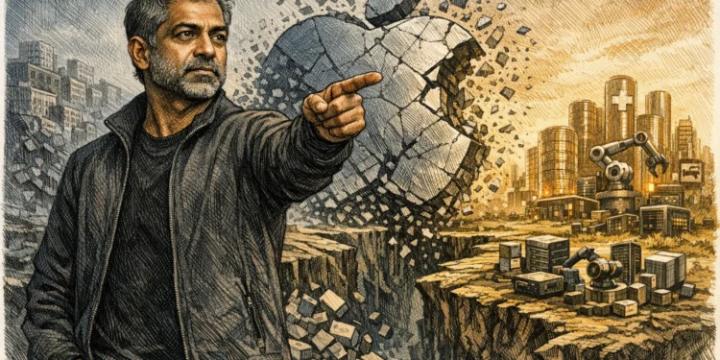
—As fiat currency continues to depreciate, how can ordinary people gradually achieve economic freedom on the blockchain?
The same story has been playing out repeatedly around the world for the past few decades.
When national finances are out of control, currency is over-issued, and politics are in turmoil, the first thing to evaporate is always the savings of ordinary people .
Look at these real-life examples:
- Iran : Over the past 10 years, the rial has depreciated by more than 90%, and ordinary people's savings have been almost completely wiped out.
- Venezuela : Once a wealthy South American country, its currency has now experienced inflation millions of times over.
- Argentina : Inflation has been above 100% for years, and young people rarely save money in the local currency.
In these countries, people have learned one thing:
Don't put all your wealth into your own currency.
Because fiat currency has a fatal weakness:
You don't have the right to distribute it.
Today, for the first time, the world has an alternative:
A decentralized cryptocurrency system.
Renminbi Risks Rise: A Triple Crisis Is Escalating
Many people always feel:
Currency collapses only happen in other countries.
Many people believe that currency crises only happen in other countries. But the reality is that almost all highly indebted countries eventually face the same choice: economic recession or currency devaluation.
China is currently facing triple pressures: a declining real estate market, high local government debt, and a reversal in its demographic structure. If the geopolitical risks associated with the Taiwan Strait are added to this, capital outflows and financial shocks are possible. Similar situations are not uncommon in history; just look at Iran today—within days of the start of the war, the Iranian currency depreciated 34 times.
This is not a prediction of a certain outcome, but rather a reminder of something:
Establish multiple asset exits before risks materialize.
As more and more countries' fiat currencies face pressure, learning to use stablecoins and on-chain accounts in advance may be the most important financial "safety channel" for ordinary people.
I. The Fate of Fiat Currency: Constant Devaluation
From an economic perspective, as mentioned earlier regarding the RMB, almost all legal tender follows the same pattern:
Long-term purchasing power continues to decline.
The reason is simple:
- The government needs deficit spending.
- Central banks need to print money to maintain the economy.
- Debt needs to be continuously rolled over
The result is:
The money supply is always increasing.
For example:
- Since 2020, the US M2 money supply has grown by more than 40%.
- Government debt in most countries hit record highs
- Global central banks continue to expand their balance sheets
As debt accumulates, the value of money is most easily sacrificed.
This is why people in many countries are starting to choose:
- gold
- Cryptocurrency
To hedge against risks.
II. Why are more and more people choosing cryptocurrencies?
The real revolution in cryptocurrencies is not just about price increases.
Instead, it's three things:
1. Issuance should not be increased arbitrarily.
For example:
Bitcoin
The total quantity is fixed at 21 million .
No central bank can print it.
2 Global Mobility
You can transfer money as long as you have internet access.
Regardless of:
- China
- USA
- middle East
- And any country or region in the world
Both can circulate freely.
3. Asset self-custody
Traditional banking system:
Banks control your money.
Blockchain system:
You control your private key.
Whoever controls the private key controls the assets.
III. The most important thing in the on-chain world: stablecoins
Many people associate cryptocurrencies with wild price swings.
What truly changes the world is:
Stablecoins - USDT, USDC, USD1, etc.
These stablecoins have the following characteristics:
1:1 pegged to the US dollar
1 USDC ≈ 1 US Dollar
This means:
You can convert your wealth from your local currency into digital dollars .
and:
- No bank needed
- No cross-border approval required
- Free from capital controls
This is why:
In countries such as Argentina, Türkiye, and Lebanon,
Stablecoins have a very high usage rate.
IV. Four Steps for Ordinary People to Enter the On-Chain World
Below is a very practical introductory route .
By following the steps, you can build your own on-chain account system.
Step 1: Register an exchange
Choose a large exchange, such as:
- Binance, Coinbase, Kraken
Register via this link to enjoy a 20% discount on the service fee. Thank you all for your support.
effect:
- Buy cryptocurrency
- Exchange stablecoins
- Fiat currency entry
Note: If you are unsure about the specific deposit, withdrawal, and exchange procedures, you can search for tutorials on exchanging fiat currency for stablecoins on video platforms and follow the steps accordingly.
Step 2: Purchase stablecoins
Most common method:
Fiat currency → USDT
For example:
RMB/USD → USDT
This completes the first transfer of your assets:
Fiat currency → Digital dollar
Step 3: Learn how to use a wallet
The exchange is just the entry point.
What is truly safe is:
On-chain wallet.
Common wallets:
- MetaMask
- Trust Wallet
The core of a wallet is:
Private key/ seed phrase.
Must:
- Offline saving
- No screenshot
- Do not upload to the cloud
Because: whoever gets the seed phrase takes the assets.
https://www.htx.com/invite/zh-cn/1f?invite_code=exchange
Important Reminder:
Additionally, we recommend using reputable brand hardware wallets to store your encrypted assets.
We do not recommend domestically produced encrypted wallets, and you should not buy wallets from Taobao, Douyin, or KOLs, as there is a significant risk of backdoors being implanted, which could result in the loss of your cryptocurrency!
My experience using a personal hardware wallet:
https://partner.coincatch.com/bg/D1GJP4
https://www.bitmart.com/invite/cVQAdY
https://partner.bitget.com/bg/7GDWYF
Step 4: Asset Diversification
A basic configuration:
Stable assets:
- USDT
- USDC
Growth assets:
- Bitcoin
- Ethereum
A simple structure for an average person:
- 60% Stablecoins
- 20% BTC
- 10% ETH
- 10% other currencies
This way, it not only preserves the value but also has room for growth.
V. The True Significance of On-Chain Economy
Many people haven't realized it yet:
Two financial systems are emerging in the world.
The Old World:
- bank
- fiat currency
- Government control
New World:
- Blockchain
- Stablecoins
- Self-custodied assets
In the future, more and more people will live in two systems at the same time.
Just like when the internet first appeared.
VI. True financial freedom is actually very simple.
To sum it up in one sentence:
The simplest way for ordinary people to protect their wealth is:
Don't hold only one currency.
Learn three types of assets:
- fiat currency
- gold
- Cryptocurrency
Especially stablecoins.
It gave ordinary people their first experience:
The right to choose a currency that transcends national borders.
As the world becomes increasingly unstable
What really matters is not predicting the future.
Instead:
Prepare multiple exits in advance.
Conclusion
On-chain accounts will become the basic accounts of the future.
If one day:
Inflation erupts, currency depreciates rapidly, and capital controls are strengthened.
You already possess at least:
An on-chain account that belongs to you.
You will find that at that time
Cryptocurrencies have not truly changed prices.
Instead:
For the first time, ordinary people have gained monetary sovereignty.
This is not speculation.
Instead:
A new era's wealth defense system.