This article is machine translated
Show original
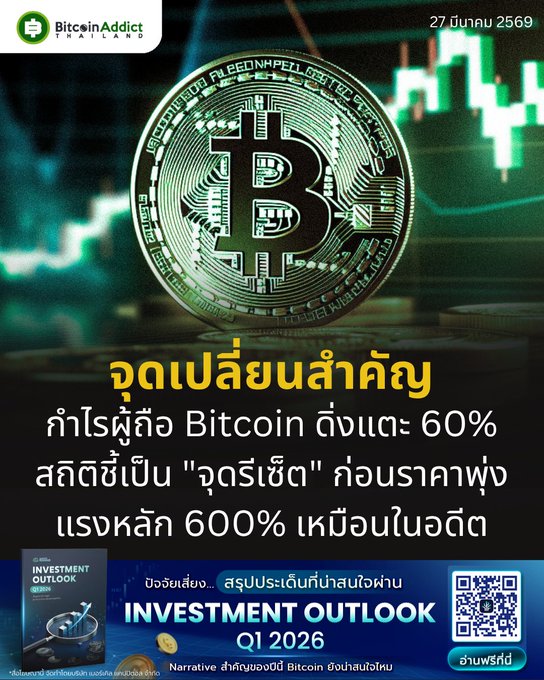
Bitcoin holders' profits plummeted to 60%, with statistics indicating a "reset point" before a potential 600% surge like in the past.
Earlier this year, every week was filled with news of losses, discouragement, and people saying BTC was "dead" after falling nearly 45% from its all-time high (ATH).
But on March 27, 2026, a number appeared in the on-chain data (directly on the Bitcoin blockchain) that many analysts in the industry recognized because it had previously appeared during the best accumulation periods.
That number was 60.6%. This is the proportion of all Bitcoins in the market that owners still hold "in profit" relative to their purchase price, known as Supply in Profit. Why is this number important? We need to look back at the story:
1) March 2020 — The global market collapsed due to COVID. The price of BTC plummeted to around $6,500. Supply in Profit dropped below 50%, meaning more than half of all Bitcoins in the world were "below their cost price." Most holders were losing money. The resulting surge — BTC reached $69,000 in 2021, an increase of approximately 10 times.
2) January 2023 — The second surge of similar figures after FTX (the crypto exchange that went bankrupt at the end of 2022) flooded the market, with a Supply-in-Profit ratio of 51%. The price of BTC was at $16,682. Most people in the industry thought it was "over." The resulting surge — BTC reached a 655% increase, reaching $126,000 in 2025.
3) October 2025 — The peak of the cycle, and then everything started to change. After reaching an all-time high of $126,000, the market began to correct. Retail investors who entered late in the market exited first, causing BTC to gradually decline by approximately 45% from its peak.
4) February 5, 2026 — The day of peak selling pressure; Supply-in-Profit ratio plummeted to 50.8%, the lowest since early 2023. During the same period, BTC being sent to Binance (the world's largest exchange) by short-term investors surged to approximately 100,000 BTC per day. This was a signal of panic and selling.
5) March 18, 2026 — The US Federal Reserve announced it would keep interest rates at 3.5–3.75% and signaled it was not in a hurry to lower them. Because inflation remains at 2.7%, and pressure from oil prices soaring more than 60% since the beginning of the year due to tensions in the Middle East, the direction of risk assets like crypto remains difficult to predict.
6) March 25, 2026 — Selling pressure subsided, with BTC flowing from short-term investors into Binance dropping to only 25,000 BTC per day. Analyst Darkfost noted this as a new market low, down from 100,000 BTC during the February crisis. Simply put, most of those who panicked and wanted to sell have already done so, and what remains are the stronger hands.
7) March 27, 2026 — Today, the Supply-in-Profit ratio returned to 60.6%. This figure remains in the historical zone of interest for long-term collectors. But one thing that's different from all previous cycles is that LTH-NUPL (Long-Term Investor Profit/Loss Index) remains at 0.40. This means that long-term investors haven't really suffered yet, unlike in 2018 and 2022 when this number plummeted below zero before reaching a true bottom.
8) The game-changer this time is that financial institutions and spot ETFs (funds that actually hold Bitcoin, not just contracts) currently hold approximately 15.8% of the total circulating BTC, or about 3.3 million BTC. CoinShares reported that money has continued to flow into Bitcoin ETFs for three consecutive weeks, totaling over $340 million, even though the market is stable and directionless. This group isn't panicking like retail investors, so the panic selling that heavily pressured the market in previous cycles is significantly less.
The Supply-in-Profit figure isn't an accurate indicator of the bottom, but in every past cycle, it has often shown that "selling pressure is dissipating" before the market truly starts accumulating.
The remaining question isn't "Has this signal ever been correct?" because historically it has, but "How long will it take this time?" amidst the Fed's continued interest rate cuts. Oil prices remain high, and altcoins are still bleeding.
Sector:

From Twitter
Disclaimer: The content above is only the author's opinion which does not represent any position of Followin, and is not intended as, and shall not be understood or construed as, investment advice from Followin.
Like
Add to Favorites
Comments
Share