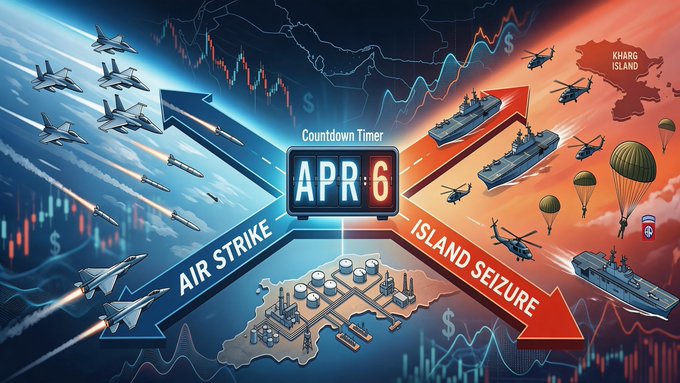
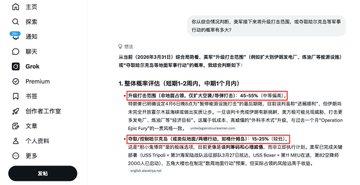
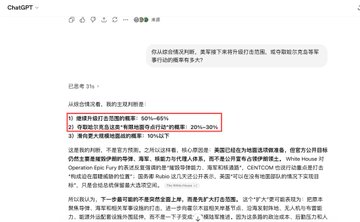
I've been closely monitoring US military deployments and the evolving war situation, as this is currently the most crucial and direct factor influencing market trends, bar none. I'm not a macro analyst; I'm just an ordinary trader. I must combine the information I have with my trading decisions. Regarding the analysis of the war situation, I consulted grok and chatgpt. Based on the current situation, after the April 6th ultimatum expires, if Iran doesn't make substantial concessions to the "15 points," both AI models believe that the probability of the US expanding its airstrikes/strike range is very high (over 50%), while the probability of seizing/controlling Kharg Island is very low (around 20%). I've summarized their main considerations as follows: 1. Kharg Island is too close to the US mainland, placing it completely under saturation fire from Iran. Seizing the island would make it an easy target, contradicting the modern US military's "zero casualties" or "non-contact warfare" philosophy. 2. There's a high probability of economic backlash. If the conflict escalates, soaring oil prices will have a real impact on US Treasury bonds and stocks, posing a significant obstacle for Trump. 3. Occupation is easy, withdrawal is difficult. Trump is more like a "businessman"; he doesn't want the US dragged into a protracted ground conflict. However, I personally think the probability of ultimately "seizing the island" isn't that low. I'm looking at it from a micro-level troop dynamics perspective: First, in the US military's tactical manual, the 82nd Airborne Division is used for "knocking on doors," not for "disruption or defense." If it's just about expanding the long-range strike range, deploying a few air force squadrons or adding destroyers (fully equipped with launch units) would suffice. Since they've already come, it means the plan to seize the island (or other key facilities) has moved from a contingency plan to an execution. Second, if it's an expanded air strike, it can only destroy, not "close" or "take over"; this also forces Iran to adopt self-destructive scorched-earth tactics and prolonged harassment. However, if physical takeover can be achieved (e.g., shutting down the island's pumping stations and loading facilities), the US would have its biggest bargaining chip at the negotiating table. If Iran does not back down after the ultimatum (currently it appears quite tough), to maintain its prestige as the leading power, it will inevitably have to take a middle ground action that is heavier than an airstrike but lighter than a full-scale war; and seizing the island is the perfect middle option. I've read many foreign analysts who, from a "rational game" perspective, mostly believe that if Iran adopts an asymmetric attack on oil fields in other parts of the Middle East, it will hinder the US military's actions. But I still believe that the US military's current posture is precisely to prepare for a strong counterattack. Perhaps this time the US is no longer afraid of a short-term surge in oil prices. If it can gain control over Iran's energy exports for the next 20 years through a week of pain (seizing the island and physically blocking the Strait), it might consider the price worthwhile.
This article is machine translated
Show original

Murphy
@Murphychen888
03-30
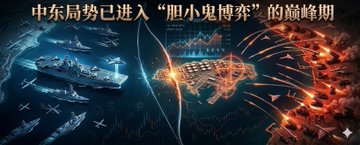
中东局势已进入“胆小鬼博弈”的巅峰期!
美军“的黎波里”号两栖打击群带着第31海军陆战队远征部队,以及F-35B+武装直升机的军事部署已到位。另外一艘“拳师号”搭载第11海军陆战队正在前往中东途中,尚未抵达。 x.com/Murphychen888/…

From Twitter
Disclaimer: The content above is only the author's opinion which does not represent any position of Followin, and is not intended as, and shall not be understood or construed as, investment advice from Followin.
Like
Add to Favorites
Comments
Share
Relevant content