Written by: Lawyer Shao Jiadian
Recently, the term "AI payment" has become increasingly popular. However, the concept itself is still evolving rapidly, and different people often see different aspects of it. Some focus on user experience upgrades such as voice ordering and automatic payment, while others focus on connecting AI agents to wallets and enabling them to make payments. But as some projects actually emerge, the market is beginning to see that the focus of AI payment is not just "payment" itself, but how AI services are priced, transacted, and settled .
Take Nevermined as an example. It doesn't create a single-point payment tool, but rather an infrastructure that allows AI services to be priced, charged, and settled. Its capabilities include billing, access control, real-time settlement, and compatibility with agent protocols such as MCP, A2A, x402, and AP2. What it truly aims to solve isn't "how to pay," but rather how to instantly generate revenue from each task performed by AI .
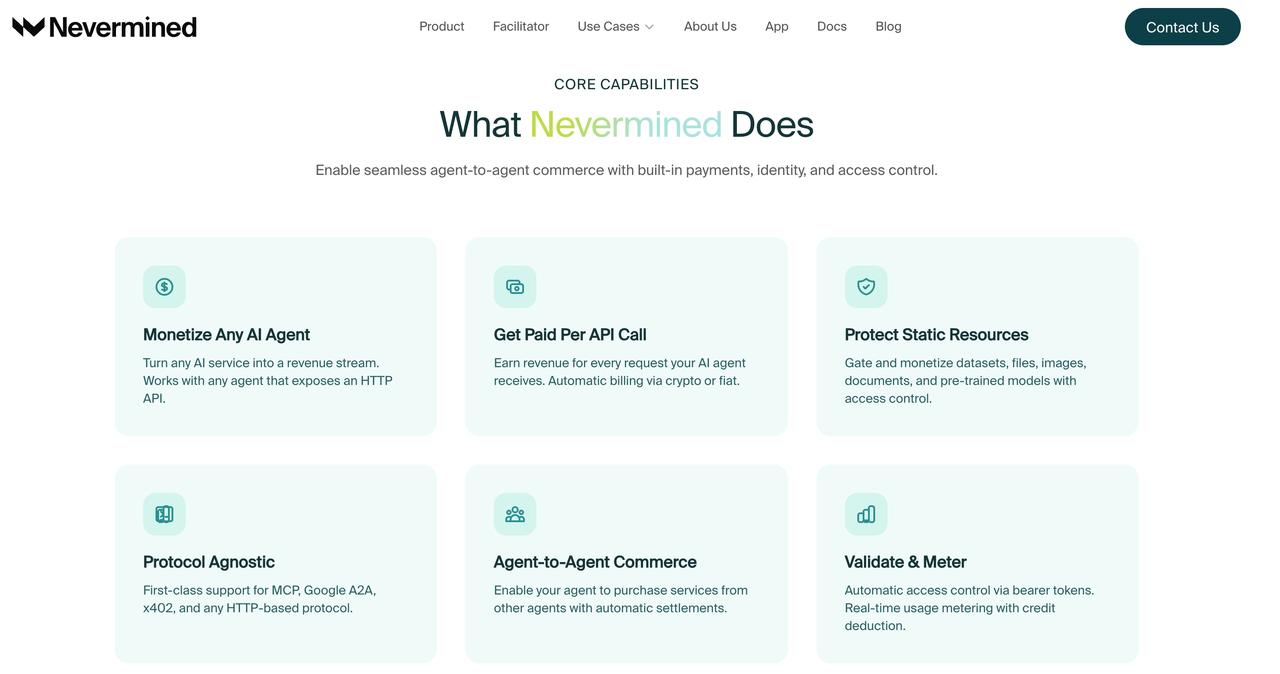
(The above images are screenshots from Nevermined's official website)
It's not selling wallets, but rather a payment system for AI services.
Many payment products are more like cashiers, focusing on collecting money. Nevermined is different; it's more like installing a complete charging system for AI services. Each time an AI service is invoked, the system can determine whether to allow the service, how much to charge, how to record the deduction, and how to handle any disputes that may arise later.
This might sound technical, but it's actually quite simple to understand. Many AI products are working today, but few are truly generating sustainable revenue. The problem often isn't with capability, but with the pricing model. Traditional software can charge per account, per year, or per package, but AI agents typically operate differently. A seemingly simple task might actually involve multiple calls to models, multiple tools, and several rounds of external services. Continuing to use the traditional software pricing method easily leads to distorted pricing.
Nevermined capitalized on this step. It transformed previously background processes into individually billable commercial transactions. In the past, people sold "software usage rights"; now they're selling "every instance of machine labor."
Why did this business start to take hold?
The reason AI payments are becoming practically significant is not because the concept has become new, but because the way AI works is forcing a change in how pricing works. Nevermined offers different models such as pay-per-use, pay-per-result, and pay-per-value, essentially answering a very real question: how should AI services be sold?
In the past, many AI products struggled to sell, not because there was no demand, but because customers couldn't understand where their money was going. Monthly subscriptions were risky, as they worried about overpaying; per-seat pricing didn't reflect actual usage. This was especially true in agent-based scenarios, where a single conversation could involve dozens or even hundreds of micro-operations. If the pricing logic didn't align with the actual workflow of AI, commercialization would remain awkward.
Nevermined's solution is to turn actions like invocation, results, and access into chargeable events, and then integrate billing, authorization, and settlement into the same process. This way, customers are no longer buying a vague "AI capability package," but rather a series of visible and quantifiable services. The real value of AI payments lies not in enabling machines to make payments, but in finally allowing the work done by machines to be properly priced.
Another crucial move it made was avoiding locking itself into purely crypto payments. Public information shows that it also supports bank cards, stablecoins, crypto assets, and real-time bank transfers. This choice is important because to make AI payments a business, customers must first be able to easily integrate. The more open the payment channel, the more it resembles infrastructure; the higher the barrier to entry, the more it resembles a toy for insiders.
It's no longer a concept project.
To determine whether such projects are still in the conceptual stage, one cannot simply look at their storytelling; it's crucial to examine what's actually presented on their product page. Nevermined's public information shows that it has already partnered with platforms like CrewAI, Olas, Naptha, Mother, and Helicone , aiming to provide payment and billing capabilities for next-generation agent transaction scenarios. On its official product page, it directly lists MCP tools, A2A services, x402 payments, as well as cards, stablecoins, and bank transfers as product capabilities, rather than just leaving them as vision descriptions.
More notably, there is public overlap between Nevermined and Olas. Nevermined mentions that Valory, when deploying payment and billing capabilities for Olas' AI agent marketplace, reduced the deployment cycle from 6 weeks to 6 hours with the help of Nevermined. Olas' public page also mentions its marketplace integration with Nevermined, enabling agents to pay and get paid, and supporting real-time, dynamically priced agent-to-agent transactions.
This at least demonstrates one thing: Nevermined isn't just a figment of imagination about "future machines trading with each other"; it's already being used in real-world scenarios. Of course, this doesn't mean it's achieved phenomenal revenue. Publicly available materials prove that it has been productized, integrated into an ecosystem, and entered real-world usage scenarios; as for specific profits, there are currently no publicly disclosed figures. This boundary needs to be clearly defined.
The real sensitive issue isn't the technology, but the legal status.
The most troublesome aspect of AI payments is often not whether the technology can be implemented, but rather what the platform's legal standing is once it's implemented. Many tech teams tend to overestimate "code neutrality," but regulators usually don't buy into that.
Nevermined emphasizes traceability, auditability, real-time invoicing, and tamper-proof logs in its product description. These capabilities are certainly good from a business perspective because they increase trust; however, from a regulatory perspective, problems also arise.
If a platform only provides billing logic, access control, and API verification, while the funds remain under the user's control and payment authorization stays with the user or their wallet, then it's more like a technology service provider. However, once the platform starts collecting, distributing, settling, or managing funds, or becomes deeply involved in stablecoin transfers, its regulatory profile changes significantly. Regulators are never too concerned with what you call yourself; they're more concerned with whether you're handling other people's money .
This is also the biggest difference between AI agent payments and ordinary software services. Previously, software platforms primarily sold tools; now, these platforms are starting to encounter issues closer to the core of payments, such as "billing," "authorization," "settlement," and "record keeping." Going a step further, there's the issue of liability: if the agent automatically calls the wrong service or makes an incorrect decision within its authorized scope, who bears the loss? The user, the platform, the service provider, or the model itself? The smoother the AI payment process, the clearer the boundaries of backend liability need to be defined.
What it truly changed was not just the way we pay, but the way we transact.
It's easy to underestimate Nevermined if you only see it as a new payment tool. What's truly interesting is that it envisions a future where AI isn't just used by humans, but also purchased, invoked, and employed by other AIs.
Once this stage is reached, the transaction structure changes. Previously, it was one company selling software to people; now it might be one agent directing another agent. Previously, one purchase corresponded to one contract; now it might be a series of automatically triggered small transactions. Previously, payments were manually confirmed; now payments might be completed automatically by the system within authorized limits.
What has truly been rewritten behind this is not just the cash register, but also pricing methods, contract structures, risk control logic, and even the perspective of payment regulators. Nevermined is certainly not the end game, but it has at least brought a trend to the forefront: in the future, many transactions may not be negotiated between people, but may be calculated, called out, and settled by machines.
Understanding this is far more important than simply focusing on the phrase "AI payment." Because what's truly valuable in the next stage isn't necessarily whose model is better at chatting, but rather who can successfully streamline the "machine work—machine payment—machine settlement" process. The value of AI payment lies not in whether it can order a coffee for someone, but in whether it can truly transform machine labor into a revenue stream. Whoever gets this working first is closer to the entry point into the next stage of AI commercialization.