Compiled by: Block unicorn
Foreword
Visa's entire business model is based on human behavior. It's about human consumption and psychology. The reward points you accumulate, the fraud protection you rely on, the Centurion card you dream of, and the zero-liability policy that makes you feel safe swiping your card at ATMs abroad—all of this exists not because of difficulties in transferring funds, but because of human anxiety, the pursuit of status, and a lack of understanding of terms and conditions. Visa has leveraged this cognitive difference to build a $500 billion company.
However, AI agents do not possess these qualities.
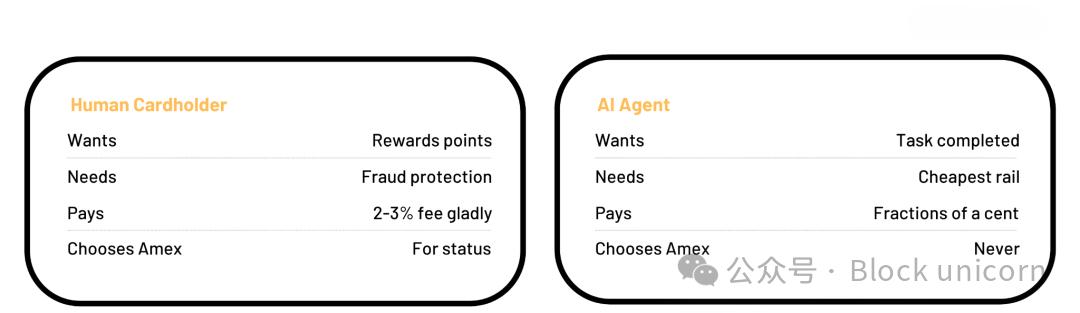
It doesn't accumulate points, doesn't pursue fraud protection, and doesn't aspire to obtain a black card. It has only one instruction: complete the task. And when the task involves payment, the agent performs complex calculations that humans would never bother to do: the cheapest path, the fastest settlement, the lowest fee. Every time, it does this automatically, without any emotion.
Last month, a SubStack article titled "The Global Intelligence Crisis of 2028" caused Visa's stock price to plummet 4% in a single day of trading, Mastercard to fall 6%, and American Express to drop 12%. The report was labeled a "scenario analysis," not a "prediction" (as stated in the original text). But the market didn't buy it. The technical arguments were also irrelevant. The problem is that by 2027, agents will bypass exchanges and use stablecoins for settlement. Visa has spent fifty years perfecting its product, and now its customer base is being replaced.
In machine-to-machine commerce, a 2-3% exchange rate is clearly a target. This assertion by Citrini Research is its core argument. This doesn't mean that artificial intelligence will destroy Visa tomorrow. Rather, it means that Visa's fee structure, upon which its business empire is built, is essentially a tax on irrational human behavior, while the transacting parties themselves are perfectly rational. This is the very reason for Visa's existence.
What is Visa selling?
To understand why this is important, you must understand where the exchange fee is actually used.
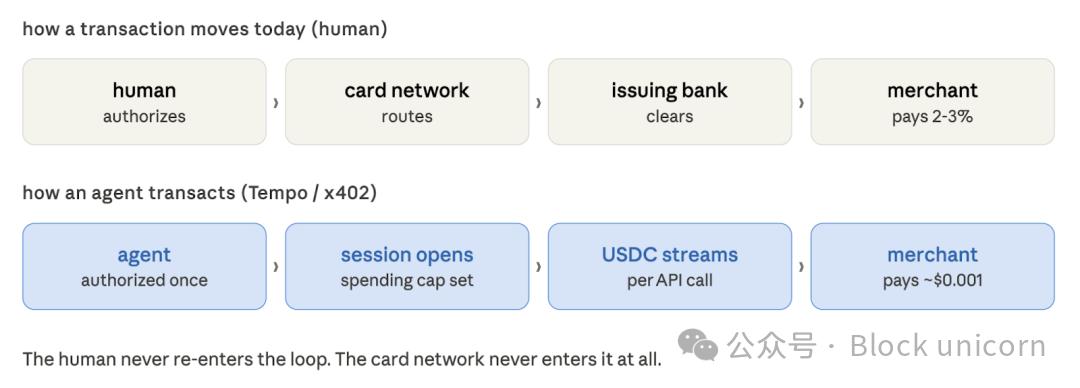
When you use a credit card to shop, the merchant pays a 2-3% fee to the credit card network and your issuing bank. This fee covers your points rewards, fraud protection, shopping insurance, and dispute resolution services. The entire consumer value proposition of a credit card is borne by the merchant, who ultimately passes on these costs to the consumer by slightly increasing the price of the goods. This is a well-established and stable system that has been running for fifty years because consumers in the transaction are willing to bear all these costs, even if they don't pay them directly.
AI agents don't need these. They won't object to the fee or request a refund. The justification for charging this fee is that it protects against human error, fraud, and impulsive behavior. If there were no human involvement in the transaction, this fee would be completely meaningless.
American Express is the most typical example of this problem. Its customers are high-income, high-spending, and ambitious high-end cardholders. Its annual fee is higher than Visa or Mastercard precisely because its customers are willing to pay for status and privileges. This model presupposes that the purchase is deliberate; customers choose American Express over Visa because the access to VIP lounges is worthwhile. Agents, however, don't actively choose American Express; they only seek the cheapest option to complete the transaction. In a world where software controls credit cards, high-end membership tiers don't truly exist.
The agency-driven business routing model that bypasses exchange fees poses a greater risk to credit card banks and single-business issuers that heavily rely on 2-3% transaction fees and build their entire business around merchant subsidy and rewards programs. Visa and Mastercard have a network of businesses that can adapt. However, issuers that build their entire profit and loss model around exchange fees and rewards programs have no way out.
The week when everyone shipped their orders at the same time
The Citrini report and the infrastructure project launch were released within the same three weeks.
Tempo officially launched mainnet last Wednesday. Developed jointly by Stripe and Paradigm, this payment blockchain is specifically designed for high-volume stablecoin settlements and was launched simultaneously with the Machine Payment Protocol (MPP). MPP is an open standard that allows AI-powered agents to autonomously pay service fees without requiring manual approval. The protocol introduces a session mechanism. Agents only need to authorize a spending limit once, and can continuously make micropayments as they consume data, perform computations, or make API calls. Payments are made using OAuth authentication. Once the user authorizes the spending limit, the agent can spend it. The entire process does not require the use of a bank card at every step.
Anthropic, DoorDash, Mastercard, Nubank, OpenAI, Ramp, Revolut, Shopify, Standard Chartered Bank, and Visa are all listed as Tempo's design partners. This structural change is endorsed across the entire payments and e-commerce ecosystem.
On the same day Tempo launched, Visa's cryptocurrency division released a command-line interface tool that allows AI agents to make payments via the terminal without API keys, accounts, or human authorization. Visa calls it "command-line commerce"—transactions can be conducted by machines without human intervention.
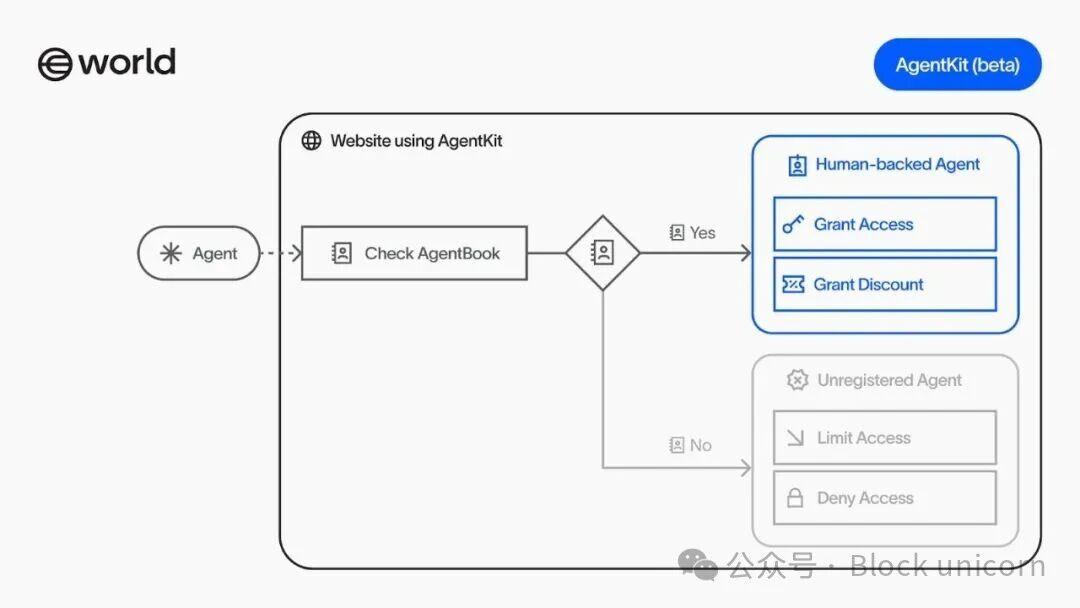
Mastercard has agreed to acquire stablecoin infrastructure startup BVNK for $1.8 billion. Circle launched Nanopayments on its testnet, a USDC trading service built for agents using a pay-per-use API that offers transactions for less than a cent and is gas-free. Sam Altman's Project World launched AgentKit, which allows agents to carry cryptographic proof of their identity as human agents. This toolkit is directly integrated into Coinbase's payment system, enabling the platform to verify agent identities without hindering legitimate transactions.
In my view, what happened last week was that companies were racing to become the new Visa so that Visa wouldn't realize what it had already lost.
An obvious paradox
Nothing is unclear now: Visa has not stagnated.
It participated in the development of Tempo's Machine Payment Protocol (MAPPS), launched Visa Crypto Labs, and its head of cryptocurrency even wrote an article in Fortune magazine explaining how agents can use bank cards for payments through the new standard. Mastercard is investing $1.8 billion in stablecoin infrastructure. Stripe acquired Bridge and Privy. Existing companies are aware of this shift and are preparing for the full arrival of the new infrastructure.
Visa's argument is that it can extend its track to agency-driven commerce before agency-driven commerce establishes a track that renders Visa irrelevant.
This statement isn't entirely wrong. Stripe processed $1.9 trillion in payments in 2025, a 34% year-over-year increase. These companies aren't shrinking. The network distribution advantage of card organizations is difficult to replicate. I admit I'm reluctant to say this publicly because, historically, whenever someone raises this argument, a new product is released that makes them look foolish.
So here's the flaw in this argument: Visa's distribution advantage is built on relationships with merchants and trust with consumers. Merchants accept Visa because consumers hold Visa accounts; consumers hold Visa accounts because merchants accept Visa. The entire cycle operates on people. Once an agent becomes a major buyer in a significant business sector, this flywheel slows down. Agents have neither brand loyalty nor money. All they have are budgets and instructions. They can win business with whichever route is cheapest and fastest, with zero switching costs.
I want to be precise about where we are, because the current pace of public opinion development has outpaced the data itself.
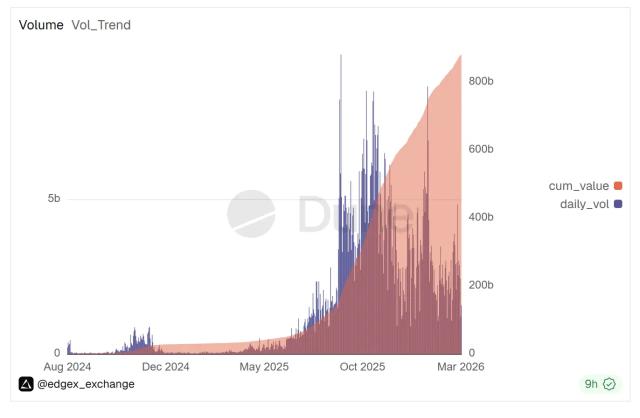
Despite the x402 ecosystem being valued at approximately $7 billion, on-chain data shows that the protocol's daily transaction volume last week was only around $28,000, with the majority coming from testing rather than actual transactions. This figure is a far cry from Visa's daily transaction volume.
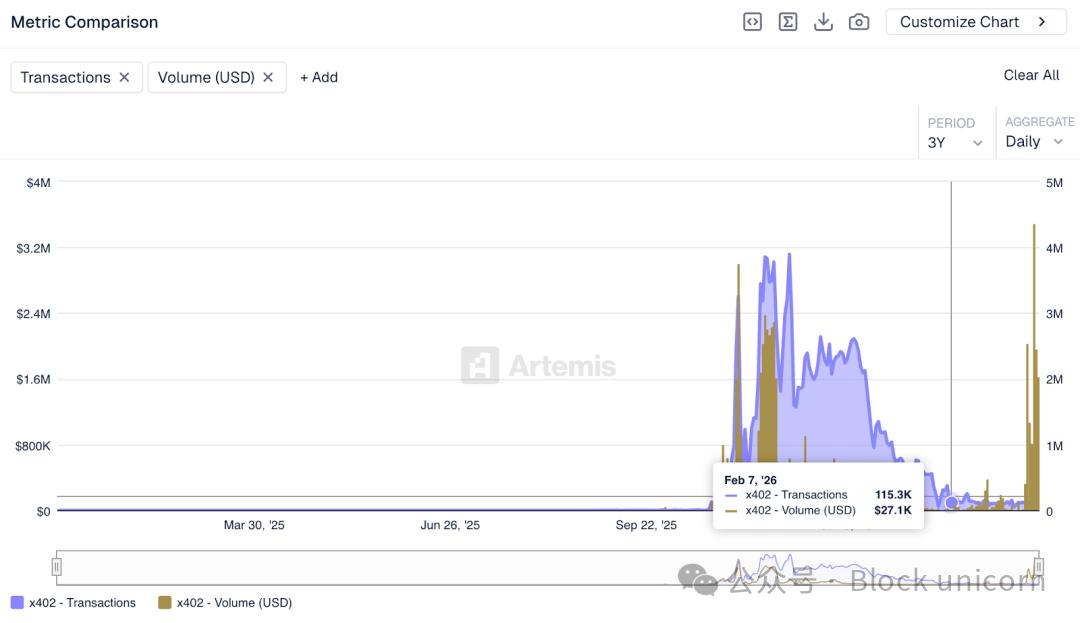
x402's transaction volume has surpassed 50 million. While the individual transaction amounts are small, the sheer volume demonstrates the infrastructure's usage. Developers are building upon it. Merchant-side services accepting proxy payments are also continuously growing. This is how payment networks began.
McKinsey estimates that by 2030, AI-powered agents could facilitate $3 trillion to $5 trillion in global consumer transactions. This estimate may be accurate, or it may be overly optimistic. However, it's undeniable that agent-driven business models are not yet widely adopted. Merchants building native agent services, companies using agents as primary buyers, and transaction volumes that truly measure the economic viability of transactions are still developing.
Citrini's report triggered market panic because it simulated a series of plausible events. Mastercard's Q1 2027 earnings report will not attribute the slowdown in transaction volume to "agent-driven price optimization." At least not for now.
The first to be affected are micropayments for AI infrastructure, rather than consumer commerce.
The agent completing the research task makes hundreds of calls to a specialized data API per session. Each call costs only a fraction of a cent. Over a week, these calls could generate $40 in revenue for the developers operating the service. Credit card networks cannot handle this. Minimum transaction amounts don't work. Merchant onboarding processes don't work. Fee structures don't work. This type of business model is destined not to operate within Visa's framework. It requires a completely new model, and x402, Nanopayments, and Tempo are building that model.
As Citrini's model suggests, any disruption to consumer commerce, even if it occurs, will only come later. It requires agents to handle a significant portion of discretionary spending, which in turn demands that consumers trust these agents and entrust their current purchasing decisions to them.
Visa is being challenged by higher-quality customers who no longer need the elements that made Visa successful. The 2-3% exchange fee is not a transaction tax, but a tax on irrational human behavior. Agents, on the other hand, are perfectly rational.
How do I know this is important? Because Visa spent $1.8 billion last week to make sure it wasn't left out of the answer.