Written by: Cookie
Different countries have different cultures, and cultural differences make NFT player groups in different countries have different characteristics. These characteristic differences are reflected in various aspects, such as project type preferences, aesthetic preferences, the motivation of "diamond hands" and even views on NFT, etc.
Due to the difference in native language, in the general (general chat) channel of each NFT project Discord server, it is not easy for us to feel the group characteristics caused by this cultural difference, but as long as we observe the chat content of different native language channels, we will There is a more direct feeling. This time, Rhythm BlockBeats had an in-depth conversation with some NFT players from Japan. Among the Japanese NFT players interviewed are the founders of the Chain Game Association and Bitcoin OG, which has invested in Crypto for more than 8 years. Both seasoned Discord modders and the average young player. Through conversations with these Japanese NFT players, we were able to get a glimpse of the characteristics of the Japanese NFT player group.
"careful"
Investing in NFT has a high learning threshold, which has always been one of the factors restricting new players from entering the NFT world. The "caution" of the Japanese makes many Japanese still wait and see about NFT:
"I believe that many Japanese will say, this NFT is cool, I want to buy it! But, what is MetaMask? What is OpenSea? It is not easy to get started. At the same time, they will also worry, will I Encountered a terrible deception?"
At the same time, the main information flow in the NFT circle is mainly in English, which makes it difficult for Japanese players to obtain information. Therefore, the "localized community" is very important to Japanese NFT players, which is one of the reasons for NinjaDAO's success - the Japanese community not only facilitates Japanese players to obtain information to make judgments on investment targets, but also enables them to communicate "Enjoy the community".
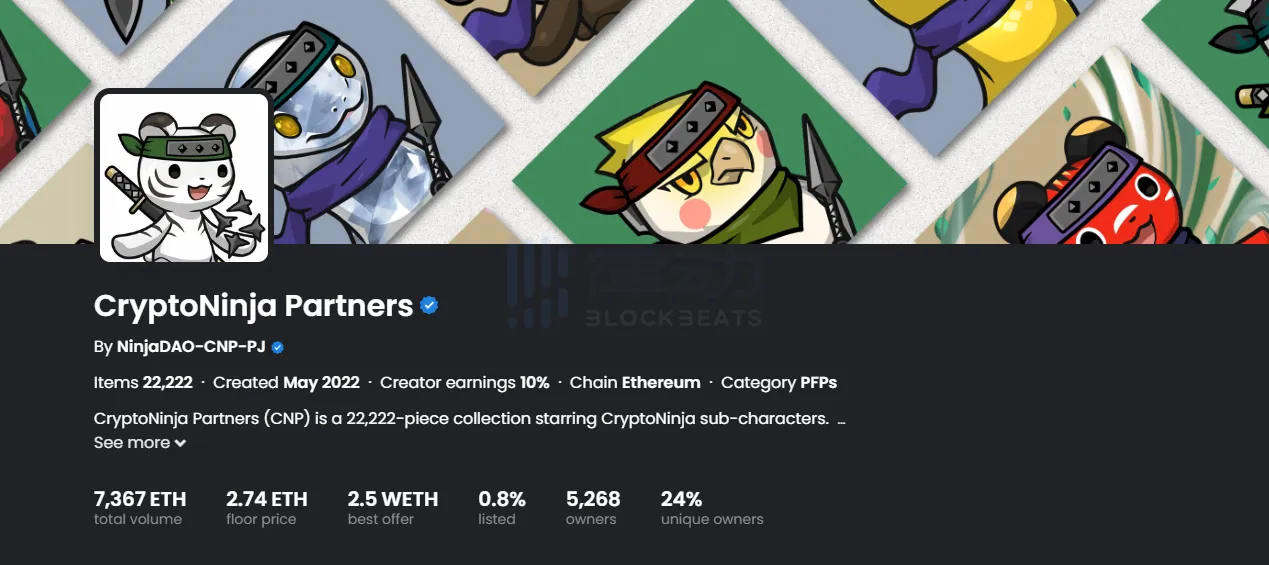
Except for Murakami Flowers whose influence is mainly overseas, NinjaDAO’s CryptoNinja Partners is the No.1 of Japan’s local NFT projects. The total order rate of 22222 is only 0.8%, and the floor price is close to 3 ETH , which is very excellent market performance
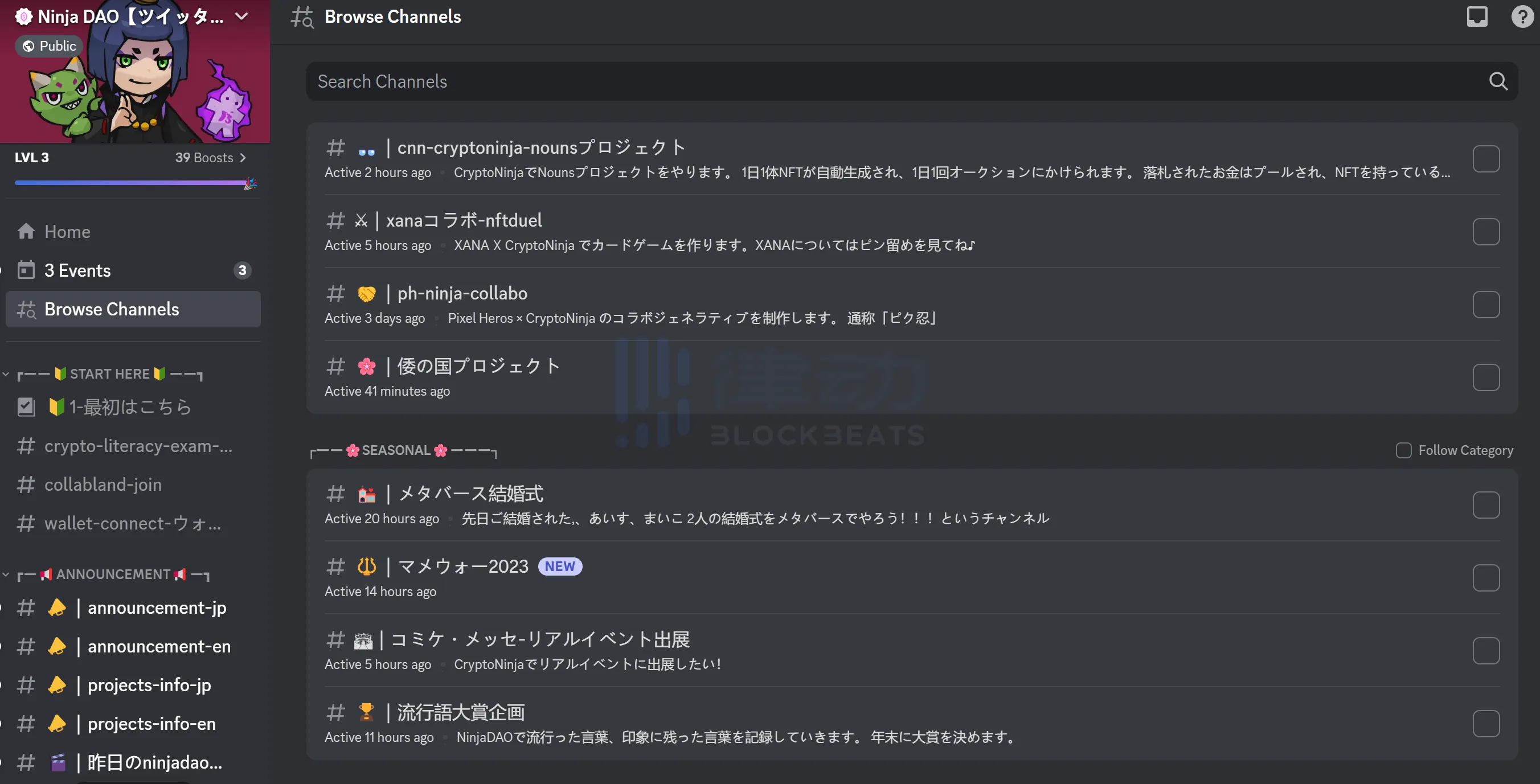
"Enjoy Community" has higher requirements for the operation of the Discord server - it is not only an information center for a specific NFT project, but also a platform for players to communicate, like a big BBS with many sections and a complex structure. Eliminate "individual discretion" in "communication". Taking NinjaDAO as an example, non-Japanese NFT players will feel confused when they first enter:
Low prices and even Free Mint are also a strategy to resolve "cautious" . It is quite common for Japanese NFT projects to have an offering price of less than 0.005 ETH (such as the CryptoNinja Partners mentioned above, whose offering price is only 0.001 ETH), and the white list of new projects is often issued based on the NFT of old projects as a screening condition. Some interviewees explained the effectiveness of this strategy from a relatively novel angle, which they called "trial", and mentioned Japan's unique "otaku culture":
"In Japan, there is a culture of buying paintings by amateur authors who are good at painting. This is the so-called otaku culture. For collectors with this hobby, whether to buy NFT or physical paintings, the only difference may be in Japanese yen Or use ETH to pay. But NFT is relatively new after all, and there are many consumers who buy NFT for the purpose of making money. Therefore, on the premise of loving paintings, it is quite attractive to test the water at low cost. As I saw an unfamiliar new brand of cereal in the supermarket, and bought a small trial pack to taste it. If all aspects of the experience after this NFT are good, players will continue to invest.”
In addition, Japanese NFT projects pay great attention to the development of offline activities and the display of offline influence. The interviewees believe that although it cannot be confirmed that this is a measure of the project party to prescribe the right medicine, it can indeed have a good effect on "cautious":
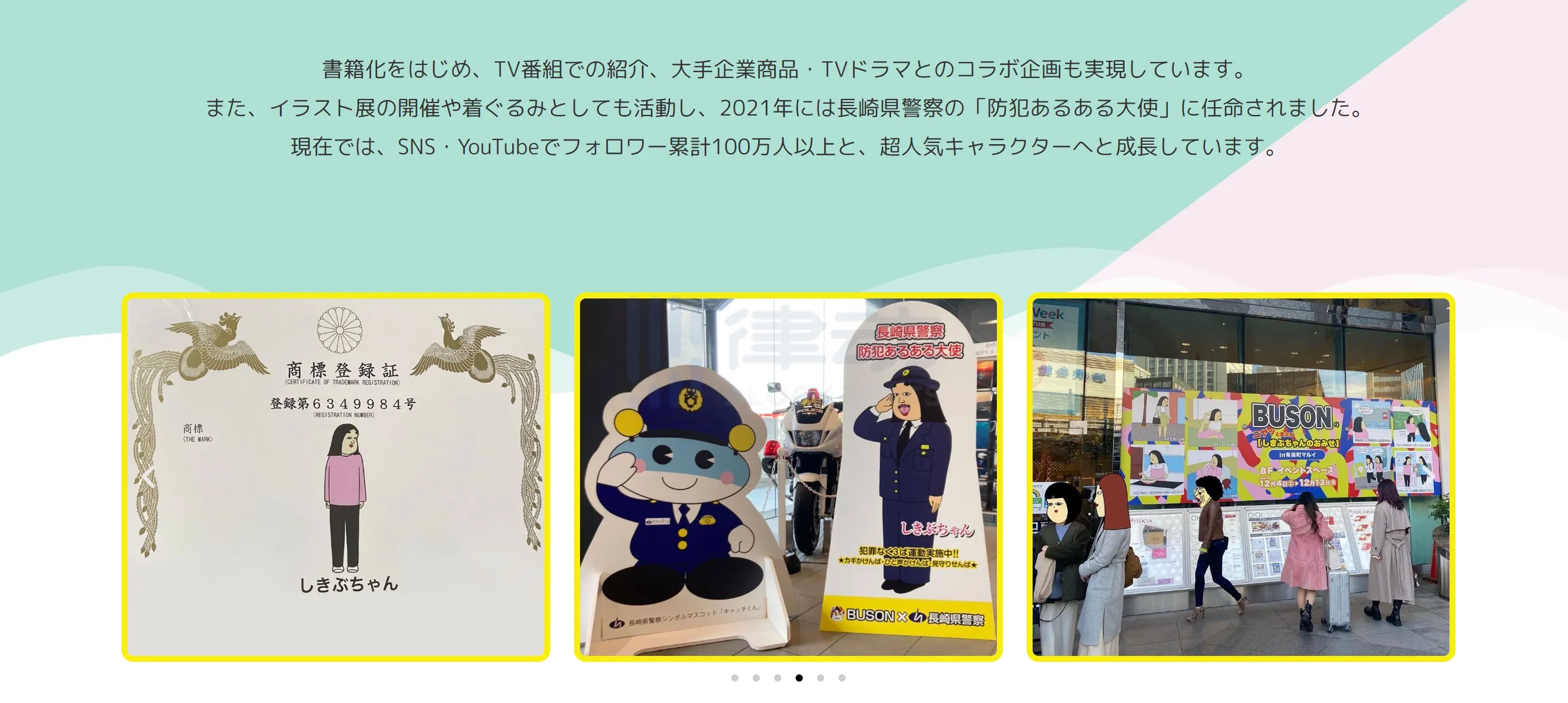
ShikibuWorld mentioned that his IP will be appointed as a "Crime Prevention Ambassador" by the Nagasaki Prefectural Police in 2021. Currently, the floor price of this series is 0.5 ETH, and the order rate is only 1%
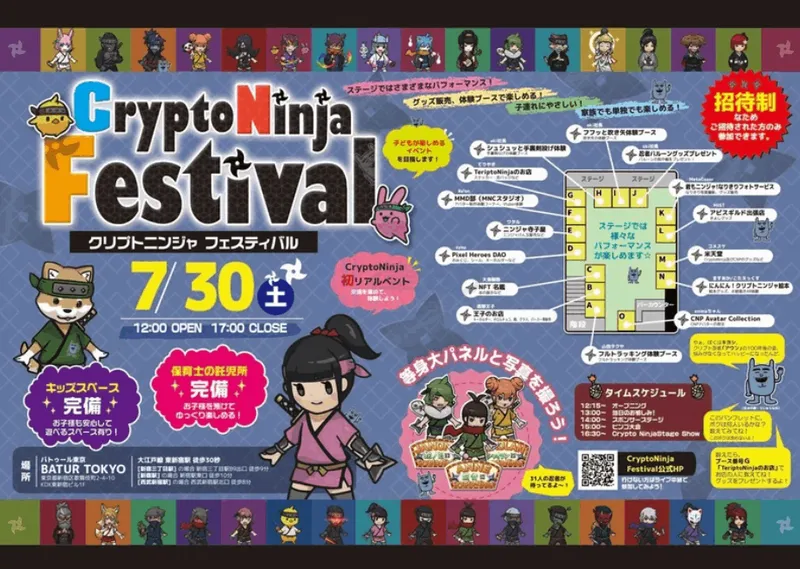
NinjaDAO's offline activities, CryptoNinja Festival 2022, are rich and colorful. In addition to regular activities such as peripheral sales and creator meetings, there are also card collection contests, Super Smash Bros. tournaments, and live shows with rich programs. In order to encourage parents and children to participate together, there are specially prepared children's entertainment spaces, diaper changing rooms and even staff who help take care of children
"Preferences"
Most of the respondents said that they started to get in touch with NFT because of StepN. After the money-making effect of StepN has weakened, Japanese players still have a high enthusiasm for "XX To Earn" type projects. "Play To Earn", "Move To Earn" and even "Sleep To Earn", Japanese players hope to find the next phenomenal "XX To Earn" project like StepN. One interviewee said that when Japanese players were most enthusiastic about the "XX To Earn" project, some minors even participated in it.
Some players have been disappointed by the mixed success of new projects, which has dampened some of that enthusiasm. Respondents generally have the following attitudes:
"There are too many beautiful stories in the market that are unable or unwilling to deliver. I don't reject the Ponzi stage at the initial stage of the project, but I need to see whether the project party has a clear understanding of what can and should be delivered in the short term and what it wants to achieve in the long term planning. Now, I hope to see excellent products made with care, which can be judged in many aspects, such as the beauty of UI/UX, the fluency of use, etc. As long as I can gain fun in use, I am willing to do what is needed A long-term investment to wait for."
When it comes to PFP, many respondents said they are not very interested. Moreover, the concept of "fried pictures" is relatively unfamiliar to them, and it is more out of interest in collecting. When they encounter works they like, as long as the price is right, they will be willing to buy them. Although there is a lack of data support, most of the interviewees believe that the number of "XX To Earn" fans among Japanese NFT players is more than that of PFP fans, and PFP fans are more willing to spend money, " XX To Earn" lovers tend to "zero roll".
Japanese players also have a preference for the aesthetics of PFP. Most of the interviewees are not interested in the style of CryptoPunks and Bored Ape Yacht Club, and one of the interviewees even said bluntly:
"I haven't met a Japanese NFT player who likes CryptoPunks or Bored Ape Yacht Club... For the purpose of making money, of course someone will buy it, but the style of painting is really not to my liking, or it can be said that it is not Japanese People's appetite. Japanese people prefer manga-style design."
If the respondents were asked to choose one of the blue-chip projects in the existing market, Azuki was the choice of the vast majority of respondents. Judging from the historical trading volume ranking of NFT projects in Japan, there are indeed a large number of NFTs in Japanese style:
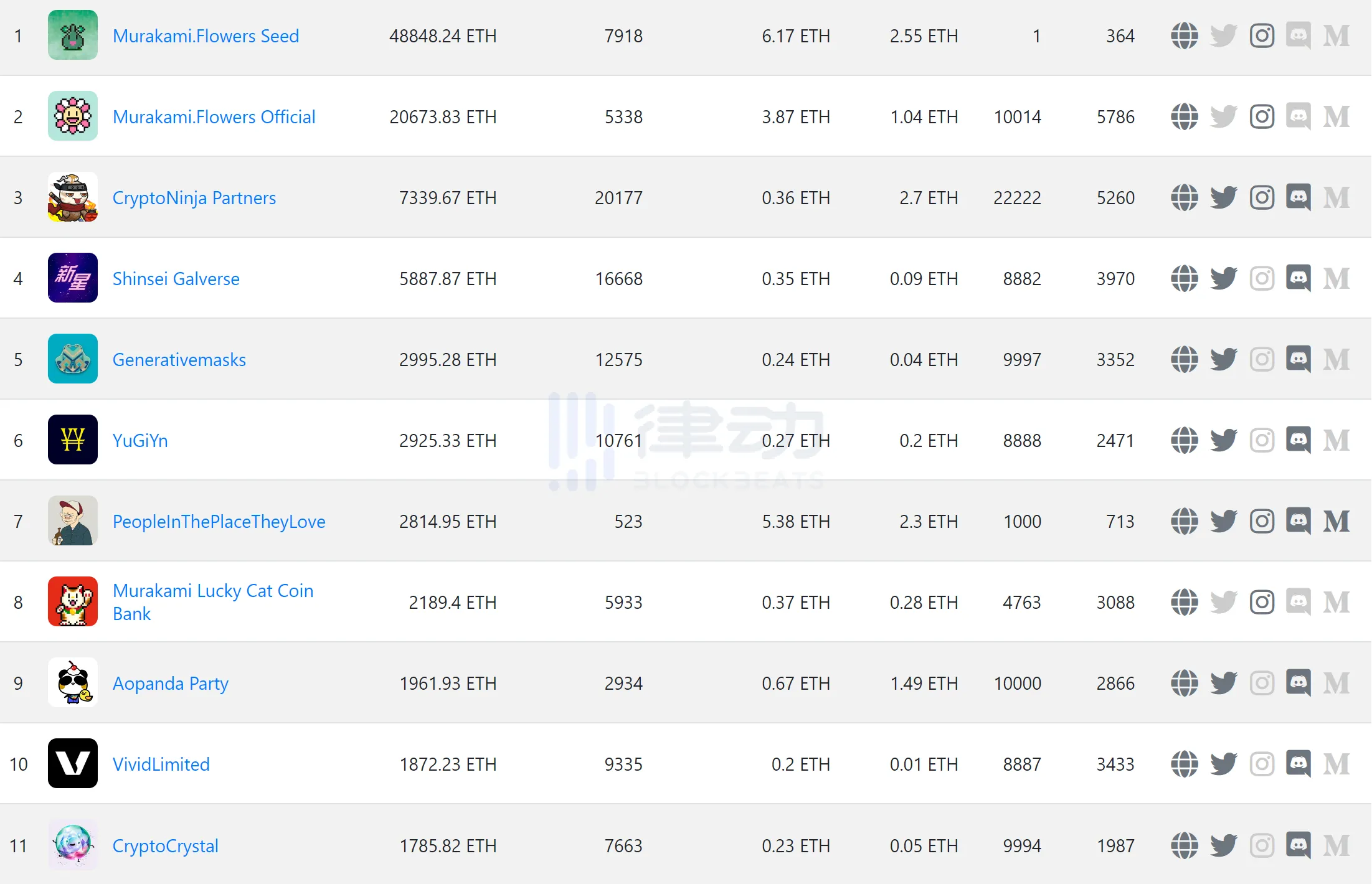
In addition, the NFT series produced in Japan are more popular with Japanese players. 70% of the respondents bought the first NFT produced in Japan, and another 30% only bought Japanese products. They said that the NFT produced in Japan made them more at ease and more popular with them. The reason for the peace of mind is that there are Japanese people in the management team who can give them a kind and familiar feeling, and there are no language problems at the same time, so they can understand more deeply. Favorite is the painting style preference mentioned above.
"Buddha"
In the community, I was impressed by the "Buddhism" performance of Japanese players. I have seen statements like this:
"Earning $10 a day in StepN is also quite good. I am satisfied with gaining health and some income at the same time."
I thought that such a speech might be just an example, but in the conversation with the interviewees, I found that there are not many interviewees who hold such views, but they have different prerequisites. Some people think that $10 a day is good enough for them as long as the project works and they see it as a solid long-term investment. Some people think that such a view is based on the low cost/cost has been recovered. But despite these prerequisites, I still think Japanese players are more "Buddhist".
Another point of "Buddhism" is that there is less FUD in the Japanese community, and more often it shows support for the project. Regarding this point, some interviewees believe that this may be a "national issue":
"Japanese players are indeed more inclined to express support for a project, at least they rarely criticize a project outright. This may have something to do with the character of the Japanese - unless someone takes the lead in pointing out the general dissatisfaction, otherwise everyone will still criticize it There are reservations, people are unwilling to be bad guys, or worry about expressing opinions that are not in the group, this tendency is more obvious in NFT newbies and non-influential community members.”
So, is this the reason why Japanese players have more "diamond hands"? Not quite. At least, judging from the answers given by some interviewees, their "Buddhism" is more pure than I imagined:
"You mentioned to me the low listing rate of NinjaDAO. In their community, HOLD is the consensus there. They have achieved a level that attracts the attention of NFT players outside of Japan. This will expand the influence of Japanese NFTs overseas. Good thing. However, I don't really like being surrounded by voices that I have to HOLD. Feel free to buy and sell what you like. This is your freedom - NFT is supposed to be like this, why must HOLD be emphasized? If I am interested , I will buy it and enjoy the process of holding it. If I lose interest, I will leave. It is really magical to dislike selling the NFT I once held. Of course, such a consensus construction, with their Founder Ikehaya Mr.'s own influence is inseparable from his trustworthiness, and he has a loyal following."
Another interesting point is that Japanese members in Discord don't like being @everyone too often, but turning off Discord notifications may make them miss important new information, which makes them distressed. The solution is also very simple, setting an exclusive role for them to receive notifications will make them feel appropriate.
epilogue
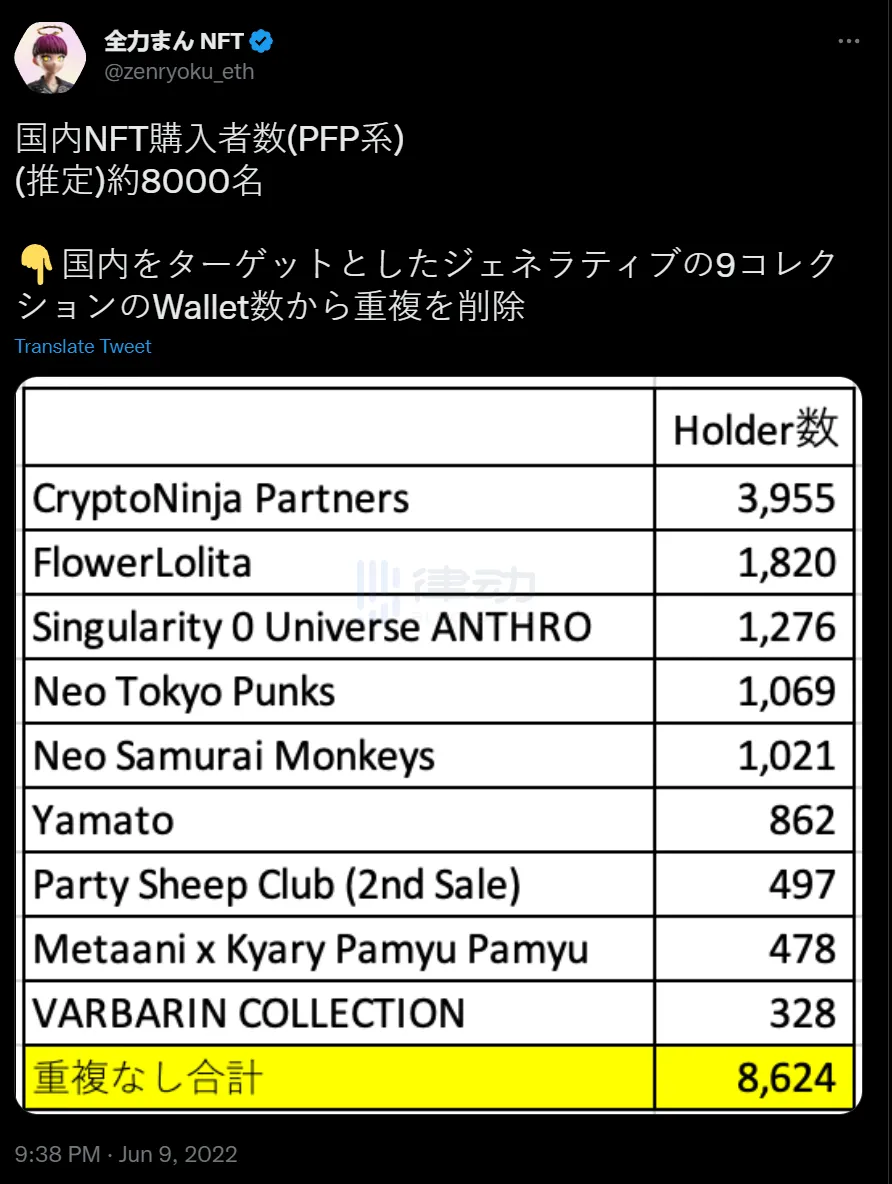
@zenryoku_eth released a statistic in June last year. After deduplication of the holder's address, it is estimated that there are about 8,000 Japanese PFP buyers. And the conversations with Japanese NFT players convinced me that there is still a lot of room for development in the Japanese NFT market. The success of CryptoNinja Partners has taken the first step of Japan's NFT overseas, and more and more people are paying attention to the rising Japanese NFT market because of this successful project. Its issuer, NinjaDAO, currently occupies the throne of the PFP track, but as more incremental funds enter, there may be more turbulent waves. However, the "more turbulent Houlang" is likely to be born from the NFT produced in Japan. For NFT markets in different countries, only by formulating appropriate "local taste" operation strategies according to their cultures can they be better loved and trusted by users.
The community operation strategy of the Japanese NFT project also inspired me a lot. In the past, we focused more on the success of a single NFT project. However, after the sale is completed, maintaining the "cohesion" within the community and the "attention" outside the community is often a big problem. Since the realization of the long-term vision is not easy to give users direct and frequent feelings to enhance confidence, it is difficult for users to buy NFT "long-term investment" at the moment when incremental funds are insufficient and narrative appeal is reduced. If it was "buying narratives" during the bull market, it is more about "buying communities" now. Japan's NFT projects are showing us how to dilute "speculative awareness" through the construction of low cost, large community scale, and "friendship". "s solution. There are still many details in this solution that are worth pondering. After all, it is still difficult to build a "friend relationship" with frequent chats or simple and traditional community activities.
At the end of the article, I would like to express my deep gratitude to all the interviewees who talked with me, and I also borrow a sentence that an interviewee said to me at the end of the interview:
"Thanks for the common love for NFT, let us get to know each other."