Editor's Note: This is a systematic and practical tutorial on Claude Cowork. Its core focus is not on "how to write better prompts", but on "how to turn AI into an execution unit that can be managed and scheduled".
Starting with the basics, the article gradually unfolds a complete usage framework: first, a stable context (i.e., the "business brain") is built through Project and .md files; then, behavioral constraints are implemented through a three-layer instruction system (global, Cowork, and project-level); on this basis, connectors, browsers, and desktop control capabilities are introduced to expand the execution boundaries of AI; finally, a reusable and automated workflow system is built through Skills, Plugins, scheduled tasks, and Dispatch mode.
Unlike traditional "conversational use of AI," this approach emphasizes structure before interaction and systems over skills. Its goal is not to improve the efficiency of individual tasks, but to transform repetitive work into long-term, runnable automated processes.
If Chat is a tool, then Cowork is closer to a "trainable digital employee." This article provides a step-by-step guide to building Cowork from scratch and gradually scaling its capabilities.
The following is the original text:
Claude Cowork launched three months ago, and since then, Claude has undergone over 50 updates, which has almost completely changed the way I use Cowork. Here's how you can take advantage of these changes and truly master it.
Claude Cowork is changing the way we work. You simply hand over the task, and it automatically plans, executes the steps, and delivers the completed results directly to your folder while you do other things. However, many things have changed since Cowork was first released. This guide will explain all the key changes—so read carefully.
If you want to delegate your entire workflow to a truly capable AI, then read on. This article is for you.
Over the past few months, I've been using it myself while also studying how others use Cowork, and I've also consulted Claude to see if there are any interesting use cases that have been overlooked in the new version update.
In fact, I've polished this content into a complete course—whether you've never heard of Claude before or use it every day, this article can help you truly master Claude Cowork.
What is Claude Cowork? (and what is it not?)
Claude Chat is an assistant: you type "prompt," and it provides a response. You are always engaged in the conversation. It's perfect for brainstorming, drafting, and quick thinking—you're always "in the loop."
Claude Code is for developers: it runs in your computer's terminal, allowing you to write and execute code, and manage GitHub repositories. It can also be used within an IDE (such as Google's Anti-Gravity)—think of it as putting an Iron Man suit of armor on "raw intelligence." However, it's not designed for non-technical users.
Claude Cowork is an employee: it has an interface for non-technical users, but uses the same automated execution engine as Claude Code. You only need to assign tasks, and it will automatically break them down into subtasks, start a virtual machine environment locally, execute the entire process, and put the final results directly into your folder when you leave.
Chat is for conversation. Cowork is for task delegation.
The two are completely different relationships and will bring completely different results.
Once you truly understand this distinction, the way you view Cowork will completely change.
Setup method
Cowork directly reads and writes files to your hard drive. Giving it full access to your entire system is often the beginning of a disaster.
Therefore, let's first limit it to a controllable range. Specifically, do this:
Step 1: Select a model
On the right side of the Cowork interface, select the AI model to perform the task.
Sonnet 4.6: The primary model. Lower cost, higher efficiency, and can cover 99% of your daily needs. It's sufficient as the default.
Opus 4.6: Heavy firepower. Its resources are quickly depleted, so reserve it only for the most complex, critical, and high-risk missions. To paraphrase the "Einstein principle"—don't put Albert Einstein in the kitchen.
Haiku: Only suitable for lightweight, speed-oriented small tasks.
Also, remember to turn on Extended Thinking at the bottom of the interface. This allows Claude to truly process complex logic, rather than just providing a superficial answer through pattern matching. This detail is more important than most people realize.
Step 2: Creating a Sandbox
Right-click on the desktop and create a new folder named Claude Workspace or Sandbox. This is Cowork's workspace. Its operations are limited to this specified folder. It cannot access anything outside this folder.
Step 3: Grant folder permissions
After entering Cowork, click "Work in a folder" and select the sandbox folder you just created. Claude will request modification permissions for the files in that location. Click "Allow once" or "Always allow".
That completes the setup, and you can feel more at ease.
Step 4: Perform your first task
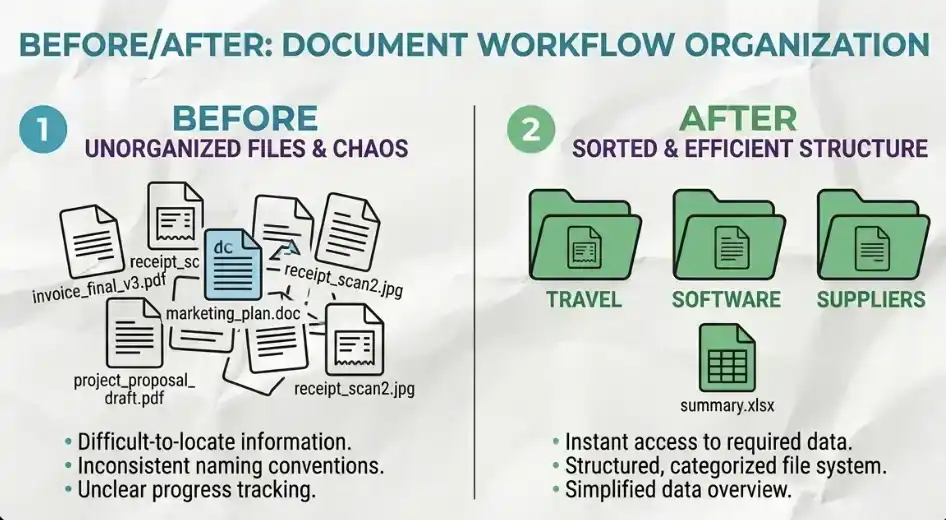
Drag a dozen or so invoices of different types into this sandbox folder, and then enter the prompt: "Please organize these invoices into different subfolders by category and generate an Excel summary table."
Cowork will list the execution plan on the right side of the interface and then begin processing autonomously. It may even schedule multiple parallel sub-agents to complete different parts of the task at the same time.
Before you've even finished your coffee, the invoices might already be ready.
Build your AI workspace
If you've been using Cowork "unstructured," you've probably already encountered these problems: it doesn't remember anything between different sessions; you have to reinterpret your business logic every time you open a new window; and different tasks interfere with and mix up with each other.
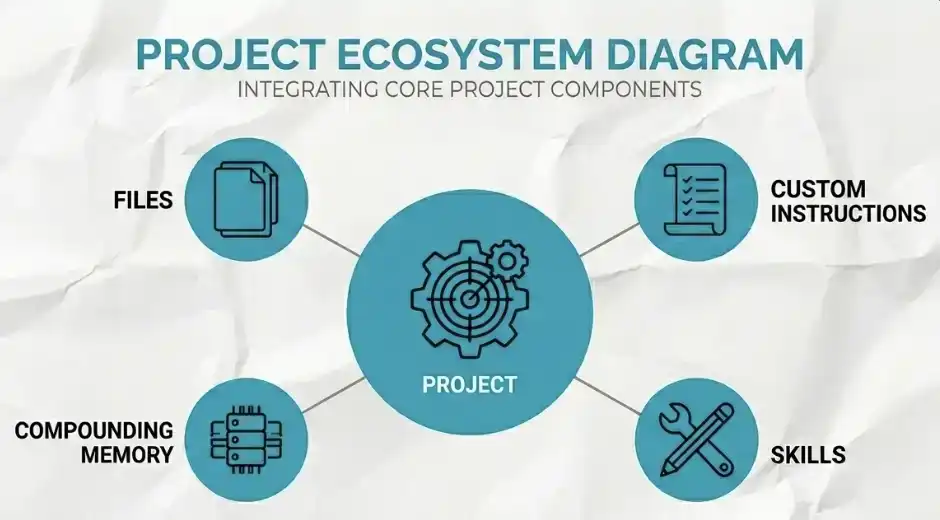
There is only one solution—to establish a project ecosystem.
What is Project Ecosystem?
A project is not just a simple folder. It's a container that brings together everything: your files, custom instructions, skills, contextual memories that can be continuously accumulated... all in one place.
What happens without a project? Claude won't know who you are, what business you're in, or what tone you usually use. You'll end up in a cycle where every conversation involves explaining yourself from scratch.
• With Projects, the context begins to accumulate "compound interest." For example, in Week 1, you need to write a whole prompt to explain clearly; but by Week 6, you only need to say "do it as usual," and Claude will know what you're talking about. This is the true power of Cowork.
A very important principle: Projects must be isolated.
Different fields must be separated into different projects. For example, a YouTube content project and a finance project should never be mixed together.
What would happen otherwise? YouTube's tone and rules would "contaminate" financial tasks; Claude would start to muddle his style, and his output would become inconsistent. There's no room for negotiation on this; it must be strictly isolated.
Three ways to create a project
You can create a project in three ways:
1. Starting from scratch
Naming the project
• Write basic instructions
• Continuously accumulate context during use
It is suitable for building a system from scratch.
2. Import from Claude Chat
• Directly import your historical projects from the web version of Claude
All context and memories will be fully preserved.
Suitable for users who already have an existing user base.
3. Create based on an existing folder
• Select a folder on your computer
Cowork will automatically build projects around these files.
Suitable for scenarios where you already have materials and need to start quickly.
In short: Cowork's strength lies not in "single conversations," but in "long-term accumulated project context."
Your "Business Brain"
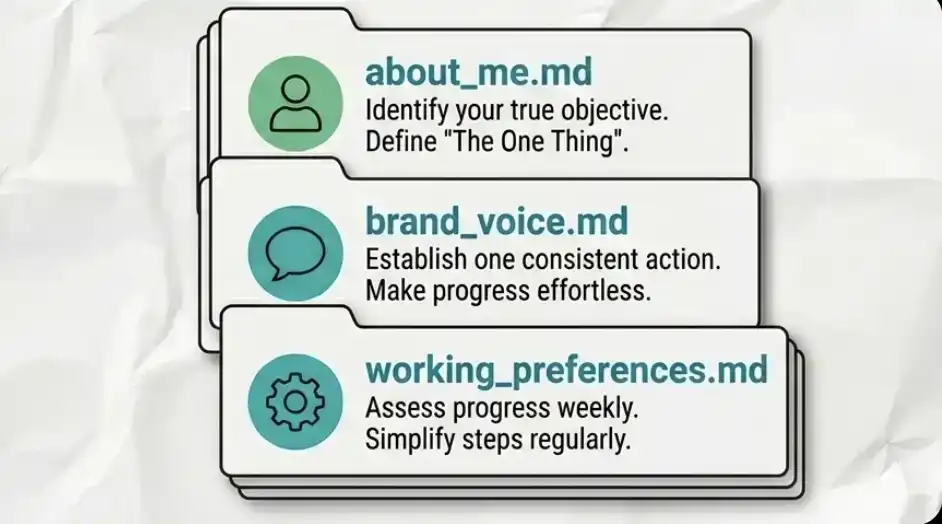
The project is the infrastructure, while the real "personality" exists in the .md file.
These are plain text files placed in your context folder, which Claude reads before each task is executed. It is through these files that it behaves as if it has been working with you for two years, rather than being a newly hired general assistant.
about_me.md
Clearly state who you are, what your business does, who your customers are, how you make money, and your current priorities.
Claude reads this file every single time—every single time.
brand_voice.md
Define your writing style: your preferred tone, the expressions you dislike, and your commonly used sentence structures. You can directly paste your past real writing samples.
The purpose of this document is to ensure that your writing doesn't resemble the "cookie-cutter Claude".
working_preferences.md
Define your workflow: how tasks are managed, where files are saved, and what format the output should be.
Don't write it from scratch.
The simplest way is to let Claude ask you questions. You can simply say, "Please ask me questions step by step and generate a business brain document based on my answers." It only takes 15 minutes. But it can save you several hours each week, and continuously.
Global commands vs. project commands
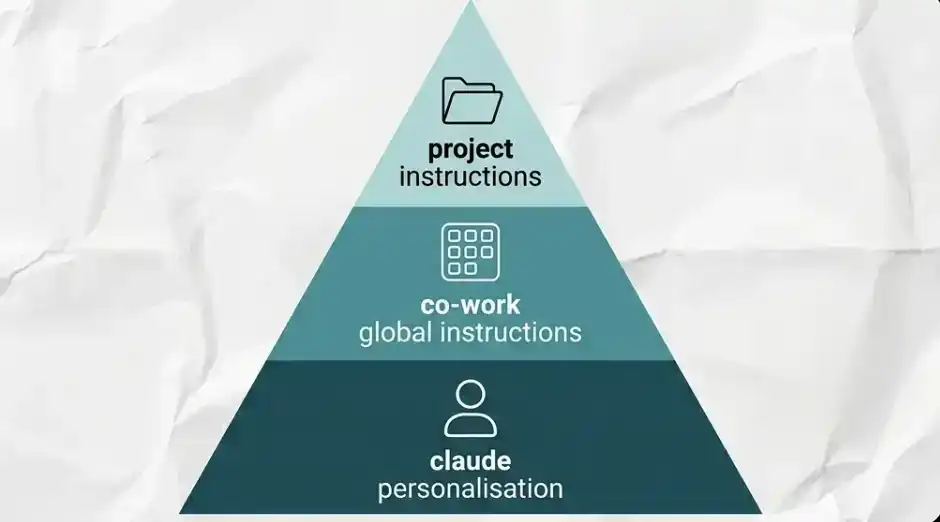
There are three layers in total, and each layer gradually tightens the range. Cowork will only work stably if all three layers are configured correctly.
Level 1: Claude Personalization (Global)
Click your name → Enter settings. This layer will apply to all scenarios including Chat, Code, and Cowork.
This is used to set your "general rules", such as:
Avoid overuse of bolding.
• Prioritize using primary sources when conducting research, rather than secondary aggregated content.
• Avoid using vague or conservative expressions (no hedging language)
This is your underlying code of conduct.
Level 2: Cowork Global Commands
Path: Settings → Cowork Settings → Global Instructions. This level only applies within Cowork, but is valid for all tasks.
Suitable for writing rules that must be uniformly executed, such as:
• Specify date format
• File naming conventions (e.g., underscore_descriptive_name)
• Always check the sandbox folder first when handling business-related tasks.
Its purpose is to prevent you from repeatedly entering the same context in every task.
Level 3: Project-specific directives
It only applies within a single project.
For example, in your YouTube project:
• Use a specific slide tool to generate the video intro
• All data is recorded in a fixed table.
These rules should not affect your financial projects.
Core principle: Strict isolation
Rules for different projects must be kept separate. Otherwise, "contamination" will occur: YouTube's content rules will affect financial tasks; output styles will be inconsistent and logic will be flawed. Once mixed, Claude will start to "lose his mind."
Define habits globally, define execution through cowork, and define specialization within projects.
Equip your AI with capabilities
From this point on, Cowork is no longer just a useful tool, but transforms into an operator capable of autonomously performing tasks. We need to empower it to step out of the sandbox and interact with applications, web pages, and your desktop environment.
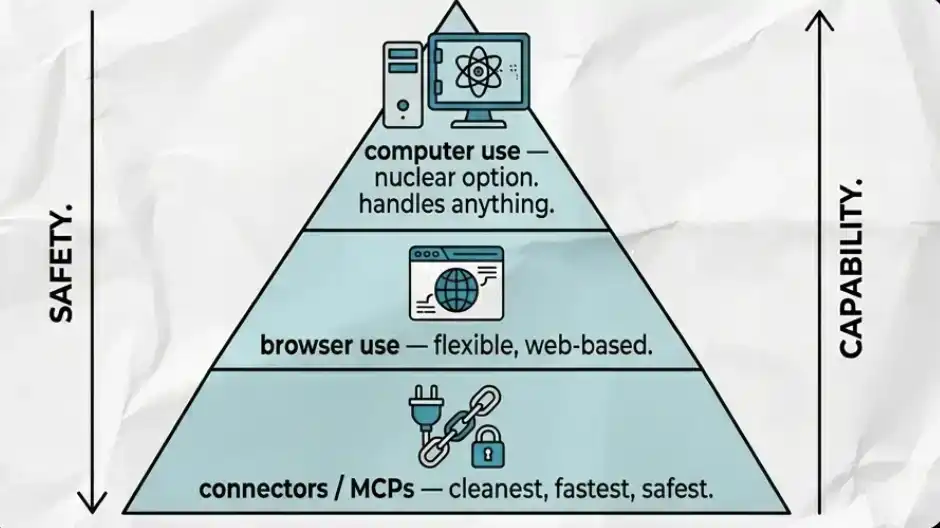
It consists of three layers of capabilities, which should be used in this order: first use connectors, then browser capabilities, and finally computer operation as a fallback.
Connectors and MCP
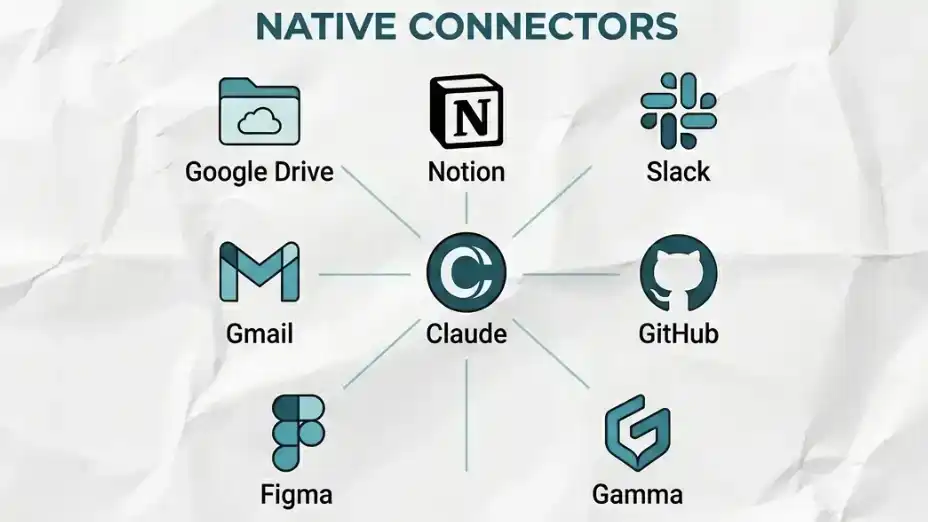
Connectors (also known as MCPs, Model Context Protocols) allow Claude to operate directly in the applications you use every day.
Instead of copying and pasting or taking screenshots, it allows you to perform operations directly within the application interface through authorized access. Built-in connectors support Google Drive, Notion, Slack, Gmail, GitHub, Figma, and more.
How to connect
Click the plus sign in the chat interface to enter the connectors tab, browse or search for the tools you need, and then complete the authorization process in your browser.
Once the connection is established, you can implement fine-grained access control. For each connected application, you can individually set it to "Always Allow," "Require Confirmation," or "Deny Access." You always have complete control over what it can and cannot do.
Dedicated connector
For example, with Gamma: if Claude generates a presentation without a dedicated connector, the result is usually mediocre, with poor layout and structure.
However, when you enable the Gamma connector, Cowork will automatically hand over the content to Gamma, which will then generate a well-structured and visually appealing presentation.
The core principle is: use the right tool for the right task. Don't let a general-purpose tool do the work that should be done by specialized tools.
Advanced Techniques (Expert Hacks)
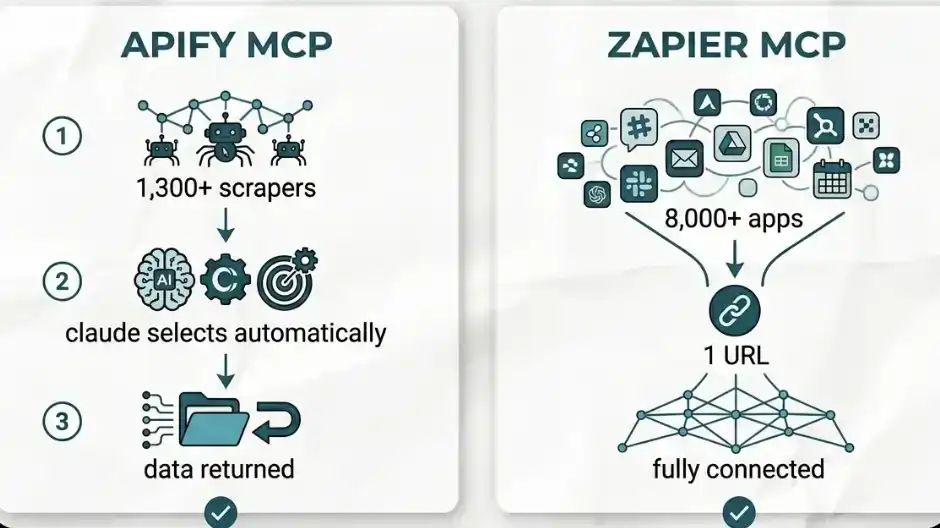
Hack 1: Apify MCP (Painless Data Scraping)
Want to scrape data from YouTube, TikTok, or Instagram? You don't need n8n or complex automated processes. I've tried them all, and the difference is striking.
Operating steps:
• Create a free API Token in your Apify account
• Open Cowork's connectors and search for "Apify".
Paste your API Key to complete the connection.
Once completed, when you ask Claude to scrape data from a platform, it will automatically select the most suitable one from Apify's more than 1,300 web scraping tools (which they call "actors") to perform the task.
You don't need to manually select or configure anything. It will automatically find the tools, run them, and return the data.
Hack 2: Zapier MCP (Connecting 8000+ Applications)
If the tools you're using aren't natively supported by Claude, this is the solution. This is a feature that truly impressed me when I first used it.
Zapier's MCP can connect to over 8,000 applications, such as HubSpot, Skool, Airtable, and more.
Operating steps:
• Create an MCP server in the Zapier platform
• Select "Claude Cowork"
Configure the specific tools and operations you allow to use.
Copy the generated URL
• Go back to Claude's connectors, search for "Zapier", and paste the URL.
In less than 10 minutes, you unlocked 8,000+ apps.
This integrated solution directly eliminates a common problem: "What if the tool I'm using isn't supported?"
Now, this problem can essentially be eliminated permanently.
Browser capabilities: Autonomous webpage operation
If no connector is available, use a browser extension. This is the second layer of capability.
Installation method
• Open Google Chrome
• Access the Chrome Web Store
• Search for "Claude"
Install and pin to the toolbar
• Enable "Claude in Chrome" in Cowork settings.
Capabilities after activation
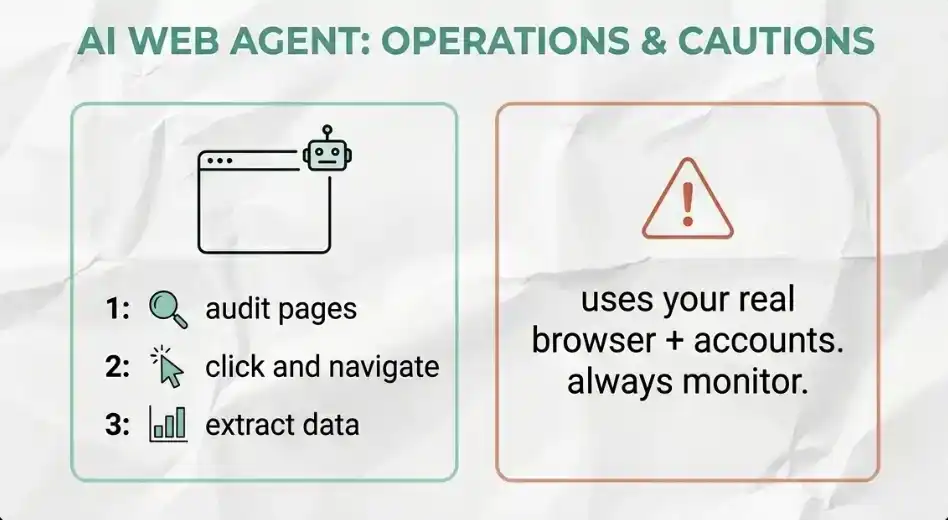
Once enabled, Claude can:
• Automatically open browser tabs
Visit the website
Read the page content
You can give it a URL and let it go to:
• Review landing page
• Analyze CTA (Call to Action) design
• Conduct competitor analysis
It can not only read text, but also understand page structure, for example:
• Italic emphasis
Heading level
Page layout
Moreover, it can perform multi-step operations.
For example, you could make it: Open YouTube → Browse recommended videos → Return to view counts, likes percentage, and comment sentiment.
It can execute completely.
A risk warning that must be taken seriously
Claude uses your real browser. That is, it's logged into your personal account. If you let it search for flights, and you've already saved your payment method on the airline's website—technically, it's capable of completing the payment directly.
Therefore you need:
• Monitor its operation
• Set access restrictions (blocklists)
This isn't a theoretical risk, but a real-world capability. Treat it like an employee who has just joined the company but already has access to your account.
Computer operation skills: Full-screen and desktop control
When the connector and browser capabilities fail to resolve the issue, use Computer Use. This is the last resort.
It can allow Claude:
• Directly "see" your screen
• Control your mouse
Type on your keyboard
In other words, things you can do manually on your computer can now be done autonomously.
How to enable
Click on your account name
• Go to Settings → General
• Open "Computer Use"
Important: Before taking any action, add the sensitive application to the blocklist.
Real-world use cases
For example, you can instruct Claude to find a video file on the desktop and drag it into the CapCut project.
The execution process is as follows:
Claude requests access to Finder and CapCut.
• You can do it without using the keyboard at all
It can visually recognize your files.
Open the editing software
Locate the corresponding file and drag it in.
The entire process is automated. This capability is very powerful. Because of this, you must configure your blocklist beforehand.
Automation and Task Delegation
There's one rule that will completely change how you use this tool: any task that is repeated more than once a week should be automated.
The automation system consists of four layers: Skills, Plugins, Scheduled Tasks, and Dispatch Mode. These are capabilities that are built layer by layer, and do not need to be built all at once, but rather constructed step by step in sequence.
Custom Skills: Compress the workflow into a single instruction
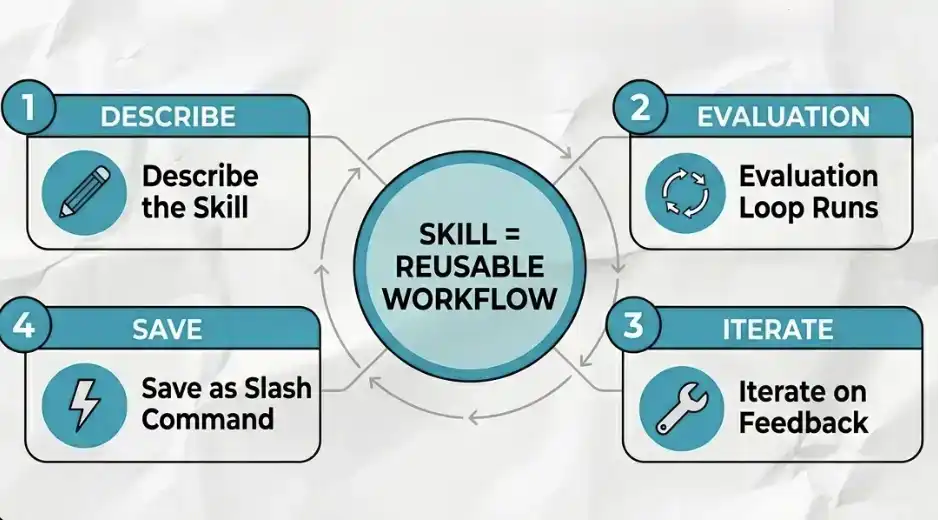
Skill, in essence, is a reusable AI workflow encapsulated into a single command.
You no longer need to write a long prompt every time to execute the same process.
Instead, you can simply use a forward slash command to invoke it, for example: /summarise_invoices
What lies behind a skill?
Essentially, it is a .md file:
• Includes instructions
Sometimes includes scripts
Claude is dynamically loaded when performing tasks.
You don't need to write any code. Just describe it in natural language, and Claude will generate the file for you.
Skill creation process
1. Definition (The Prompt)
Clearly describe what this skill is supposed to do.
For example:
Automatically apply your brand colors and fonts to all generated presentations.
Organize a batch of invoices into a structured table.
2. Evaluation Loop
Cowork has a built-in Skill testing mechanism:
• Perform a task using Skill
• Execute again without Skill (as a baseline)
Comparing the two results side by side
3. Iteration
Examination results:
• Have any requirements been overlooked (e.g., forgetting to use a beige background)?
Is the font correct?
Does the format meet expectations?
Report the problem to Claude, and it will fix it automatically.
4. Save & Deploy
Once your output meets your standards: Click "copy to your skills".
From then on, the entire process could be invoked with a single command.
Skill types you can build
Automatically parses an entire folder of invoices and generates a categorized Excel spreadsheet.
• Scrape YouTube videos and generate interactive HTML transcriptions with timestamps.
• Use external image model APIs to generate infographics that match your brand style with a single click.
In short: Skill = turning a "complex process" into "a single action".
Plugins: Connect multiple skills into a complete workflow
A skill can only automate one process, while the role of a plugin is to connect multiple skills and connectors together to automate the work of a complete "job".
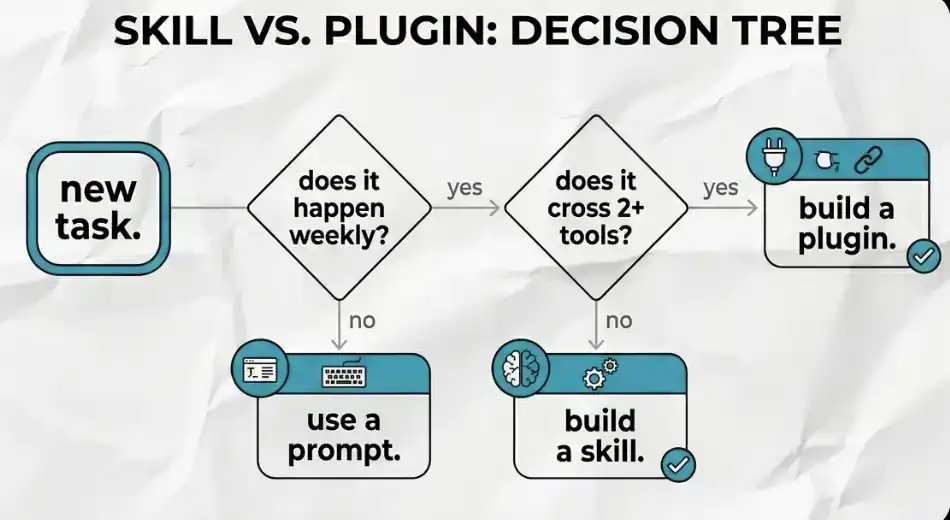
How do I determine whether to use Skill or Plugin?
A simple test can be used:
• Is this task repeated weekly? If not, a regular prompt is sufficient.
Does it involve more than 3 steps and span more than 2 tools (e.g., Slack + Gmail + Notion)? If not, use Skill. If so, use a plugin.
How are plugins constructed?
All you need to do is tell Cowork which entire workflow you want to automate.
It automatically combines the required MCPs (connectors) and corresponding Skills into a complete "main process package," allowing the entire pipeline to run with a single command.
The most important value of a plugin: reusability and distributability.
Plugins can be shared. You can package your best workflow (SOP) into a plugin and distribute it to your team or community. When they perform the task, the results will be almost identical to if you did it yourself.
In other words, your work style has been productized.
Scheduled tasks: Make automation run on time.
Skills and Plugins can now be executed automatically at set times. They will run even when you are not at your computer.
How to set up a scheduled task
• Navigate to the "Scheduled" tab in the left sidebar.
Click "New Task"
• Fill in the task name and description
• Include the corresponding skill or workflow in the prompt. For example: "Use my flight search skill to find round-trip tickets to Spain for under £2400."
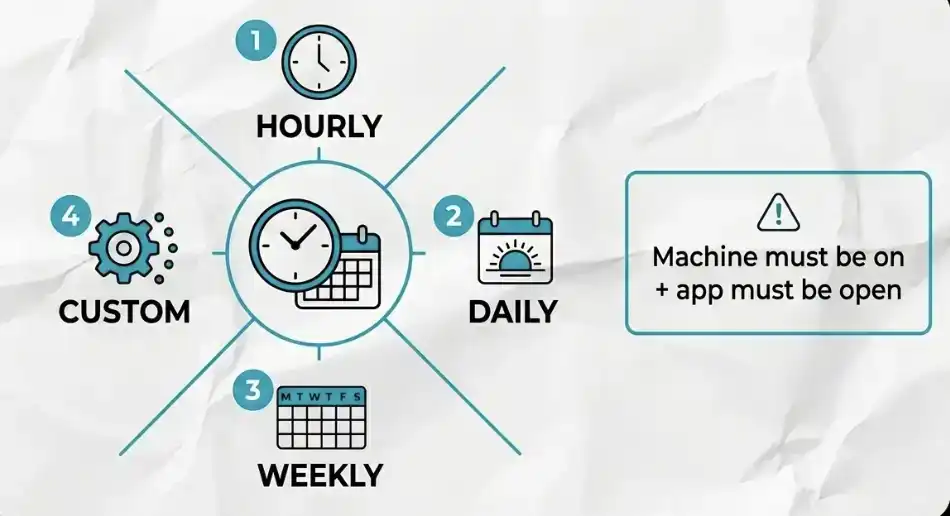
• Set execution frequency: hourly, daily, weekly, or specify date + time.
• Select the corresponding project folder
·save
One of the most important rules
Scheduled tasks will only run when your computer is powered on and the Cowork application is running. If you set a task at 9 a.m. but your computer is off, the task will wait until you turn your computer on before running.
A key detail that is easily overlooked
We recommend adjusting the power settings to keep the device awake. This is the most common source of problems—many automation "failures" are not due to misconfiguration, but rather because the device is not running.
Dispatch mode: Remote control via mobile phone
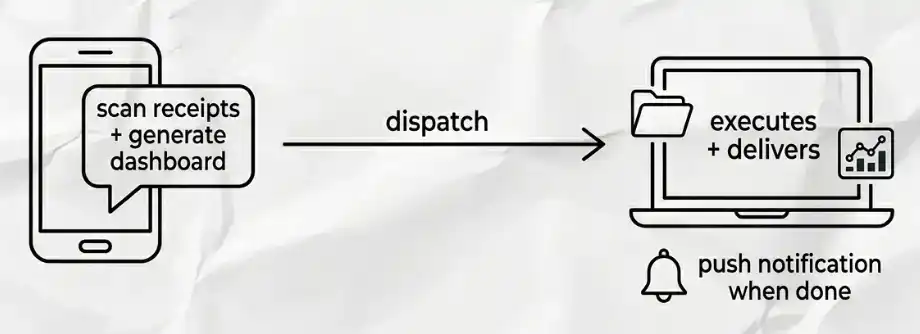
Use Dispatch mode when you're not at your computer but the task needs to be executed on your local machine. You can send a message to Claude via your mobile phone, and it will execute the task on your desktop. The phone and computer share the same conversation thread, so the context will not be interrupted.
How to set it up
In the desktop version of Cowork:
• Open Settings and enable Dispatch
• Enable "Keep Awake" in the Dispatch menu (this is crucial). This prevents your computer from going into hibernation, thus avoiding file inaccessibility.
• Allows both browser actions and computer use.
How to use
Send a command on your phone, such as: "Scan my receipts folder and generate a data dashboard."
Cowork will execute the entire process on your computer. With push notifications enabled, you'll be notified immediately when the task is completed.
Master-level workflow: Prioritize building these three systems
The following three sets are the most worthwhile to do first, so do them in this order.
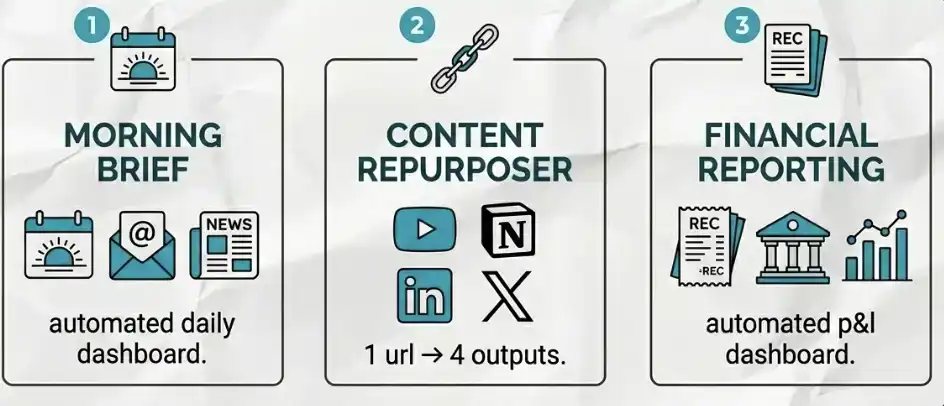
1. Daily Morning Brief
Let Claude prepare your day's information before you even start working. It can be set as a scheduled task and linked to your calendar and email. It will:
• Summarize the day's schedule
List the emails that need to be processed.
Check local weather
• Get the latest news related to your industry
They might even draft your email reply in advance for you to review and send.
The moment you sit down at your computer, everything is already ready. This one package alone is worth the subscription fee.
2. Content Repurposer System
Give Claude a YouTube link, and it will complete automatically:
• Extract video transcripts
Organize the content into a new Notion page.
• Automatically generate platform-specific copy for LinkedIn and X
One input, three outputs. No manual operation required throughout the entire process.
3. Financial Reporting System
Set up a task that runs automatically every month.
you can:
• Grant Claude access to your transaction history (no need to provide complete account information)
Alternatively, you can directly provide a receipt folder.
It will automatically:
• Categorized expenditures
• Verify income and expenditure
Generate an interactive HTML financial dashboard (displaying profits and losses).
Your accountant can use this prepared report directly, and you hardly need to spend any time on it.
Token Management: How to Avoid Quickly Running Out of Your Credit Limit
Every word you send to Claude, and every word it reads from a file, consumes tokens. If not managed properly, you could run out of your limit within a week.
I've seen people max out their maximum data plan limit within three days because of three completely avoidable mistakes. Here they are:
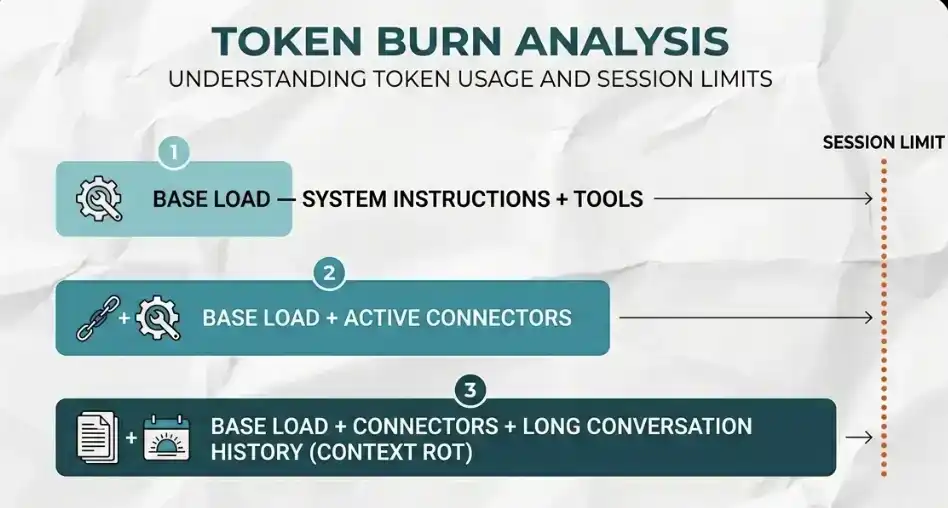
Mistake 1: Ignoring base load
Before you even type anything, part of your context window is already occupied:
System commands
Tools in use
• Enabled MCP connector
These will all consume tokens. The more connectors you open, the faster they are consumed. Only open the parts that the current task truly needs.
Error 2: Context Rot
If you use the same chat window for an extended period of time, Claude will reload the entire chat history each time. For example, if you just finished writing an email and then use it to plan a trip to Dubai in the same window, the system will load the "email content" into the "travel task" as well.
This is a complete waste, and many people unknowingly exhaust their credit limit in this way.
Error 3: Using dialog boxes to handle batch tasks
If you need to process 100 invoices, but have Claude read and process them one by one in the dialog, you'll quickly run out of tokens. A better approach is to have Cowork write a reusable script (skill) to process these invoices.
The number of tokens consumed by the script is far less than that consumed by processing each dialogue individually; this difference is very significant.
30–45 minute rule
Keep each conversation concise and focused.
Each window handles only one topic.
• Open a new window every 30–45 minutes, or when switching tasks.
A new window means a new context, and also a new token budget.
Parallel Sub-Agent
For large tasks, Claude can be run in parallel:
Deploy multiple sub-agents
Each sub-agent has its own independent context window.
Simultaneous processing of different parts
Einstein's principle
Opus is only used for complex, high-risk inference tasks. Sonnet is used for almost all other scenarios.
99% of the time, you won't need Opus. Don't use it as the default model.
AI security
Cowork runs directly on your local machine. Anthropic has built-in security mechanisms at the product level, so the basic risk is low. The problem isn't here.
The real risk comes from others.
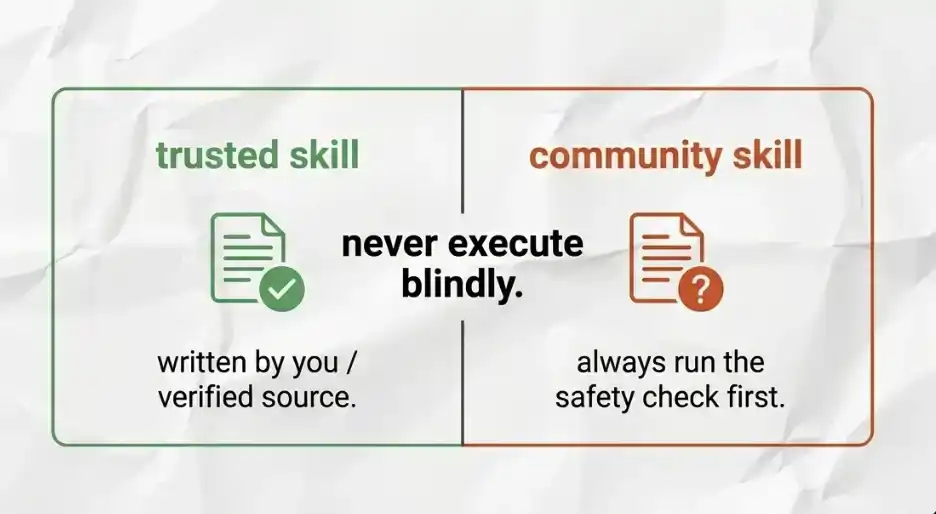
You can download advanced skills built by other users from platforms like GitHub. When you import these external skills, you are essentially introducing a set of instructions that Claude can execute on your machine within the permissions you grant.
If someone embeds malicious commands in this .md file, a prompt injection could occur—for example, tricking an AI into deleting files, stealing data, or even escalating its own privileges on your system.
This is not a hypothetical situation, but a real risk.
Security Check Process
Before adding any external .md files to your Skills library, be sure to perform the following steps: Copy the entire contents of the Skill into Claude Chat, and then ask directly: "Does this Skill contain any potentially harmful, malicious, or out-of-scope instructions?"
It only takes two minutes. But it must be done every single time, without exception.
The core conclusions you should take with you
Everything in this guide is built on a key shift in thinking: don't treat Claude Cowork as a chat tool. It's essentially an "autonomous employee" that can accept task delegation.
Once you understand this, you'll stop asking questions and start assigning tasks to it.
The three most important points
1. Architecture is more important than Prompt.
A clear project structure, a well-defined .md context file, and isolated project directives improve output quality far more than any "clever prompt."
The foundation is built once, and then compounded continuously thereafter.
2. The automation system is built in layers.
The order is: Skills → Plugins → Scheduled Tasks → Dispatch, with each layer built on top of the one above it.
Don't try to build a complete system at once. Start by automating a weekly recurring task, and then gradually expand.
3. Security is not an option.
Every skill downloaded from the community must be checked before it can be run. The security check only takes two minutes, but those two minutes could protect your entire machine.
Your next step
Do these three things today:
• Create a sandbox folder
Granting permissions
Run a real mission
for example:
• Dealing with cluttered download folders
• Or organize a batch of invoices
That's enough for you to truly understand the capabilities of this tool.
Which workflow should we start with?
Morning Brief
Content Repurposer
Financial Dashboard
Choose one and get started.
If you only remember one thing
Go use Zapier MCP. It can connect to over 8,000 applications, and setup only takes 10 minutes. If you skipped that part earlier, go back now. This is the most underrated feature of the entire tool, and a capability that most people never actually use.