Original article | Odaily Odaily( @OdailyChina )
Author | Asher ( @Asher_0210 )

Last night, US President Trump issued an ultimatum to Iran, stating that "the entire civilization will perish tonight," and hinted at possible military action before Tuesday. However, just as the market held its breath in anticipation, he suddenly announced today that he would suspend bombings and attacks on Iran for two weeks.
This unexpected turn of events instantly ignited the entire crypto market, ushering in a long-awaited significant rebound.
OKX market data shows that in the early hours of today, BTC rose from $67,700 to above $72,000, a 24-hour increase of 4.01%; ETH also rose from $2,060 to above $2,270, a 24-hour increase of 6.03%; and SOL rose from $78 to $87, a 24-hour increase of 5.92%.
According to Coinglass data , $530 million in positions were liquidated in the past 12 hours, including $402 million in short positions and $129 million in long positions; in addition, nearly 120,000 people were liquidated in the past 24 hours.
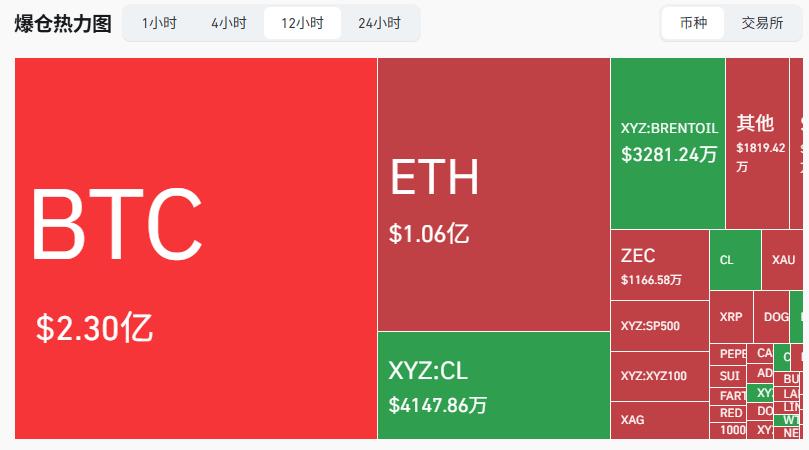
Aside from the brief easing of tensions between the US and Iran, what other hidden variables have truly ignited the market? After the surge, is the crypto market a turning point or just a flash in the pan? Odaily Odaily will break it down one by one in this article, helping you understand this silent battle of emotions and capital.
The window for a ceasefire between the US and Iran is short and the conditions are unlikely to be met, making any subsequent resurgence of tensions difficult.
Although the US-Iran ceasefire officially took effect at 8:00 AM Beijing time today, and Pakistani Prime Minister Sheikh Sharif has invited representatives from both sides to Islamabad for negotiations, the market remains skeptical about its sustainability. The ceasefire conditions announced by Iran's Supreme National Security Council are extremely stringent, including controlled passage through the Strait of Hormuz under Iranian leadership, the withdrawal of US troops from all bases in the region, the lifting of all sanctions and the unfreezing of overseas assets, full reparations for war losses, and final confirmation by a UN Security Council resolution. Iran has also expressed "complete distrust" of the US, emphasizing that it will not negotiate under threats or deadlines.
Trump's repeated threats of deadlines followed by suspensions or extensions have kept markets highly wary of a genuine ceasefire. Furthermore, The Times of Israel reported on the 8th, citing a security official, that despite the ceasefire announced by the US and Iran, Israel "continues to strike Iran," leaving significant uncertainty in the region.
In the short term, the rebound in the crypto market is mainly driven by short squeezes and a momentary recovery in risk appetite, rather than trend confirmation. Market skepticism is evident, with frequent comments on the X platform suggesting that "the ceasefire won't last 24 hours" and that it's "just a word game." If negotiations fail within the two-week window, or if risks such as missile attacks or Israeli military action occur, the conflict could escalate again at any time.
Therefore, this morning's rebound is more like an event-driven, temporary recovery than a confirmation of a bottom.
Bitcoin ETF Funds Rebound: Prices Stabilized in March, Net Inflows Continued in April
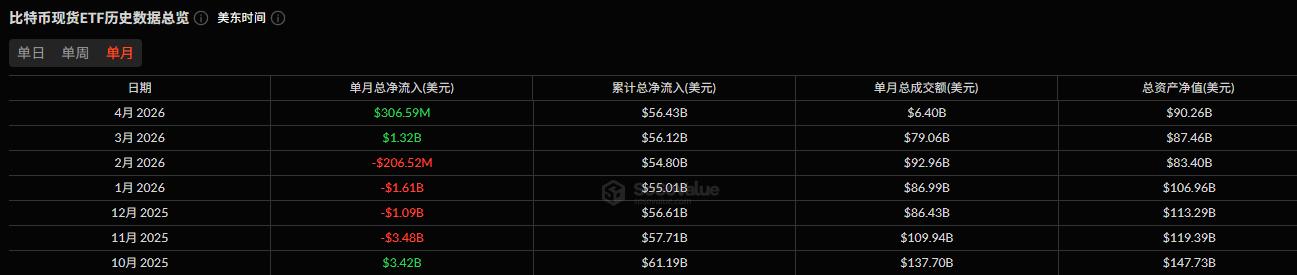
According to SoSoValue data, Bitcoin spot ETFs have shown a clear divergence since 2026.
From January to February, Bitcoin spot ETFs experienced continuous outflows, with net outflows of approximately $1.6 billion in January and approximately $206 million in February, indicating significant pressure on the crypto market at the beginning of the year. However, in March, Bitcoin spot ETFs saw a strong rebound, with a net inflow of $1.32 billion in a single month. This not only ended the previous four-month outflow trend but also marked the first positive monthly inflow in 2026, and the first monthly positive inflow since October 2025.
Entering April, Bitcoin spot ETFs continued their net inflow trend. On April 6th, the net inflow reached $471 million , the highest single-day inflow since February 25th, and also the sixth largest single-day inflow in 2026. Specifically, BlackRock's IBIT led the way with a net inflow of approximately $182 million, followed by Fidelity FBTC with approximately $147 million, and ARK 21Shares ARKB with approximately $119 million. Most other ETFs recorded positive inflows or remained flat.
Eric Balchunas, a senior ETF analyst at Bloomberg, wrote on the X platform that U.S. baby boomer investors have quietly poured a lot of money into Bitcoin spot ETFs amid a stressful market environment and frequent macroeconomic headwinds. This inflow has, to some extent, filled the funding gap since the beginning of the year.
Outlook for Cryptocurrency Market
Bloomberg analysts: Unless Bitcoin can recover to $75,000, the risk of it falling to lower levels remains.
Bloomberg analyst Mike McGlone said that unless Bitcoin can recover to $75,000, the risk of falling to lower levels remains; if the current price cannot hold above $70,000, it will face a new round of downward pressure after short-term holders lose confidence.
Glassnode: Bitcoin faces resistance at $72,000; if momentum weakens, the downside risk is higher.
Glassnode states that Bitcoin currently faces resistance around $72,000, while support is relatively weak. If upward momentum weakens, the price could still fall. Furthermore, the rebound momentum has improved, spot demand has stabilized, and selling pressure at a loss has significantly decreased. However, participation remains weak across exchanges, ETFs, and on-chain metrics, indicating that market confidence has not yet fully recovered.
Analyst Wedson: Bitcoin may fall to the $54,000 range within the next 5 months.
Crypto market analyst Wedson stated that Bitcoin's 720-day Tactical Bull-Bear Sentiment Index has fallen into extremely bearish territory, indicating that prolonged market fear may be nearing its end. Historically, low levels of this indicator have often been accompanied by a so-called "shakeout," after which Bitcoin enters a more robust rebound phase. For example, in 2022, when this indicator was at a low level, Bitcoin fell by more than 20%; in a similar situation in 2018, Bitcoin fell by about 50%.
Wedson warned that Bitcoin could experience a sharp drop of around $15,000 over the next five months, meaning BTC could fall from its current price to the $54,000 price range. Therefore, $50,000–$55,000 could be a key support level for Bitcoin. However, Strategy's recent large Bitcoin purchases have absorbed some selling pressure, potentially limiting downside and making an extreme bearish scenario less likely.
Arthur Hayes: Bitcoin may fall below $60,000 before rising to $250,000.
Arthur Hayes stated on the Coin Stories podcast that he will not put his last dollar into Bitcoin at the moment because the Federal Reserve has not yet been forced to expand liquidity, and believes that tariff policies will lead to inflation and may prompt the United States to move towards capital controls, which would be a huge liquidity catalyst for Bitcoin.
Arthur Hayes maintains his long-term price target for Bitcoin in this cycle between $250,000 and $750,000, but warns that Bitcoin could fall below $60,000 in the short term if the US-Iran conflict continues.
Greeks.live: The market is starting to desensitize to Trump; there's little consensus, and everyone is waiting.
Greeks.live stated that the market is beginning to desensitize to Trump, and Bitcoin's implied volatility has decreased significantly compared to last week. Although Trump will definitely make statements that affect the market, no matter what he says, even if he says he will send ground troops tomorrow, it will not deviate from market expectations. Currently, the changes in Skew and trading volume distribution are quite scattered, and the market has no consensus; everyone is waiting.