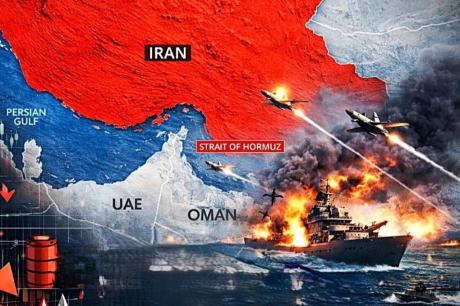
 Iran is requiring oil tankers passing through the Strait of Hormuz to pay in cryptocurrency. Hamid Hosseini, spokesman for Iran's Union of Oil, Gas and Petrochemical Exporters, recently specifically mentioned Bitcoin (BTC) in a statement.
However, Chainalysis argues that stablecoins are a more suitable payment tool, similar to how Iran's Islamic Revolutionary Guard Corps (IRGC) has used them to circulate money in the past.
Stablecoins fit Iran's strategy.
Chainalysis argues that stablecoins, not BTC , are more likely to be used by the IRGC to collect fees. The company points out that the Iranian authorities have long had a tendency to use USD- Peg Token in illicit commercial activities.
The reason is quite clear: USD- Peg stablecoins help preserve value , something Bitcoin cannot guarantee. The Iranian rial has depreciated sharply against the USD, making price stability a key factor for large-scale revenue streams.
Meanwhile, the frequent price fluctuations of Bitcoin can expose fee revenue to unpredictable losses between the time of collection and conversion.
“The government has leveraged stablecoins because being Peg to the USD helps secure value and provides the necessary liquidation for large-scale use,” the report states. “In contrast, Bitcoin is frequently volatile in price.”
Chainalysis also stated that the IRGC has previously used stablecoins in various activities such as selling oil, purchasing weapons, and funding proxy forces . Meanwhile, Bitcoin plays a different Vai in Iran's crypto ecosystem.
The report primarily links Bitcoin to Iranian hacker activities, including ransomware campaigns and other malicious activities — a purpose entirely different from collecting large-scale commercial fees.
Billions of dollars are already in operation on-chain.
The current scale of IRGC's crypto operations further strengthens the likelihood that stablecoins will be the primary choice. Chainalysis estimates that wallets linked to the IRGC received over $2 billion in 2024 .
This figure is projected to exceed $3 billion by 2025 , equivalent to approximately half of Iran's entire crypto ecosystem by the fourth quarter.
However, this is only a minimum estimate, as it only includes wallet addresses identified through OFAC sanctions lists and seizures from Israel's National Counterterrorism Financing Agency. The actual network, including "shell" companies and intermediary wallets, is believed to be much larger.
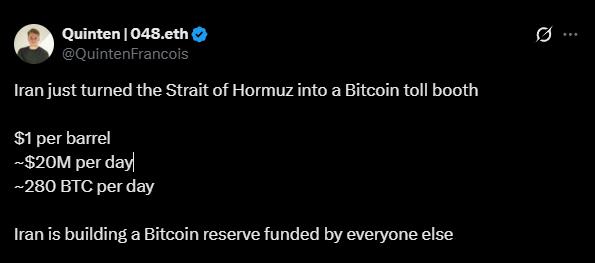
Before the potential disruption, the Strait of Hormuz processed approximately 20 million barrels of oil per day , equivalent to 20% of global seaborne oil traffic . At a fee of just $1 per barrel, even with partial collection, revenue could reach billions of dollars annually . Stablecoins offer the ability to liquidation and process transactions on such a large scale.
"These oil shipments could generate much-needed revenue for the government as it faces its most serious threat in decades," Chainalysis noted.
However, stablecoins also present their own risks for Tehran. Unlike Bitcoin, stablecoin issuers can freeze assets in designated wallets. Chainalysis considers this a critical point of intervention for regulators and law enforcement agencies if a stablecoin-based fee collection model is actually implemented.