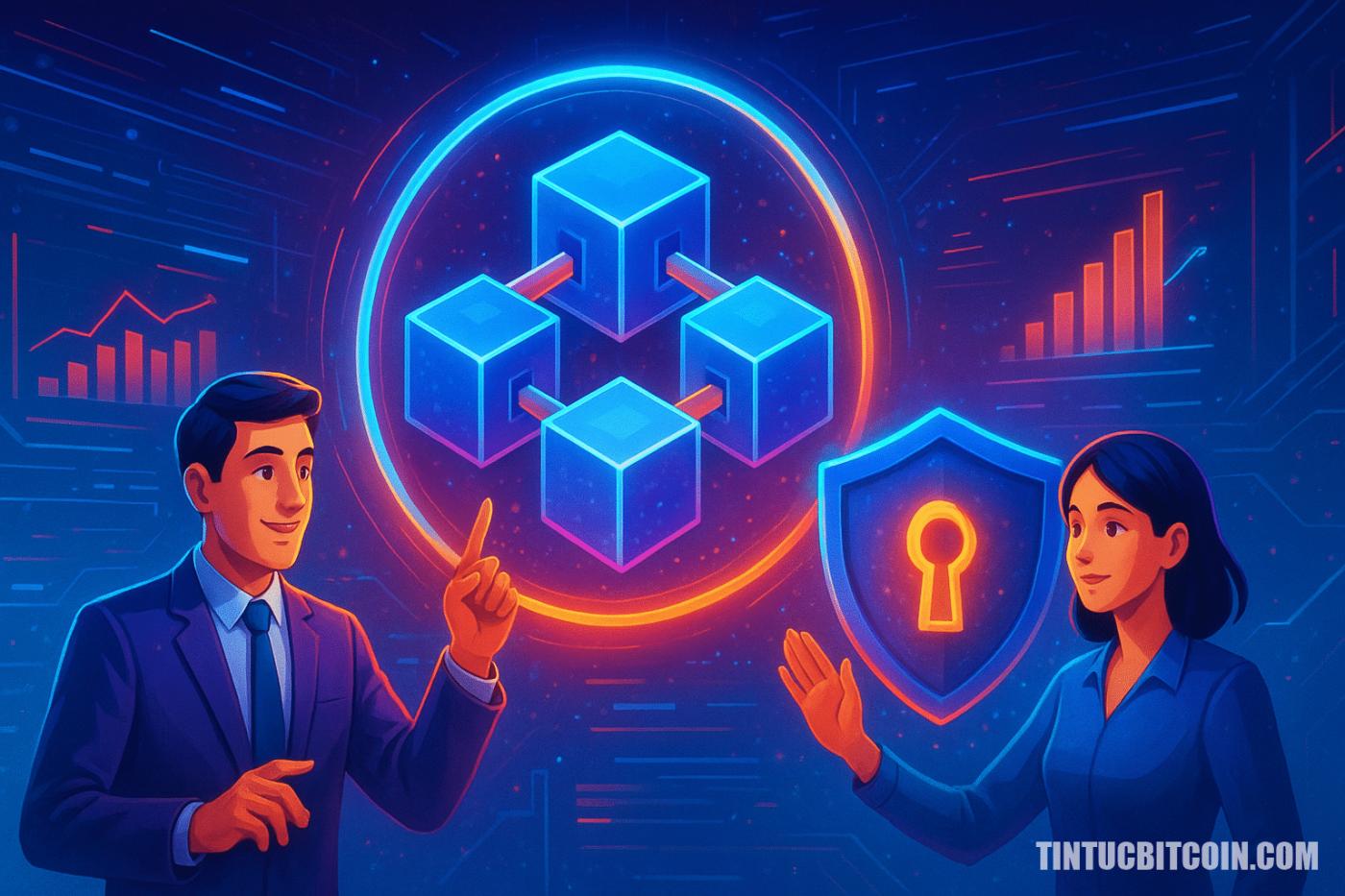
Blockchain is a digital infrastructure that uses cryptography to verify transactions, records data that is virtually immutable, and does not require a third-party intermediary for authentication.
The key to this technology lies not in its anonymity but in its ability to generate independently verifiable proof. Therefore, blockchain is often mentioned when discussing payments, asset tracing, and markets lacking traditional financial infrastructure.
- Blockchain verifies transactions using private keys and cryptographic signatures instead of relying on banks or intermediary organizations.
- This technology does not make transactions invisible; all on-chain data leaves a traceable record.
- Blockchain is useful where there is a lack of financial infrastructure, from property registration to cross-border value transfers.
What can blockchain really do?
Blockchain creates cryptographically verifiable proof of transactions. Once a transaction is signed with a private key, its authenticity is independent of the bank or any other confirming party. Users can prove ownership of a transaction without revealing their full identity.
This value is particularly useful in situations requiring proof of the origin or history of an asset. Instead of relying entirely on paperwork or confirmation from a single organization, on-chain data provides a financial trace that can be verified at any time.
This design also helps blockchain record the long-term history of digital assets. A transaction validated today can still be examined years later, as long as the associated keys and data exist.
Blockchain does not provide financial anonymity.
Blockchain does not erase transaction traces. Each transaction is timed, associated with a cryptographic identifier, and permanently stored on the Distributed Ledger. What can remain private is the real identity behind the wallet address, unless the wallet owner voluntarily reveals it.
This transparency is what sets blockchain apart from cash. While cash is often difficult to trace, on-chain data leaves a much clearer history of money transfers. According to figures presented in Chainalysis' Crypto Crime 2025 report, illegal activity accounted for only 0.14% of total on-chain volume in 2024.
Therefore, understanding blockchain as a tool for "hiding money" is a misconception. It is more suited to the Vai of a transparent tracking system where transactions can be verified without revealing all personal information.
Why is blockchain important for financial infrastructure?
Blockchain is noteworthy because it can expand access to finance where traditional systems are underperforming or non-existent. One example is the Dubai Land Department's blockchain-based real estate registry, where ownership data is recorded as coded entries on a Distributed Ledger.
According to official information cited in the input, the first Tokenize real estate project on this platform, launched in 2025, has attracted 224 investors from 44 nationalities, 70% of whom are first-time participants in the Dubai real estate market. The waiting list for subsequent projects also exceeds 6,000 requests.
On another level, blockchain and cryptocurrencies can help transfer value where there are no bank accounts or traditional payment networks. With over 1.4 billion adults worldwide lacking formal financial accounts, according to the World Bank's Global Findex, the ability to transfer money using only a wallet and mobile connection represents a significant change.
Limitations to consider when evaluating blockchain.
Blockchain doesn't automatically solve all financial problems. It doesn't replace legal mechanisms, eliminate market risk, or erase the need for asset governance. Its strength lies in authentication and traceability, not in concealing information.
Therefore, when evaluating blockchain, it's necessary to clearly distinguish between two layers: what the technology can do technically, and what practical problems users expect it to solve. These two things don't always coincide.
Summary
Blockchain is an infrastructure layer based on cryptographic signatures and a Distributed Ledger, enabling the authentication, recording, and tracing of transactions without the need for an intermediary. Its greatest value lies in its verifiability and scalability in finance, not in anonymity.