This article is machine translated
Show original
I used to be confused about how exactly Long-Term Holders (LTH) and Short-Term Holders (STH) are defined. If you misunderstand the logic behind the data, your analysis can easily become biased or even flat-out wrong.
To get clarity, I had some deep discussions with the Glassnode dev team about the algorithms and definitions for LTH and STH. As far as I know, the Chinese community hasn’t had a thorough breakdown of this topic yet.
Saw @PhyrexNi and @riyuexiaochu chatting about this, so here’s my attempt to explain:
Step 1: To determine the exact threshold for STH vs LTH based on coin age, Glassnode analyzed the slope of the probability curve for UTXOs being spent over various timeframes. Turns out, the coin age with the maximum slope in each sample is exactly 155 days.
Basically, BTC needs to be held for at least 155 days before the probability of it moving again hits its lowest point. So, 155 days is used as the baseline to distinguish LTH from STH.
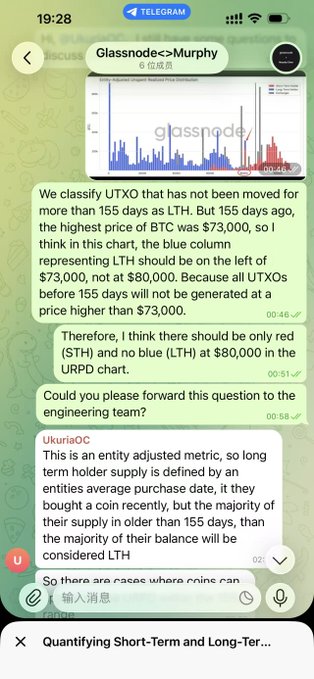
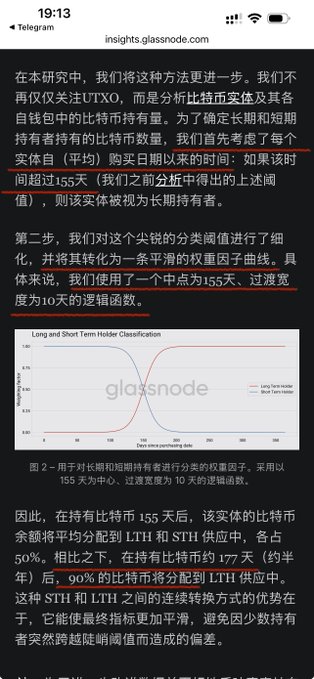
Step 2: On top of that, Glassnode engineers also consider the average holding time for each on-chain entity since their purchase date. If the average is over 155 days, that entity is classified as a long-term holder.
Example: If my wallet has 10 BTC held for 300 days, and I buy another 5 BTC today (held for 1 day), the average holding time is (10*300 + 5*1) ÷ 15 = 200 days. Since 200 > 155, even the 5 BTC I just bought would count as LTH.
Step 3: To refine the sharp threshold and turn it into a smooth weighting curve, Glassnode uses a logistic function with a midpoint at 155 days + a 10-day transition width.
This makes the curve much smoother and avoids sudden jumps. Roughly speaking, after about 177 days of holding, 90% of BTC is classified as LTH supply.
So, in summary, an increase in LTH net position indicates two things:
🚩 1. Old LTHs are accumulating more, as long as the average BTC holding time in their wallets is over 155 days;
🚩 2. STH BTC held for around 177 days gets reclassified as new LTH;
But an increase in LTH net position doesn’t mean LTHs aren’t selling.
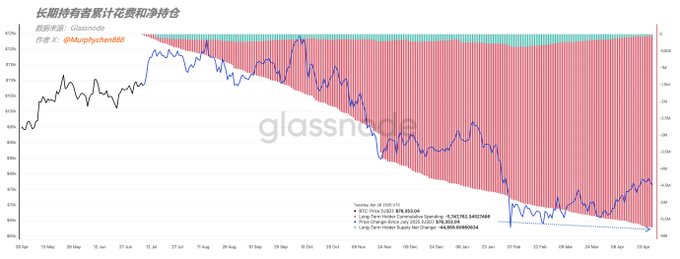
Check out chart 4: Since July 7, 2025, LTHs have spent a cumulative 5.747 million BTC, but their net position only dropped by 44,000 BTC. That means while LTHs are spending, a ton of STHs are holding, which replenishes the LTH supply.
Since February 14, 2026, LTH net position has resumed its upward trend, meaning the combined amount from old LTH accumulation + STHs holding and turning into new LTHs is now greater than LTH spending.
For the market, this means supply-side pressure is easing. Once demand starts ramping up as the macro environment improves, we’ll slowly crawl out of the bear market swamp.

Phyrex
@PhyrexNi
😂😂Let me explain a bit:
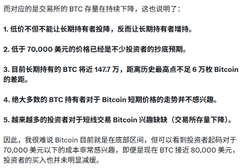
First: Glassnode defines long-term holders as those who haven't moved their coins for 155 days, so from the most basic data perspective, an increase in long-term holders means that the amount of Bitcoin not participating in trading is rising.
In other x.com/riyuexiaochu/s…

The above content, the official text explanation from Glassnode is as follows:
On-chain metrics for short-term and long-term investors:
insights.glassnode.com/sth-lth...…
Quantifying the supply held by short-term and long-term Bitcoin holders:
Sector:

From Twitter
Disclaimer: The content above is only the author's opinion which does not represent any position of Followin, and is not intended as, and shall not be understood or construed as, investment advice from Followin.
Like
Add to Favorites
Comments
Share
Relevant content