Today's top news highlights:
Binance Alpha has listed UnifAI Network (UAI), with an airdrop threshold of 237 points.
The X platform has launched the Cashtags feature on its web version.
CertiK: April crypto security incidents have caused approximately $651 million in losses.
The US Senate passed a resolution banning senators from trading in prediction markets.
Regulation & Macro
U.S. Defense Secretary Pete Hegseth confirmed that the United States is conducting a secret operation to gain a strategic advantage over other countries in Bitcoin. He stated that he is a long-time and enthusiastic supporter of Bitcoin's potential.
US government officials: "Hostile operations that began on February 28 have ended."
A senior U.S. government official said that, under the War Powers Act, "hostile action that began on February 28 has ended."
CMU, the Hong Kong Monetary Authority's (HKMA) Central Moneymarkets Unit (CMU) responsible for operating debt instruments, plans to establish a digital asset platform by 2026 to support the issuance and settlement of digital bonds, and gradually expand to other digital assets, as well as connect with other tokenized platforms in the region. Furthermore, CMU plans to launch a new platform in 2027 to enhance system processing capabilities and provide more comprehensive collateral management and liquidity management functions.
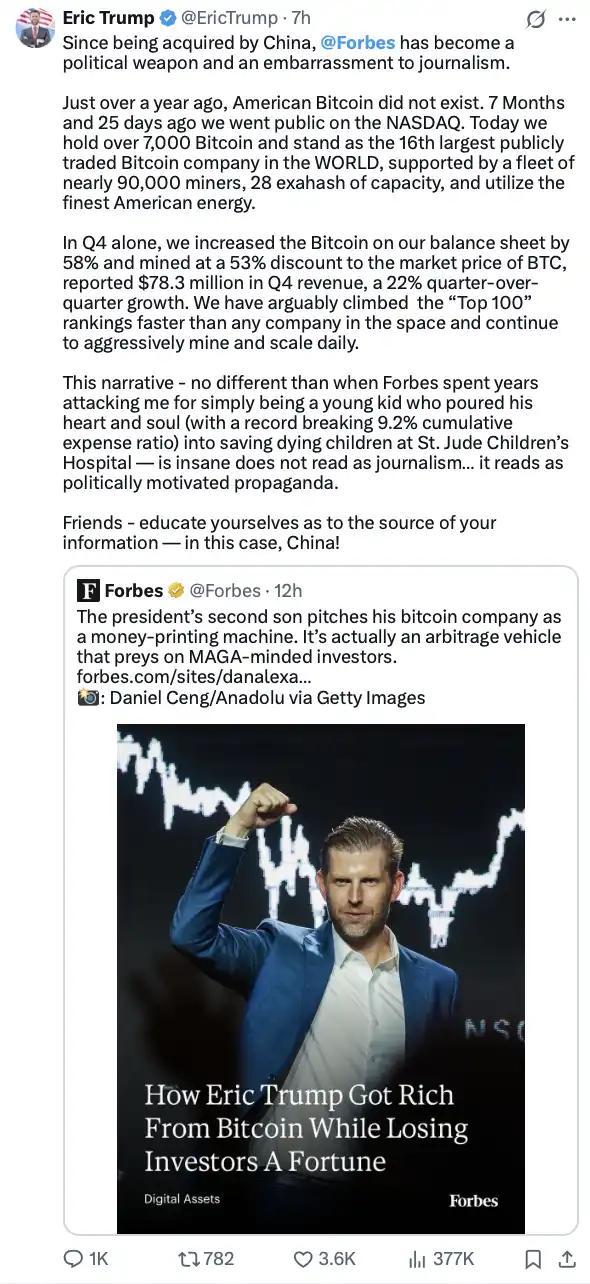
The U.S. crypto market structure bill is gaining momentum in the Senate Banking Committee, with lawmakers aiming for hearings in mid-May. Several controversies remain unresolved, including how stablecoin yields should be handled, ethical provisions, and how to address President Trump's crypto interests. Senator Thom Tillis has asked Committee Chairman Tim Scott to advance the process but stated he will oppose the bill if it lacks ethical provisions. Senator Angela Alsobrooks emphasized that illicit finance and ethical issues must be addressed to secure bipartisan approval. Committee Chairman Scott described the bill as being in the "red zone," hoping for bipartisan consideration in May and a Senate vote in June or July. Industry insiders estimate the bill's chances of passing to be only 15% to 25%, while Galaxy estimated it at 50% last week. Furthermore, the Trump family's crypto interests have raised ethical concerns. Bloomberg estimates Trump has profited at least $1.4 billion from his crypto projects, including DeFi and stablecoin project World Liberty Financial, and the Trump family also holds a 20% stake in mining company American Bitcoin.
Trump said he might need to break the Iran ceasefire agreement.
US President Trump commented on the status of negotiations with Iran, refusing to rule out the possibility that hostilities could continue. Trump stated that negotiations with Iran are fraught with problems due to Tehran's "stubbornness" and because "nobody knows who their leader is." He also called the blockade of the Strait of Hormuz "unthinkable" and claimed that Washington has "destroyed" Iran's nuclear capabilities.
The US Senate passed a resolution banning senators from trading in prediction markets.
The U.S. Senate unanimously passed S. Res. 708, banning senators from trading in prediction markets, effective immediately. The proposal, introduced by Ohio Republican Senator Bernie Moreno, aims to prevent insider trading. This comes after a Polymarket account profited $400,000 betting on the ouster of Venezuelan President Maduro, raising concerns about insider information. Last week, U.S. Army soldier Gannon Ken Van Dyke was arrested in connection with the case, but he has pleaded not guilty. Kalshi founder Tarek Mansour called the move "an important step," and Polymarket expressed its full support, stating that its rules and terms already prohibit such behavior, but the clarification of the legislation is progress for the industry.
The UK's FCA has released new rules and guidelines on fund tokenization.
The UK Financial Conduct Authority (FCA) has released a policy statement and accompanying guidance on "Progressing Fund Tokenization," clarifying that asset management firms can use distributed ledger technology (DLT) for fund tokenization within the existing regulatory framework. The new regulations also introduce an optional Direct to Fund (D2F) model, allowing investors to trade directly with traditional or tokenized funds to improve subscription and redemption efficiency. The FCA stated that this framework provides operational guidance for funds adopting tokenized and digital cash instruments and is part of the UK asset management industry's digital asset roadmap. The FCA will continue to communicate with the industry regarding the application of DLT in the UK wholesale market.
The Cyberspace Administration of China recently launched a four-month nationwide campaign, "Clean Up the Internet: Rectifying the Chaos in AI Applications," to be carried out in two phases. The first phase focuses on issues such as the lack of large-scale model registration, insufficient platform security and review capabilities, illegal and non-compliant training data, AI data poisoning, inadequate labeling of synthesized content, abuse of AI for cyberattacks and illegal activities like "face-swapping and voice-mimicking," and the lack of security management for open-source models. The second phase will focus on rectifying illegal activities such as using AI to "modify" classic works, mass-producing "digital garbage," creating and disseminating false information, impersonating public figures and "resurrecting the deceased," producing violent, vulgar, and harmful content targeting minors, using AI for "hosting" online troll activities, and providing illegal services such as pornographic chat, "one-click stripping," and counterfeit AI websites and applications.
Project Updates
JPX CEO: Crypto ETF may be launched next year, depending on the progress of crypto legislation.
Hiroki Yamamichi, CEO of Japan Exchange Group (JPX), stated that JPX plans to proceed with preparations for listing a crypto ETF after the revision of laws related to crypto assets is completed, with a possible listing as early as next year. Yamamichi said that many asset management companies are interested in crypto ETFs, and progress can be made at any time, provided the legal framework and tax treatment are clear. If legislation proceeds smoothly, a listing could be achieved in 2027; otherwise, it may be delayed until 2028. JPX's mid-term business plan includes "entering new asset classes," aiming to attract a broader investor base by enriching its product line.
Binance Alpha has listed UnifAI Network (UAI), with an airdrop threshold of 237 points.
Binance Alpha has listed UnifAI Network (UAI). Users with at least 237 Binance Alpha Points can claim an airdrop of 95 UAI tokens on a first-come, first-served basis. If the reward pool is not fully distributed, the points threshold will automatically decrease by 5 every 5 minutes. Claiming the airdrop will cost 15 Binance Alpha Points, and users must confirm their claim on the Alpha event page within 24 hours, otherwise it will be considered a forfeit.
Purrlend suffered a security incident on April 25th, resulting in a loss of approximately $1.52 million across its HyperEVM and MegaETH deployments. Attackers compromised two-thirds of the team's administrator multisignature wallets, granting malicious addresses multiple administrator privileges, including BRIDGE_ROLE. They then minted approximately 2 million pUSDm and 4.85 million pUSDC without collateral using the mintUnbacked function, using these as collateral to borrow real assets from the liquidity pool. HyperEVM lost approximately $1.2 million, and MegaETH lost approximately $325,000. Purrlend has suspended the protocol, revoked permissions, and contacted law enforcement and blockchain analytics firms to trace the funds. The root cause of the incident was the lack of a time lock in the multisignature configuration, rather than a vulnerability in the smart contract logic. The team is exploring compensation options.
Binance Alpha will open the airdrop for collection and trading at 15:00 (UTC+8) today. Users holding at least 237 Binance Alpha points can claim the token airdrop on a first-come, first-served basis until the airdrop pool is exhausted or the event ends.
Carrot, a DeFi protocol within the Solana ecosystem, has announced its impending shutdown. Carrot stated that the Drift exploit had a catastrophic impact on its continued operations. Carrot has set May 14th as the deadline for withdrawing remaining funds from Boost, Turbo, and CRT, after which the system will begin deleveraging, reducing all leverage to zero and releasing all liquidity for CRT redemptions. Carrot stated that any recovery funds from Drift will still be distributed as previously promised, but no specific timeline has been provided at this time.
The X platform has launched the Cashtags feature on its web version.
Platform X has launched the Cashtags feature on its web platform, providing real-time charts and posts for each asset, positioning itself as a core component of the user's trading terminal. This feature was previously launched on iPhones in the US and Canada.
Wasabi Protocol: Vulnerability limited to EVM deployment; Wasabi Solana contract security.
Wasabi Protocol issued an update regarding yesterday's security incident, stating that the Wasabi Solana contract is secure and unaffected by the attack, and the vulnerability is limited to the Wasabi EVM deployment. The team is working with security teams and has contacted law enforcement and the FBI. Previously, PeckShield reported that Wasabi Protocol was suspected of having its administrator's private key compromised, resulting in approximately $5.5 million in losses across multiple chains.
Security research firm ReversingLabs discovered that a malicious npm package named PromptMink, submitted via code generated by Anthropic's Claude Opus AI model, was implanted into the open-source crypto trading project openpaw-graveyard, resulting in the theft of users' crypto wallet credentials and system keys. This attack originated from Famous Chollima, a North Korean state-sponsored hacking group that has been distributing malicious npm packages since September 2025. The group employs a two-layer strategy: a first layer of "bait" packages without malicious code, and a second layer carrying the actual malicious payload. Whenever the second-layer package is removed, the attackers release a replacement version on the same day. This malware has evolved through multiple iterations and is now a compiled Rust payload. Once installed, it steals crypto wallet credentials, system information, project source code, and implants SSH keys on Linux and Windows systems to achieve persistent remote access.
Arbitrum DAO has begun voting on a proposal to release approximately 30,700 frozen ETH to DeFi United, with voting continuing until May 7th. The Arbitrum Security Council previously froze approximately 30,700 ETH (worth approximately $71.1 million at the time) transferred to the Arbitrum One address by Kelp DAO attackers. If this vote passes, Arbitrum will become the largest contributor to DeFi United. DeFi United is an Aave-led rescue operation aimed at raising funds to restore rsETH's collateral support; it has already raised over $311 million in ETH and stablecoins. Other major contributions include a combined donation of 30,000 ETH from Consensys and Joseph Lubin, a loan of 30,000 ETH from Mantle, 25,000 ETH to be released from Aave DAO for voting, 10,000 ETH donated and deposited by LayerZero, and 2,000 ETH donated by Kelp.
The latest 13F filing shows that in the first quarter of this year, Dan Bin's Oriental Harbor Overseas Fund purchased 31,700 shares of Circle (CRCL) Internet Group, with a market value of approximately US$3.025 million.
Investment and financing news
Solana-based yield trading platform Exponent has raised $5 million in seed funding, led by Multicoin Capital, with participation from Solana Ventures, RockawayX, L1D, Prelude, Theia Blockchain, and Solana Labs CEO Anatoly Yakovenko. The round was structured with SAFE plus token options, and valuation was not disclosed. Exponent plans to launch a new version of its platform next month, expanding from a single-rate trading platform to a yield infrastructure, introducing an on-chain rate order book and strategy vault. This will allow for the conversion of floating yields into fixed or leveraged positions, and enable asset managers to issue fixed-rate revolving and hedging strategies. Since its launch in late 2024, the platform has processed over $2 billion in yield trading and served over 35,000 users. Approximately $1 million of the new funding will be used for security investments such as auditing and bug bounties.
Esports trading platform Legend has raised $3.5 million in seed funding, led by Electric Capital.
Esports trading platform Legend announced the completion of a $3.5 million seed funding round, led by Electric Capital, with participation from Amber Group and GSR, bringing its total funding to over $5 million. Legend achieved over $80 million in trading volume within just three weeks of its public beta launch, and based on 7-day trading volume, it has already entered the top 20 builders on Hyperliquid. Legend stated that it will use this funding to advance product iterations and launch the "Season Zero" phase to expand its user base and market share.
Opinions & Analysis
A CryptoQuant report indicates that Bitcoin's approximately 20% surge in April was entirely driven by increased demand for perpetual contracts, while spot demand continued to shrink, suggesting that new buyers were speculative rather than fundamentally driven. This divergence between price increases and shrinking spot demand is one of the clearest on-chain signals that the price surge was speculative. The current demand pattern is similar to that at the start of the 2022 bear market, when futures demand surged while spot demand declined, ultimately leading to a sustained price drop. The Bitcoin Bull/Bear Strength Index has fallen from 50 in April to 40, indicating a bearish market sentiment.
Nic Carter, a partner at Castle Island Ventures, points out that the quantum computing "canary warning" mechanism cannot provide enough buffer time for Bitcoin. Classical computers can currently solve the Elliptic Curve Discrete Logarithm Problem (ECDLP) with approximately 117 to 130 bits, while quantum computing results below this threshold are often suspected of "classical cheating" or having a pre-set answer, thus failing to generate a valid signal. Once a quantum computer truly breaks through this classical limit, it may only be months away from directly attacking the 256-bit secp256k1 curve used by Bitcoin, while the quantum signature migration after Bitcoin's completion will take years. Therefore, the truly feasible approach is not to wait for a clear warning, but to immediately begin preparations for the post-quantum (PQ) migration.
Musk claims that "most cryptocurrencies are scams," but some cryptocurrencies have value.
When asked how he would explain cryptocurrency to a jury during his trial against OpenAI, Elon Musk stated, "Some cryptocurrencies have value, but most are scams." This response stemmed from OpenAI's early consideration of raising funds through an ICO. Musk has also been accused of supporting such ICO schemes. Musk previously publicly supported crypto assets during the bull market, driving Tesla to purchase $1.5 billion worth of Bitcoin in 2021 and repeatedly contributing to the rise of Dogecoin through his posts. Tesla sold approximately 75% of its Bitcoin holdings in 2022, currently holding about 11,509 coins. After a $222 million impairment charge in the first quarter according to regulatory filings, the remaining value is still approximately $786 million.
Important data
According to Arkham's monitoring, Machi Big Brother (Huang Licheng)'s trading account has lost $4.42 million this week, with its market value shrinking by 77% in four days. He has accumulated losses of $75.6 million in the past seven and a half months, and currently still holds long positions in ETH and BTC.
A new wallet withdrew 400 BTC from Binance, worth $30.78 million.
According to Onchain Lens monitoring, a newly created wallet withdrew 400 BTC from Binance, worth $30.78 million.
According to Mlm Onchain, Paradigm sent 2.14 million HYPE tokens (worth $86 million) to Coinbase Prime in the past two days.
Binance's crude oil futures contract 24-hour trading volume has surpassed Hyperliquid.
According to on-chain analyst Ai Yi, Binance's 24-hour trading volume has surpassed Hyperliquid's one month after launching its crude oil futures contracts. For CL contracts, Binance's 24-hour trading volume was $1.423 billion, while Hyperliquid's was $817 million; for BZ contracts, Binance's 24-hour trading volume was $404 million, while Hyperliquid's was $294 million. The Strait of Hormuz blockade has entered its third month, and the situation between the US and Iran remains uncertain.
Riot Platforms deposited another 500 BTC into NYDIG, equivalent to approximately $38.24 million.
According to Lookonchain, Riot Platforms continues to sell BTC, having deposited another 500 BTC ($38.24 million) into NYDIG five hours ago.
Deribit: Approximately $2.14 billion in cryptocurrency options will expire today.
According to Deribit data, approximately $2.14 billion worth of cryptocurrency options expire today. Of this, Bitcoin options have a notional value of $1.74 billion, a put/call ratio of 1.10, and a maximum pain point of $76,000; Ethereum options have a notional value of $394 million, a put/call ratio of 0.95, and a maximum pain point of $2,325. The spot price of Bitcoin is currently at its maximum pain point, while Ethereum is trading below that level.
CertiK: April crypto security incidents have caused approximately $651 million in losses.
According to CertiK Alert data, crypto security incidents in April have resulted in confirmed losses of approximately $651 million, of which about $3.5 million came from phishing attacks. April's losses are the highest monthly figure since March 2022 (approximately $715 million), excluding the Bybit incident in February 2025.
Data from DeFiLlama shows that April saw a record high in crypto security incidents, with over 20 vulnerability breaches reported in the month. Cryptocurrency commentator Stacy Muur tallied 24 hacking attacks as of Wednesday, resulting in losses exceeding $600 million. The KelpDAO attack, costing approximately $292 million, was the largest single attack of the month, followed by the Drift Protocol attack costing approximately $280 million. Drift Protocol stated that the attack was part of a "structured intelligence operation" that lasted approximately six months. The Polkadot ecosystem protocol Hyperbridge lost $2.5 million due to cross-chain message forgery. Furthermore, on-chain analyst Wazz stated that hundreds of wallets on the Ethereum mainnet (many of which had been inactive for over seven years) were compromised by the same address, suggesting a potential new active vulnerability.
According to Bubblemaps, MEGA tokens were allocated to 8,360 addresses. Approximately 50% of these addresses still hold all tokens, about 40% have sold all of them, and about 10% have only sold a portion. The current fully diluted valuation of MEGA is approximately $1.7 billion.
TRM Labs stated that by early 2026, 76% of cryptocurrency hacking losses would be linked to North Korea, totaling $577 million.
Bitmine has staked over 162,000 ETH again, bringing its total staked value to $9.5 billion.
According to Onchain Lens monitoring, Bitmine staked 162,088 ETH six hours ago, worth $365.67 million. Its total staked ETH now stands at 4,196,973, worth $9.5 billion.
According to on-chain analyst Ember, the Ethereum Foundation wallet received 22.92 million USDC from Coinbase Prime five hours ago. It is speculated that this may be payment received a week ago for the Ethereum Foundation's sale of 10,000 ETH to Bitmine via over-the-counter trading.