The Ethereum price has rallied 15% over the past month, but the on-chain story has quietly turned bearish. Active users dropped 33% from the January peak. Average gas sits at the lowest sustained reading in two years.
Volume has trended lower even as price climbed. And on May 1, exchange net position change pivoted from accumulation to distribution. The rally is showing up on price. The network is signaling something different.
Ethereum’s Network Demand Has Quietly Collapsed?
Three structural data points frame the network picture heading into May.
Want more token insights like this? Sign up for Editor Harsh Notariya’s Daily Crypto Newsletter here.
Daily active users on Ethereum peaked at 15 million in January 2026, per BeInCrypto’s exclusive Dune dashboard. By April, that figure had fallen to 10 million. The 33% three-month drop matters because of its velocity, not its resting point. The 10 million reading is still higher than the 6 to 7 million baseline that held during the July 2024 spot ETF launch. The momentum reversal is the signal.
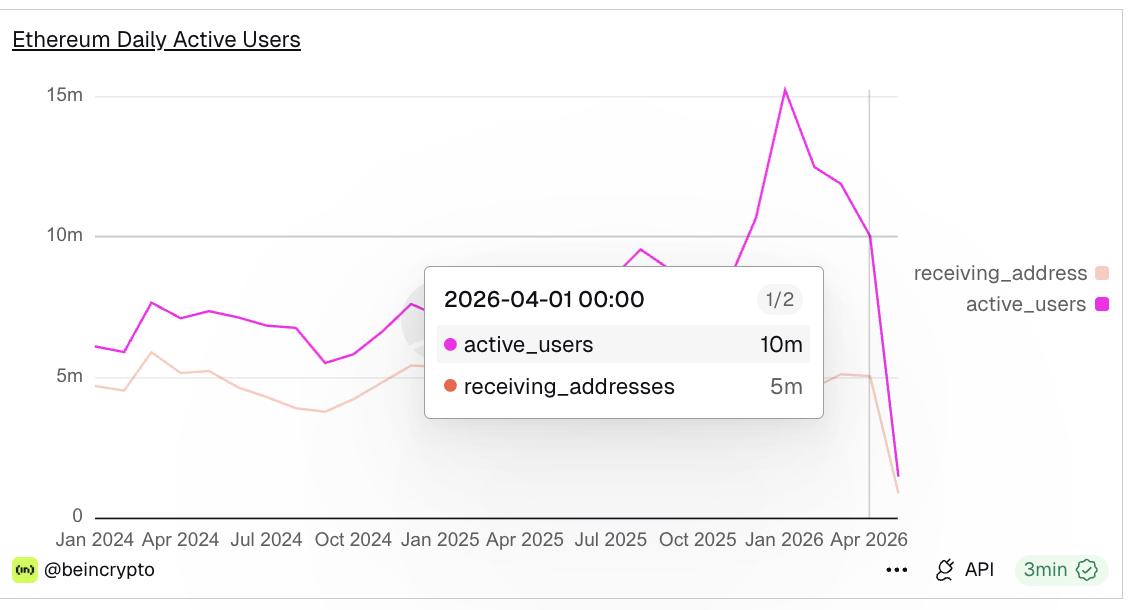 Ethereum Daily Active Users: Dune
The second data point is gas. Average gas prices on Ethereum sit at roughly 1 gwei, the lowest sustained reading since early 2024 when the metric peaked at 49 gwei. Low gas is not always user-friendly feature. It is a measure of demand for block space, and it directly weakens the EIP-1559 burn mechanism that creates supply pressure on ETH. Less activity means less ETH burned, which means less deflationary support for the Ethereum price.
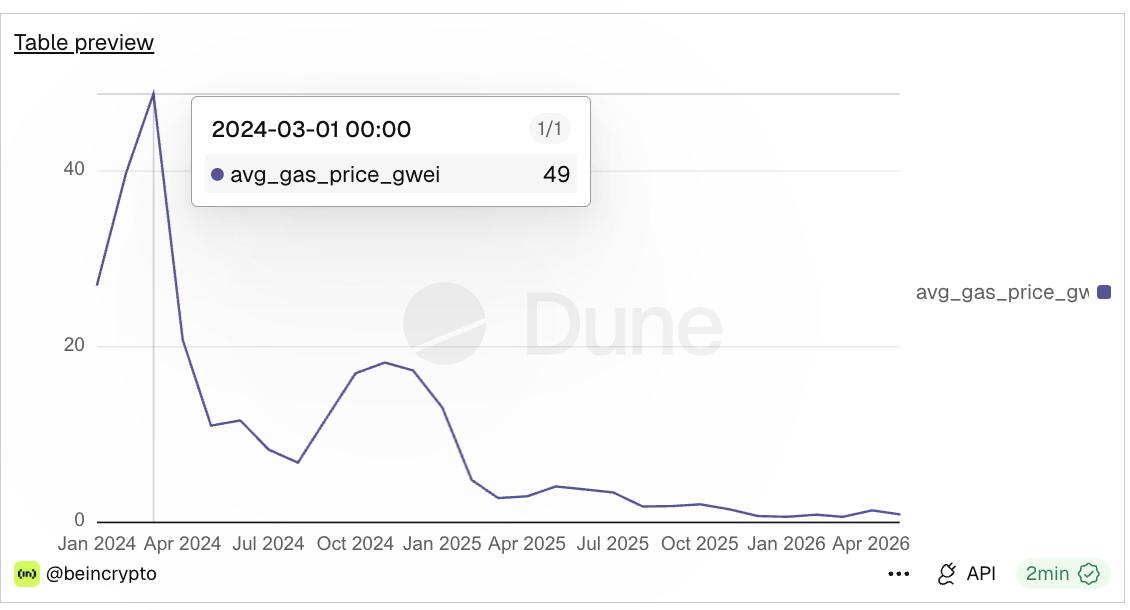 Ethereum Gas Price: Dune
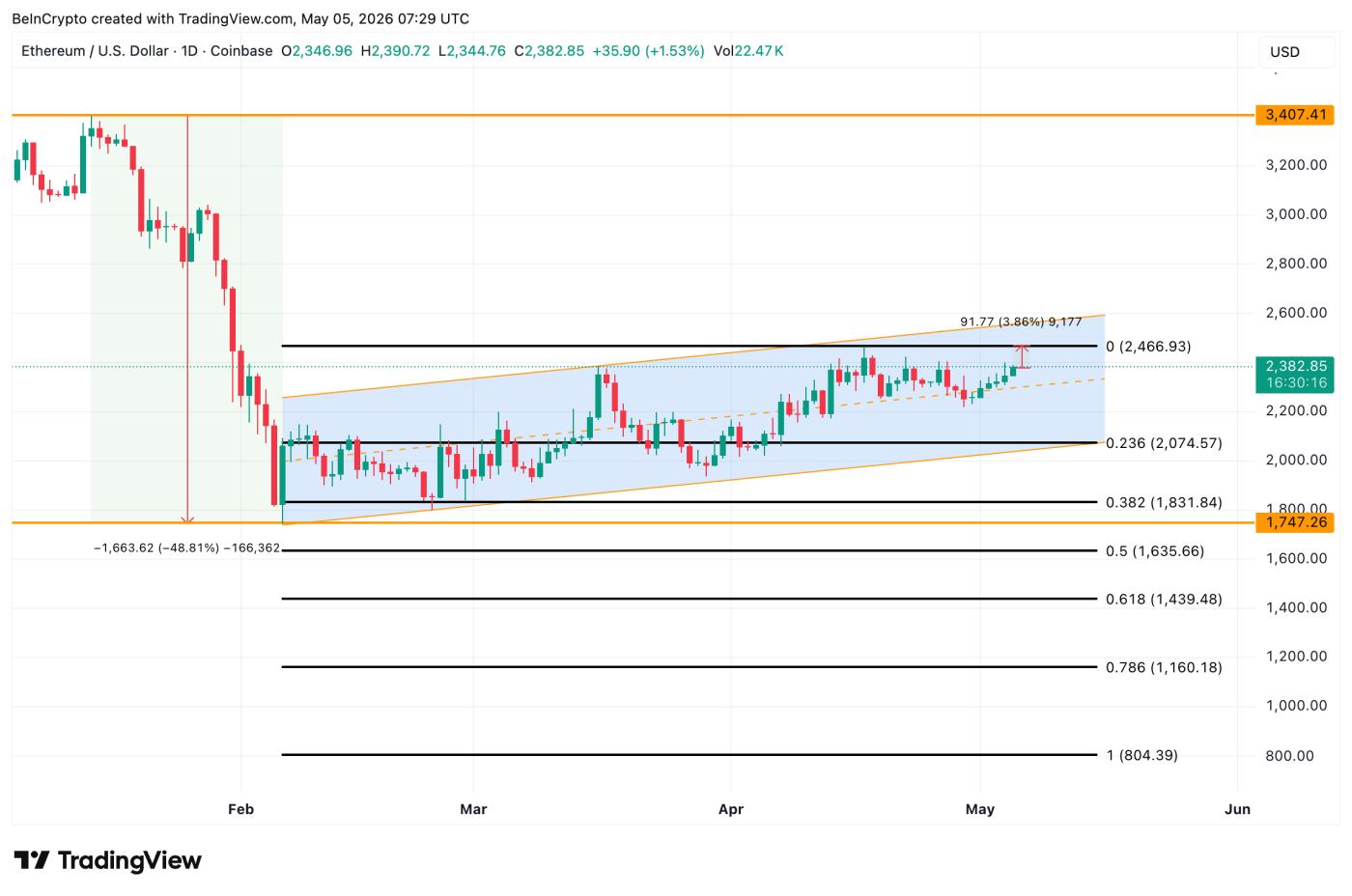
The third data point comes from the price chart itself. Since February 6, Ethereum has traded inside a parallel rising channel. Price has steadily climbed. Volume over the same window has trended lower. That bearish volume divergence means the rally is being carried by progressively less buying conviction, even as price extends. Moreover, the ascending channel forms after a near 50% dip from the mid-January highs. This makes the pattern way less bullish than usual.
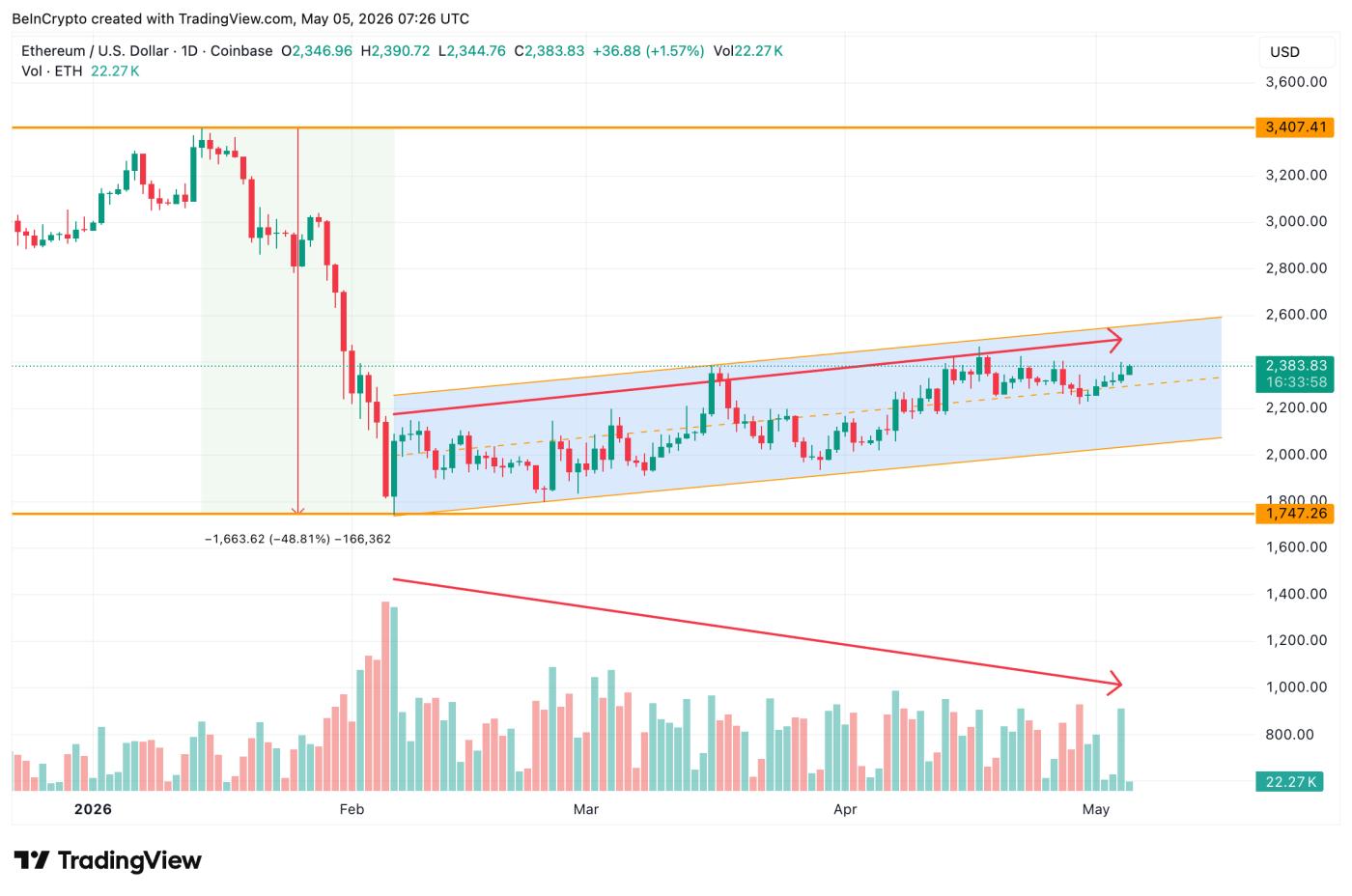 Price Action: TradingView
The pieces add up to one observation. The Ethereum price is rising. The network supporting that price is not.
Exchange Flows Just Confirmed What the Network Was Already Signaling
The clearest validation that the network weakness is now bleeding into price action sits in Glassnode’s Exchange Net Position Change data, a metric that tracks net flow of ETH into and out of exchange wallets.
For most of April, the metric was deeply negative. ETH was leaving exchanges at a steady pace. Each red bar represented withdrawals from exchange wallets into self-custody, a classic accumulation signal. Through April 28, daily outflows averaged roughly 300,000 ETH.
Then it flipped.
On May 1, exchange net position change turned positive. By May 4, 60,449 ETH had moved into exchanges. The pivot from sustained accumulation to fresh distribution is the kind of pattern shift that historically precedes price weakness. Holders who were absorbing supply through April have started to send tokens back to exchanges, which is where they get sold.
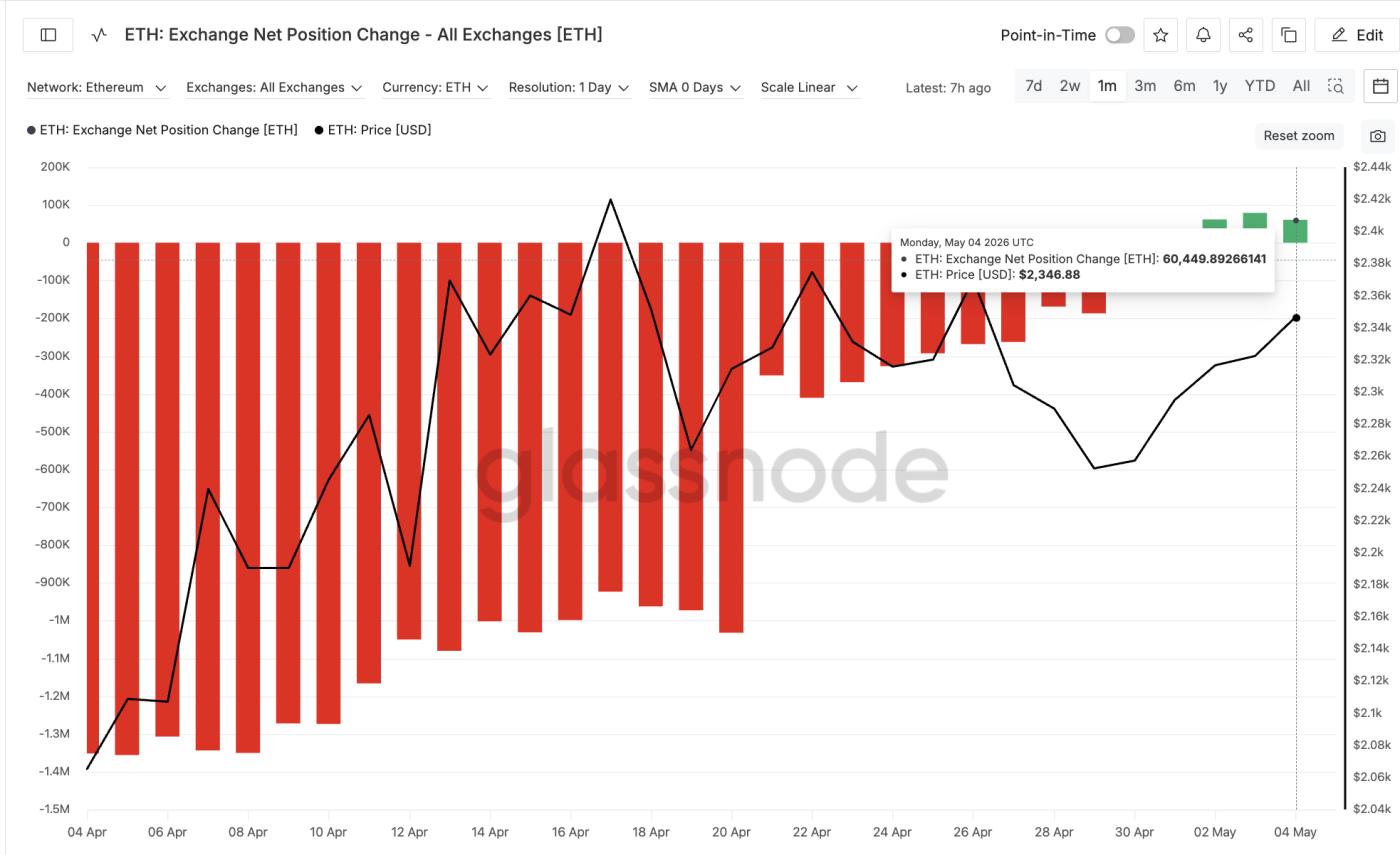 Ethereum Exchange Net Position Change: Glassnode
The historical precedent reinforces the read. The last time Ethereum rallied with a similar fundamental setup, July 2024, ETH dropped 40% within days of the spot ETF launch. The cause then was the same as now. Institutional flows lifted price without organic network demand to support it. Active users were flat at 6 to 7 million, as shown by the image shared earlier. Gas was low. The rally fizzled within weeks.
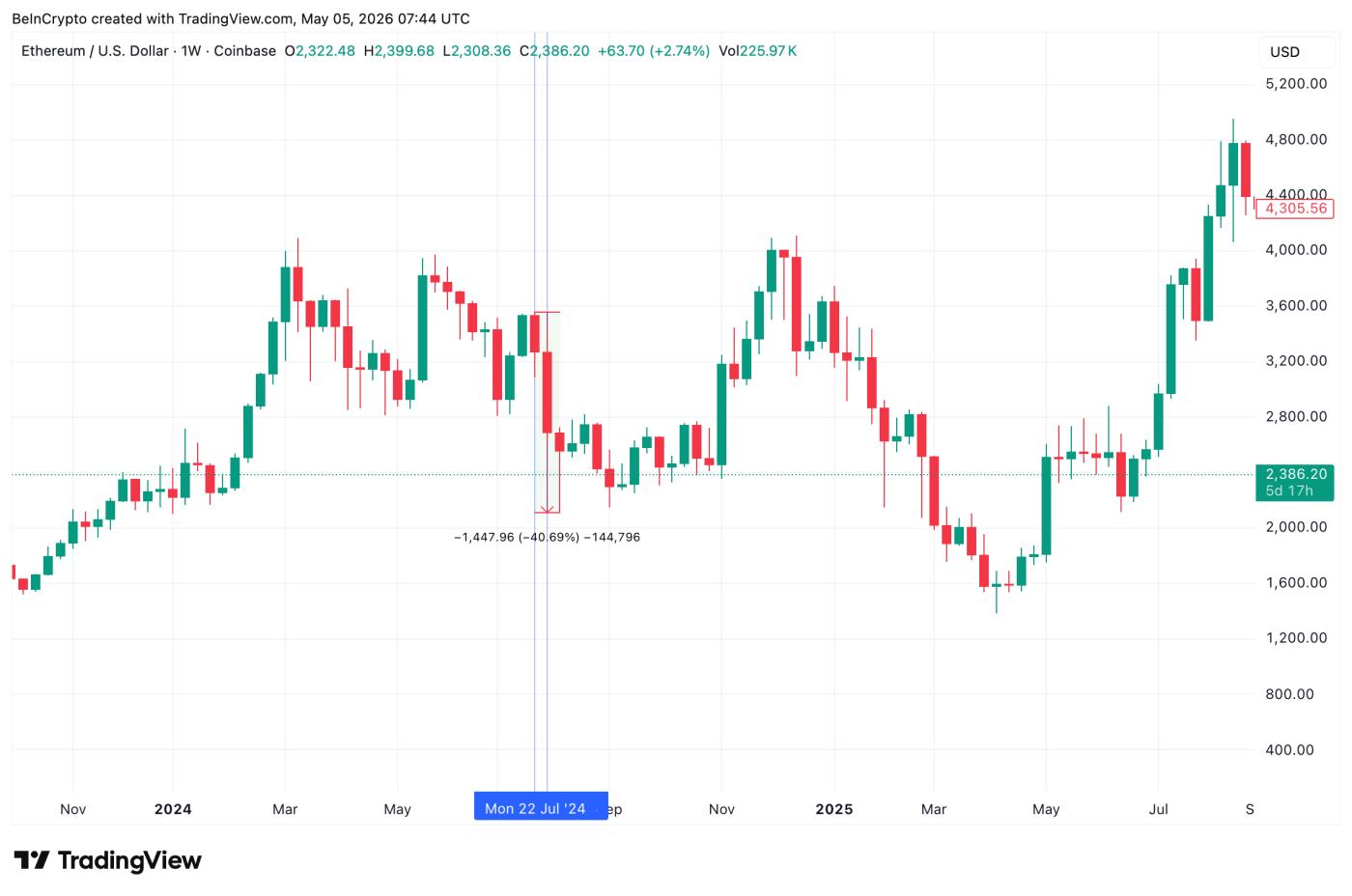 Historical Price Precedent: TradingView
The April 2026 setup matches that template. Active users have collapsed from January’s peak. Gas is at multi-year lows. Volume on the price chart has thinned. And exchange flows have just confirmed that holders are starting to take chips off the table.
The network gave the warning. The exchanges are now the confirmation.
Ethereum Price Levels Show Where the Rally Has to Prove Itself
Ethereum (ETH) trades at $2,383 inside a parallel rising channel that has guided price higher since February 6. That channel followed a 48.81% drop from the January peak of $3,407 to the February low of $1,747. The current rally is a recovery attempt, not a continuation.
The first test sits at $2,466. A daily close above this level brings ETH closer to the channel’s upper trendline and gives the rally room to validate itself with the volume the chart has been missing. Without that close, the structure stays compressed and the bearish on-chain signals from active users, gas, and exchange flows get the chance to translate into price weakness.
 Ethereum Price Analysis: TradingView
The downside levels are stacked tightly. Holding $2,074.57, the 0.236 Fibonacci level, keeps Ethereum inside the channel. A break of $2,074 cracks the channel and exposes $1,831, the 0.382 Fibonacci level. Below $1,831, the path opens to $1,747, the February low, and $1,635, the 0.5 Fibonacci level.
The level math is asymmetric. Upside requires reclaiming $2,466 with volume the chart has not delivered. Downside, if the channel cracks, opens a path back to the February lows. A daily close above $2,466 weakens the bearish on-chain thesis. A close below $2,074 confirms it.