
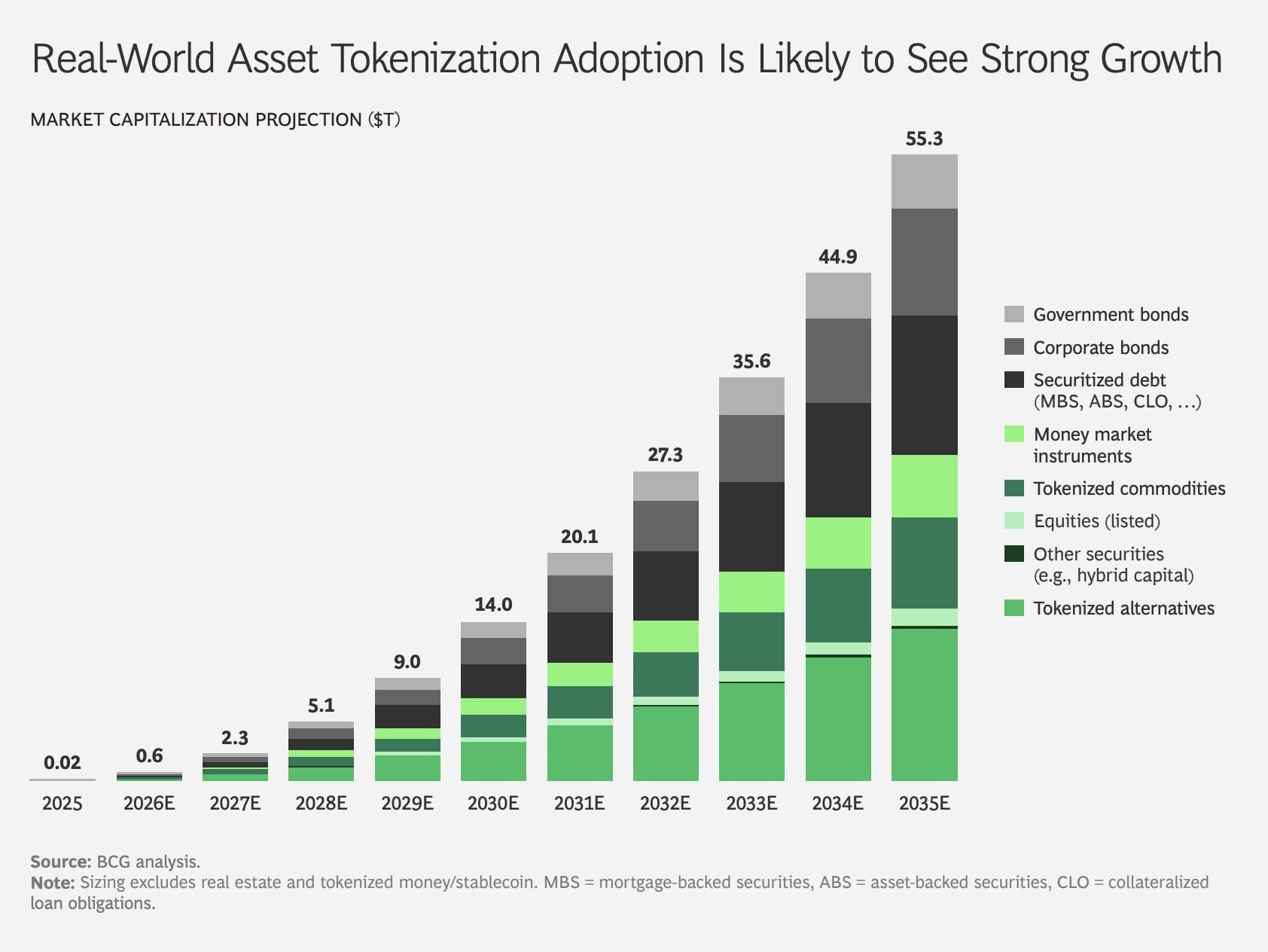
Tokenized real-world assets could develop into a $14 trillion market by 2030 and eventually reach $55 trillion by 2035, according to BCG projections. According to that prediction, tokenization would rank among the biggest structural changes in the current financial system, affecting bonds, commodities, private credit, stocks, and other assets.
Instituionalization of the field
There is increasing pressure on conventional asset managers. While profit margins hardly change, assets under management are still growing globally. Institutional products became more commoditized, passive investing reduced fees, and competition grew more fierce.
Distribution is turning into the primary battleground in that setting. BCG makes the straightforward claim that companies with control over investor access will rule the financial industry in the coming years.
The source of capital flows is also rapidly shifting at the same time. Approximately 61% of the growth in global AUM between 2020 and 2025 will come from retail investors. With an annual growth rate of almost 9%, Asia-Pacific is also growing more quickly than any other region. This combination is important because tokenization is most effective in markets that want more access, fractional ownership, quicker settlement, and global liquidity.
Blockchain rails are already being used in pilot programs and institutional experiments for government bonds, corporate debt, private credit, commodities, and even structured products. Tokenization facilitates 24/7 trading, lowers settlement friction, enhances transferability, and may open markets that were previously closed to smaller investors.
More opporutnities for yield generation
Private credit could end up being one of the main winners. Insurance companies are looking for yield-generating instruments more and more, and blockchain technology makes it possible for those assets to transfer between institutions and secondary markets more effectively.
However, the $55 trillion estimate is still very ambitious. Regulators must standardize compliance frameworks across jurisdictions in order for tokenized finance to grow to that extent. Additionally, institutions require dependable identity verification layers, interoperable blockchains, custody systems, and legal clarity. It becomes challenging to adopt on a large scale without those components.
Tokenization is no longer considered a niche cryptocurrency experiment by major financial institutions. More and more, they see it as a layer of modernization for global finance. Tokenization may develop into the infrastructure supporting established markets rather than a rival system if adoption keeps picking up speed.
Forecasts like BCG's are receiving significant attention on Wall Street and in the cryptocurrency space precisely because of that possibility.