Table of Contents
ToggleKey Summary
- Taiwan's UNECE R79 vehicle regulations, passed in 1988, will not be fully implemented until 2025, while Level 3 autonomous driving regulations will not be in effect until 2031 at the earliest.
- Ge Rujun requested that a dual-track system of Dutch RDW certification and US FMVSS be discussed within a month, and Zhuo Rongtai promised that the Ministry of Transportation would cooperate.
- Following the model of cultural coins, the Executive Yuan plans to launch "AI coins" to subsidize the public's use of paid AI tools, promising to submit a proposal within two months.
Taiwan produces the world's most advanced AI chips, yet its own citizens can't even achieve Level 2 driver assistance until 2032? During a general interpellation session at the Legislative Yuan on the 12th, Legislator Ge Rujun pulled out a 1980s-era black iPhone and shouted at Premier Cho Jung-tai, saying that if the government stipulated that everyone could only use a black iPhone to make calls and not be allowed to use iPhones, society would find it absurd, but the same scenario is playing out in Taiwan's vehicle regulations.
The 1988 regulations will apply until 2032.
Ge Rujun pointed out that the UNECE R79 vehicle steering regulations, passed in 1988, will not be fully enforced in Taiwan until 2025. A nearly 40-year-old regulation is still preventing people from using the latest traffic technologies. Even more absurdly, R171, which regulates Level 2 driver assistance systems, is not expected to be fully implemented until 2032, and R157, which regulates Level 3 autonomous driving, may not be implemented until 2031.
Ge Rujun: "Taiwan cannot make AI chips for the whole world, but instead locks its own people out of the world of technology by old regulations."
He put forward two specific demands: First, to consider adopting the certification results of the Dutch Roads Authority (RDW) for autonomous driving systems, and to make good use of the long-term cooperation between the Taiwan Vehicle Safety Center (VSCC) and RDW to accelerate international alignment. Second, to establish a dual-track system of self-certification for European and American FMVSS standards, allowing safe and qualified new technologies to be put on the road more quickly, while the government retains the authority for random testing, recalls, and penalties.
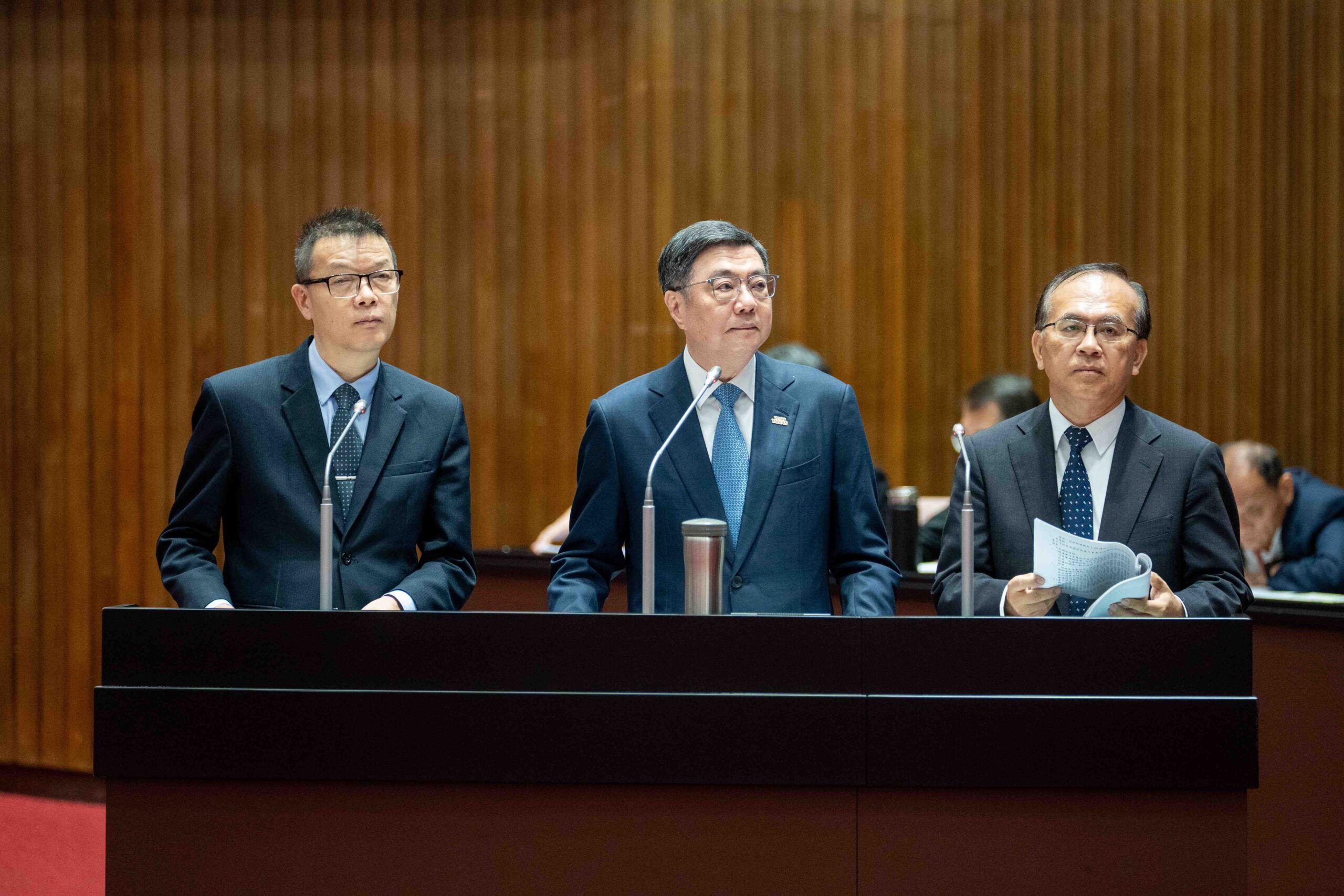
Zhuo Rongtai immediately promised that the Ministry of Transport would submit its research results within a month.
AI data processing delayed for 194 days; demands to issue AI coins.
On the issue of sovereign AI, Ge Rujun criticized the Ministry of Data Development for delaying the "Act on Promoting the Development and Utilization of Data" announced last year for 194 days before it was submitted to the Legislative Yuan. He pointed out that 18 out of the 34 articles in the draft are filled with the word "may"—"the government may encourage" and "agency may establish"—and sarcastically suggested that it would be better to simply provide "micro-encouragement".
Because local AI training relies on a large amount of local language data, but the governance of traditional Chinese data in Taiwan is seriously inadequate, which directly reduces the understanding of the Taiwanese context by large language models. If the government does not show a proactive attitude, sovereign AI is just empty talk.
Regarding AI equality, he pointed out the significant functional gap between free and paid AI tools, and that government inaction would only exacerbate the education and urban-rural divide. Through Ge Rujun's advocacy, the Ministry of Education has approved the "AI in Every Library" policy, which will provide paid AI services such as ChatGPT, Claude, and Gemini at the National Library starting in the fourth quarter of this year. He further requested the Executive Yuan to launch an "AI Coin" or "Digital Coin," similar to the cultural coin, and to submit a formal proposal within two months. Zhuo Rongtai responded that they will study the integration of payment methods within two months.
Ge Rujun also called for support for amending Article 36 of the Telecommunications Management Act to specifically approve foreign low-orbit satellite communication service providers to operate in Taiwan, thereby strengthening communication resilience in disaster prevention, rural areas, and national security.
Frequently Asked Questions
What is the dual-track system for self-driving cars proposed by Ge Rujun?
The European (UNECE) and American (FMVSS) self-certification systems coexist, with the government retaining the power of random testing, recalls, and penalties. This allows self-driving cars that have passed international certifications such as the Dutch RDW to be driven on the roads in Taiwan more quickly, without having to be tested from scratch.
What is AI Coin, and when will it be launched?
Similar to the cultural currency model, where the government subsidizes the public to use paid AI tools such as ChatGPT and Claude, the Executive Yuan has promised to submit a formal plan integrating payment methods by July 2026, but the exact distribution schedule has not yet been confirmed.

 Related reports