RippleX has put forward 'privacy,' 'zero-knowledge proofs,' and 'post-Qtum' support as the next phase of the XRP Ledger (XRPL). The plan is to add security and confidentiality features tailored to institutional needs while maintaining the core design of the payment network.
According to Cryptorator TV on the 13th, Anchal Malhotra, Head of Research for RippleX, explained the research roadmap in Episode 25 with XRP Ledger Foundation member Hussein 'Bet' Zangana and Cryptorator. He stated that while RippleX covers privacy, consensus, protocol design, interoperability, and DeFi in general, it avoids following trends.
Malhotra said, “Sustainable impact does not come from chasing ‘buzz’,” adding that “it is important to focus on security and foundational systems.” RippleX is currently focusing on establishing a strong cryptographic foundation and strengthening verification procedures to translate research into actual services.
XRP Ledger maintains 'payment-only' structure
Malhotra, in particular, viewed the existing structure of the XRP Ledger as still valid. He emphasized that the fixed-function architecture, designed for fast, inexpensive, and transparent payments, remains competitive even after more than a decade. His judgment is that it is better to maintain performance and security boundaries rather than forcibly layering general-purpose smart contracts on Layer 1.
Against this backdrop, the technology that RippleX is focusing on is 'zero-knowledge proof.' Zero-knowledge proof works by verifying only the necessary facts while concealing the rest of the information, allowing verification of whether conditions are met without disclosing deposit balances or identity documents. However, Malhotra explained that zero-knowledge is not a single technology but a combination of various methods, stating that the key lies in 'conciseness,' which compresses complex calculations into a small size for verification.
'Privacy' feature targeting institutional demand
Privacy strategies are also far removed from simple anonymization. Malhotra stated, “Privacy is not the enemy; opacity is the problem,” adding that public financial systems require both the protection of sensitive information and market verifiability. RippleX is designed to conceal balances and transaction amounts while disclosing the total supply through the 'confidential transfer' feature of its multi-purpose token, and to enable external audits if necessary.
In this process, RippleX selected Bulletproofs. While incorporating larger ZK capabilities in the long term would require tweaking the signature method, hash function, and curve structure, the current strategy is to implement it starting with a scope suitable for actual services. Malhotra believed that, considering XRPL's short block finalization time and low fees, a method where complex computations are processed externally and only proofs are settled with the main body is realistic.
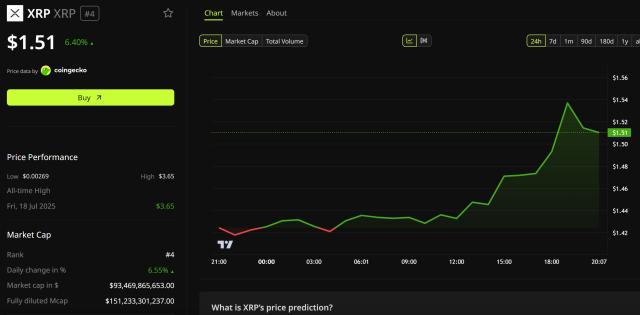
Ultimately, this statement demonstrates the direction in which XRP and XRP Ledger intend to evolve beyond a simple payment network into an institutional settlement infrastructure. As 'privacy' and 'quantum resistance' emerge as key factors for future blockchain competitiveness, market attention is focused on whether RippleX's research will lead to actual product commercialization. Currently, XRP is trading at $1.43379.
[Political Analysis] U.S.-China Summit Could Do More Bad Than Good
View full Alpha Report →🔎 Market Analysis
RippleX presented a direction to expand the XRP Ledger from a simple payment network into institutional financial infrastructure.
Privacy, Zero-Knowledge Proof (ZK), and quantum resistance technology are emerging as key competitive factors in the future of blockchain.
In particular, the balance between 'maintaining transparency + protecting sensitive information' is acting as a key condition for institutional adoption.
💡 Strategic Points
XRPL chose a strategy of maintaining its role as a 'fast settlement layer' rather than unnecessarily expanding functionality at Layer 1.
The core of the structure is that complex calculations are processed externally (Layer 2), and only the results are verified using ZK proofs.
With the introduction of Paul Proof-based confidential transmission, we are pursuing the phased implementation of privacy features that are actually service-ready.
📘 Glossary
Zero-Knowledge Proof (ZK): A cryptographic technology that proves whether specific conditions are met without disclosing information.
Confidential Transmission: A method that hides transaction amounts and balances while allowing verification of the total amount and rule compliance.
Quantum-resistant cryptography: Cryptographic technology designed to be secure against future quantum computer attacks
Layer 2: Scaling technology that processes computations outside the main blockchain and reflects only the results.
💡 Frequently Asked Questions (FAQ)
Q. Why have privacy features suddenly become important in XRP Ledger?
Q. How is Zero-Knowledge Proof (ZK) utilized in XRP Ledger?
Q. Is quantum resistance technology a necessary element right now?
<Copyright ⓒ TokenPost, unauthorized reproduction and redistribution prohibited>