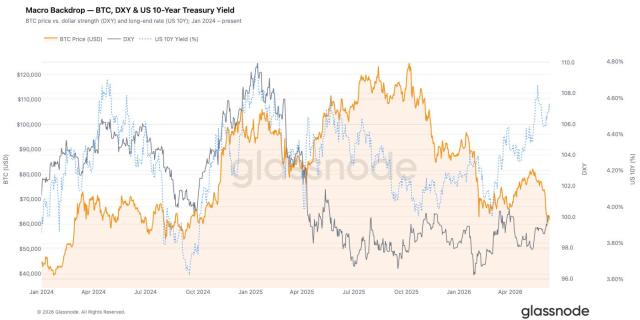
According to Mars Finance, although the US Clarity Act passed the Senate Banking Committee last week, providing the clearest path to date for establishing a comprehensive regulatory framework for the crypto industry, the current deteriorating macroeconomic environment is suppressing market risk appetite, and crypto assets are also under pressure. Crypto analyst Omkar Godbole wrote that the market currently faces three main risks: First, the volatility of the US Treasury market has increased significantly. The MOVE index, which measures the volatility of US Treasuries, surged 14.7% to 79.87 last Friday, a new high since April 7. As US Treasuries are the core collateral of the global financial system, rising yields and volatility usually suppress the performance of risky assets and trigger widespread deleveraging. Second, the risk of yen depreciation continues to rise. The USD/JPY exchange rate has recently risen from 155 to nearly 159, approaching the key level of 160, where the Bank of Japan has historically been likely to intervene. The market is concerned that if the Bank of Japan intervenes and pushes up the yen, it could trigger the unwinding of "carry trades" financed with low-interest yen, leading to a contraction in global liquidity. QCP Capital stated that the current large number of crowded yen carry trade positions, if unwound simultaneously, could impact global risk assets. Third, international oil prices continue to rise. Both WTI and Brent crude have surpassed $100 per barrel. Fatih Birol, head of the International Energy Agency (IEA), warned that global commercial crude oil inventories are declining rapidly due to the conflict in Iran and the closure of the Strait of Hormuz, with remaining inventories potentially only lasting a few weeks. If oil prices continue to rise, it could reignite global inflation and further tighten financial conditions. Although the regulatory environment is improving, current macroeconomic pressures—including bond market volatility, yen carry trade risks, and rising oil prices—have temporarily outweighed the positive factors for the crypto market; "macroeconomic factors are currently dominating." Furthermore, since 2026, cross-chain bridge attacks have been frequent, with hackers having stolen approximately $328 million in assets through eight major bridge attacks, highlighting the continued prominence of infrastructure security issues in the industry.
Analysis: Three major macroeconomic risks are outweighing the regulatory benefits for Bitcoin.
This article is machine translated
Show original
Sector:

Source
Disclaimer: The content above is only the author's opinion which does not represent any position of Followin, and is not intended as, and shall not be understood or construed as, investment advice from Followin.
Like
Add to Favorites
Comments
Share
Relevant content