DeepSeek's price cuts have cemented its legendary status, while Doubao's new charging policy has drawn criticism! Large-scale modeling is embroiled in a price war.
Article author and source: ZhiDongXi
In the past month, the commercialization of large-scale models has witnessed its most dramatic and divisive phase.
On one hand, ByteDance's Doubao began to test the paid model , and the hashtag " Doubao is stupid and charges fees " quickly became a trending topic, encountering merciless criticism from users; on the other hand, DeepSeek-V4-Pro directly reduced the API price to 25% off , and then the input cache hit price also dropped to 1/10 of the original price.
On May 22nd, DeepSeek announced that starting June 1st, the current promotional price would become the official price and would not revert to the original price . Liang Wenfeng was thus hailed as " Saint Liang" within the developer community .

▲A trending topic on Weibo (left) and a popular post on Xiaohongshu (right) regarding the price increase of large-scale models.
At the same time, a drama of "criticizing while simultaneously engaging in corruption" is also unfolding.
Luo Fuli, head of Xiaomi MiMo's large model, published an article criticizing the price war in the large model industry, and then Xiaomi MiMo, relying on the "100 trillion token free plan", once rose to the top of Hermes' global usage volume.

▲A partial screenshot of Luo Fuli's post on X (Image source: X)
Currently, there is a serious price gap between domestic and international markets : for the same call scale, the price of the overseas giant's GPT-5.5 long context version has reached more than 40 times that of the domestic DeepSeek-V4-Pro .
To some extent, we can foresee the "helpless choice" of major domestic model manufacturers: everyone knows that AI is very expensive, but at this juncture, should they raise prices to recoup losses, or continue to lower prices to grab the ecosystem?
To accurately calculate this "AI cost," we conducted an in-depth analysis and comparison of subscription packages, API call billing, and video generation prices from dozens of mainstream large model vendors both domestically and internationally .
It is obvious that large model manufacturers are collectively bidding farewell to generous subsidies, and the era of blindly taking advantage of large model manufacturers is coming to an end.
01. Major Reshuffle of Subscription Models: Say Goodbye to "Unlimited Access"
Large model free lunches are being removed from shelves.
Compared to the early 2024 era when "one ChatGPT Plus membership was all you needed," the pricing system for large-scale models in China has undergone a qualitative change.
The most crucial change is that manufacturers no longer cover unrestrained computing power consumption, and pure "unlimited calls" have almost completely disappeared. In their place is a complex measurement system including Credits, Tokens, and Agent fuel values.
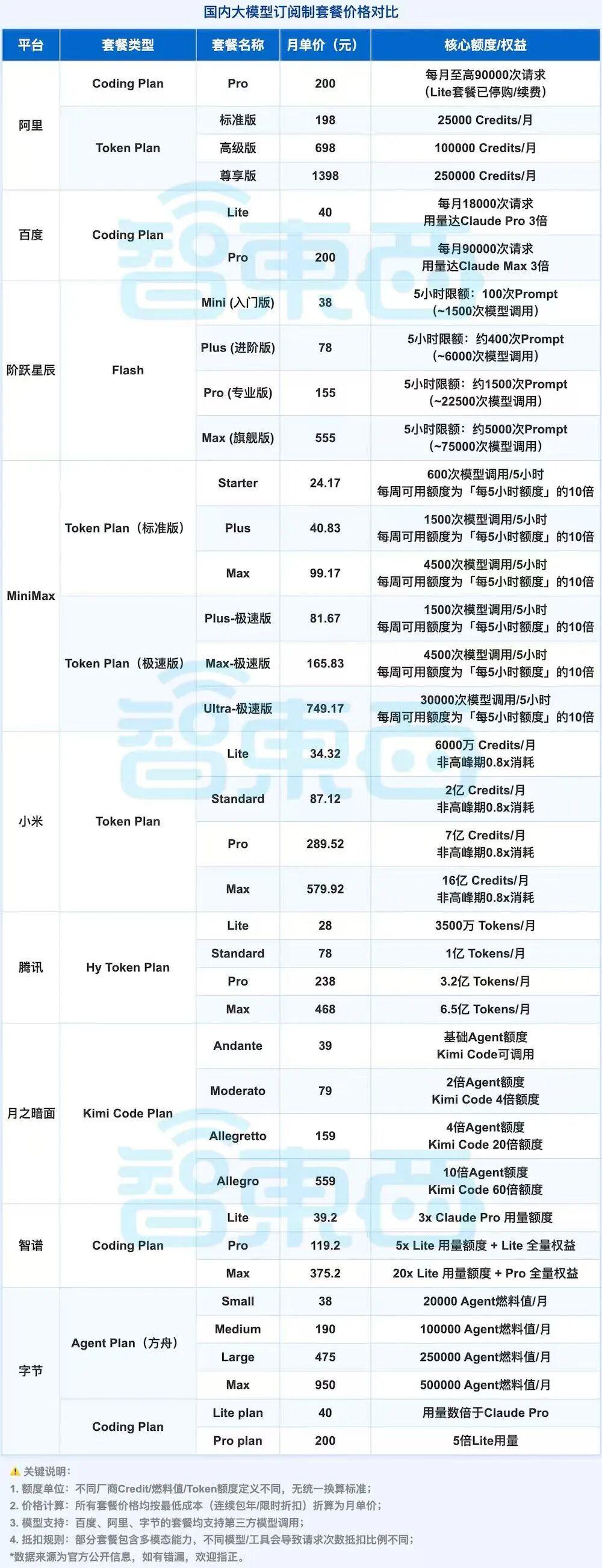
▲Comparison of subscription package prices for large-scale models in China (Table compiled by Zhidongxi, statistics as of: 2026/05/21)
We can clearly see that the membership systems of mainstream domestic platforms have formed three distinct "price bands":
The first tier can be considered the " traffic acquisition price ," with most platforms keeping the entry threshold below 50 yuan .
MiniMax, Xiaomi, Kimi, Zhipu, ByteDance, and other entry-level plans are mostly around 40 yuan. However, Alibaba's Token Plan Standard Edition starts at 198 yuan/month, which is significantly higher, perhaps due to its coverage of larger token amounts and support for multimodal capabilities.
The second tier is concentrated in the 80 to 200 yuan range , which is also the most competitive price range at present.
At least eight platforms, including Alibaba, Baidu, Jieyue Xingchen, MiniMax, Xiaomi, Tencent, Zhipu, and ByteDance, have placed a core upgrade tier in this range.
Further up, you enter the zone of high productivity.
Several platforms have already exceeded 500 yuan per month for their premium plans, with ByteDance and Alibaba's highest tiers reaching the thousand-yuan level. Among them, Alibaba's Token Plan Premium Edition is the most expensive, reaching 1398 yuan per month .
With attention turned overseas, the situation became even more radical.
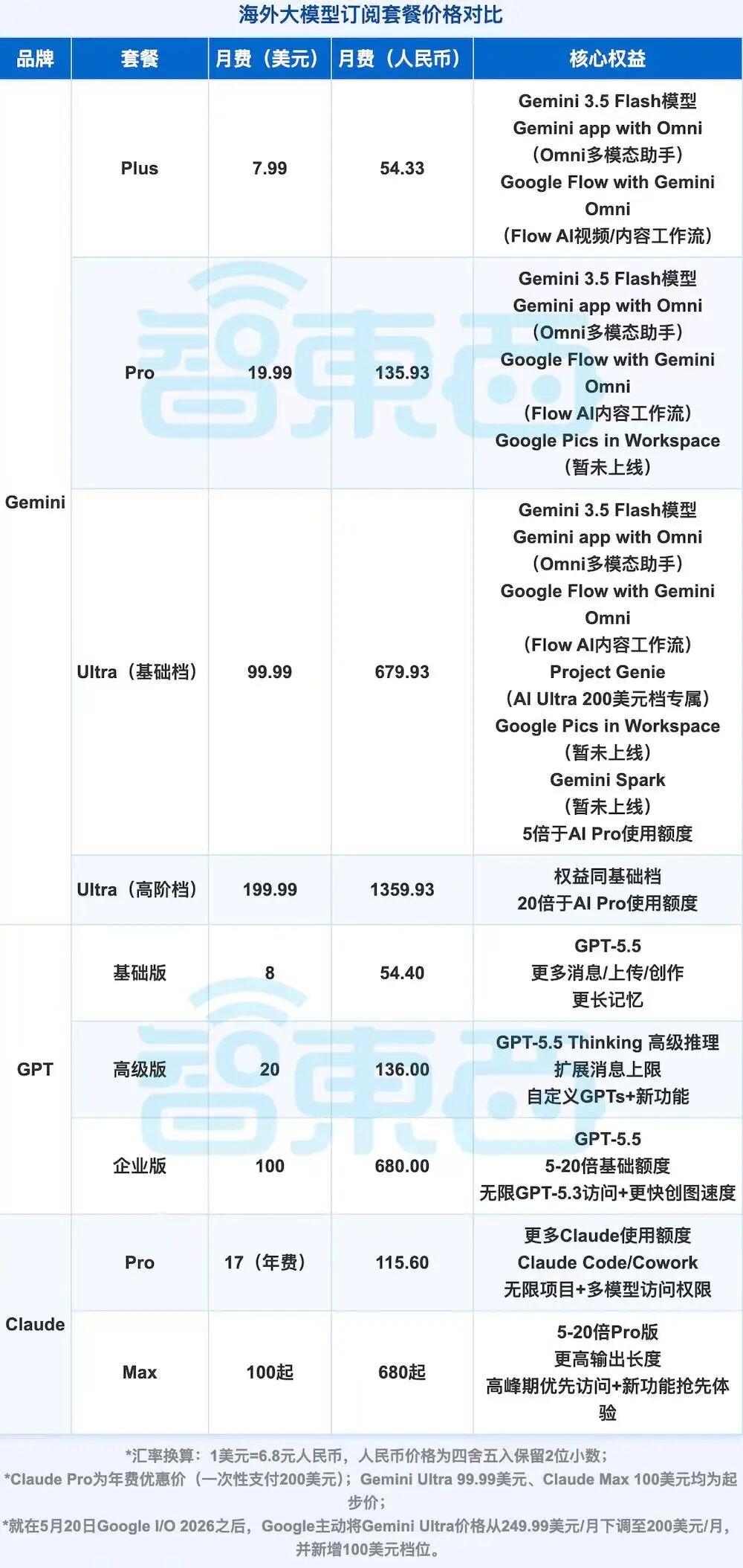
▲Comparison of overseas large-scale model subscription package prices (Table compiled by Zhidongxi, statistics as of: 2026/05/21)
The lowest-priced products are generally around $8 (approximately RMB 54.3), while mainstream subscriptions are concentrated around $20 (approximately RMB 136).
Meanwhile, the three major international data providers have also begun to rapidly expand into high-end memberships costing $100 or even $250 or more. Following Google I/O 2026 in May of this year, Google proactively lowered the price of Gemini Ultra from $249.99/month to $199.99/month (approximately RMB 1359.9), and added a new $99.99 tier .
Compared to the domestic pricing system, the monthly fee for a Gemini Ultra (premium version) is close to the annual fee level in China. Meanwhile, the $100-plus Gemini Ultra (basic), ChatGPT Pro, and Claude Max are roughly three to five times the price of mid-to-high-end plans in China .
02. Interface Price War Begins: Overseas Giants Hold High Prices, Domestic Players Vie for Market Share
If the subscription model for ordinary users has an element of "user acquisition," then the API pricing for developers and the Agent ecosystem exposes the divergence in business strategies between domestic and international markets.
The difference between the API pricing tables and the actual prices is staggering.
Taking DeepSeek-V4-Pro as an example, the combined price of its API input and output has been reduced to as low as about 9 yuan per million tokens.
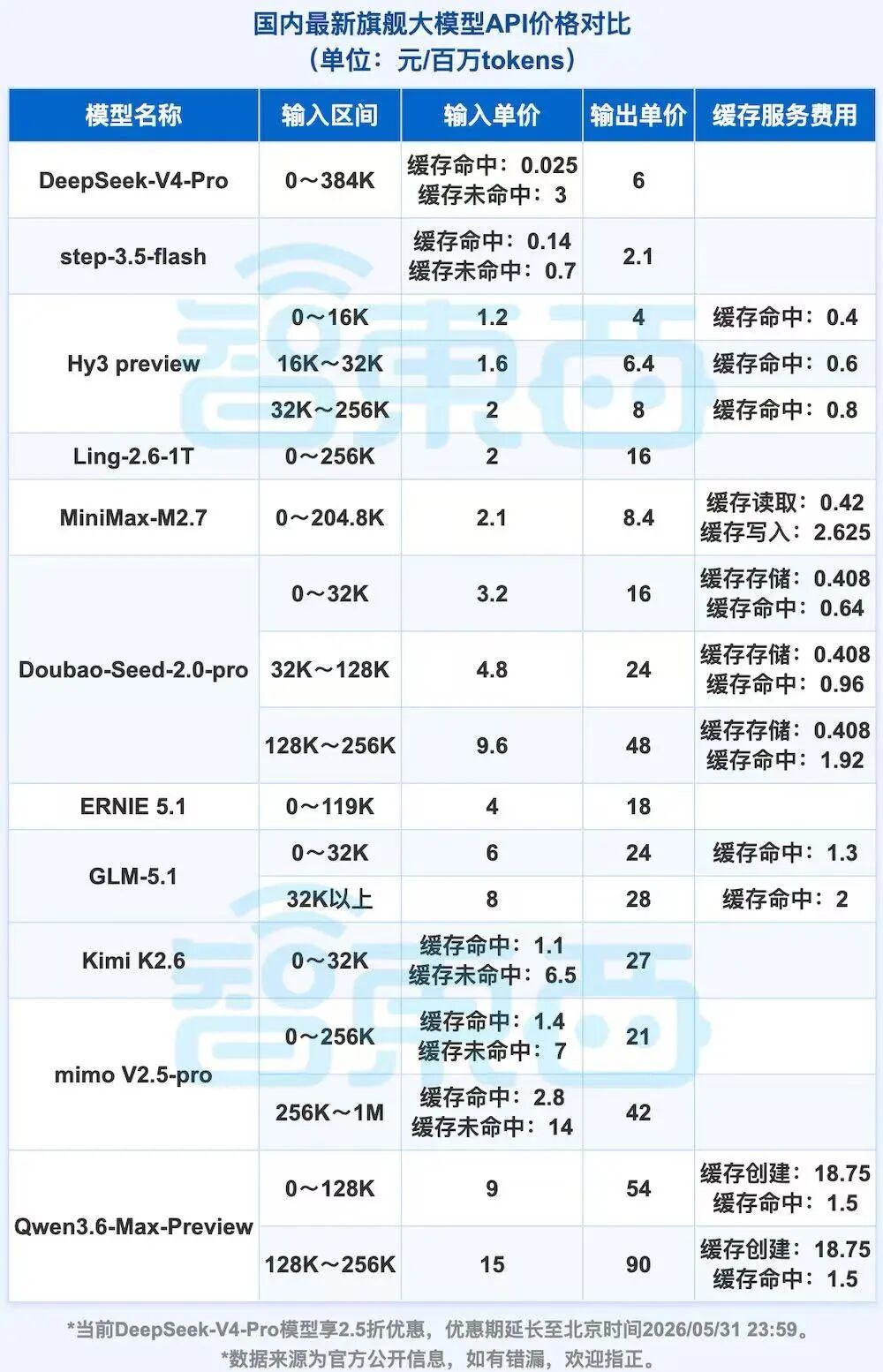
▲Comparison of the latest flagship large model API prices in China (Table compiled by Zhidongxi, statistics as of May 21, 2026. Note: The API price of DeepSeek-V4-Pro has been officially adjusted to the current promotional price and will not be restored to the original price.)
In contrast, overseas: Gemini 3.1 Pro Preview has a total price of 149.6 yuan in long context scenarios ; Claude Opus 4.7 reaches 204 yuan ; and the GPT-5.5 long context version reaches 374 yuan .
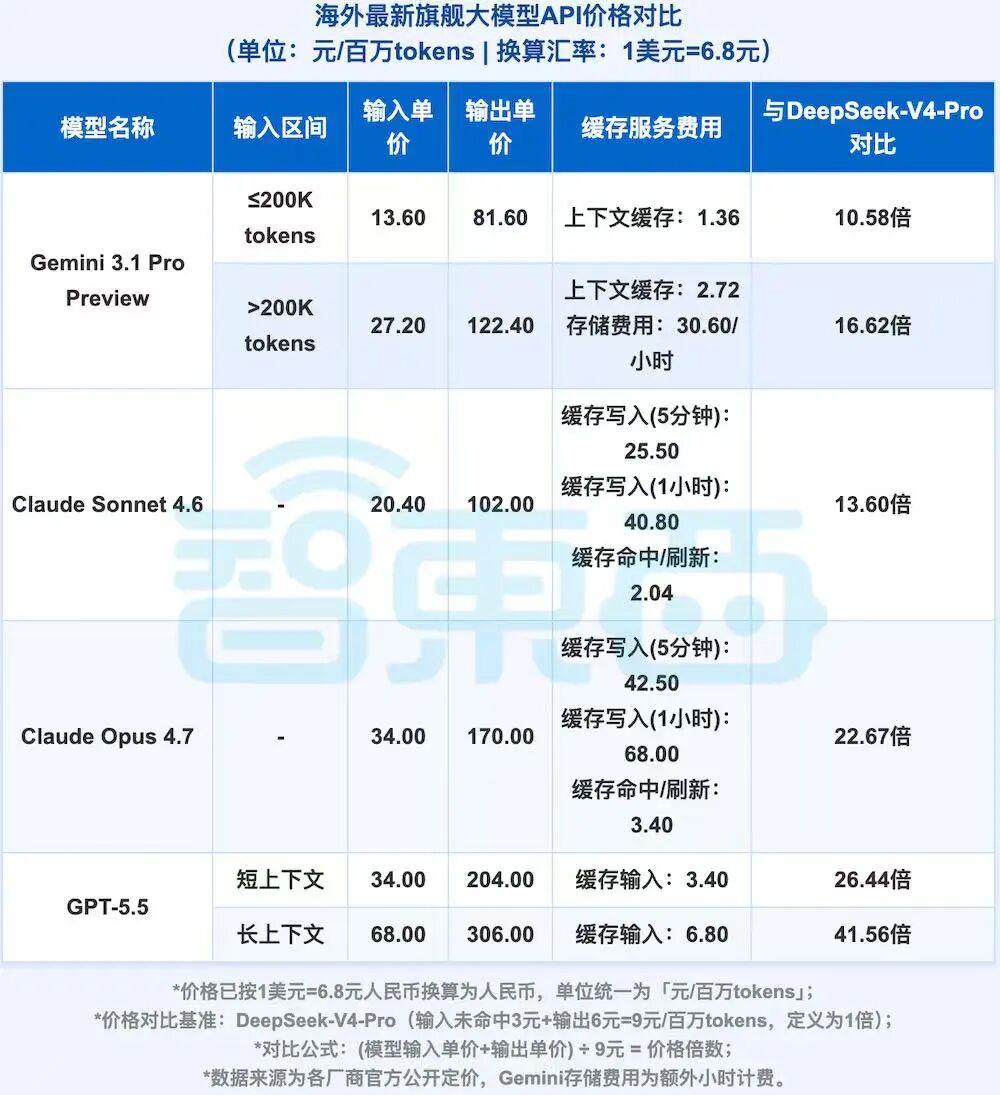
▲Comparison of the latest flagship large-scale models' API prices overseas (Table compiled by Zhidongxi, statistics as of: 2026/05/21)
Behind the data lies a completely different strategy.
Overseas giants OpenAI, Google, and Anthropic are trying to maintain high gross margins and high ARPU (average revenue per user), relying on high-end enterprise customers to cover huge computing power costs; while domestic manufacturers are drastically compressing profits and even subsidizing at a loss, intending to hold on tightly to the Agent ecosystem and developer market during the short window of opportunity.
03. A single video's price increased nearly eightfold: Even the most expensive AI capabilities couldn't withstand the pressure.
Among all AI capabilities, video generation is the most GPU-intensive and money-guzzling , and also the area with the most significant price increases.
Currently, the domestic video generation model has formed several leading players, including ByteDance Seedance 2.0, Kuaishou Keling, MiniMax Conch, and Alibaba HappyHorse. Similarly, compared to the early extensive model of "charging based on membership," its pricing system is increasingly resembling the "cloud GPU leasing logic."
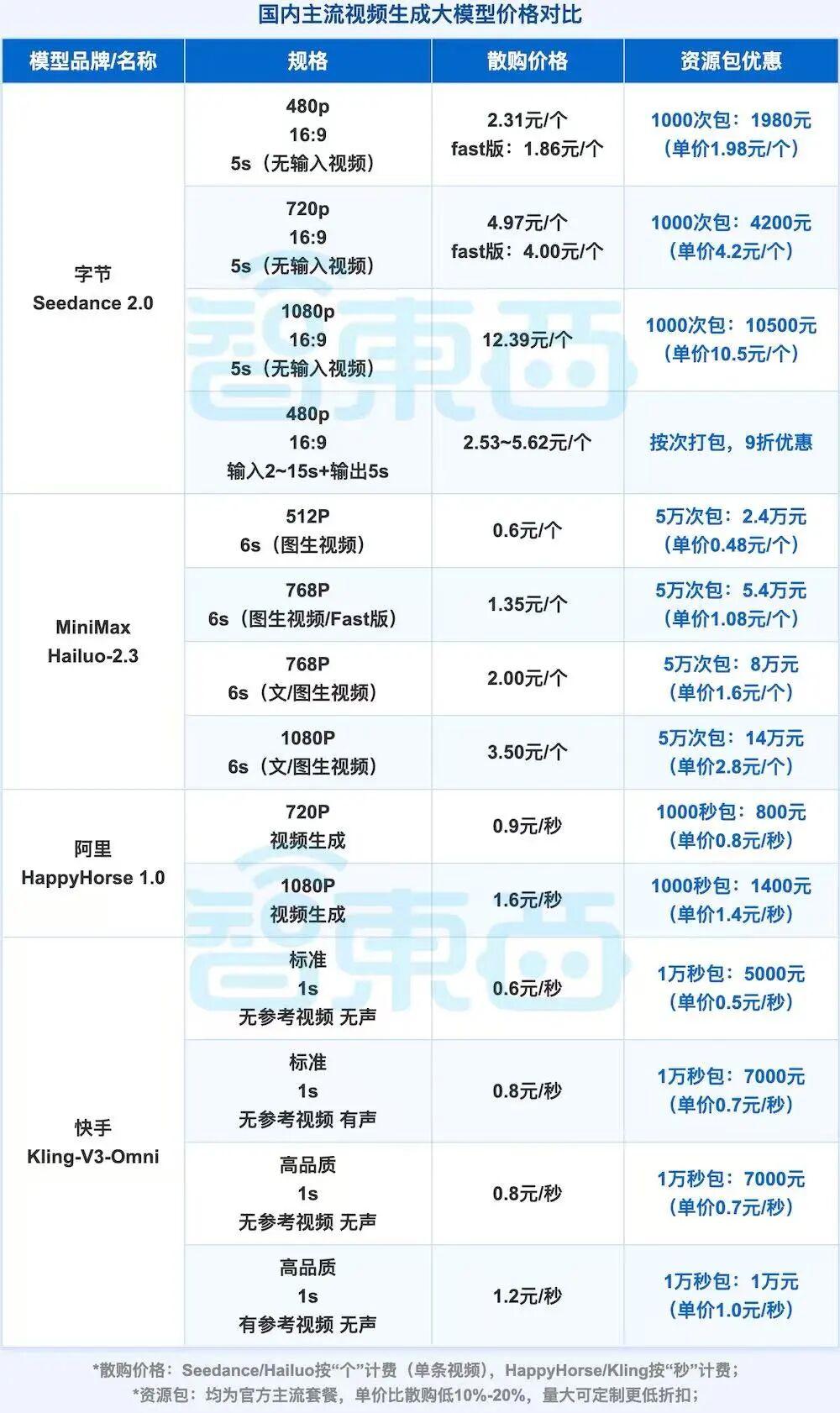
▲Price comparison of mainstream video generation models in China (Table compiled by Zhidongxi, statistics as of: 2026/05/21)
Different resolutions, different generation times, whether there is sound, whether there is a reference video, and whether the queuing is accelerated will all directly affect the price.
Taking Seedance 2.0, a phenomenal model under ByteDance, as an example, its price fluctuations can be described as a "microcosm of the industry": the billing was adjusted three times in less than a month . The cost of generating a 15-second video rose from about 0.65 yuan to about 5 yuan, an increase of nearly 6.7 times .
When traffic surges during the evening peak hours, users are either forced to wait in long queues or are forced to purchase priority computing power using expensive "VIP points".
04. DeepSeek Cuts Prices: Why Did Leung Man-Fung Dare to Slash Prices to Rock Bottom?
In the entire price war, the most unique player remains DeepSeek.
Amidst a backdrop of industry-wide tightening of incentives, DeepSeek's two significant price cuts at the end of April stand out starkly. Currently, the DeepSeek-V4-Pro cache hit input price has been driven down to an astonishing 0.025 yuan per million tokens.
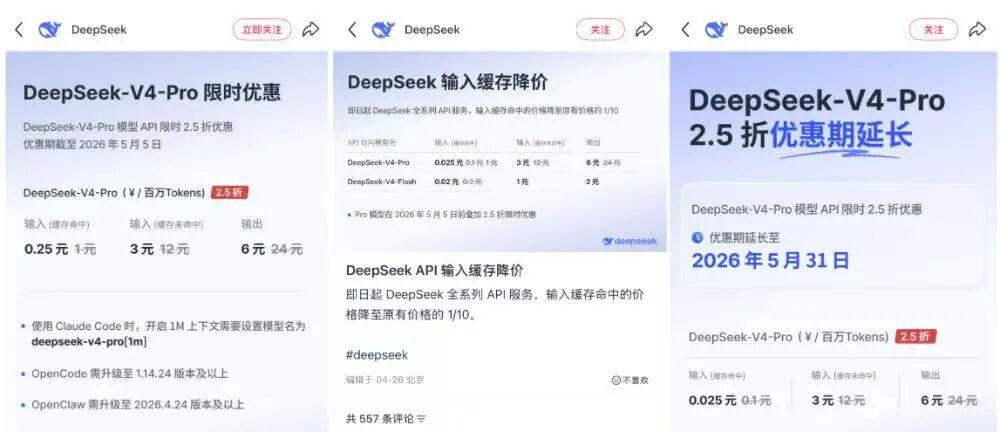
▲Image source: DeepSeek official website
Why does DeepSeek dare to further "cut itself in two directions" when it has not yet fully achieved self-sufficiency?
The answer to the suspense lies, on the one hand, in the injection of capital : a huge financing window of up to 50 billion yuan is rumored to be opening; on the other hand, the more crucial trump card comes from the deep reconstruction of the underlying hardware and computing power architecture.
The latest flagship DeepSeek-V4 not only features further radical optimizations in long context efficiency , but more importantly, it is actively adapted to domestic chips from Huawei, Cambricon, and other manufacturers.
This highly efficient combination of domestically produced hardware and algorithm optimization has drastically reduced the computational cost of single-token inference and the KV Cache usage in scenarios with millions of tokens ; compared to DeepSeek-V3.2, its cost of inference with millions of tokens has been reduced by 73% .
Simply put, DeepSeek achieves " cost reduction and price reduction " through underlying technology.
If Huawei's Ascend 950 supernode is further deployed on a large scale and the cost of domestic computing power continues to decline, then this extremely low-price strategy may further impact the price system of the entire AI market in the future.
05. Call volume skyrockets, but financial reports are still bleeding: Vendors still need to keep their heads down and work hard.
However, the overall financial situation of the large model industry remains dire.
Judging from the data from OpenRouter alone, user demand is indeed exploding, and tokens have completely entered a "boiling" state.
In the past six months, the presence of domestically produced models has been rapidly increasing . Domestic models such as DeepSeek, Tencent HY, Alibaba Qwen, Lunar Dark Side Kimi, MiniMax, and Xiaomi Mimo have begun to consistently appear in global token share rankings.
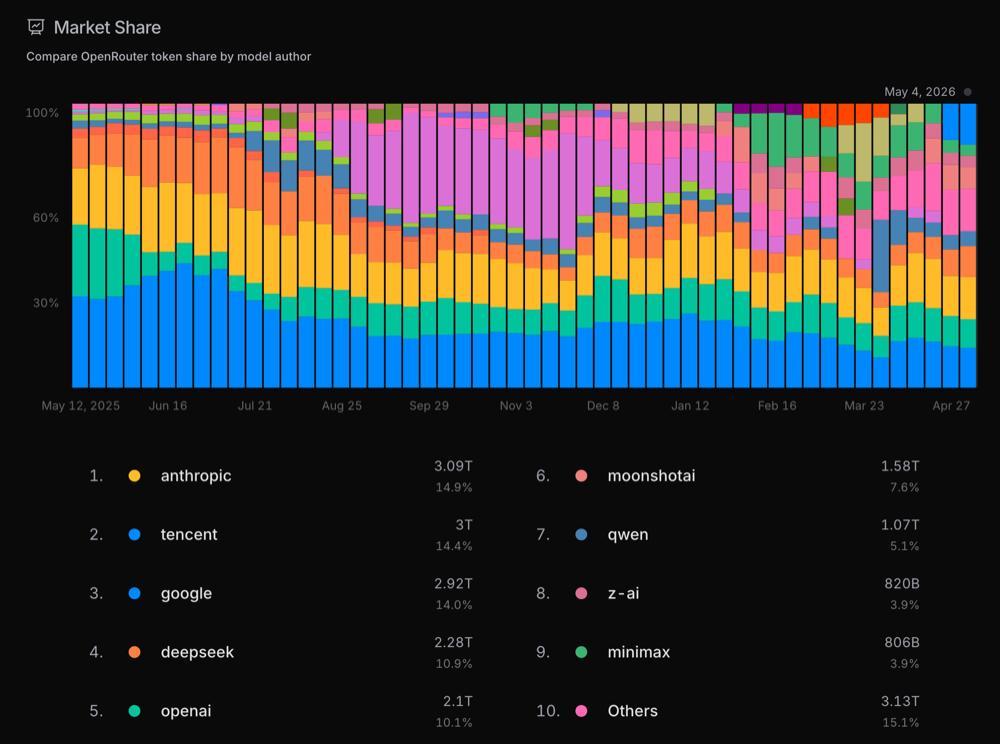
▲ Market share of large-scale models (Source: OpenRouter)
According to the latest weekly call data from OpenRouter, DeepSeek-V4-Flash and Hy3 preview have entered the top tier in terms of call volume, with both reaching 1.46T tokens per week. Among the top ten models in global call volume, five are domestic models, with DeepSeek V series models occupying three of the spots .
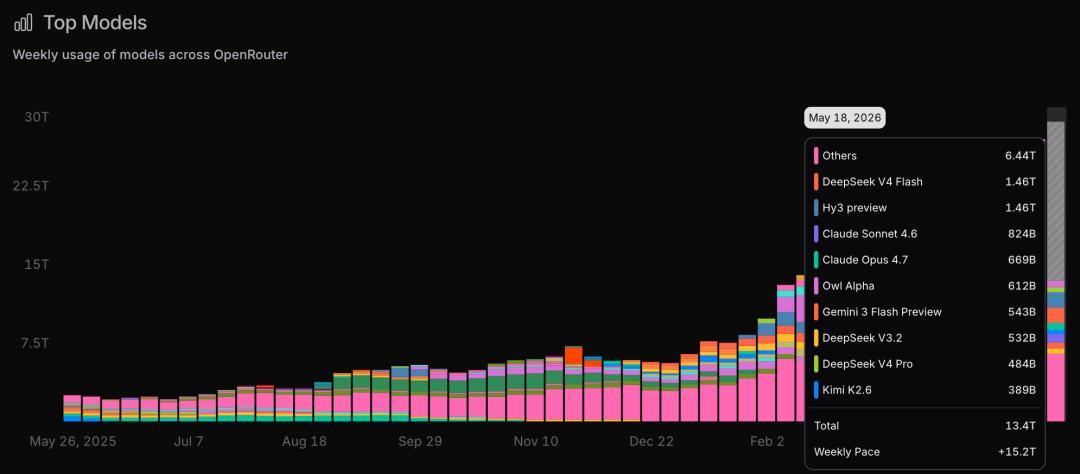
▲ Latest weekly call data for the large model (Source: OpenRouter)
However, the booming demand did not immediately translate into healthy cash flow.
As Baidu founder Robin Li said at the Baidu AI Developer Conference in May this year: " Tokens do not necessarily represent the end game. They represent costs, not benefits ; they measure inputs, not outputs."
Reality has also confirmed this judgment: taking Zhipu as an example, its total operating revenue in 2025 reached 724 million yuan , a year-on-year increase of 131.9%, but its adjusted net loss in the same year was still as high as 3.182 billion yuan ; MiniMax's revenue in 2025 was 79.04 million US dollars (approximately 537 million yuan), but its loss reached 250 million US dollars (approximately 1.7 billion yuan).
To some extent, the large model industry is now facing a common problem: for every dollar earned, there may be a loss of three to four dollars.
Even more brutally, despite the capital market's willingness to pay for "AI narratives," the market remains extremely sensitive to changes in model capabilities. Following the release of DeepSeek-V4, the share prices of Zhipu and MiniMax, which were listed on the Hong Kong Stock Exchange, plummeted by more than 9% for two consecutive days.
But the giants can't stop.
ByteDance's AI infrastructure spending in 2026 is rumored to be approaching 200 billion yuan ; Xiaomi's Lei Jun announced in March this year that Xiaomi's R&D and capital investment in the AI field will exceed 16 billion yuan this year .

▲Image source: Lei Jun's Weibo
At this game of strategy, the risk of being disrupted by "not investing in AI" is perhaps far better than the growing pain of "losing money in AI."
06. Are users willing to pay? AI, accustomed to offering free services, is finally eyeing the wallet.
Finally, and most importantly: when manufacturers start handing out "bills," are users willing to pay?
Over the past year, a large number of AI products have rapidly acquired customers through subsidies, free quotas, and high-frequency marketing, and users have also formed a default habit: AI should be cheap, preferably free.
When Doubao started charging fees, the backlash from public opinion was a particularly vivid reflection of this. After Doubao's trial launch of paid services, hashtags such as "Doubao is stupid and still charges fees," "Doubao makes charging fees sound so refreshing," and "Doubao gives three answers to the same question" trended on Weibo.

Some people joked: "DeepSeek woke up to find that its competitor had committed suicide . "

Some people say: If Doubao is gone, there's Qianwen; if Qianwen is gone, there's Yuanbao; if Yuanbao is gone, there's DeepSeek.
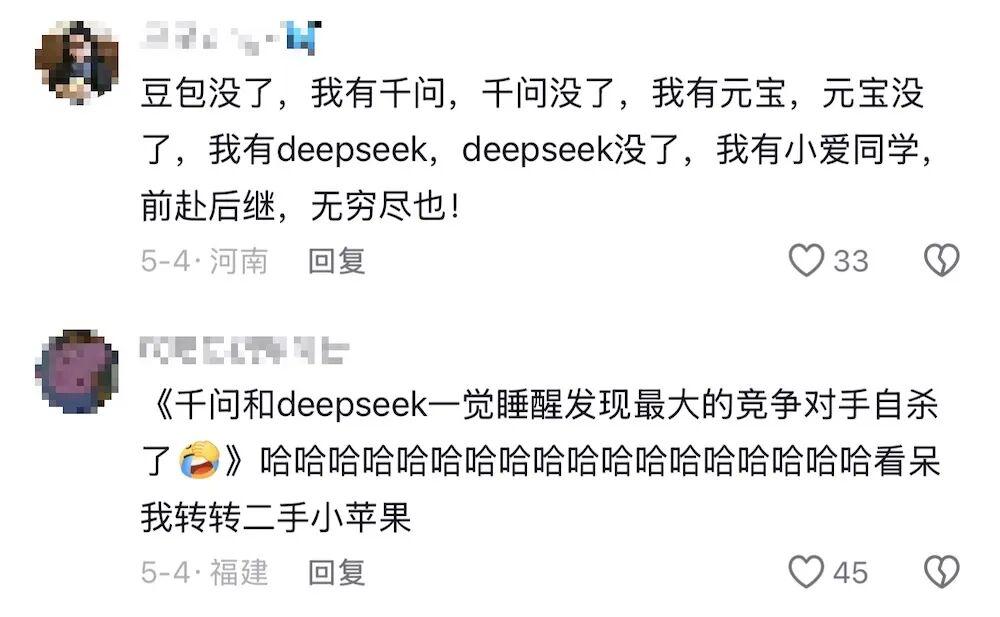
These seemingly joking remarks also reflect the extremely low cost of user migration at present —if you think Doubao is expensive today, you can seamlessly switch to Qianwen, Kimi or DeepSeek tomorrow.
What's more troublesome is that the model itself still has a lot of uncontrollable problems.
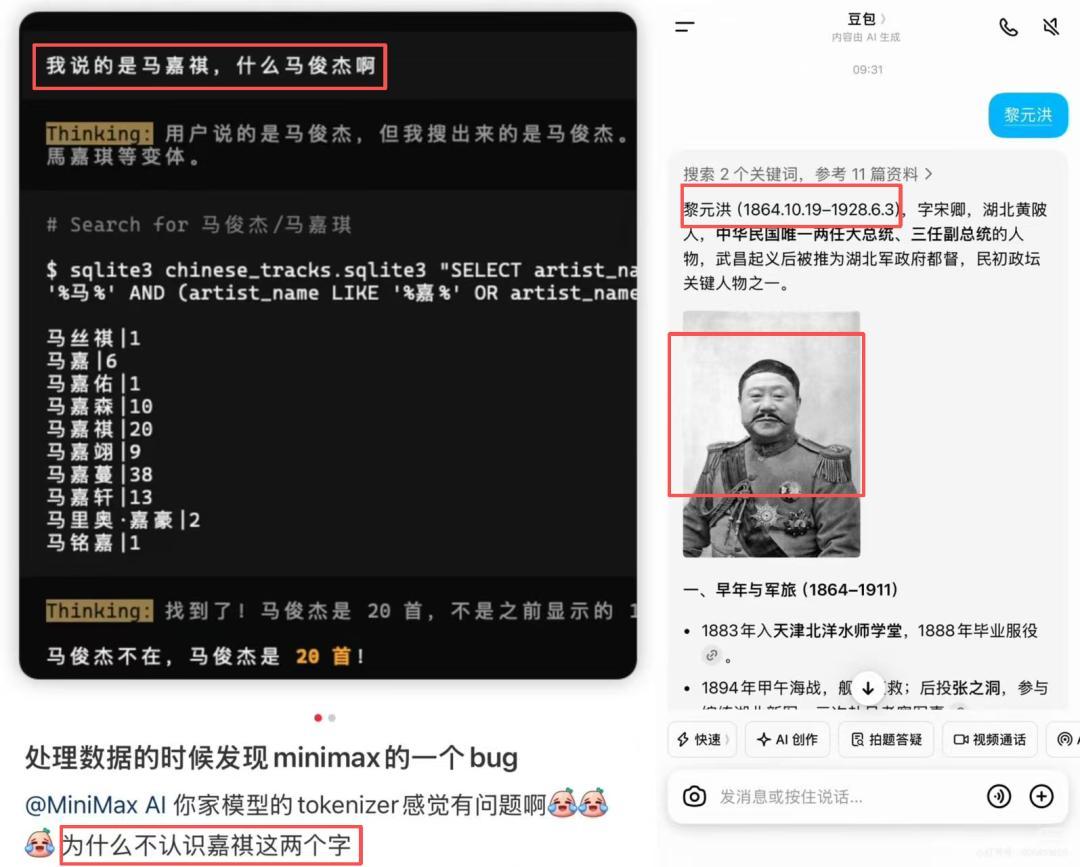
▲Image source: Popular posts on Xiaohongshu (Little Red Book)
When it's free, the illusion is fun; when it's charged for, the illusion becomes a product malfunction.
At the same time, ethical, security, and copyright issues are becoming another layer of more complex pressure.
Everyone knows that AI will change the world, but there are still many obstacles to getting the public to pay for "not-so-stable intelligence" as reliably as they pay for water, electricity, and gas.
07. Conclusion: Price increases are not the end; a healthy business model is hard to find.
Whether it's subtly reducing benefits or openly launching premium subscriptions, the trend of large-scale AI companies charging users is irreversible. However, the problem is that price increases alone cannot truly resolve the commercialization anxieties of AI companies.
Faced with high computing costs, fragile user loyalty, and flaws in the models themselves that have not yet been fully overcome, today's AI industry is frantically raising funds in the capital market to stay afloat while meticulously haggling over every penny in its billing statements.
The big picture has been revealed. However, the business model that can stop the industry from bleeding out and allow it to operate healthily is still shrouded in mystery.