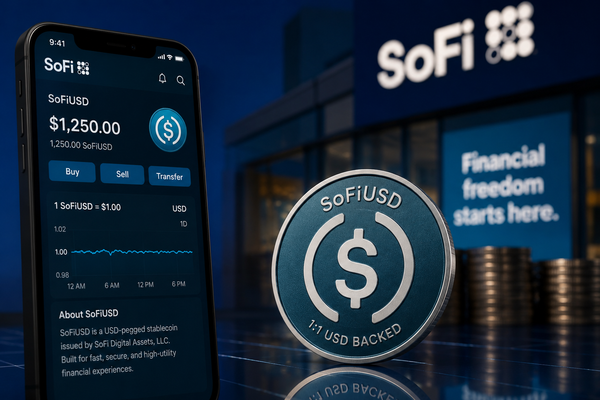
U.S. fintech firm SoFi has ignited competition in the banking sector's digital asset market by launching its own stablecoin, SoFiUSD. It is drawing market attention as the first instance of a U.S. bank directly offering its own issued stablecoin within its banking app.
This launch demonstrates that the center of gravity for stablecoins is shifting from cryptocurrency exchanges and DeFi to traditional financial apps. Users can buy, store, and convert dollar-based stablecoins within the SoFi app without going through a separate exchange. It is a structure where bank accounts and digital dollars are connected within a single app.
SoFiUSD is a stablecoin pegged 1:1 to the US dollar. Currently operating on the Ethereum and Solana networks, it is highly likely that its scope of application will expand into the areas of remittances and payments in the future. It can be viewed not merely as a simple investment product, but as a form closer to 'digital cash' integrated into banking services.
This case is significant because it indicates that banks no longer view stablecoins solely as products of the external cryptocurrency market. Previously, privately issued stablecoins such as USDT and USDC played a key role in exchange liquidity. However, SoFiUSD can be integrated with deposit, payment, remittance, and investment services through banking apps. This effectively marks the beginning of a trend in which stablecoins are incorporated as a fundamental function of financial platforms.
Particularly as discussions on the institutionalization of stablecoins gain momentum in the United States, the direct entry of the banking sector holds significant symbolic importance. As regulations become clearer, banks and fintech companies can retain customers through their own stablecoins, lower payment and remittance costs, and jump into the global competition for digital financial infrastructure.
This holds significant implications for the Korean market as well. Domestically, discussions regarding KRW stablecoins, bank-led digital asset infrastructure, and Real-World Asset Tokenization (RWA) are proceeding simultaneously. As bank app-based stablecoin models have become a reality in the United States, it is highly likely that the domestic financial sector will also consider new financial services combining KRW stablecoins with RWAs such as gold and bonds.
Ultimately, the launch of SoFiUSD goes beyond the mere release of a single coin. It signals a shift in stablecoins from being liquidity tools for exchanges to becoming payment and remittance infrastructure within banking apps. The next wave of competition in the digital asset market will no longer be limited to simply "which coin gets listed." Moving forward, the key battleground is expected to be who can make stablecoins feel the most natural to use within banking apps.