Three and a half years after the explosive growth of generative AI, the market has entered a new point of divergence: optimism continues to accelerate, while skepticism is accumulating. Simply judging whether a "bubble" has arrived is insufficient to explain the current complexity. The "AI Bubble and Divergence" series will explore key variables from different perspectives—market, technology, industry, and companies. This article is the first in the series.
Article by: Xiaojing
Article source: Tencent Technology
On June 9, the South Korean KOSPI index rebounded sharply, with intraday gains approaching 5% at one point; KOSPI 200 futures rose by 5%, triggering a buy sidecar and suspending algorithmic trading for 5 minutes. The previous trading day (June 8), the KOSPI had fallen by more than 8%, dropping below 8000 points.
Over the past two years, South Korea has been arguably the most sensitive amplifier for global AI transactions: Nvidia and HBM have risen; AI server production expansion has boosted SK Hynix's stock price; and rising storage prices have rewritten the valuation logic for Samsung and Micron. It has both fueled the imagination of global AI infrastructure expansion and addressed market skepticism about whether this expansion is overheated.
Therefore, the repeated triggering of the trading cooling mechanism in the South Korean stock market between rises and falls reflects the growing divergence in global capital markets regarding AI.
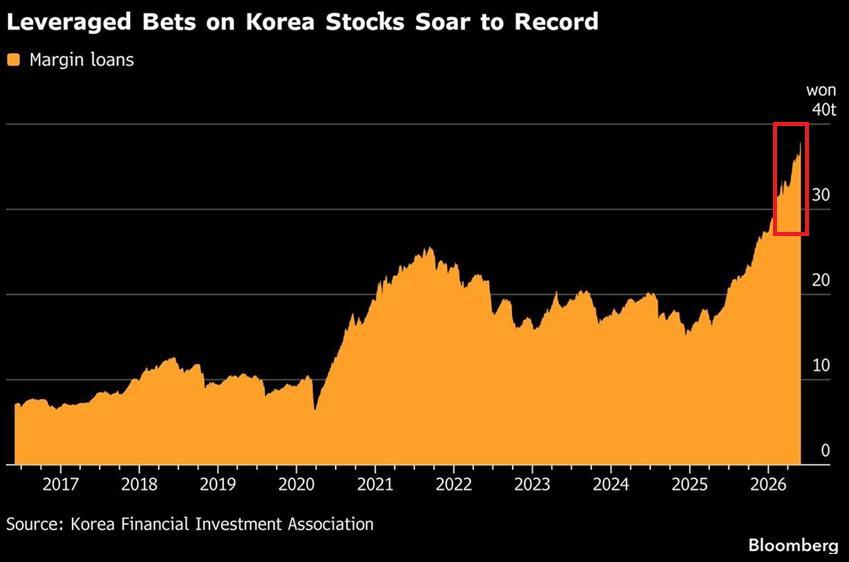
Chart: The margin trading balance of the South Korean stock market has risen to a record high.
On the one hand, AI remains the most certain investment theme. From chips, storage, and cloud computing to large-scale companies, almost all core assets have been reintegrated into the valuation framework of "AI infrastructure".
As long as the demand for computing power continues to grow, today's capital expenditures, supply chain price increases, and high valuations can all be interpreted as upfront investments for future growth.
On the other hand, doubts are also accumulating.
AI is becoming increasingly expensive. Giants continue to revise their capital expenditures upwards, valuations of large-scale companies continue to rise, and AI upstarts are lining up for IPOs.
Three and a half years into the generative AI boom, there have been three rounds of serious discussions about a bubble. Each round has had a clear triggering event, a clear logical chain, and seemingly fatal doubts. Each time, the market has found new hope from the cracks and continued to invest.
This time, judging from the market's reaction, we are already at the center of the fourth round of divergence.
Several investors said, "It's far too early to talk about a bubble. Although it has started to drain the cash flow of giants, their investment is still very determined and accelerating. You should only be wary when you see giants slowing down their investment."
Zhang Yidong, member of the Executive Committee, head of the research department and chief economist of Haitong International, said: "This wave of AI is even greater than the wave of the Internet from 1993 to 2000. In the era of AI, there is no high-low segmentation, only diffusion."
This is the core contradiction in the current AI market: everyone knows that prices are getting more and more expensive, everyone believes that the growth rate will flatten the valuation bubble, and no one dares to get off the train first.
01 Two and a half years, three "bubble theories" and a dangerous consensus
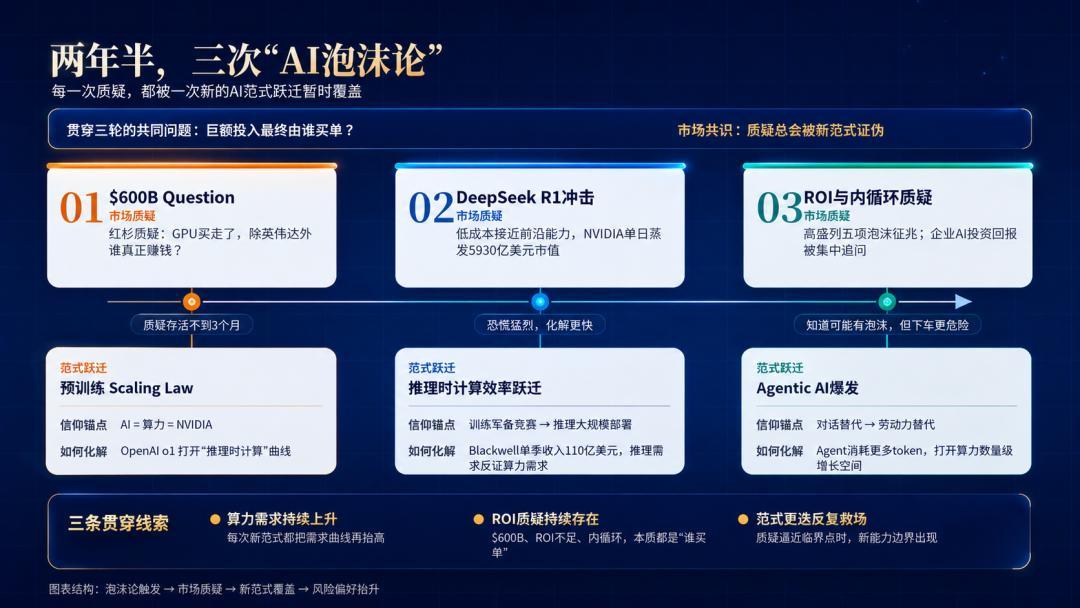
The AI bubble theory has persisted for two years. Each "bubble theory" corresponds to a paradigm shift in the AI industry, as well as the capital frenzy and wavering of faith surrounding this shift.
The first instance was in June 2024. Sequoia Capital published its famous "AI's $600B Question," raising questions for the first time about the massive capital expenditures. Sequoia's question was: based on Nvidia's data center revenue and total cost of ownership of GPUs at the time, the AI industry would need approximately $600 billion in annual revenue to support this round of infrastructure investment.
The prevailing AI paradigm at the time was the pre-training scaling law: the bigger the model, the better; the more data, the better; and the more GPUs, the better.
From the beginning of 2024 until Sequoia Capital raised its doubts, Super Micro's stock price surged by 217% and Nvidia's by 150% during this frenzy. The market's anchor of faith is a simple equation: AI = Computing Power = Nvidia.
The doubts surrounding Sequoia lasted for less than three months.
In September 2024, OpenAI released o1, marking the emergence of a computational paradigm for inference. Instead of relying on larger models, it emphasized longer thinking time, using post-training combined with reinforcement learning (RL) to break through the ceiling of model capabilities. A new growth curve for AI capabilities opened up, and the market saw a second growth engine for computing power demand.
However, the new paradigm itself quickly developed new cracks—DeepSeek R1 was released, pushing the efficiency of computation during inference to the extreme: it achieved inference capabilities close to those of state-of-the-art models with a training cost of less than $6 million.
On January 27, 2025, Nvidia lost $593 billion in market value in a single day. The second bubble theory began to emerge.
The core of the market's skepticism was: is it really necessary to achieve the same level of AI capabilities with so much computing power? This wave of panic came fiercely, but it dissipated even faster. A month later, Nvidia released its financial report, with Blackwell's quarterly revenue of $11 billion far exceeding expectations. The market used performance to prove that the new inference paradigm would create more inference demand, and the total computing power demand would not decrease but increase.
OpenAI, which is driving the inference paradigm, has become the absolute center of this market trend; whoever signs a contract with it experiences a surge in stock price. CoreWeave completed its IPO with a five-year contract worth $11.9 billion, Oracle set a new record with its $300 billion "Project Stargate" agreement, and Broadcom secured a multi-billion dollar custom chip order.
This time, market confidence was shaken the shortest, and OpenAI created a large number of "concept stocks," with the anchor of faith shifting from "training arms race" to "large-scale deployment of inference."
The third time will be from October to November 2025.
Goldman Sachs released a report listing five signs of an AI bubble: peaking CapEx, slowing corporate profit growth, rising debt among tech companies, the start of a Fed rate-cutting cycle, and widening credit spreads, explicitly drawing parallels to the eve of the 1997 dot-com bubble. A Bank of America fund manager survey included the assessment of "overinvestment" for the first time in 20 years. Wired and The Atlantic published in-depth investigations in the same week, pointing to the same finding: 95% of corporate AI investments have not generated real returns.
The narrative of massive AI investment circulating within the AI industry chain has reached its climax. Nvidia's revenue comes from cloud vendors, cloud vendors' AI revenue growth comes from the expansion of model companies, the valuation of model companies comes from investors, and investors' returns come from the paper revaluation of model companies.
But who is paying for AI upstream?
During their Q3 2025 earnings calls, major US stock market players responded to analysts' probing questions with almost the same statement, while also refuting Goldman Sachs' assessment that CapEX had peaked: "We'd rather overinvest than lose the future." Goldman Sachs also left a small caveat in its report, suggesting that the current situation is more like 1997 than 1999, implying that signs of a bubble have emerged, but it's still some distance from bursting.
In November 2025, the Federal Reserve cut interest rates again by 25 basis points, and liquidity continued to support valuations. The Nasdaq repeatedly hit new highs amidst skepticism. The market consensus became: I know there might be a bubble, but getting off now is more dangerous than staying on.
But what truly dispelled this round of doubts was the arrival of a new paradigm.
In the second half of 2025, Agentic AI will experience explosive growth, transforming AI from conversational AI into digital employees capable of autonomous planning, execution, and iteration. AI will directly replace workflows, raising the income ceiling from "search replacement" to "labor replacement." More importantly, Agents naturally consume dozens of times more tokens than conversational AI, and the demand for computing power has not only not decreased but has opened up room for orders of magnitude growth.
Looking back at the first three waves of the "bubble theory," three threads have always been present.
How long will the demand for computing power last? Who will bear the huge AI expenditures and what will be the return on investment? Will large-scale models usher in a new paradigm breakthrough?
After three waves of discussion, a dangerous consensus has emerged in the market: "Doubts will always be quickly disproven."
Behavioral finance experience shows that investors who re-enter the market after a panic often have a higher risk appetite than before, because they have "verified" that the panic was wrong.
02 The Fourth AI Bubble and Three Cracks
The market has experienced sharp fluctuations in the past few trading days.
The crack first appeared between the "profits" and "cash flow" of tech giants.
In the Q1 2026 earnings season, tech giants are seeing record profits while their cash flow is nearing zero. Amazon's free cash flow plummeted 95% year-over-year, and the four major tech giants are burning through a combined $2 billion per day. The "net profit growth" of some of these giants is being interpreted as a paper revaluation of their investments in AI companies, using the returns on AI investments to justify their investment decisions—a circular argument.
Goldman Sachs provided figures in April: approximately 40% of the expected earnings growth of the S&P 500 in 2026 will come from the industry chain transmission effect of AI-related capital investment. Multiple investment banks and media outlets estimate that by 2026, the AI-related capital expenditures of several major hyperscale cloud vendors will have reached the level of over $600-700 billion.
One media commentator remarked, "Silicon Valley tech giants are so poor they only have profits left." This also means that the overall growth expectations of US listed companies are built on the same foundation; AI CapEx can only increase, not decrease, and a change in one part affects the whole.
Morgan Stanley points out that the CapEx-to-revenue ratio of hyperscale enterprises will reach 34% in 2026 and 37% in 2028, officially surpassing the historical peak of 32% during the dot-com bubble in 2000. Between 2026 and 2028, the total spending on AI infrastructure by just the five largest companies will reach $2 trillion.
Even more concealed is that the five companies have nearly $1 trillion in off-balance-sheet lease commitments, namely long-term contracts for data centers that have not yet been built, which do not appear on any of their balance sheets.
Global AI usage is surging, and many companies are calling for "token maxing." Fomocy and fear of being left behind by AI are spreading, with CEOs vying to swipe their employees' cards to "push tokens."
However, in the "tokenmaxing" movement, a large amount of consumption comes from systemic redundancy within the Agent architecture. Over-designed Harness has created a huge bubble in the amount of token calls for large models. No organization has yet broken down the ratio of "effective computation" to "architectural idleness."
Uber burned through its entire annual AI coding budget in the first four months of 2026. Driven by token maxing, engineers began using tools like Claude Code as parallel labor: multiple tasks running simultaneously, multiple worktrees running concurrently, and agents autonomously searching, generating, reporting errors, and fixing bugs for extended periods. While AI usage appeared to increase, the finance department struggled to immediately determine the quantifiable output ultimately generated by these tokens.
The number of calls is a core indicator for valuing model companies, but if this indicator itself is inflated, how reliable is the trillion-dollar valuation built on it?
Whether the Agentic paradigm's narrative of improving enterprise productivity is truly effective is the second crack in the market.
The frenzy in the capital markets continues. Anthropic is reportedly valued at nearly $965 billion and has secretly filed for an IPO. OpenAI has also secretly filed for an IPO, with a post-financing valuation of $852 billion.
Clearly, the market is paying full price for a future that has yet to materialize. This doesn't necessarily mean a crash, but it could indicate extremely limited room for error.
“All great technological changes create bubbles. No one can predict them perfectly accurately. You either invest heavily to grab market share without worrying about whether you’re spending too much, or you underinvest and then lose market share,” said Ray Dalio, founder of Bridgewater Associates, in an interview on June 3.
Dalio believes that the bubble bursts during the process of investors trying to convert their paper wealth into cash, and the current AI-driven market "is moving along this path," even though AI itself "is a remarkable technology."
From this perspective, the long-term value of technology and short-term valuation bubbles can coexist, just as the internet itself profoundly reshaped the global economy after the dot-com bubble burst.
Discussing the bubble of generative AI from a macro perspective is a topic the media likes, but it is not a "valid topic" in the eyes of investors.
Peter Thiel believes that "AI technology is real, but the market has already priced in the next 15-20 years." In Q3 2025, he liquidated his entire Nvidia holdings, $100 million, representing 40% of his fund's portfolio, while also cutting 76% of his Tesla holdings, reducing his total portfolio by 65%. He accurately predicted the dot-com bubble in 1999; will this prediction be different? There is no answer yet.
But one thing is certain: Peter Thiel miss the pump on the Agent paradigm frenzy that was set to begin at the end of 2025.
It's not just Thiel. Berkshire Hathaway's Q1 2026 report shows that Buffett's cash holdings have ballooned to a record high of $397.4 billion, representing 59% of his total assets.
The positive long-term trend of technological evolution does not mean that investors will not take profits or reduce positions in the short term. The contradiction between long-term trends and short-term investment strategies is the third crack in the market.
Above these three cracks, the market's nerves have begun to tighten. As US interest rate expectations rise and the market begins to question whether AI capital expenditure is overheated, South Korea, as one of the "purest-blooded" markets in this AI wave, has experienced significant volatility. Its rise stemmed from its belief in AI, and its crash also arose from the erosion of that belief.
Investment and trading have thus entered an extremely difficult phase.
Many experienced investors still firmly believe that "the AI bubble hasn't arrived yet." However, judging whether AI is a bubble or undervalued is completely different from establishing an effective investment system. The former is about directional judgment, while the latter is a comprehensive test of timing, position sizing, valuation, cash flow, and exit window.
In a market where faith remains but volatility is heightened, correctly predicting long-term trends doesn't guarantee that most people can weather short-term pullbacks. The fourth generative AI bubble may not yet have arrived, but the time to be vigilant has come. Experienced and adaptable captains can navigate turbulent waters to find treasure, but ordinary sailors may perish in the storm.