Written by: Ye Zhen
Source: Wall Street News
On its second day of trading, SpaceX's stock price continued its strong momentum from the first day, pushing its market capitalization past the $2.5 trillion mark and officially placing it among the top six most valuable listed companies globally. This unprecedented mega-IPO, coupled with extremely low initial free float, is bringing a rare battle for control of the global capital markets.
SpaceX shares closed at $192.46 on Monday, surging nearly 20% and more than 42% above the IPO price of $135, adding $412 billion to its market capitalization in a single day.
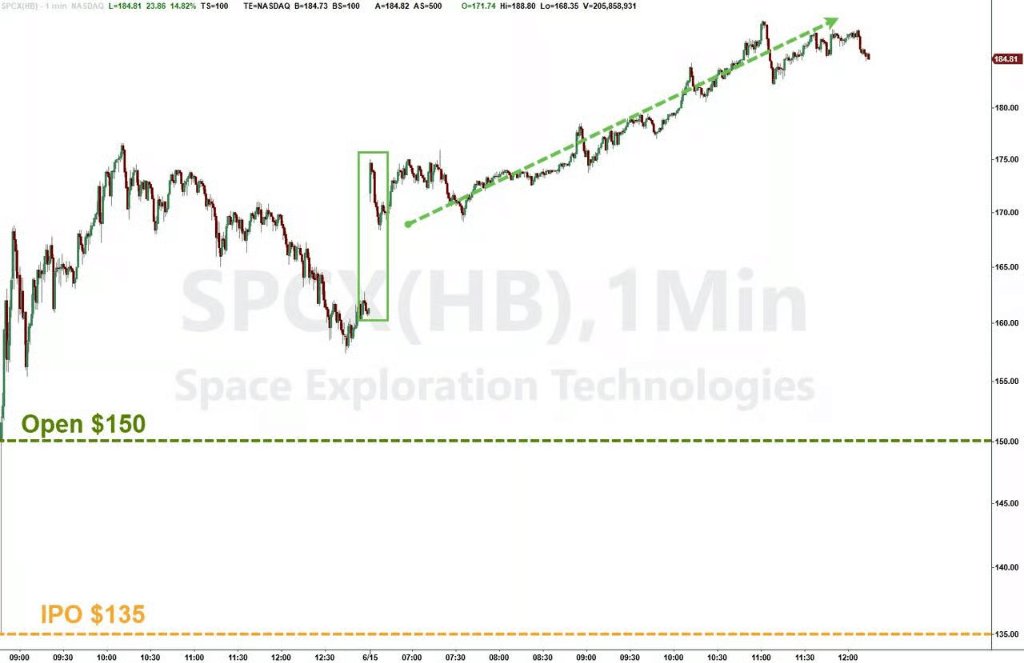
After the underwriters fully exercised their over-allotment option (greenshoe option), the company raised a total of $86.2 billion, with net proceeds of $85.7 billion after deducting underwriting fees. This strong performance not only directly boosted confidence in the artificial intelligence sector, which has driven the market rally this year, but also set the tone for a revaluation of the entire tech giants.
The market's fervent demand has made founder Elon Musk the world's first trillionaire, with a net worth more than three times that of Larry Page, the world's second richest person and co-founder of Google. This successful IPO has significantly alleviated Wall Street's concerns about the market's ability to absorb mega-IPOs and paved the way for potential listings later this year by major AI competitors such as Anthropic and OpenAI.
However, amid a strong start and expectations of passive buying, market observers warn that the stock's volatility will increase dramatically in the coming months. In this capital feast meticulously designed by Wall Street, investors need to pay close attention to two key dates approaching in July. These not only involve the clash between massive passive funds and a period of limited shareholding, but may also uncover a much larger merger strategy behind Musk's business empire.
Retail buying frenzy resonates with the macroeconomic environment
In the first two trading days after the listing, retail investors' enthusiasm for long was extremely high.
According to data from Vanda Research, the number of SpaceX shares bought by retail investors in the first two days was equivalent to the total retail buying volume of the entire U.S. stock market last week. Max Gokhman, senior vice president of investment solutions at Franklin Templeton, pointed out that the huge initial demand is not surprising, as a large number of investors who previously lacked access to investment channels have accumulated off-exchange.
In addition to the influx of funds at the micro level, the macro-geopolitical and liquidity background also provided support for the soaring stock prices.
Following the announcement of an agreement between the United States and Iran to reopen the Strait of Hormuz, and market expectations of potentially moderate easing by the Federal Reserve under its new chairman Kevin Warsh, both the S&P 500 and Nasdaq 100 indices recorded significant gains. Angelo Kourkafas, senior global investment strategist at Edward Jones, stated that the macroeconomic backdrop is becoming more favorable, and declining yields may encourage investors to continue extending outwards along the risk curve.
July 7: Nasdaq Inclusion in Extremely Low Flow
As the initial frenzy surrounding the IPO gradually cools, the market is about to reach its first crucial juncture with significant trading value: July 7th.
Former Wall Street analyst Alexandra Mertz pointed out that SpaceX's Class A shares issued this time account for only 4.3% of its total market value, which means that the free float will be extremely scarce in the early stages of the listing.
July 7th marks the first trading day after the Independence Day holiday and the 15th trading day since its listing, when the Nasdaq 100 index will officially include SpaceX. According to Bloomberg, Intropic, an index rebalancing forecasting firm, estimates suggest that due to the rapid inclusion of the stock in major indices, the proportion of outstanding shares held by passive investors is expected to surge to approximately 30% after 15 days of trading.
At that time, large index funds such as Vanguard CRSP and FTSE Russell will be required to passively build positions in the open market unconditionally according to the free float adjustment mechanism. The market estimates that this passive buying will amount to between $8 billion and $18 billion. Since early shareholders will still be under lock-up and unable to sell, the free float will drop to its lowest point.
Analysts warn that the convergence of passive fund inflows across the US and historically low float, coupled with AI model predictions, could drive extreme price surges during this period.
Late July: The Real Selling Pressure and Institutional Bottom Line During the Earnings Release Period
The second crucial timeframe falls two business days after the Q2 earnings call, expected in late July. While typical IPO lock-up periods are usually simple, fixed terms, SpaceX's lock-up release schedule is precisely tied to the Q2 earnings conference.
Market rumors suggested that up to 30% of early insider shares would be released from lock-up following the earnings call. However, Alexandra Mertz clarified that approximately 50% of these early insider shares belong to Elon Musk himself, and as the founder, he is subject to a 366-day absolute lock-up period. Therefore, the actual potential for fresh shares to enter the public market is only 10% to 15%.
More importantly, the early major shareholders had a very low willingness to sell.
Renowned investor Ron Baron has clearly stated he will not sell and plans to add $1 billion to his holdings on the open market, while BlackRock has also publicly expressed its intention to buy $5 billion to $10 billion. As Renaissance Capital senior strategist Matt Kennedy stated, the stock has been "priced to near perfection," and marginal buyers will become extremely important as the rocket booster of retail demand detaches and the stock price begins to be affected by the gravity of selling after institutional investors and employees unlock their shares.
Capital Chess Game: A $7 Billion Tax Scandal and Speculation on a "Merger of Equals"
Behind the meticulously planned IPO, Wall Street is closely monitoring Musk's personal financial timeline.
Musk must exercise his stock options under Tesla's 2018 compensation package by August 15th of this year, which would trigger a massive personal tax event of up to $7 billion. The higher the share price of his assets before this crucial date, the more advantageous it would be for him to net his shares or take out a pledged loan.
Market analysts have envisioned a "Goldilocks scenario": during the window between the surge in SpaceX's stock price on July 7th driven by index buying and the influx of new shares during the end-of-July earnings season, SpaceX and Tesla may announce a stock-for-stock merger. This public market arbitrage mechanism would perfectly alleviate Musk's tax burden.
This speculation seems to be hinted at in SpaceX's list of underwriters. The IPO unusually brought in Charles Schwab, Morgan Stanley, and JPMorgan Chase as lead underwriters. Market observers believe that granting these institutions, who previously voted against Tesla's compensation deal, such substantial IPO underwriting shares may be in exchange for their votes in favor of a potential merger at Tesla's November shareholder meeting.
Furthermore, the governance structure outlined in SpaceX's prospectus provides logical support for this potential merger.
SpaceX's Class B shares have 10 times the voting power, and all shareholder lawsuits must be resolved through private arbitration, creating a perfect "founder's defensive fortress." Analysts believe that incorporating Tesla into SpaceX's legal framework is the ultimate capital solution to fundamentally protect Musk's business empire from interference by activist investors and local courts.