The A-share market is about to have its first "pure foundation model" target, and the battle for domestic pricing power has officially begun.
Article author and source: 0x9999in1, ME News
TL;DR
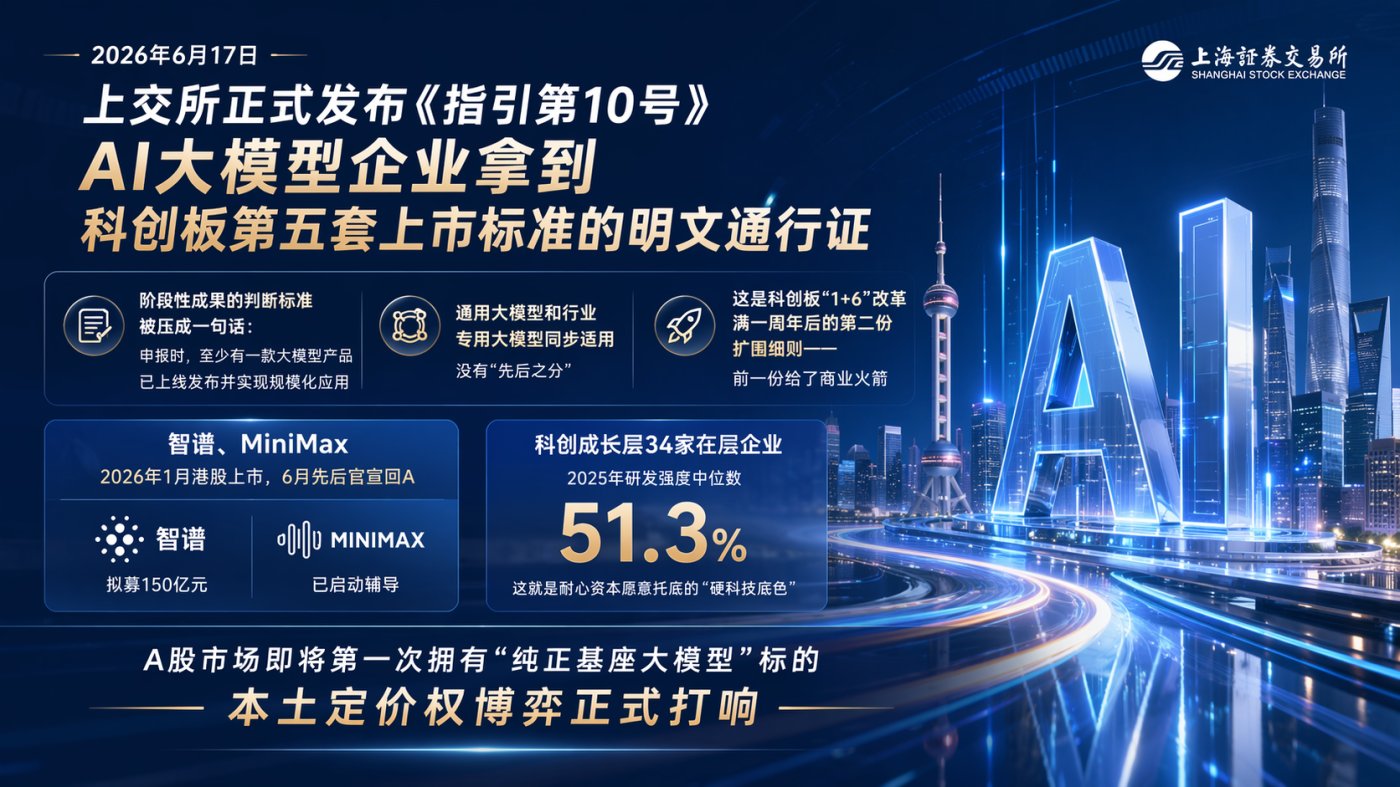
- On June 17, 2026, the Shanghai Stock Exchange officially released Guideline No. 10, granting AI large-scale model companies a clear pass to the fifth set of listing standards for the Science and Technology Innovation Board.
- The criteria for judging interim results have been reduced to a single sentence: at the time of application, at least one large-scale model product has been launched and applied on a large scale.
- Both general-purpose large models and industry-specific large models are applicable simultaneously, without any "priority".
- This is the second set of detailed rules for expanding the scope of the Science and Technology Innovation Board after the first anniversary of the "1+6" reform – the previous one was for commercial rockets.
- Zhipu and MiniMax are scheduled to list on the Hong Kong Stock Exchange in January 2026, and will officially announce their return to the A-share market in June. Zhipu plans to raise 15 billion yuan, while MiniMax has started its IPO preparation process.
- The 34 companies in the Science and Technology Innovation Growth Layer have a median R&D intensity of 51.3% in 2025, which is the "hard technology foundation" that patient capital is willing to support.
- The A-share market is about to have its first "pure foundation model" stock, and the battle for domestic pricing power has officially begun.
This time, the rules came before the valuation.
Let's talk about today's events first.
On the morning of June 17, the 2026 Lujiazui Forum opened. During his speech, Wu Qing, Chairman of the China Securities Regulatory Commission (CSRC), mentioned expanding the scope of the fifth set of standards for the Science and Technology Innovation Board (STAR Market) to the field of artificial intelligence. Shortly after, the Shanghai Stock Exchange officially released Guideline No. 10.
This is not a coincidence; it's rhythm.
On June 18th last year, also at the Lujiazui Forum, Wu Qing announced the "1+6" reforms for the Science and Technology Innovation Board. A year has passed, and from "announcement" to "restart," and then to "expansion," the regulatory actions this year have been consistent. First, the floodgates were opened, and then the first set of detailed rules was issued—the guidelines for commercial rockets have been implemented, and LandSpace became the first commercial rocket company to be accepted after the fifth set of standards was expanded. Then, the second set of rules was issued, this time for AI large-scale models.
Why now?
The answer lies in two sets of realities.
First, for the first time, domestic large-scale model companies have achieved a scale that can be "accepted by the capital market." Zhipu's revenue grew by 131.85% in 2025, and MiniMax's by 158.9%, with both companies entering the Hang Seng TECH Index. Second, to date, there is no "pure foundation large-scale model" listed company on the A-share market; the entire AI concept sector is floating at the application layer, lacking a ballast.
What are regulators waiting for? They're waiting for both of these things to come to fruition simultaneously.
What exactly did the guidelines say?
Break down the key points.
The third point defines the main business: independent research and development of large-scale artificial intelligence models, model services, or model applications. The implication of this point is that you cannot simply use AI as a front to sell other things; the business must be rooted in the large-scale models themselves.
Article 4, How to Prove Technological Advantages. The guidelines require careful demonstration of the model's scale and complexity, performance capabilities, robustness and security, breakthroughs in multimodal and intelligent agents, rankings in mainstream domestic and international evaluations over the past year, continuous iteration capabilities, and data acquisition and governance capabilities.
Note one key phrase: evaluation and ranking.
This semi-officially legitimizes the "ranking results" system. Anyone who has followed rankings like Chatbot Arena, SuperCLUE, and MMLU knows that the comparability of their evaluation criteria has always been controversial. The fact that regulators, knowing this controversy, still included it in their guidelines signifies what? It means that evaluation scores are "necessary but not sufficient"—you can't simply not provide rankings, and even if you do, you must provide other evidence.
Article 5 is the most crucial. In short: at the time of application, at least one major model product must have been launched and achieved large-scale application.
This sentence is the "passport" to the entire guide.
What is meant by "large-scale application"? The guidelines then provided supporting metrics: number of users or deployed devices, recent model call volume, download ranking in mainstream AI communities, and implementation status in real business scenarios.
This is a fairly detailed list. Hugging Face downloads, API call volume, and B2B deployments were all included in the review process.
Articles six through ten consist of the standard four-piece set: approval and registration, industry standing, market potential, commercialization arrangements, and compliance and security. Article six specifically mentions "algorithm registration" and "online evaluation," implying that any model that has not passed the generative AI registration process is not even eligible to enter the market.
Article 11 of the information disclosure requirements contains an interesting phrase: "whether there has been any investment from senior professional institutional investors." This is an implicit "endorsement requirement," which we will discuss separately later.
The most intriguing part of this guide
The fact that it was written in too much detail actually revealed the regulator's real anxiety.
Throughout the text, one phrase appears repeatedly: "reasonable and prudent argumentation and disclosure." These eight characters appear at least three times: once in the context of technological advantages, once in the context of interim results, and once in the context of the industry's overall model.
This is restraint in regulatory language.
It does not stipulate hard numbers (how many calls must be made) or ranking lines (the evaluation must be among the top few), but instead puts the "proof responsibility" on the issuer and the sponsoring institution.
Why write it this way?
Because there's no stable standard for measuring large-scale models. Models are updated annually, evaluations are changed every six months, and usage fluctuates wildly with product growth. Any hard-coded metric may become obsolete after six months.
The regulators chose a "principle-oriented" approach.
This means two things. First, the due diligence responsibilities of intermediaries have been significantly increased—Article 12 lists eight items for the due diligence scope of sponsoring institutions and securities service institutions, using the phrases "prudent due diligence" and "issuing clear opinions." Second, the way issuers tell their stories has changed from "how much money I make" to "whether I can convince investors that I can make money in the future."
This move has brought the valuation game directly to the primary and pre-IPO markets.
One year later, what exactly has changed about the Science and Technology Innovation Board?
Zoom out.
On June 18 last year, Wu Qing announced the "1+6" plan at the Lujiazui Forum. "1" refers to the establishment of a science and technology innovation growth tier, and "6" refers to six supporting reforms, including a senior institutional investor system, a pre-IPO review mechanism, capital increase and share expansion for companies under review, facilitating refinancing, expanding the scope of the fifth set of standards, and expanding investment tools.
A year has passed, and this is what the financial report looks like.
The number of newly accepted IPO applications for the Science and Technology Innovation Board (STAR Market) is expected to increase significantly year-on-year, with 56 to 59 new applications accepted (slight variations depending on the calculation method). Of these, approximately 25 are unprofitable companies, accounting for over 40%. The 34 companies currently listed on the STAR Market Growth Tier achieved a combined revenue of 49.7 billion yuan in 2025, a year-on-year increase of 18%; their median R&D intensity was 51.3%; and their losses narrowed by 18% year-on-year. In the first quarter of 2026, the revenue growth rate of these 34 companies further increased to 35% year-on-year, and their net losses narrowed by 52% year-on-year.
I stared at that R&D intensity number for a long time.
What does 51.3% mean? It means that for every 100 yuan in revenue, over 51 yuan is invested in R&D. Such a company simply wouldn't be eligible for a main board listing—the main board prioritizes stable profitability. But these are precisely the embodiment of new-type productivity.
Let's look at a longer set of data. Since its inception, the Science and Technology Innovation Board (STAR Market) has supported the listing of 62 unprofitable hard-tech companies, of which 28 have already become profitable and exited the STAR Market. The 62 companies have achieved a compound annual growth rate of 18% in revenue over three years, with the median revenue increasing from 592 million yuan in 2022 to 1.068 billion yuan in 2025, nearly doubling.
This is an ecological-level verification.
The fifth set of standards used to be a dedicated channel for biomedicine, but now it has been expanded to commercial rockets and large-scale AI models. The next step is to include quantum technology, biomanufacturing, and embodied intelligence—all of which Wu Qing mentioned in his speech today.
This can be understood as follows: regulators are systematically building a fast track for "technology companies to go public without relying on profits".
Zhipu and MiniMax: The "Target" of This Guidance
Who will be the first to use this channel?
The market already has the answer.
In January 2026, Zhipu (02513.HK) and MiniMax (00100.HK) were listed on the Hong Kong Stock Exchange, raising HK$4.348 billion and HK$5.54 billion respectively. Less than five months after listing, they officially announced their return to the A-share market in June.
Zhipu announced on the evening of June 1 that its board of directors approved an A-share issuance plan, intending to apply for listing on the Shanghai Stock Exchange's Science and Technology Innovation Board and raise 15 billion yuan—12 billion yuan to be invested in the research and development of general-purpose base large-scale models, 2 billion yuan to be invested in the MaaS one-stop service platform, and 1 billion yuan to replenish working capital. The sponsoring institution has changed from CICC as the sole sponsor to a joint sponsorship by Guotai Haitong and CICC.
On May 29, MiniMax signed a tutoring agreement with CITIC Securities, and on May 31, the Hong Kong Stock Exchange announced its preliminary proposal for listing on the Science and Technology Innovation Board.
Present the financial data.
Zhipu's total revenue in 2025 was RMB 724 million, an increase of 131.85% year-on-year; the gross profit margin was 40.96%, far exceeding the industry average; the adjusted net loss was RMB 3.182 billion, an increase of 29.06% year-on-year; if the unrealized loss of RMB 937 million due to changes in the fair value of convertible shares is included, the net loss for the whole year will reach RMB 4.718 billion.
MiniMax's total revenue in 2025 was US$79.038 million (approximately RMB 569 million), a year-on-year increase of 158.9%; over 70% came from overseas; the overall gross margin increased significantly from 12.2% in 2024 to 25.4%; the full-year net loss was US$1.872 billion, and the adjusted net loss was US$251 million. As of the end of 2025, it had served over 236 million users and 214,000 enterprise clients and developers worldwide.
Did you notice?
Both companies have revenues in the range of 500 to 700 million, but their losses are in the billions. This is not "close to profitability," it's "still burning money."
According to any motherboard standard, they cannot be listed on the market.
However, according to the logic of this guideline, they all meet the criteria: Zhipu Qingyan, Hailuo AI, and Talkie are all online and released model products; the number of calls, users, enterprise customers, and community downloads can all support the argument for "large-scale application".
A+H's local pricing
Why go back to A?
At the close of trading on June 2, Zhipu's market capitalization in Hong Kong was HK$629.5 billion, and MiniMax's was HK$209.4 billion. Both companies have seen significant gains in their Hong Kong stock offerings—Zhipu's stock price has risen by 1115.15% from its IPO price of HK$116.2, reaching a high of HK$1993 during trading; MiniMax's stock price has risen by 304.5% from its IPO price of HK$165.
However, liquidity is a major issue. Zhipu's true circulating supply is approximately 2.67%, and MiniMax's is approximately 5.44%. With this liquidity premium, the price is actually determined by a very small portion of the tokens. The upcoming unlocking in early July—5.83% for Zhipu and nearly 50% for MiniMax—will present another challenge.
Returning to A essentially involves doing two things.
First, pricing power. The international capital logic of Hong Kong stocks differs from the industrial capital logic of A-shares. Domestic patient capital in A-shares (insurance companies, social security funds, and industry funds) has a higher willingness to pay for domestically developed AI and a greater tolerance for long-term R&D cycles. This is the true meaning of "domestic pricing." In the past year, 37 new STAR Market ETFs have been listed, bringing the total to over 120, with a total scale of approximately 240 billion yuan. Nearly half of these are held by various medium- and long-term funds—this capital structure is more suitable than that of Hong Kong stocks for supporting large, unprofitable models.
The second point is ammunition reserves. Institutional estimates suggest that the overall market size of large-scale modeling in China will exceed 70 billion yuan in 2026, with a three-year compound annual growth rate of over 40%. However, the computing power expenditure for generational leaps is also growing exponentially—leading large-scale modeling companies typically have annual computing power capital expenditures exceeding 1 billion US dollars. A 15 billion yuan fundraising round sounds huge, but spread over a three-year R&D cycle, it's actually just an entry ticket.
The cost of these rules: what it didn't say
Now, let's talk about something less optimistic.
The basic threshold for the fifth set of standards is "expected market value of not less than 4 billion yuan". The guidelines further add industry status, market space, and commercialization arrangements on top of this – these are all qualitative clauses.
The advantage of qualitative clauses is their inclusiveness, while the disadvantage is their ambiguity.
Where is the blurriness?
First, how is "industry leader" defined? There are more than just one or two leading companies—Zhipu, MiniMax, Moon's Dark Side, Jieyue Xingchen, Baichuan, Lingyi Wanwu, and so on. Besides the two companies already listed on both the A-share and H-share markets, who else can squeeze into this category? Article 7 of the guidelines states "prominent industry position and high ranking," but how high exactly does "high ranking" mean? This will most likely require joint verification by the sponsoring institution and the issuer.
Second, how is "scaled application" quantified? Call volume, number of users, and download volume are all listed, but no thresholds are given. Does 100 million calls count as scaled application? Are 10 million users enough? This leaves a huge margin of error in the review process—the advantage is adaptability to technological changes, the disadvantage is unstable expectations.
Third, how is "clear commercialization arrangements" defined? This is where the most problems arise. Currently, the gross profit margins of mainstream MaaS models vary widely, To G projects have long payback periods, and To C subscription penetration is limited. The guidelines require "no significant underestimation of commercialization expectations," but what constitutes "significant underestimation" is open to interpretation.
My assessment is that this guideline entrusts the decision-making power to a collaborative game involving the "market, intermediaries, and regulators," meaning no one can make the decision alone.
This system has already been tested in the biopharmaceutical field. The fifth set of standards has fostered a group of unprofitable but well-developed biotech companies over the past few years, but it has also encountered pitfalls—companies whose core pipelines have not progressed as expected and whose commercialization has been delayed have all learned valuable lessons.
AI large-scale models are even more difficult to judge than those in biomedicine because they iterate faster, have less defined competitive advantages, and have shorter capability decay cycles.
A hidden foreshadowing
Finally, let's talk about that less noticeable "experienced professional institutional investor" clause.
This is a crucial part of the "6" in the "1+6" reform of the Science and Technology Innovation Board. The pilot program requires that the issuer acquire shares from SPI (Special Investment Provider), and that SPI can provide professional opinions on the issuer's technological innovation capabilities. Article 11 of the guidelines lists "whether or not the issuer has acquired shares from experienced professional institutional investors" as a key point in information disclosure.
This is a system arrangement that prioritizes "professional endorsement".
In other words: If an AI big model company hasn't even received a single recognized SPI investment, regulators will have to question it—if industry peers aren't interested, why should investors in the public market trust you?
Data has confirmed this: to date, more than half of the newly accepted companies applying for the fifth set of standards have disclosed relevant information about SPI.
This move poses no threat to leading companies, who are backed by a mixed lineup of Alibaba, Tencent, Hillhouse Capital, Sequoia Capital, and state-owned enterprises. However, for players below the mid-tier level, this implicit selection process will be extremely brutal.
The expansion of the Science and Technology Innovation Board this time does not mean "loosening the reins".
In conclusion
Returning to the initial question: What is the most important significance of this guideline?
It's not about allowing one or two companies to go public. That's a result, not a cause.
Its essence is to change the "pricing coordinate system" of the Chinese capital market for large AI models from a profit-driven approach to a capability-driven approach. The question of "how much money you need to earn to be eligible" has been replaced by "the model is online, users are using it, it has passed the filing process, and institutions are interested in you."
When the pricing benchmark changes, the valuation logic will change accordingly; when the valuation logic changes, the flow of funds will change accordingly; when the flow of funds changes, the pace of research and development will change accordingly.
With a push of four or five meters, the entire chain moves.
But don't forget that guidelines are just rules, and rules cannot guarantee results. Ultimately, what determines whether a company can succeed is the generational leap in its model capabilities, the construction of a commercialization loop, and continuous investment in computing power and data.
Capital can accelerate everything, but it cannot accelerate originality.
Regulators can provide rules, but they can't provide answers.
Reference source:
- Shanghai Stock Exchange, "Shanghai Stock Exchange Issuance and Listing Review Rules Application Guidelines No. 10 - Application of the Fifth Set of Listing Standards for the Science and Technology Innovation Board to Large-Scale Artificial Intelligence Model Enterprises", June 17, 2026.
- Sina Finance, June 17, 2026: "Shanghai Stock Exchange Releases Guidelines for Reviewing the Application of the Fifth Set of Listing Standards for Large-Scale Artificial Intelligence Model Enterprises to the Science and Technology Innovation Board".
- Jiemian News/Sina Finance, "Embracing Hard Technology, Expanding the Fifth Set of Standards, the '1+6' Reform of the Science and Technology Innovation Board Yields Impressive Results on its First Anniversary," June 17, 2026.
- Sina Finance, "The Countdown to the Return of the 'Twin Stars' of Large Models to the A-Shares Market: Zhipu Plans to Raise 15 Billion Yuan, MiniMax Starts Tutoring," June 2, 2026.
- Sina Finance, "A First-Year Review of the '1+6' Reform of the Science and Technology Innovation Board: The Listing Channel for Unprofitable Companies Reopens, and Patient Capital Accelerates its Gathering," June 12, 2026.
- 21st Century Business Herald, "Wu Qing Presses the 'Restart Button' as the Fifth Set of Standards for the Science and Technology Innovation Board Takes on a New Look," June 18, 2025.
- China Securities Regulatory Commission, "Opinions on Setting Up a Science and Technology Innovation Growth Layer on the Science and Technology Innovation Board to Enhance Inclusiveness and Adaptability of the System", June 18, 2025.
- 36Kr, "The first batch of large model companies are going public. The question is how to value companies like Zhipu and MiniMax?"