Wall Street is drawing a clear line between two of AI’s biggest stock winners. Analysts broadly back Nvidia at current prices and flag Micron Technology as overvalued heading into its June 24 earnings report.
Wall Street’s price targets lay it bare. Nvidia trades near $210. The 69 analysts covering it see $300, about 43% higher.
Meanwhile, Micron is the mirror image. It sits around $1,133, but the 49 analysts on it call fair value just $949, roughly 16% under today’s price.
Why Analysts Back Nvidia
NVIDIA powers nearly 90%+ of AI training compute globally. Its reported fiscal first-quarter revenue of $81.6 billion is up 85% year over year. The next-generation Vera Rubin GPU platform is set to ship later this year, with CEO Jensen Huang telling analysts that every major frontier model company will adopt it immediately.
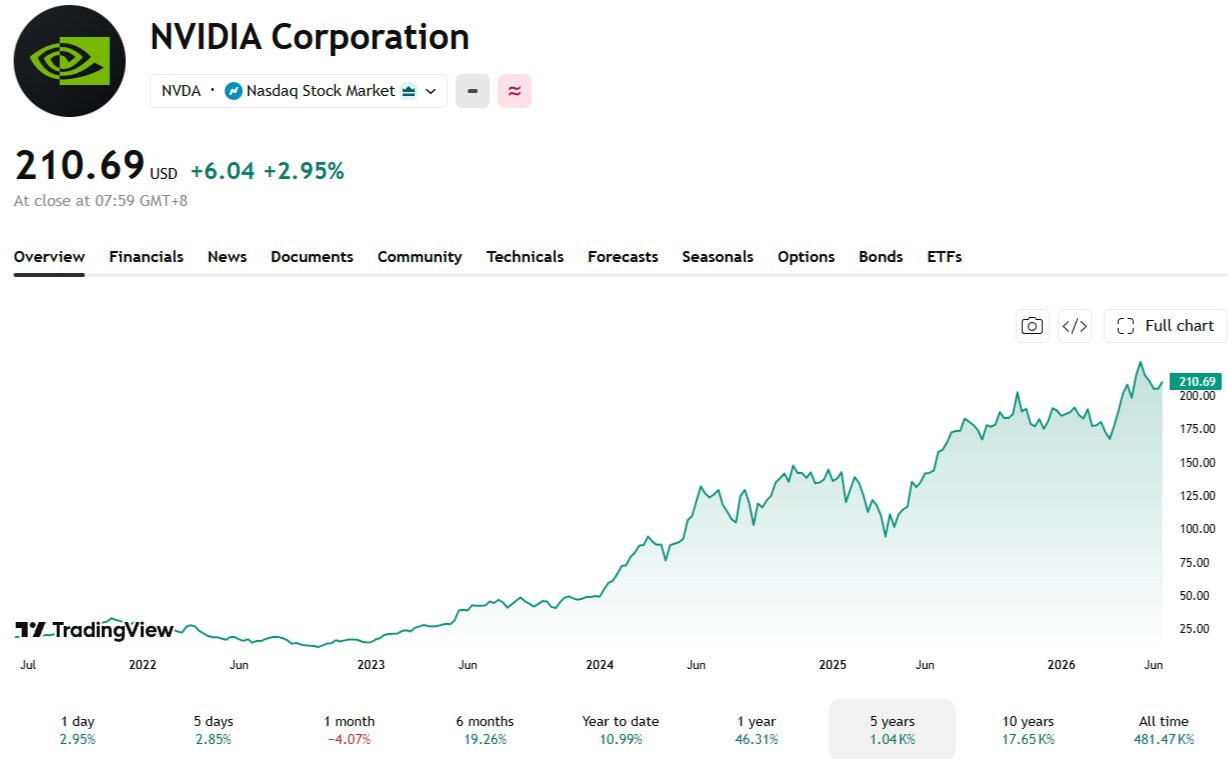 Nvidia is up over 1,000% in the last five years thanks to the AI boom. Image Source: Trading View
Despite that momentum, Nvidia trades at 32 times earnings, essentially its cheapest valuation in seven years. Wall Street forecasts adjusted earnings growth of 43% annually through fiscal 2029.
Why Analysts Are Cautious on Micron
The skepticism on Micron comes down to one structural problem: memory chips are commodities. Products from different manufacturers are largely interchangeable, leaving Micron without a durable competitive advantage.
Industry leaders Samsung and SK Hynix both gained DRAM and NAND market share at Micron’s expense in the most recent quarter. Their larger production capacity gives them a structural edge. The HBM memory boom is expected to peak around 2028, after which sales are projected to drop sharply.
According to The Motley Fool, Micron’s adjusted earnings are forecast to grow at 13% annually through fiscal 2029. At 48 times earnings, that trajectory makes the current valuation look stretched against Nvidia’s cheaper multiple and faster growth outlook.
Micron’s June 24 report may shift some of those targets. But the structural divide Wall Street sees between the two stocks is unlikely to close on one quarter alone.