At the beginning of 2023, the popularity of Layer 2 remains high after long preparations. Some people have called 2023 the year of "Layer 2". In addition to Arbitrum 's AirDrop and Coinbase 's entry, the undigested Layer 2 attention has poured into StarkNet, Zksync and other L2 projects that are already at the center of the Web3 community's vision. In the past few days, the interest rate hike by the Federal Reserve has caused less than one-third of the noise on social media.
At this time, we take a step back and keep a distance from the market situation. From the perspective, we may get new inspiration: What is "Layer"? Among the many expansion plans, which ones are structural changes; and which ones are functional changes. The maturity of the L2 expansion ecosystem means the solidification of the structure or a new round of adjustments?
We can start from the concept of "Layer 3". The concept of "Layer 3" comes from StarkWare , which wrote an article titled "fractal scaling" at the end of 2021, and defined L3 as an application-specific layer built recursively on L2. layer), which particularly emphasizes the practicality of recursive proofs in the multi-layer architecture of the blockchain, so that it may be extended beyond L3 (It's layers all the way down!).
One year after the concept of Layer 3 was proposed, that is, at the end of last year, Vitalik proposed three visions of "Layer 3" in a new article (Original text: https://vitalik.ca/general/2022/09/17/layer_3.html ; Chinese version: https://www.ethereum.cn/Layer 2/layer 3 )
L2 is used for scaling, and L3 is used for custom features such as privacy. The L3 of this vision is not intended to provide "scalability squared"; rather, there will be one layer of the stack to help applications scale, and then there will be separate layers of the stack for custom functionality required by different use cases.
L2 is used for general-purpose expansion, and L3 is used for customized expansion. Customized expansion may take different forms: dedicated applications can use virtual machines other than EVM for computing, and Rollup data compression will also be optimized around the data structure of customized applications (including converting "data" from "proof" to , and completely replace all proofs of transactions in each block with a single SNARK in each block).
L2 is used for trustless expansion (such as Rollup), and L3 is used for weak trust expansion (such as Validium). Validiums refer to systems that use SNARKs to verify computations, but place data availability on a trusted third party or committee. In my opinion, Validium is vastly underestimated: in particular, a centralized server running a Validium proof generator and submitting hashes to the chain on a regular basis may indeed serve many "enterprise blockchain" applications well. The security index of Validium is lower than that of Rollup , but it is much cheaper in comparison.
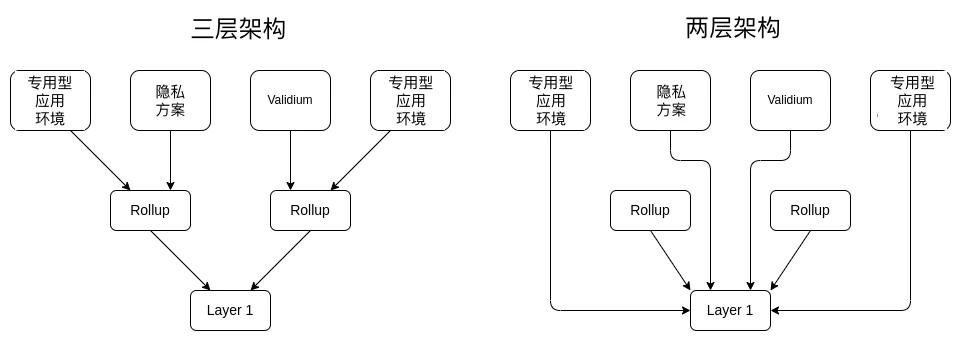
In the discussion that follows, Vitalik gives a comparison chart. He believes that in the picture on the left (three-tier architecture), dedicated application environments or privacy solutions, Validium and other sub-ecosystems can exist in the Rollup of Layer 2, which means that cross-domain operations at the next layer of the Rollup can be performed without going through the layer 1, thereby reducing the cost of operation. For ZK Rollup , this is a better solution, especially in balancing batch interval and gas fee overhead (by nesting another ZK Rollup in a ZK Rollup , layer by layer from the outer layer to the inner layer Packaged proofs, no need to submit proofs to L1 frequently, only read L1 state root without writing transactions). Of course, not all Layer 2s need to apply such a solution, and not only this solution can solve the corresponding problem. For Layer 2 such as Optimism , due to the existence of the fraud proof window period, the application of Layer 3 has more complexity in terms of time and technology .
In this article by Vitalik, StarkWare's architecture is given high marks (his blog post itself has input from the StarkWare team). StarkWare extends the concentric circles up to L4. Except for L1 being Ethereum, StarkWare's own ecology ranges from L2 (public StarkNet) to L3 (application-specific StarkNet, Rollup or validium StarkEx, private StarkNet, etc.), and L4 ( Similarly, private StarkNet is also classified as a fourth layer, it is not a scaling requirement, nor does it need to be packaged into the public StarkNet layer of L2).
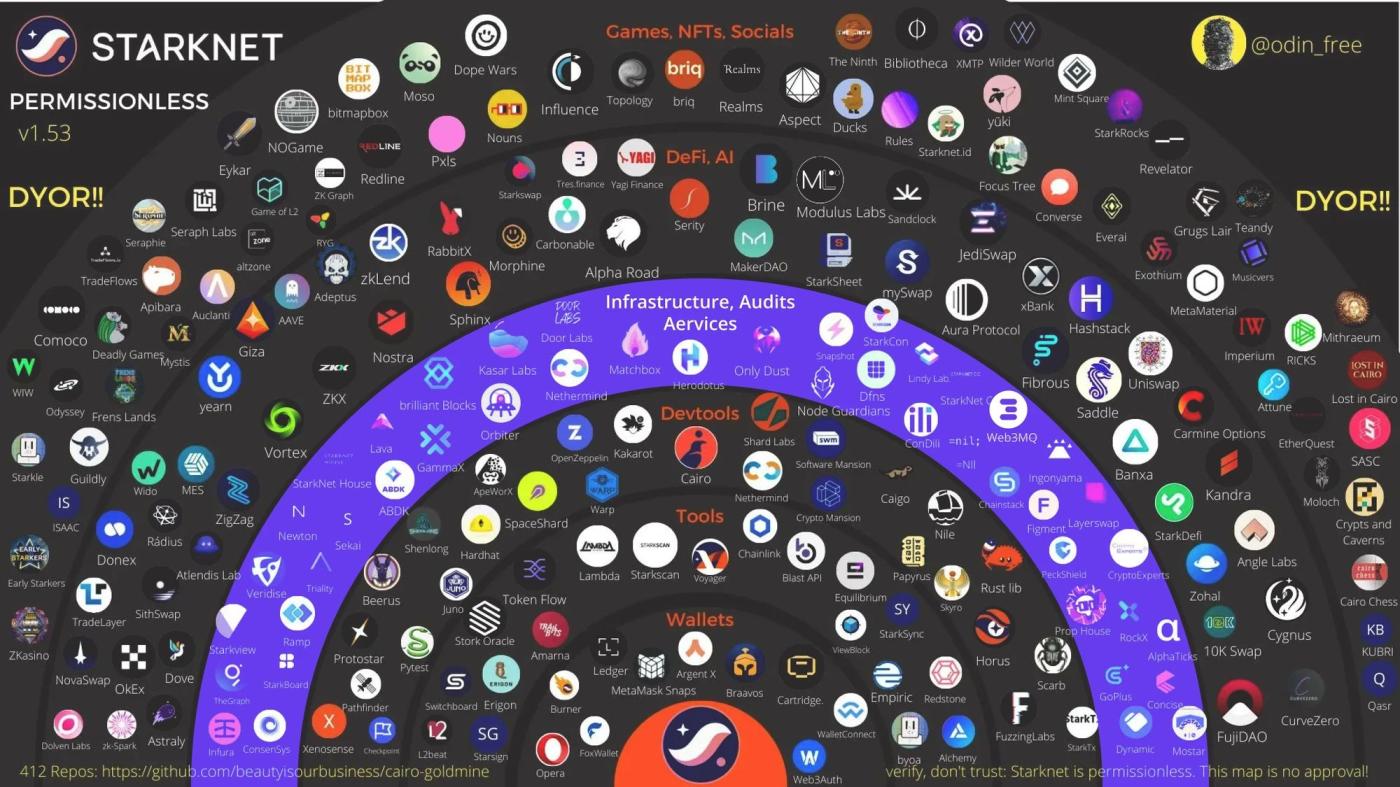
In StarkWare's ecology, apart from the centralized/decentralized services of its own StarkEx and StarkNet, there is another important link, namely the application-specific StarkNet. StarkWare has actively expanded its ecosystem in recent months and has achieved fruitful results:
App-specific StarkNet one: StarkEx
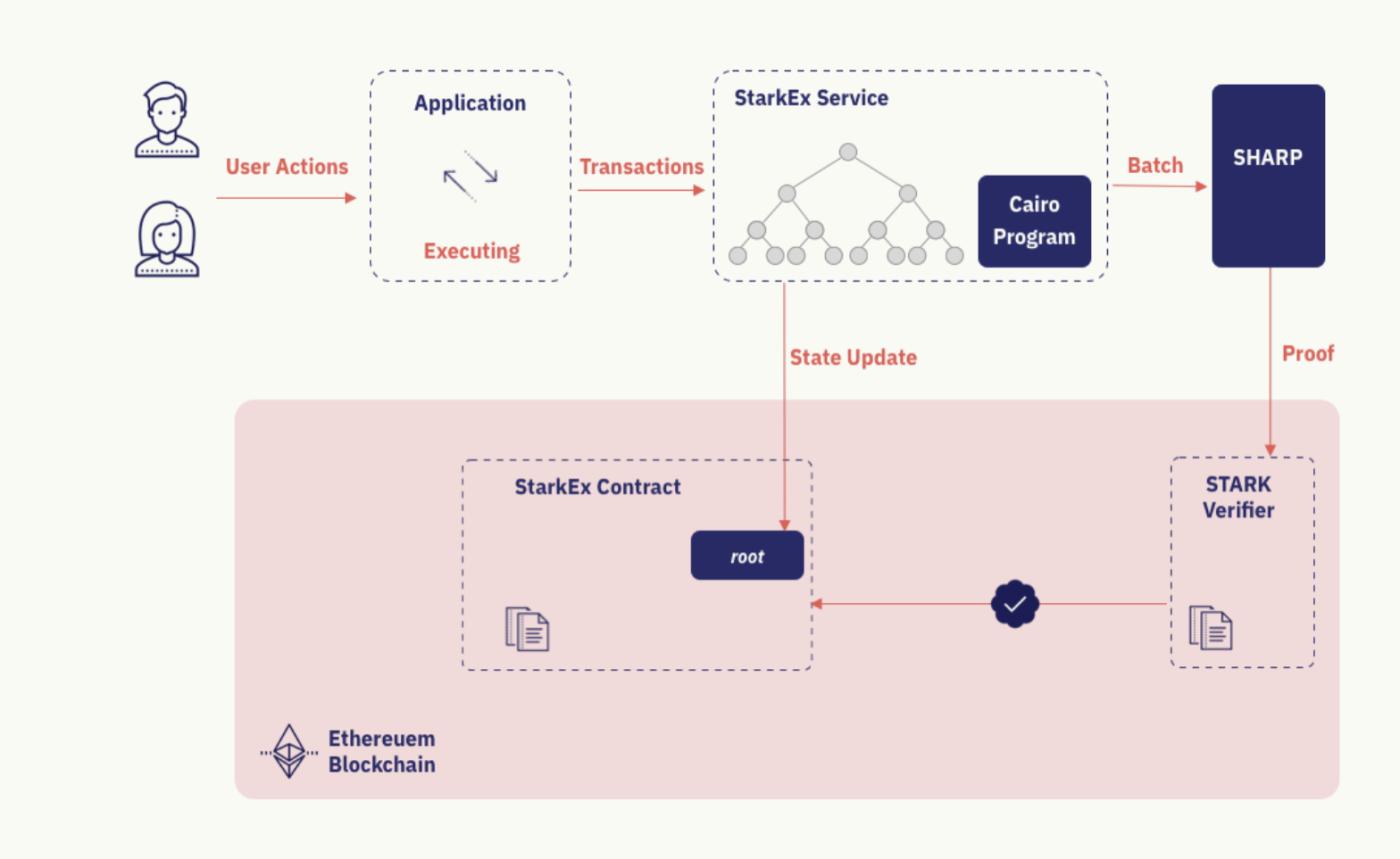
In StarkNet's official tweet, StarkEx is introduced as "a scaling engine for specific applications", which is a scalability engine made for specific applications. Through StarkNet and zk-STARKs, StarkEx is a solution to improve scalability for Dapps (especially DEX ). Off-chain computing, batch processing and other technologies have greatly optimized the gas fee and transaction processing time while being safe and reliable. dYdX , ImmutableX, etc. are all examples of applications on StarkEx.
App-specific StarkNet II: Web3 MQ
Using Web3 MQ focusing on social communication and Gamefi as Layer 3 of App-specific StarkNet
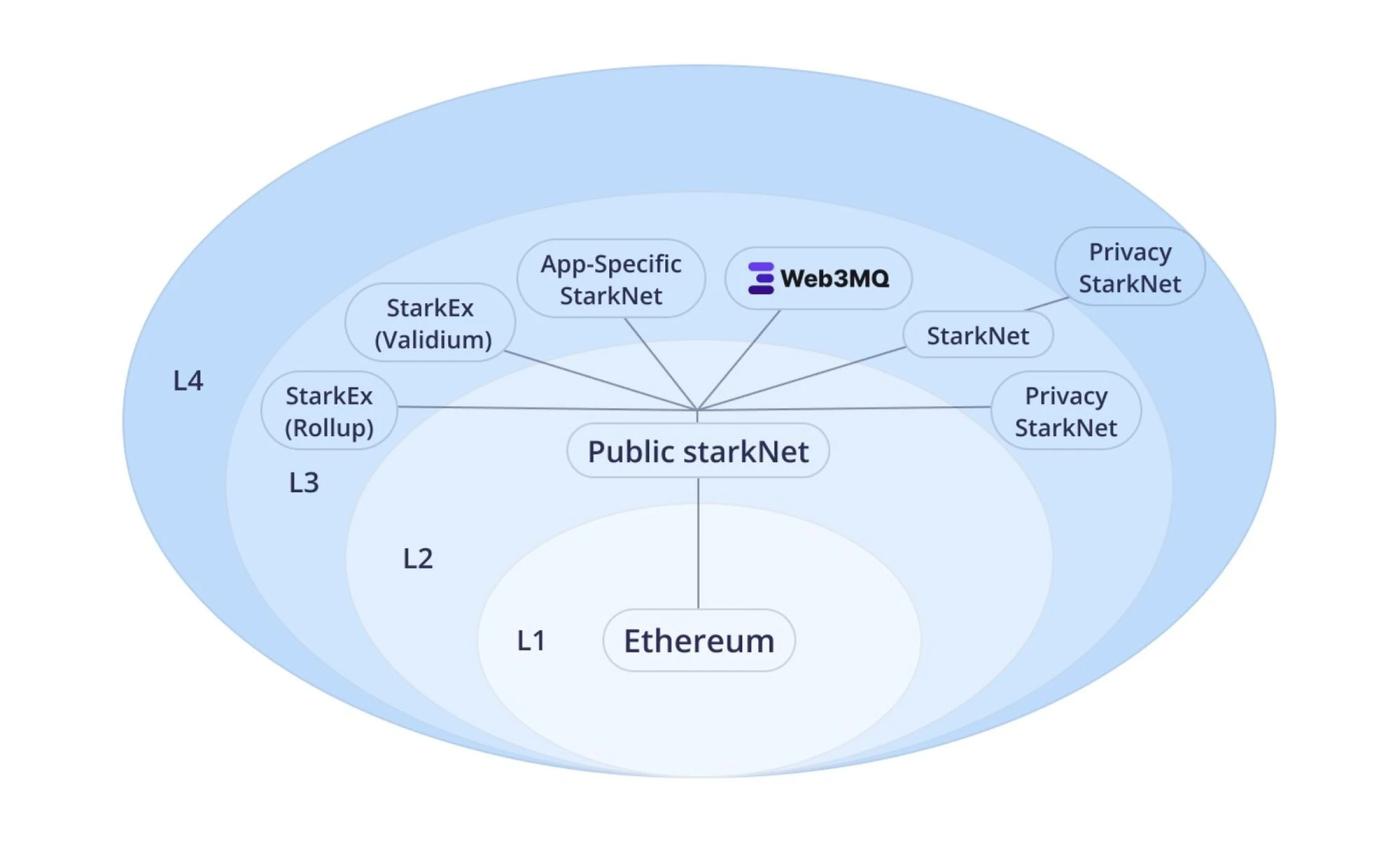
In the test results of the decentralized communication protocol, Web3 MQ occupies a relatively technically dominant position with the fastest and best scalability indicators (the Mainnet has not yet been launched). Through the settlement on L2, the token economy and payment security of Web3 MQ are effectively guaranteed; and as an independent relay network that can operate nodes in a distributed manner, Web3 MQ provides a Buidl for anyone who wants to build on its ecology. Social d/apps or games provide a user-friendly development layer. Web3 MQ's sub-protocols DAppMQ, PushMQ and SocialMQ draw and complete the Web3 communication infrastructure layout in different aspects. In 2023 Q1, Web3 MQ will also launch a test network open to everyone.
App-specific StarkNet 3: dojo
"Autonomous Worlds" ( Autonomous Worlds ) is a concept that has been frequently mentioned in and outside the blockchain game circle recently. dojo is a chain game dedicated chain built on the StarkNet network. According to ETH, dojo is based on Cairo 1.0, which provides a standardized development framework for chain games, provides a modular and scalable cornerstone for the autonomous world, and is further developing the high-throughput layer 3 on StarkNet.
"Layer 3" is sometimes referred to as "L2 of L2", but it doesn't imply scalability squared. L1 locks in security, L2 locks in scalability, and L3 doesn't need an extra layer if it's just for further expansion, because often "if the data can be compressed again, then there's usually a way to take the second compressor's The logic is put into the logic of the first one, as long as it is compressed once, the second compressor can have the same effect as the first compressor." ( Original text ) The significance of proposing "Layer 3" is that it is only general The type-expanded L2 cannot meet the needs of specific application types, and if each specific application is allowed to develop its own protocol, it will lose the meaning of infrastructure as a public construction layer.
Finally, we can see that the Web3 world continues to produce new concepts: from Layer 1 to Layer 3, from Defi Summer to L2 Summer, and even Web3 itself is a conceptual innovation from crypto. This undoubtedly proves that this is an extremely fast-growing industry, and every concept will be quickly used until it becomes obsolete, and everyone urgently needs new concepts to accommodate the innovation impulse hidden within the industry. The naming behind Version represents a consensus, and various projects suffixed with "3" represent unmet wishes in the existing Web2 Internet world. And "Layer 3" also represents a new demand not met by "Layer 2": a "reminder", waiting behind Layer 2 for a new germination point. When Layer 2 is approaching summer, pay attention to the missing parts and take the first step to care about the early spring of technology. Compared with continuing to participate in the high-temperature AirDrop competition, it will be cooler for a long time.
Web3 Digital Gardens: Links to Social Infra Insights Article Collection