Original text: " The Mainnet is coming soon, how to introduce Sui Network to your friends? "
On April 15th, exchanges such as OKX, Bybit, and Kucoin announced that they would list Sui Token, and all relevant exchanges have launched the WL whitelists subscription mechanism for Sui Token. The launch of the Sui Network Mainnet goes a step further, but there is little detailed explanation of what exactly Sui is and how it works. This article is compiled by Sui World by ALEX MAC'EVOY, a core team member of Sui ecosystem, one of Move Accelerator's partners. (Related reading: " Sui Benchmarking Aptos Up At Least 10 Times? A Quick Look at How to Participate in Token Sale? ")
First, we need to understand "Blockchain". Another definition of Blockchain is a distributed database or ledger. The closest analogy is cloud services. There are several industry giants, such as Google, Amazon, and Microsoft, providing global Millions of projects and companies provide data storage and computing power. The cloud is essentially an aggregation of servers that share resources to act as a single platform.
However, relying on centralized cloud services implies some limitations:
1) The server used can be shut down by the platform;
2) Privacy is sacrificed.
The blockchain can lift the above restrictions and provide decentralized services. In short, there is no one person or company that controls the blockchain network and data, and the blockchain is maintained by all machines or servers connected to it, as long as these servers If a fraction of them are still connected and running, the network cannot be shut down. At Sui, we refer to these servers as "validators" because they validate transactions on the blockchain.
Sui is a layer1 blockchain, which means it is a foundational blockchain whose software runs on a set of independently maintained "validators". Conversely, layer2 or higher blockchains are complementary to layer1 blockchains. A layer2 blockchain may be built on top of layer1 to increase scalability or add functionality not present in the original chain.
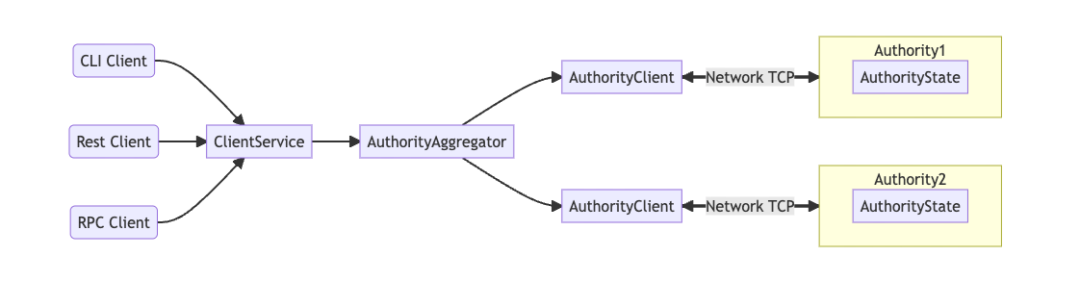
This Sui network architecture diagram shows how applications send transactions to validators for verification
Next, the concept of "proof-of-stake" is explained. The verifiers supporting the blockchain must agree on which transactions are valid. This process is called consensus. Consensus is not an issue when one company runs all the servers, but when there are many independent operators, there must be a mechanism for them to agree on when to approve transactions. The "proof-of-stake" mechanism is essentially a certificate for these independent operators to prove that they have the right to approve transactions.
Independent operators who run the "validators" that support the Sui blockchain should also be rewarded for their efforts, since running servers costs money. Sui rewards these validator operators with the native Token on the chain - SUI.
Sui can also be thought of as an operating system similar to Linux, Windows, and macOS. Builders can write applications that run on these operating systems. On Sui, builders use a relatively new programming language - Move. Specifically, Sui uses a variant we call Sui Move, which is quite different from other general-purpose programming languages for blockchains such as Rust and Solidity.

Sui Capys is a game released on Sui Devnet, each Capy exists as an object on Sui Network.
Transactions involving shared objects must be approved by validators on the blockchain. This is a resource-intensive process. On most blockchains, all objects are shared, so every transaction must go through this approval process. Many transactions on Sui involve a simple one-to-one exchange, reducing resource costs.
To get more technical, each Sui object must have the following fields:
Unique ID: similar to the hash or contract ID on Ethereum;
Version: Displays the transaction quantity of the object, starting from 1;
Transaction Summary: Indicates the last transaction that included this object as an output;
Owner field: shows the owner, which can be an account address, another object, immutable or shared
Of course builders can customize objects by including additional fields, Sui allows for a lot of creativity in object design.
As a popular use case, builders can create a game made of objects. For example, in a racing game, the player's car is an object that the player owns, and the car in the game can be modified, so the player can add a paint job, change tires, upgrade the supercharger, etc. to make the car more competitive. Each of these upgrades is a separate object that, when acquired by the player and added to the car, will be owned by the car object in Sui's.
We mentioned shared and owned objects above, let's take a deeper look at how Sui processes transactions using these different types of objects, we mentioned consensus when referring to the validators that Sui validates transactions, Sui only needs to Objects reach consensus, and ordinary transactions involving owning objects do not require consensus.
Owned objects are not included in the "blocks" of the blockchain, they interact directly with validators on Sui using a simplified algorithm, due to this architecture, owned object transactions happen almost instantaneously, in fact, these simple A transaction might involve one player gifting a car to another player in a racing game, someone posting a message to a social network, or submitting a vote in a poll.
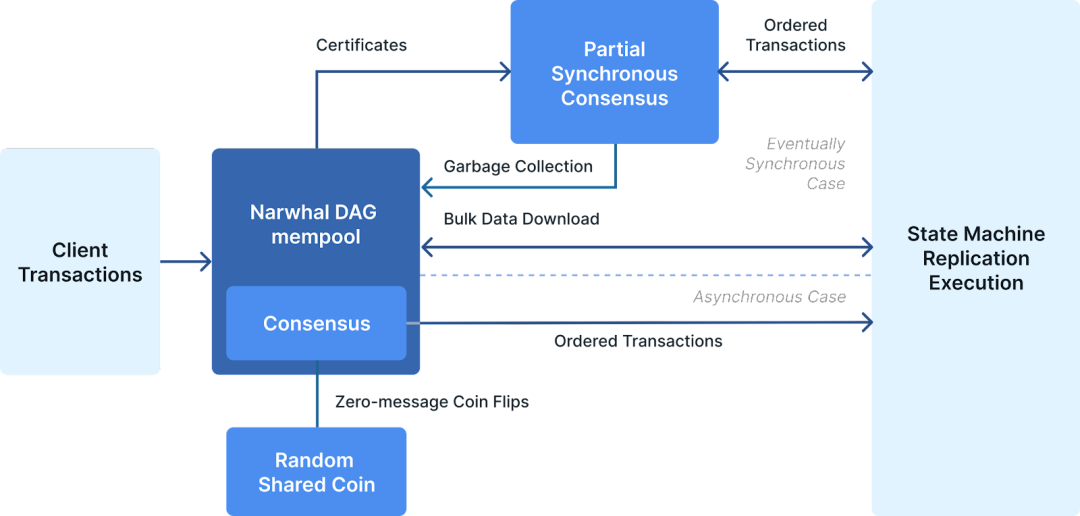
Sui's novel consensus mechanism can execute both simple and complex transactions, the former requiring fewer resources and processing very fast
How does Sui conduct verified simple transactions?
1) The sender broadcasts the transaction to all Sui verifiers;
2) Each Sui validator will vote on the transaction, and each vote has a weight based on the validator's pledge;
3) The sender collects the anti-Byzantine majority votes into a certificate and broadcasts it back to all Sui validators, which process the transaction, record it on Sui, and ensure that the transaction will not be deleted or revoked.
In the face of more complex transactions, Sui performs verification according to the following steps:
1) The sender broadcasts the transaction to all Sui verifiers;
2) Each Sui validator will vote on the transaction, and each vote has a weight based on the validator's stake.
3) The sender collects the Byzantine-resistant majority votes into a certificate and broadcasts it back to all Sui validators. This time, however, the certificates are ordered through a process called Byzantine agreement, in which validators must come to a consensus, and once the transaction is successfully ordered, the sender broadcasts the certificate to the validators to settle the transaction.
As mentioned above, individual transactions bypass consensus and are processed almost instantly. Transactions using shared objects must go through consensus. If Sui processes many transactions simultaneously using a shared object, each consensus must happen sequentially, which can delay transactions. Most other blockchains only allow the latter transaction type, and there is no way to bypass consensus.
Sui's distributed computing model is more like a traditional cloud service than a typical blockchain. Many blockchains use a token economics model to control server load: as load increases, gas fees also increase. Higher gas fees reduce the number of transactions because users can only pay a certain amount.
As the load on Sui increases, validators can simply add more processing power, similar to how Amazon Web Services might add more servers as client traffic increases. Verification nodes can earn more Gas fee instead of spending more, so they will be motivated to increase verification servers. This model not only allows Sui to scale to support increased user traffic, but also maintains a stable and stable Gas fee, allowing more users to join Sui's ecosystem. Increasing the network capacity in this way can ensure that the game runs quickly, the application app can respond quickly and the release of the social application, the builder will not set the fee due to the rising Gas price, and the network will not cause failure due to the Gas war.
Sui Move is Sui's native programming language. The core Move language on which Sui Move is based was created in 2018 and is designed for smart contract programming developed on the blockchain. The creators of Move saw the need for asset and access control abstractions that did not exist in previous blockchain programming languages, and these abstractions make sense for blockchains because decentralization brings asset and access control to the network Center of most activity.
However, as Sui's founding team began developing this new blockchain, they felt the need to further refine Move. Although Move is designed for programming smart contracts on the blockchain, it still lacks native support for blockchain-specific concepts such as accounts, transactions, time, and cryptography. Blockchain needs to build support for these functions, which is not only time-consuming, but also leads to inconsistent implementation of critical functions such as security. Sui Move aims to bring together everything a blockchain developer needs to create high-performance, secure, feature-rich applications.