Edit丨YuanShan@Web3CN.Pro
Table of contents
1. Project introduction
2. Project Vision
3. Features and advantages
1. Privacy
2. PLONK proof system
4. Development history
5. Team background
6. Financing information
7. Development achievements
1. PLONK proof system
2. Aztec Connect
3. zk.money
4. Noir
8. Economic Model
9. Fundamentals and Industry Analysis
10. Analysis and opportunities
one. Project Description
Aztec Network is the first private zk- Rollup on Ethereum, helping decentralized applications gain privacy and scalability. Aztec's Rollup is secured by the industry-standard Plonk proof mechanism and is being used in leading zero-knowledge scaling projects. Since the establishment of the project, it has been committed to realizing affordable and privacy-guaranteed DeFi services through Zero-knowledge Proof technology.
two. project vision
Aztec's vision is "Encryption (encryption) for all", that is, to let everyone enjoy privacy protection. Aztec's goal is to dramatically expand Ethereum's capabilities by making it fully encrypted, thereby fulfilling Ethereum's original promise of building a decentralized and verifiable world computer. Why does Ethereum need full encryption? From the perspective of the "impossible triangle" of the blockchain, only a blockchain that satisfies decentralization, security, and scalability at the same time is a perfect chain. When it comes to security (when it comes to privacy), Ethereum is not perfect. Not only does an unencrypted blockchain inherently expose privacy, it also requires a lot of redundancy to compute and verify the legitimacy of transactions.
Aztec is building an encrypted Ethereum network, including cooperating with investor a16z to fund the development of the next-generation encryption architecture, allowing users to follow the rules of the blockchain without revealing any personal information. Trust and security.
CEO Zac Williamson said: "We are building a revolutionary technology that can change the way we interact online, where the end user is the customer rather than the product. The end-to-end encrypted blockchain protects individuals and eliminates centralized finance. The necessity of the system."
3. Features and advantages
1. Privacy
Aztec's most famous feature and advantage is its privacy. Like all zk Layer2 projects, they focus on privacy protection. Aztec's privacy protection lies in its adoption of the ZK-ZK Rollup(ZK²) technical solution. The overall method of its privacy realization is similar to that of Zcash, sharing the security of Ethereum through Rollup technology.
What is the technical principle of ZK-ZK Rollup? For example, when a user transfers a balance to Aztec, the smart contract issues the user an equivalent token beginning with "zk (Zero-knowledge Proof)". For example, if you transfer 100 ETH to Aztec, it will consume 100 ETH and send you 100 zkETH in return, and zkETH can be exchanged for ETH 1:1.
After that, the smart contract stores zkETH in a different way than the Mainnet, and it is tracked by the network as a bank note-like existence (not a fund balance). Thus, your 100 zkETH will be stored as a form of ticket that you own.
But these tickets are encrypted. No one knows the face value of each of your notes and who owns them. At the same time, as the owner of the note, you have the private key to decrypt the note to show the amount contained in the note and whether you are the legal owner. You can use it to redeem your ETH at any time.
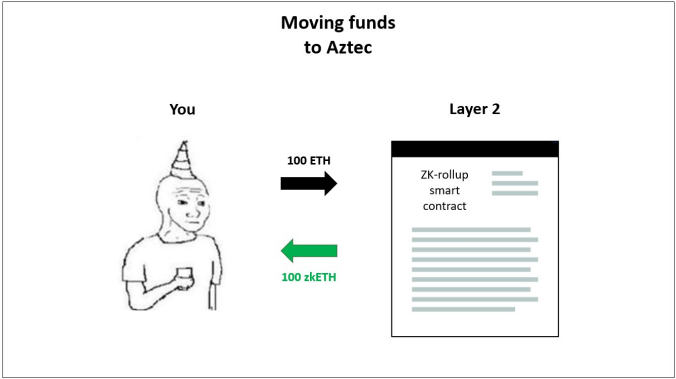
How does Aztec share the security of Ethereum through Rollup technology while achieving privacy protection for network activities?
Generally, the conventional ZK Rollup utilizes the "simplicity" property of SNARKs to expand the congested Ethereum. This technology allows a large number of transactions to be "Rollup" into one aggregated transaction, which leads to the execution of 100 or 1000 transactions at a time on the Ethereum network, but The gas cost spent only requires an Ethereum transaction fee. Aztec doesn't stop there.
Aztec's ZK-ZK Rollup technology solution includes two layers of SNARKs:
1) "Low-level" ZK-SNARKs each represent a private transaction;
2) The "upper layer" ZK-SNARKs (i.e. Rollup SNARKs) succinctly prove the correctness of the lower layer SNARKs;
In other words, when users conduct transactions on the Aztec network, the network only needs to create low-level "SNARKs (private transactions) to ensure transaction privacy (the process of obtaining zkETH), and there is no need to aggregate the "upper layer" into ZK (zero knowledge) , the "upper layer" ZK-SNARKs only need to verify that they are correct. It takes a high cost to check the private transactions and replace them with a simple Rollup proof, and then its cost is distributed to all transactions .
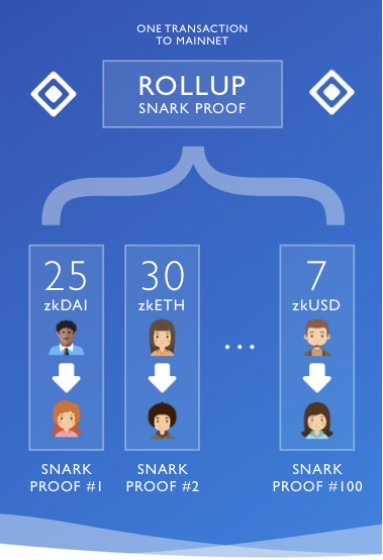
100 transactions "Rollup" to a single SNARK proof
The original Rollup can theoretically reach 2000 tps, but due to privacy considerations, the Aztec network runs at 100 tps on the Ethereum mainnet.
2. PLONK proof system
Aztec Network's SNARK proof is derived from the latest mathematical achievement called the PLONK proof system created by CTO Zac Williamson and current chief scientist Ariel Gabizon. The full name of PLONK is Permutations over Lagrange-bases for Oecumenical Noninteractive arguments of Knowledge. It is an efficient Zero-knowledge Proof technology. It is not only adopted by Aztec, but also adopted by MINA, Dust, zkSync, Polygon Zero and other platforms.
The PLONK proof system is based on the PlonK algorithm, which is a Zero-knowledge Proof algorithm that implements Universal (the initial trusted setting of Universal is only needed once, and it can be directly iterated on the original basis). The purpose is still to solve the privacy problem of blockchain.
Vitalik, the founder of Ethereum, once expressed the superiority of the PLONK proof system, "Although the improvement of the general Zero-knowledge Proof protocol has continued for many years, PLONK (and the more complex but earlier SONIC and the recent Marlin) have brought a series of enhancements that could greatly improve the usability and progress of these types of proofs in general."
In order to strengthen the privacy protection issue, the PLONK proof system has implemented two "improvements":
The first improvement is that although PLONK still requires a trusted setup process similar to that required for SNARKs in Zcash, it is a "generic and updatable" trusted setup. This means two things: first, you no longer need to set up trust individually when you want to prove There is a way to participate in the security setting - as long as any one of them is honest, the multiparty process is secure, and the multiparty process is completely sequential.
The second improvement is: the "fancy cryptography" it relies on has only one standardized component called "polynomial commitments", PLONK uses "Kate commitments" based on trusted settings paired with elliptic curves, This allows developers to replace it with other schemes such as FRI (which would make PLONK a kind of STARK) or DARK (based on hidden order groups). This means that PLONK is theoretically compatible with any (realizable) trade-off between proof size and security assumptions.
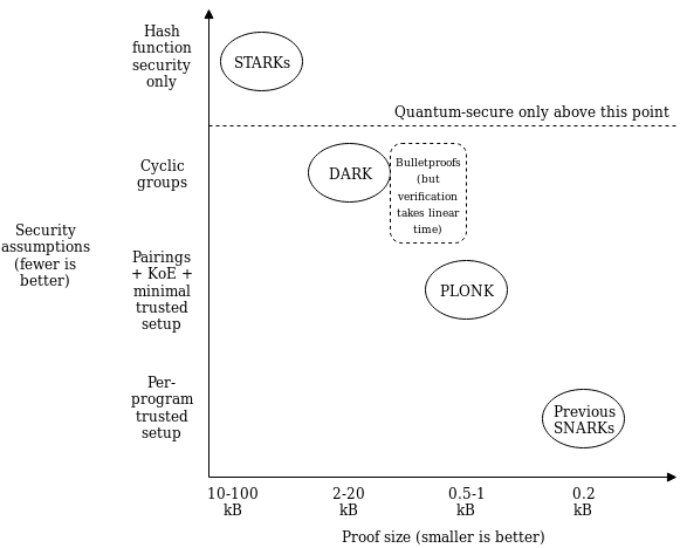
Aztec CEO and Co-Founder Zac Williamson stated that the invention of PLONK (the universal zk-SNARK that defines the paradigm) demonstrates our ability to produce technology that matches our ambition: to unlock the entire blockchain application universe, which cannot exist without privacy. of.
4. Development history
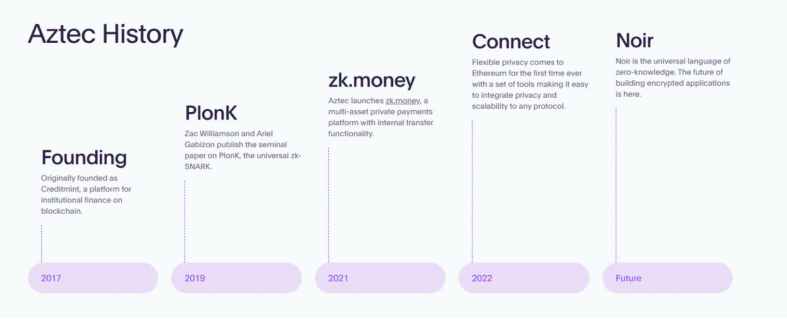
Aztec was originally established as a blockchain institutional financing platform, and later pivoted to develop ZK technology. It was founded in 2017, released PlonK in 2019, zk.money in 2021, Aztec Connect in 2022, and plans to launch Noir in Q2 2023.
5. Team background
Headquartered in London, Aztec was founded in 2017 by Zac Williamson and Thomas Walton-Pocock (who has since left).
Aztec's core team has strong technical capabilities, and two of the three collaborators of its underlying proof system PLONK are in Aztec.
CEO Zac Williamson is a PhD in particle physics from Oxford University, one of the inventors of PLONK, and worked as a physicist at CERN (European Center for Nuclear Research) and T2K (a particle physics experiment in Japan).
Joe Andrews, CPO product director, holds a bachelor's degree in materials science from Imperial College London, and worked as CTO at Radish, a catering start-up company in Silicon Valley.
CTO Chief Scientist Ariel Gabizon, Ph.D. in Computer Science from the Weizmann Institute in Israel, worked as a researcher and engineer in Zcash, and is also one of the inventors of PLONK.
In addition, the team also includes Lisa Cuesta, director of cooperation, Jon Wu, director of growth, and others.
6. Financing information
In November 2018, Aztec Network announced a $2.1 million seed round financing led by Consensys;
In September 2019, Aztec Network also announced a round of seed round financing, but the amount was not disclosed.
In December 2021, Aztec Networks raised $17 million in Series A funding from Paradigm to bring programmable privacy to Web3. This round of financing was led by Paradigm, with existing partners a_capital, Ethereal Ventures and Libertus Capital as additional investors, and followed by well-known institutions such as Variant Fund, Nascent, IMToken, Scalar Capital, Defi Alliance, IOSG Ventures and ZK Validator. Top angel investors including Anthony Sassano, Stani Kulechov, Bankless, Defi Dad, and Vitalik Buterin. Proceeds from the Series A financing will be used for network decentralization, Aztec Connect Grants, and the continued development of the Zero-knowledge Proof system.
In December 2022, Aztec Network received US$100 million in Series B financing led by a16z, with participation from A Capital, King River, Variant, SV Angel, Hash Key, Fenbushi and AVG.
7. Development achievements
The development results of Aztec can be simply understood as one is the development results based on the product system, which is reflected in the underlying PLONK proof system (product zk.money), which realizes anonymous transactions between accounts, and through the grafting of Aztec Connect and Defi Project's private interactions. The second is the Aztec Connect ecosystem. Specifically, the development results are as follows:
1. PLONK proof system
The PLONK proof system is the development result of Aztec Network. The specific details are discussed in the "Features and Advantages" section of this report and will not be repeated here.
It is worth adding that Aztec's smart contract has laid a solid foundation in the underlying design and has three sections:
1. AZTEC Cryptographic Engine (ACE): ACE can be considered the "brain" of the Aztec smart contract system, which is responsible for coordinating smart contracts. Specifically, ACE has two main responsibilities:
a. Delegate the verification of zk proofs to the appropriate smart contract;
b. Process state, update instructions from proof of successful verification;
2. Proof validator: Every Zero-knowledge Proof has a proof validator contract. It is the verifier's responsibility to verify the evidence provided, thereby confirming the legality of the proposed action.
3. zkAsset: can be considered as a confidential version of an ERC20 contract, such as zkDAI. They are used to store users' funds in a ticket registry and to perform confidential transactions.
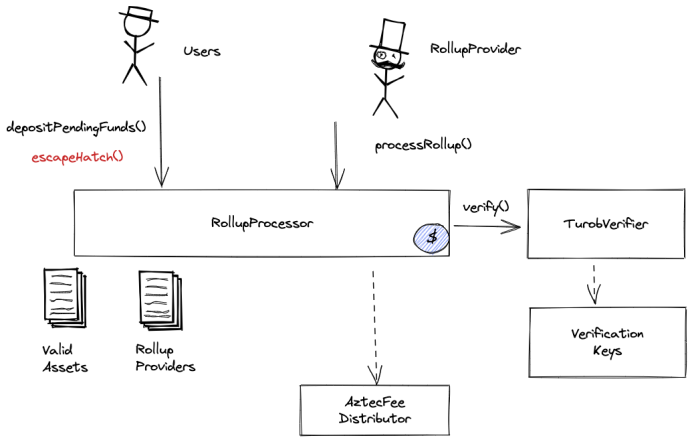
Smart contract architecture diagram
2. Aztec Connect
Aztec Connect will be officially launched on July 7, 2022, as a "bridge" to provide privacy protection for DeFi transactions. It is the first "privacy bridge" for the Ethereum DeFi ecosystem. For users, Aztec Connect enables users to privately access world-class DeFi services on Ethereum and save up to 100 times the cost. For developers, Aztec Connect SDK can be used to build private Ethereum applications. Its open tool, Connect SDK, will allow any Ethereum project to be integrated in the Aztec network without permission, thereby achieving privacy protection and cost savings.
Aztec Connect can be seen as a proxy service for DeFi. Anyone can deposit funds into Aztec and still interact with the Ethereum mainnet protocol, enjoying additional privacy and cost savings.
The working method of Aztec Connect is based on the PLONK proof system, and the principle is the same. Users interact with Ethereum services within the Aztec network by using Aztec's Rollup contract as a proxy. Taking DeFi services as an example, when a transaction encryption command is passed to Aztec's Layer 1 Rollup contract, the contract executes these commands, and Aztec batch-processes transactions through zk-zk Rollup technology, reducing user fees and saving the cost of the Mainnet.
Since Aztec Connect relies on Ethereum as the execution environment, smart contracts can be stored on the Mainnet, and the protocol can maintain Liquidity while maintaining the composability of the Ethereum ecosystem.
The Aztec network integrates such zk- Rollup technology, for example, it can bring Element's fixed interest rate to L2, and the result is that users can obtain Element's fixed interest rate, while saving up to 80-90% of the cost of L1 transactions. % Gas fee.
In addition to achieving the above goals, what is more important are two important basic design advantages of Aztec Connect:
1) No need to redeploy the core contract. Developers only need to write a simple 50-100 line interface to connect Aztec Network Layer 1 smart contract.
2) Retain the first layer of Liquidity. Users directly interact with the first layer of Liquidity, reducing fragmentation and Liquidity leakage to the second layer.
Currently, the Aztec Connect ecosystem includes many DeFi protocols, such as AAVE, Curve, Lido, Element, Set Protocol, Compound, and Liquity. With Aztec Connect, DeFi protocols can integrate privacy protection without losing interoperability. Among the companies funded by Aztec, platforms such as Nucleo, Trelis and zkGiving are also developing native private Ethereum applications.
On March 21, 2023, Aztec Network officially announced that the deposit function of its DeFi privacy bridge project Aztec Connect has been closed as scheduled, but users will still have one year to withdraw money for free.
3. zk.money
zk.money, Aztec Network's first private transfer protocol product, is a TypeScript-based front-end development tool that allows anyone to integrate privacy and cost savings into Ethereum applications. Since its launch, zk.money has had more than 75,000 registered users, 250,000 transactions and a transaction volume of $100 million in total deposits.
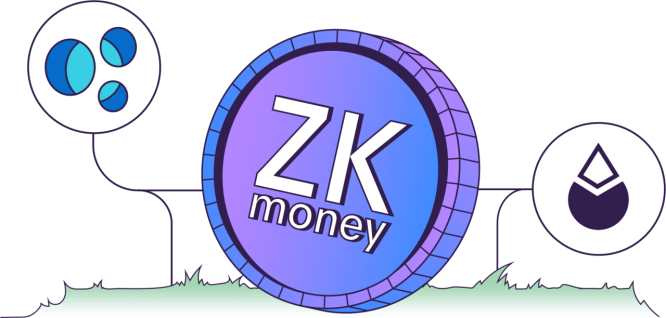
zk.money has integrated some DeFi protocols, including Lido, a Liquidity pledge protocol, and Element Finance, a fixed-rate protocol. Expanded zk.money functionality, support for DeFi interactions with privacy protection by default, use Curve to buy Lido liquid pledged Ether (stETH) and enter Element Finance's fixed rate storage room.
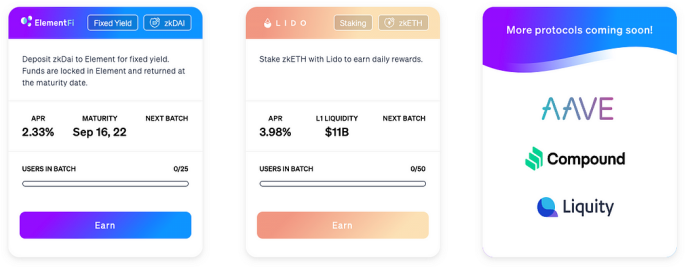
After the completion of zk.money, users can interact with Curve-Lido and Element bridges, enjoy Liquidity , complete privacy and cost savings up to 100 times that of Layer 1 Ethereum on the Mainnet , and will support users' favorite DeFi applications in the future program.
4. Noir
"In order to realize a new world of verifiable encryption, we completely overturned the paradigm of writing encrypted blockchain programs and invented a zero-knowledge universal language called Noir." When launching the Noir programming language, the founder of Aztec said this.
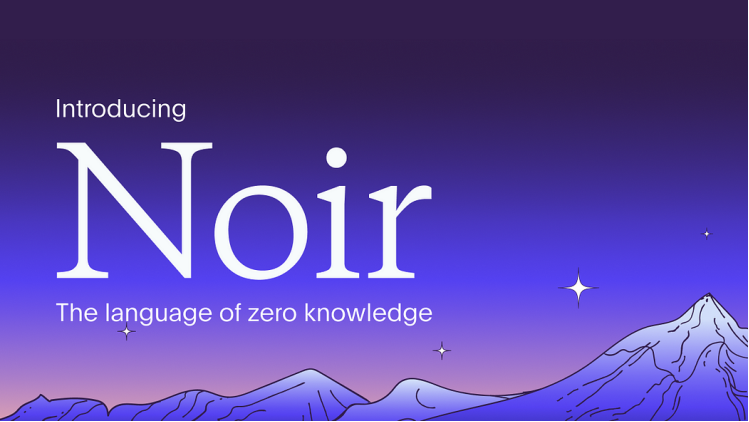
Noir is Aztec Network's zero-knowledge universal language and a Rust-based programming language for creating and verifying Zero-knowledge Proof, allowing anyone to write zero-knowledge circuits and build provably secure encryption applications. Using Noir, developers can write development programs as easily as writing plain text, because development based on the familiar Rust syntax makes zk applications easier to read, safer, and easier to understand than ever before. The Aztec team calls Noir a transformative technology around which “we are building an entire zero-knowledge ecosystem”.
Developing zero-knowledge applications is not as simple as conventionally imagined, but requires a certain basic threshold such as cryptography. The purpose of the Noir language is to solve this problem, allowing any developer (not just those with knowledge of cryptography) to build zero-knowledge applications.
eight. economic model
Aztec has not yet issued a Token economic model, nor has it issued a native Token.
Nine. Fundamental and Industry Analysis
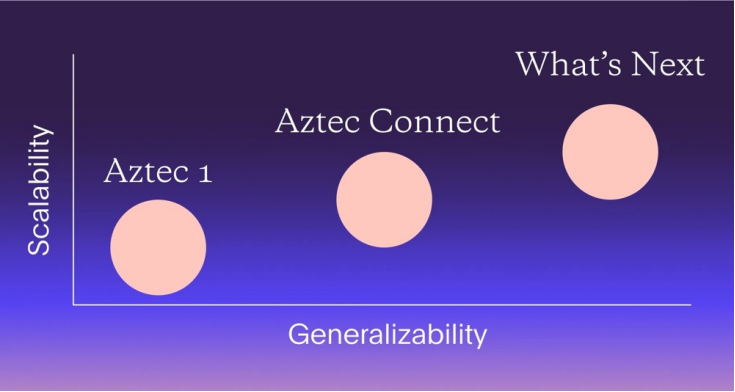
Effective March 13, 2023, Aztec Network will decommission zk.money and the supporting infrastructure, Aztec Connect. After shutting down Aztec Connect, the Aztec team is now focused on developing 2 interrelated products: Noir, a general-purpose development language supporting Zero-knowledge Proof, and their next-generation encrypted zkRollup, a new privacy-friendly blockchain. It is expected that in 2023, the team will provide more Noir functions and a full set of specifications for Aztec's next-generation blockchain, and launch a fully functional Noir language and local development network by the end of 2023. This makes Noir the most concise and powerful Zero-knowledge Proof programming language that can be used for any EVM chain information verification.
Now there are no more protocols that can interact with Aztec Network.
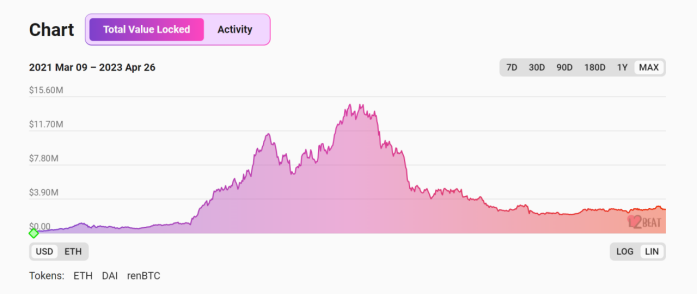
From the perspective of TVL (total lock-up volume), Aztec Network continued to maintain a historical high of TVL of 14 million US dollars from March to May 2022, and then continued to decline to a TVL of 3 million US dollars.
From an industry perspective, in the Layer2 ZK field, projects that are often as famous as Aztec Network include Starkware, Zk-Sync and other projects.
Aztec vs. Starkware/Zk-Sync
It should be considered that Starkware and ZK-Sync focus on solving the expansion problem of Ethereum - they have higher TPS (transaction processing per second) than Aztec, while Aztec Network focuses on solving privacy issues. Aztec is also currently regarded as a Layer 2 solution that pays special attention to privacy issues in the Ethereum ecosystem. Therefore, it can be seen from this that they are not competitors, but there is room for mutual cooperation. Aztec can integrate more Layer 2 projects so that they all have strong privacy protection features.
From a technical point of view, Aztec's privacy design is based on the UTXO model, which is not suitable for complex smart contract development. The current products are limited to zk.money developed by the team itself, and the integration of other projects is mainly realized through the Aztec Connect gateway contract. It further stated that the focus of the Aztec project is to use ZK technology to realize a network world with privacy protection.
ten. Risks and Opportunities
Chance
The core advantage of Aztec is the word "privacy", which is reflected in the realization of a privacy function with a high level of security and the ability to interact with Defi projects on the product. Privacy and expansion are subdivisions of the Leyer2 ZK track. A relatively complete blockchain also lies in achieving scalability (expandability) while providing privacy protection. In terms of expansion, there are projects such as Polygon, Starkware, and ZK-Sync, but in terms of privacy, Aztec Network is an outstanding entrant who focuses on the construction and development of privacy tracks. This is not only reflected in the technical strength of the team itself, but also in the bets made by VCs such as A16Z, a well-known investment institution.
risk
One body has two sides, and the special privacy function also limits the development of the project to a large extent. On the one hand, Aztec relies on Aztec Connect to realize the operation of Defi projects, which reduces the difficulty of deployment and also reduces flexibility. In the short term, it is more suitable for operating single, capital-intensive projects.
On the other hand, in order to achieve privacy protection (requiring a privacy proof for each transaction), although the project has shared the storage space through zk Rollup, the Aztec network’s handling fee is still the highest among all L2. The threshold is also higher, which is more suitable for large and powerful households.
This will test Aztec's later development strategy, including how to achieve relatively low fees without sacrificing privacy protection, so that it will have an advantage in Layer 2 projects. Aztec's long-term goal is to realize the private interaction of all smart contracts. If it is expected to develop in this direction, the opportunity of Aztec Network still has deep potential.
refer to:
https://medium.com/aztec-protocol/aztec-network-raises-17-million-series-a-from-paradigm-to-bring-programmable-privacy-to-web3-beb2982a92f3
https://aicoin.app/article/327128.html
https://vitalik.ca/general/2019/09/22/plonk.html
Disclaimer: web3 Chinese edited works, the content only represents the author's position, and does not constitute investment advice, please treat with caution, if the article/material is infringing, please contact the official customer service.