introduction
As Vitalik recently mentioned the issue of the ultimate oracle in his article, the "oracle" has re-entered the attention of the encryption community. At present, oracle machines have irreplaceable value in many fields and sectors such as insurance, finance, random forecasting, and the Internet of Things. The core point of OKX Ventures is that as long as off-chain data still has value, middleware such as oracle machines will play an important role in the entire Web3 will continue to play a key role in the narrative. Specifically, the following aspects:
In the context of the continuous development of the Web3 ecosystem, it is foreseeable that the increase in dapps and platforms will drive the expansion of the demand for calling data sources and APIs through oracle. In the future, Dapp, especially defi exchanges, are likely to integrate more than one oracle machine (usually with one as the main data source, and 1-2 as a cross-validation backup) to obtain off-chain metadata, thereby avoiding the delay of a single oracle machine Or be attacked, causing an unbearable loss to the agreement (similar to agreement accidents such as Venus).
In terms of investment opportunities, although the direction of traditional DeFi’s oracle machine is mainly based on the data feed function, it is difficult to see who will break Chainlink’s monopoly in the short term, but there may still be second place in the remaining 10% of the market competition space. In addition, oracle machines in subdivided fields, such as L2, credit, NFT, DID, etc., have noteworthy innovative protocols and narratives.
Based on the experience of DEX and L1, from the perspective of incremental market demand and L2/ZK and subdivided emerging scenarios, the oracle track cannot be monopolized by only one winner in the long run. Greater development potential and market space are still worth exploring, such as off-chain computing scenarios, NFT and other non-standard on-chain asset pricing and deep integration of AI/ML.
In the following, we will give an in-depth explanation of the concept, classification, application scenarios and investment opportunities of oracles.
event background
According to Vitalik's recent article, he believes that in the future there will be a more effective oracle protocol with a trust mechanism. He mentioned his two solutions in the article:
Price oracle : one is a decentralized oracle based on an incomplete encryption economy , and the other is an oracle based on validator voting.
The latter are mostly recovered through emergency recovery strategies rather than resorting to L1 consensus. For example, price oracles rely on the trust assumption that voting participants can be corrupted by bribery, and users can get early warning of attacks and withdraw from any system that relies on this oracle. Such oracles can deliberately delay rewards for a long time, so that if the protocol fails, participants will not be rewarded.
The price oracle proposal is mainly based on the previously proposed schellingcoin/point mechanism , imagining a reverse prisoner's dilemma game theory
The core idea is to keep the chain simple and avoid the Hard fork of the chain directly caused by the failure of a single oracle machine
More complex truth oracles: for reporting more subjective facts than prices
Something like some sort of decentralized court system built on an incomplete cryptoeconomic DAO .
Rocket Pool Oracle DAO The idea of a DAO composed of nodes should also be in line with Ethereum's expectations for the development of oracle machines
But according to Vitalik's thinking, he seems to be more inclined to the first voting verifier scheme based on complex game theory.
track data
Looking at the overall oracle track data, Chainlink is still in the leading position in the market. In the subdivision of the entire defi track, the oracle machine, as the core middleware, has not received much attention. This is due to the lack of practical use cases for most protocol currency prices, and the lack of awareness and understanding among ordinary users in the market. Learning motivation.
However, it is worth noting that, referring to the prices of the last few coins such as Band and UMA, they have also performed well in history.
In addition, protocols such as Gelato that provide automation, Cross-chain and off-chain computing and other similar services have good fundamentals. As the team gradually begins to empower tokens and increase utility, it is expected that there will be a lot of room for imagination.
With the addition of more developers and the emergence of dapps in the next cycle, it is impossible for the demand for oracle to call data sources and APIs to shrink in reverse. A large number of unstimulated market increments may drive the sector to take off.
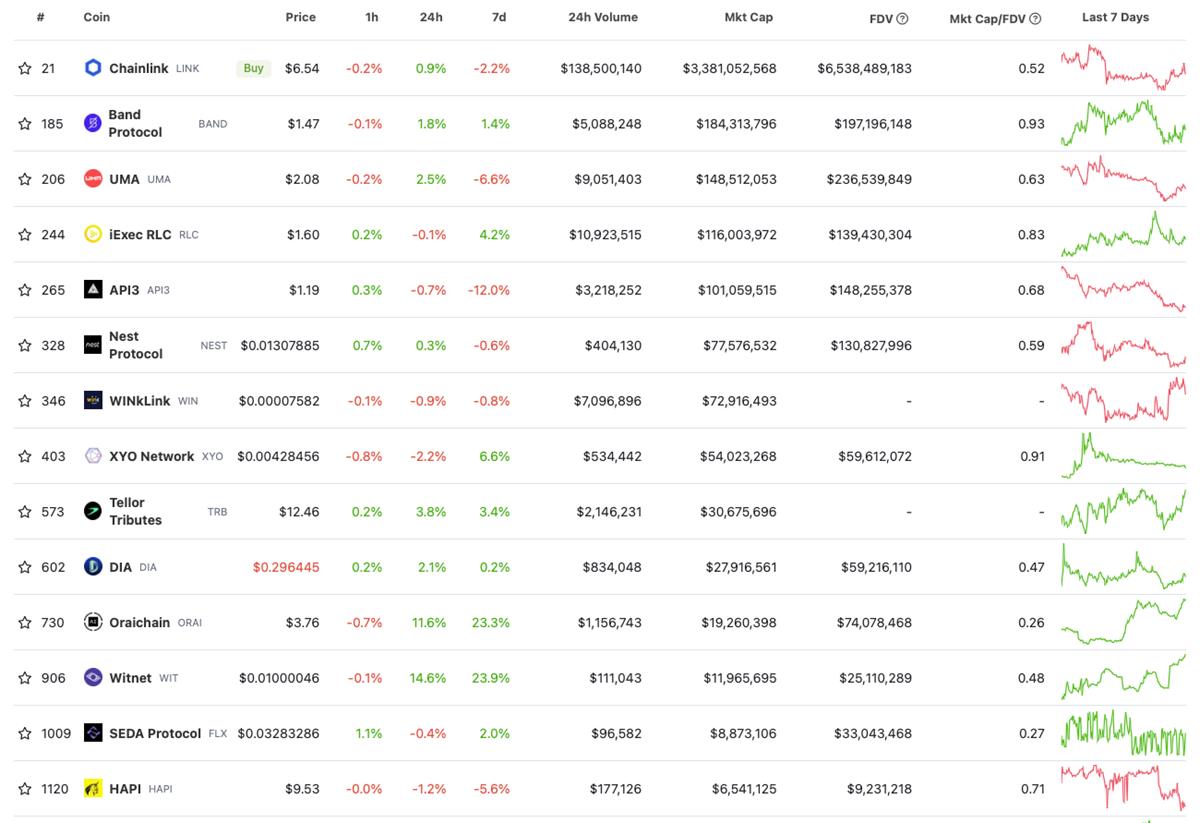
To sum up, we believe that oracle machines, especially the vertical oracle machine category on the segmented track, can still be regarded as an investment direction worthy of attention in the medium and long term.
Interpreting the oracle
1.1 Concept
The oracle is generally regarded as a bridge connecting data on and off the chain. In short, an oracle is a middleware that provides trustworthy off-chain data services for blockchain projects.
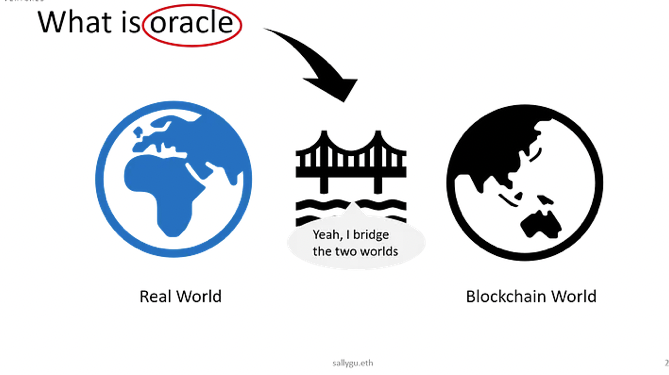
The biggest reason we need oracles is that the trust generated by the current blockchain itself is not enough to support all the needs of upper-layer applications , so more trust needs to be injected into oracles:
At present, the amount of data off-chain and on-chain is still unequal. Compared with the off-chain real world with rich data types and huge data volume, the data volume of the on-chain world is far from enough to support its complete independent development from off-chain . Most of the current protocols cannot survive without access to oracles.
This is why many people say that the oracle is a "necessary evil" for the blockchain . When one day the richness of data on the chain surpasses that of the off-chain and becomes thick enough, we no longer need to rely on oracle machines or similar relay agents. This is why many DEX and DeFi protocols are very obsessed with oracleless The root cause of the native design on the chain .
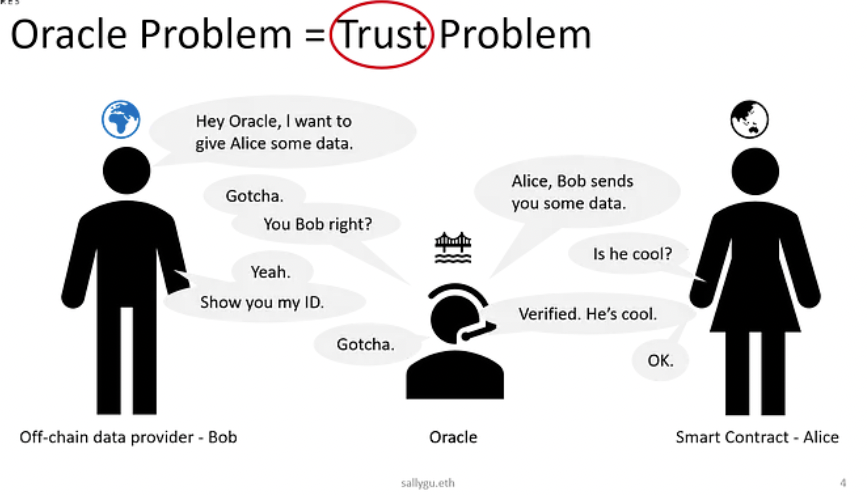
The blockchain is a closed system that cannot be directly connected to the Internet. Smart contracts cannot directly access deterministic information from the Internet and the real world, including stock prices, exchange rates, the final results of the presidential election, etc., and the consensus mechanism also requires credible A third party verifies the data. Therefore, the oracle machine plays more like a broker role that matches trust on and off the chain.
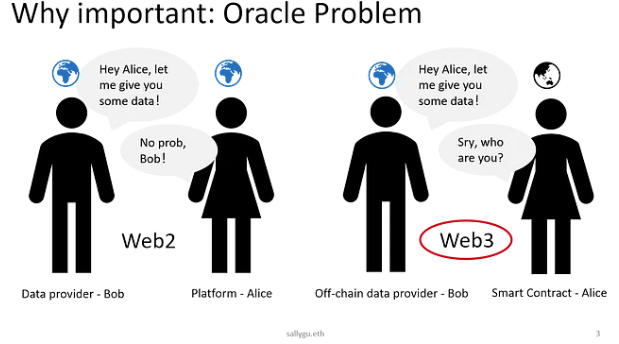
It is worth pointing out that the key problem solved by the oracle machine here is not how to obtain information from the real world (in fact, anyone, you and me, can upload data off the chain to the chain), but how to help the blockchain To trust the information from the real world (even if you and I pass the data off the chain to the chain, it is useless, no one will believe it, and no one will adopt it. Of course, the issue of honest nodes is also involved here).
It is communication, not just connection, that generates trust. Therefore, the intrinsic value of the oracle machine depends on its opening up the communication channel on and off the chain, that is, its function of injecting trust into data from the real world under the chain by forwarding, verifying and filtering information. Therefore, the key to judging the quality of an oracle machine is to figure out how "trustworthy " it is.
1.2 Classification
According to the form, we can divide it into software oracle machine and hardware oracle machine according to the form of oracle machine:
Software Oracle: Provide API/SDK and other services to help the protocol access and transmit third-party server data, such as commodity prices, weather indexes, flight numbers, etc.
Hardware oracles: Hardware oracles are widely used in IoT, such as electronic sensors and data collectors.
According to the data source, it can be divided into centralized oracle machine and decentralized oracle machine:
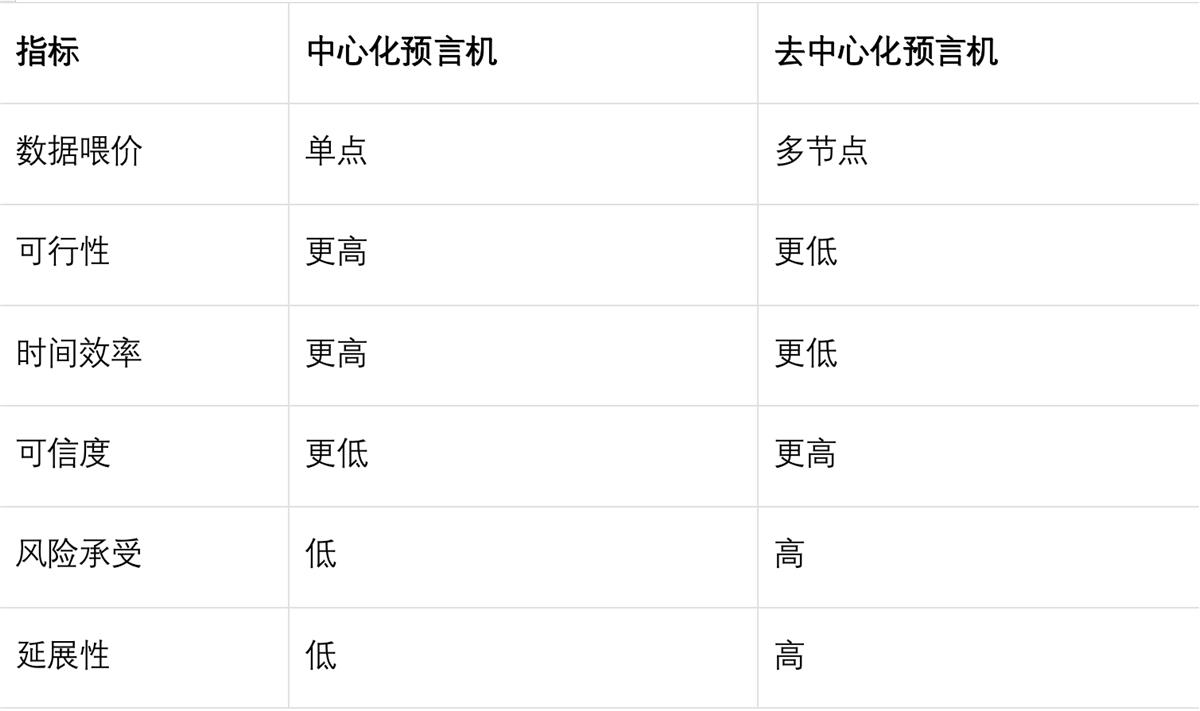
Centralized oracle: Usually only a single trustworthy third party such as government departments, official institutions, and reputable companies is integrated to provide data. Its advantage is that it can separate data from the untrusted operating system of the local device, preventing data tampering and loss. The disadvantage is that a single centralized data brings the risk of a single point of failure.
Decentralized oracle: A decentralized oracle refers to an oracle with a distributed consensus mechanism, also known as a consensus oracle. It gets data from multiple external sources instead of a single one, so it is more reliable and trustless.
Centralization vs Decentralization
The centralized oracle machine has the advantages of high efficiency and great feasibility. Decentralized oracles are more trustworthy and secure due to their discrete multi-node and cross-referencing process.
When efficiency is not the main purpose, centralized solutions are not the most desirable. Obviously, the information provided by a single node is likely to be biased and arbitrary, in which case authority comes from authoritarianism rather than its credibility.
Due to the requirements and concerns of trust risk management and control, most DeFi applications basically directly use third-party decentralized oracles such as Chainlink instead of independently building a simple centralized oracle or running nodes to transport off-chain data To the chain (re-emphasize that even if the project party or individual uploads the data to the chain by themselves, they will not be able to gain the trust of the community).
1.3 Application scenarios
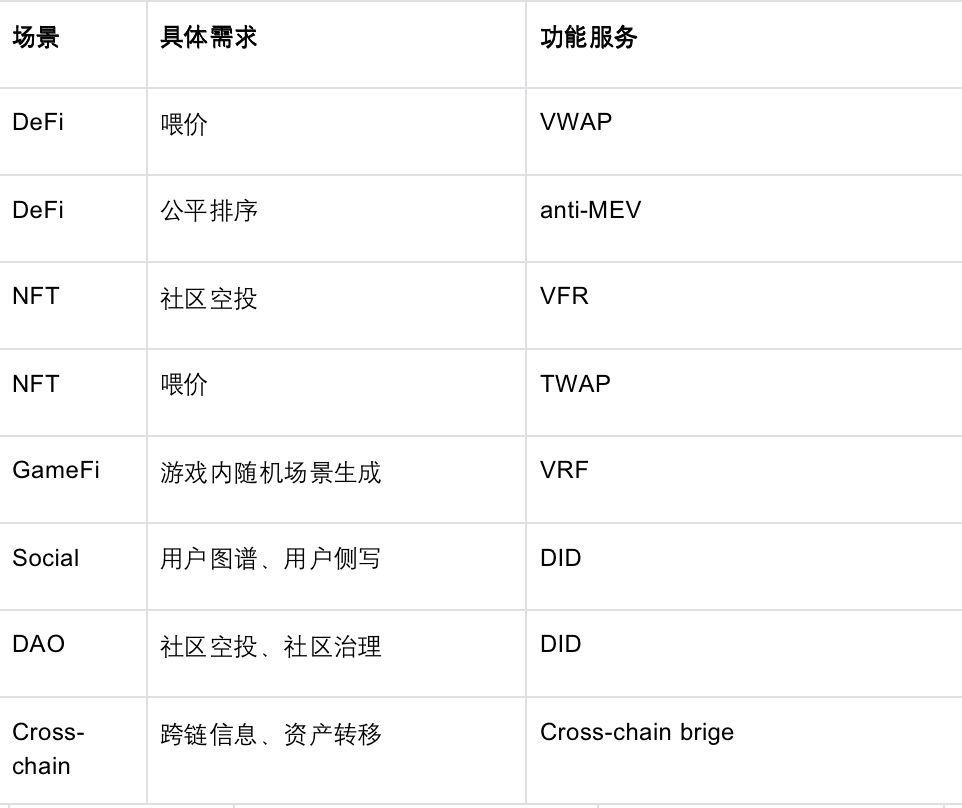
The Whitepaper of Chainlink 2.0 in 2021 introduced the concept of DON (Decentralized Oracle Network) for the first time. DON is a network maintained by a group of Chainlink nodes, which allows Chainlink to provide external data to the blockchain through trustless off-chain calculations. In order to achieve its vision, Chainlink launched a series of products and services such as VRF, Keepers, and CCIP , which further opened up the application scenarios of oracles in web3. In the figure below, we list the application cases of oracles in several different scenarios such as DeFi, NFT, GameFi, Social, DAO, and Cross-chain for reference:
1.4 Track map
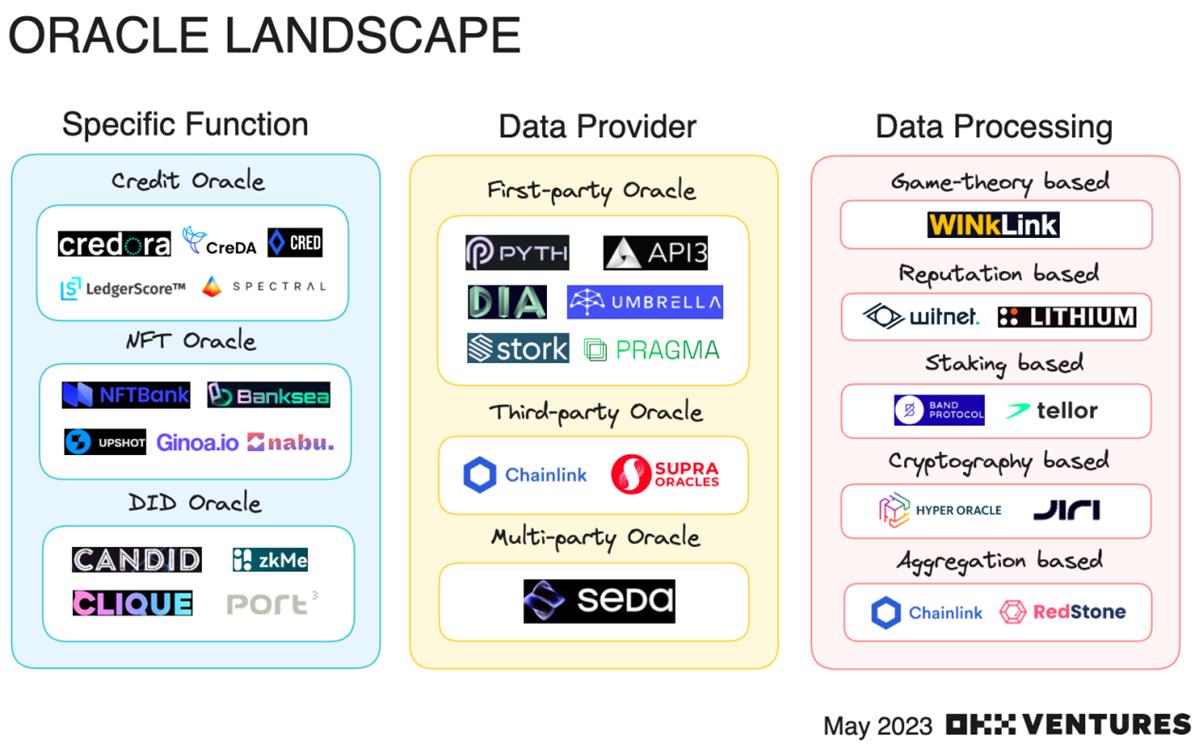
We believe that oracles can be simply classified using three dimensions:
They are based on specific functions, data sources, and data processing methods.
According to specific functions , in addition to the common defi oracle, three common types are listed here: credit oracle, NFT oracle and identity (DID) oracle .
According to the source of data , it can be divided into three types: first-party oracle, third-party oracle, and multi-party oracle.
According to the data processing method , it can be divided into five types : game theory-based oracle, reputation-based oracle, pledge-based oracle, cryptography-based oracle and aggregation-based oracle.
Anticipation of Investment Opportunities
2.1 Viewpoint
A. The traditional defi is based on the direction of the oracle machine based on the data price feed function. In a short time, it is difficult to see who will break the chainlink monopoly (market share 80-90%). But there may still be room for second place in the remaining 10% or so of the market :
One is that this project has an innovative consensus mechanism. Vitalik gave two solutions that may have theoretically implemented projects in the future
With game theory as the core, combined with PoS/PoW
Form of DAO Committee/Decentralized Court
One is that the cost-effectiveness of functions has been greatly improved, and the price feed or random number generation is cheaper than Chainlink . For example, Redstone, Ontropy, etc. claim that their feed price can be 80-100 times cheaper than traditional solutions such as Chainlink. Because generally speaking, only under the premise of greatly reducing the call cost, defi or gaming project parties may use it to replace the original service providers such as chainlink out of economic benefits.
B. For oracle machines in subdivided fields, there are potential opportunities in several directions such as L2, credit, NFT, and DID :
The L2 oracle machine is mainly a native solution for OP/zk ecosystems. Low latency and security should be the core concerns, and cheap feeding is relatively secondary.
Considering the expansion progress of chainlink on various non-EVM chains, if the price feed on a certain chain is basically monopolized by chainlink, the competition will be greatly increased.
To a large extent, L2 oracle should meet the high-frequency trading demands of Derivatives exchanges (L2 is more capable of providing higher tps support and thus can support decentralized Derivatives transactions on the chain), similar to pyth and empiric, which feed higher prices An oracle protocol that is more robust in the fine or data integration process (such as directly doing on-chain first party data integration + verification, so that off-chain nodes are not needed) .
If the tokenomics design reasonably adds more utilities (Chainlink’s tokenomics design has been criticized for lack of utility, but LinkPool’s similar Liquidity staking + interest-earning agreement appeared later, which activates Liquidity to a certain extent), we think it is usually predicted The currency price of the machine protocol can be expected to have a relatively stable performance.
The credit oracle combined with the credit expansion theory on the chain is likely to detonate in the next cycle.
The perfection and soundness of the credit rating system on the chain is the prerequisite for building an insurance and recovery mechanism on the chain, so it plays an important role in the development and evolution of the entire defi. We have given several examples of credit oracles in the track map above : CreDA \ Cred Protocol \ LedgerScore \ Spectral \ Credora: Infrastructure for Institutional Credit , ETC.
As far as this specific subdivision is concerned, we believe that more attention should be paid to the differences in on-chain data verification and integration of similar products (on-chain data coverage, cleaning capabilities, and credit rating accuracy, etc. ). In addition, if the team has a strong financial engineering background or actuarial ability, it will be a good plus
At the same time, we also noticed that the entire project of the off-chain credit system on the chain will be more complicated than expected:
On the one hand, it is difficult for a single project to directly link with a certain country's social credit system. A key question may be: Can economic activities under the chain really endorse the credit capacity on the chain? However, as Spectral Finance has strong BD capabilities, it may be a good solution to directly cooperate with large credit rating agencies in the United States.
On the other hand, the barriers to uploading the credit data released under the integrated chain are not high (traditional Internet cloud teams theoretically have the ability to develop and implement related functions).
NFT oracles are mainly divided into two ideas:
One is twap time-weighted average, of course moving average is also useful
At present, vwap cannot be realized because the transaction volume is insufficient. Considering the non- Liquidity and non-homogeneous nature of NFT itself, it is unlikely that we can foresee the realization of NFT vwap in a short time.
Several traditional DeFi oracles such as chainlink and DIA have already provided NFT twap price feeding services, and many of them will directly adopt chainlink's twap solution.
After communicating with the relevant technical team, we tend to think that most of the current NFT twap price feeding functions are still in the preliminary stage, and there is room for optimization in the integration method, but generally speaking, the development prospects in this direction are not great.
One is the off-chain calculation and valuation pricing scheme using AI/ML , which we think is relatively more promising.
Some horizontal integration can be carried out in the later stage, and it is a good potential scenario to transform into a full-stack NFT data analysis + purchase + evaluation application (traffic entry and Liquidity activation scheme for NFT spot).
However, this kind of scheme is basically a black box because the algorithm is not open source, and it is difficult to obtain the trust of cooperation agreements (such as upshot, banksea, although they have achieved good results at the financing level, because the project is difficult to create income sources or issue coins in a short period of time, Profit depends on other derivative services, such as wallet data analysis and market integration service fees).
Nabu's similar open source ML may be a good transparent solution, but its future profitability is still difficult to predict. However, if a similar protocol can be transformed into an open source ML model DAO+ to issue coins , refer to commercialization ideas such as Forta/Go+ on the security track, theoretically there is a good room for imagination in the development prospect.
The DID identity oracle machine is to collect user off-chain data and upload it to the protocol service that requires identity verification and drawing social graphs. This subdivision field has a high value in the long run.
The CanDID (DECO) team under Chainlink relies on highly optimized multi-party computing and Zero-knowledge Proof technologies to try to build a decentralized on-chain identity infrastructure. Like legalDAO, zkDID projects such as Intuition are also providing similar solutions by designing DAO committee-type authentication services.
However, most of the identity oracles seen at present are basically centralized, and the barriers are very low (although most of them plan to transform into a decentralized form in the future, it is difficult to verify their feasibility before they are actually implemented).
At the same time, it is necessary to focus on the verification process (such as the quality of the nodes, whether the verification is credible) and how the storage is implemented.
2.2 Case
According to the investment point of view given above, we selected a case in each subdivision direction for simple analysis for reference.
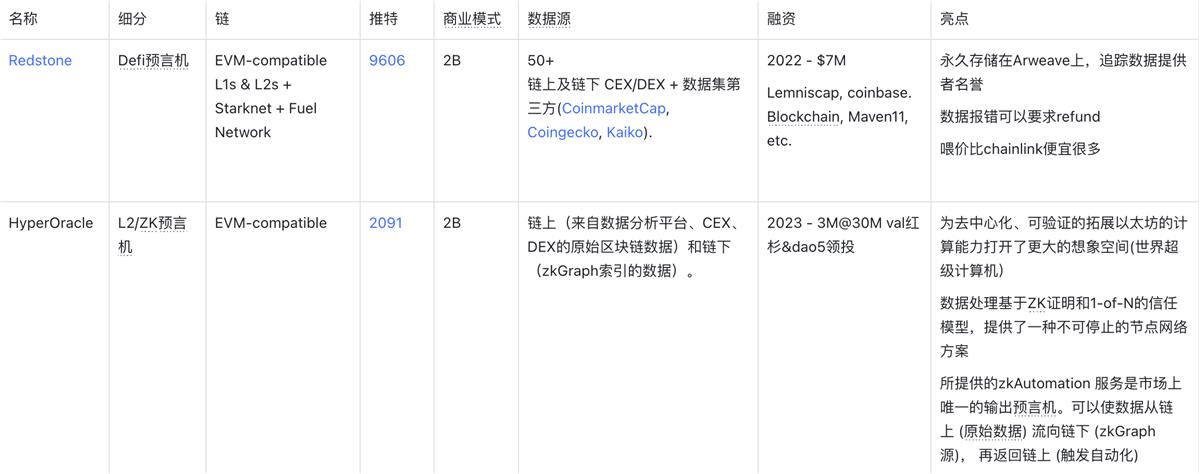
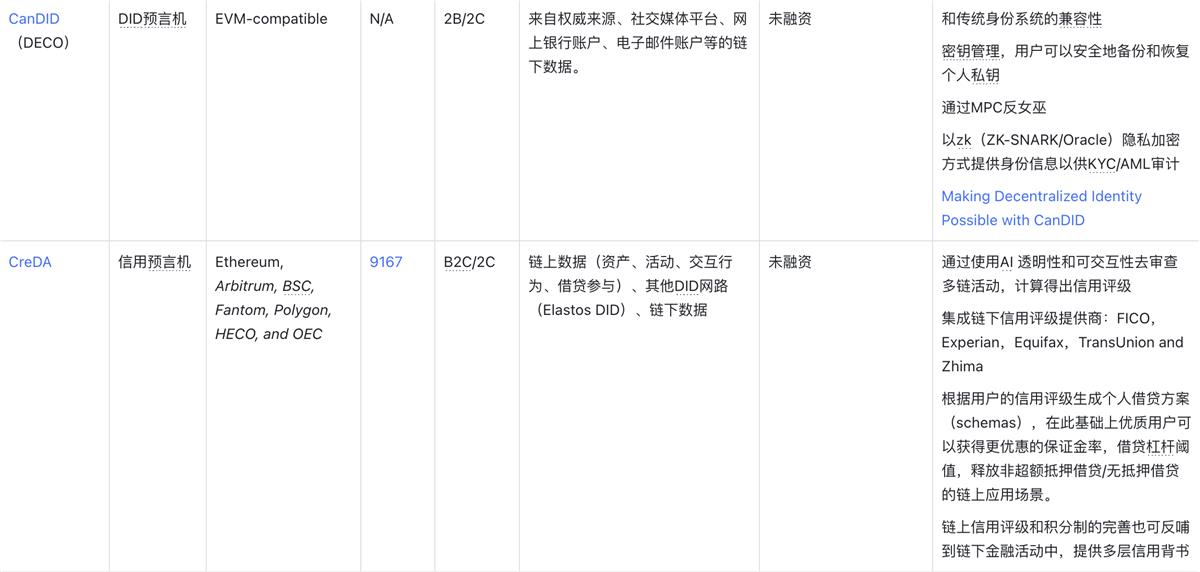

To sum up, OKX Ventures believes that with the continuous development of blockchain technology , the oracle will still play an indispensable role in the encryption track in the next cycle, and the greater development potential and market space are still worth exploring. For example, off-chain computing scenarios, NFT and other non-standard on-chain asset pricing and deep integration of AI/ML . We will also keep a close eye on innovative agreements and investment opportunities in the oracle track.