Investors should remain vigilant and conduct adequate due diligence on projects.
Written by: Lawyer Liu Honglin
How was this article born?
On a whim, ask ChatGpt what are the routines for making money in the currency circle.
Not surprisingly, GPT's list of common routines is quite in place, and can be used as the core framework of the article, but the content of the paragraphs is not rich enough, and there are no cases to support it.
Therefore, manual guidance was adopted to improve the content. In the content improvement process, Copilot of the Microsoft edge browser was used as an aid. For each content, the robot was allowed to expand, rewrite, and supplement the case, and then I chose from the answers. Satisfied to add to the text, I use Feishu documents for daily writing.
In order to prevent the serious nonsense of AI, I also deliberately conducted a second confirmation of the relevant cases and things in the answer, and tried to ensure that the content was roughly correct. From this perspective, AIGC is not suitable for seeking answers across disciplines, which itself is still the job of search engines.
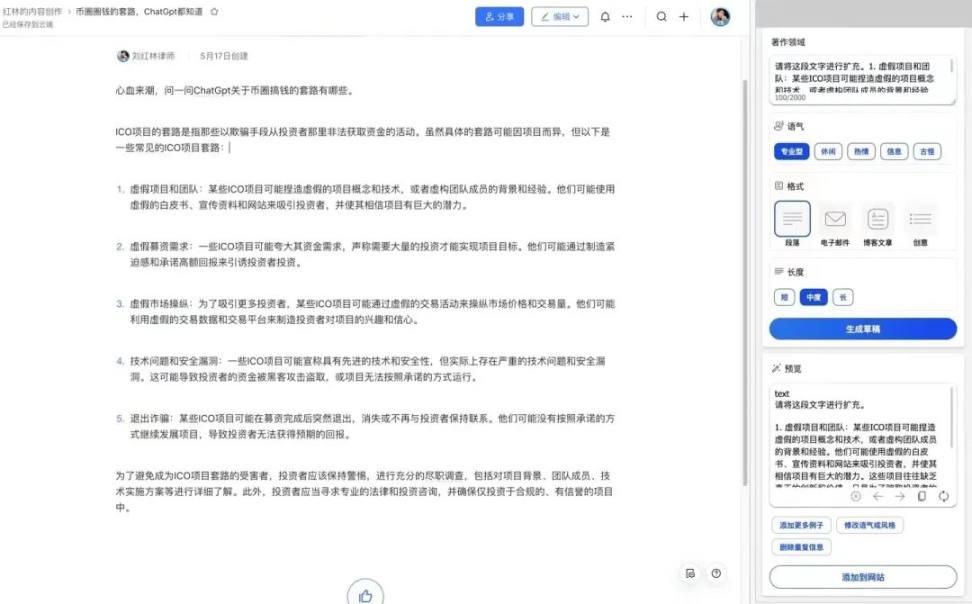
At the time of writing this article, the workbench page looks like this
The following is the dinner of the man-machine combination article, for reference only.
Fake projects and teams
Certain ICO projects may fabricate false project concepts and technologies, or fictitious team members' backgrounds and experiences. They may use fake Whitepaper, promotional materials and websites to lure investors and convince them that the project has great potential. These projects often lack real innovation and value, and are just designed to defraud investors of their money.
For example, in the US ICO project MIROSKII, Perry Henderson is described on the website as the CEO of several Internet companies and a blockchain fanatic, but in fact he is a real estate agent from Texas; Kevin Belanger, Introduced as the designer of the project, but the avatar on the website is Canadian actor Ryan Gosling.
Therefore, investors should conduct sufficient investigation and analysis on ICO projects, including checking the project party's social media, forums, blogs, etc., and verifying the identities and qualifications of team members. Investors should also read the content of the Whitepaper to understand the project's goals, roadmap, technical architecture, token distribution, etc., and compare it with other similar projects.
False fundraising needs
Some ICO projects may exaggerate their funding requirements, claiming that a large amount of investment is required to achieve project goals, but in fact there is no clear business model or technical solution, and there may even be risks of fraud or illegal fundraising. They may lure investors to invest by creating a sense of urgency and promising high returns, but when the project does not go well or encounter regulatory crackdowns, they will disappear or Rug Pull, causing investors to suffer heavy losses.
For example, a blockchain project raised US$150 million through an ICO in April 2022, claiming to build a decentralized social networking platform, but announced the failure of the project shortly after the fundraising ended and refused to return investors' funds . The person in charge of the project was arrested by the police and charged with the crime of illegally absorbing public deposits.
The promotional information of Superstar (MXCC) is as follows: Superstar is an intelligent digital asset of the star film and television industry developed and operated by a well-known company incubating blockchain based in Silicon Valley in the United States and jointly with Superstar Media Ventures Co., Ltd. in Malaysia. As a result, an induced fraud involving the project party, agent investors and some media took away nearly 5 billion yuan of real money from investors in just 6 weeks.
false market manipulation
In order to attract more investors, some ICO projects may manipulate market prices and trading volumes through false trading activities. They may use false transaction data and trading platforms to create investors' interest and confidence in the project.
Some common means of operation include:
- By buying or selling virtual currency in large quantities, an illusion of rising or falling prices is created to attract other investors to follow suit, thereby amplifying price fluctuations.
- By publishing false or exaggerated information on social media, forums, blogs and other platforms, it can affect investors' confidence and expectations in virtual currency projects, thereby driving price changes.
- By cooperating with exchanges, media, celebrities, etc., using their influence and resources to increase the exposure and awareness of virtual currency projects, thereby increasing market demand and prices.
For example, before a virtual currency project is listed on an exchange, a large amount of virtual currency may be distributed to some specific groups of people through private transactions or AirDrop, and let them sell it collectively after listing, causing the price to plummet , and then recycle at a low price to make a profit. Or, a virtual currency project may publish an article in a certain media claiming that it is about to cooperate with a well-known company, which will attract market attention and heated discussions, thereby pushing up the price, and then shipping at a high level, thereby profit.
Technical Issues and Security Vulnerabilities
Technical issues and security breaches are among the most common and dangerous risks in ICO projects. When some ICO projects develop smart contracts, they may use immature languages, frameworks or tools, or fail to conduct sufficient testing and auditing, resulting in logic errors, injection vulnerabilities, re-entry attacks and other defects in smart contracts. These flaws may be exploited by hackers to steal or freeze investors' funds from smart contracts, or affect the normal execution of smart contracts.
For example, in June 2016, an ICO project called DAO on Ethereum was hacked by hackers using a re-entry attack to steal $50 million worth of Ethereum; in July 2017, an Ethereum wallet called Parity Wallet Hackers used a vulnerability in the initialization function to steal $30 million worth of Ethereum; in November 2017, another Ethereum wallet called Parity Wallet was locked by a user who inadvertently triggered a self-destruct function worth $150 million Ether in dollars.
In addition to the technical problems and security vulnerabilities of the smart contract itself, ICO projects may also face other types of technical risks, such as network attacks, platform failures, data leakage, etc. These risks may affect the availability, integrity and confidentiality of ICO projects' websites, exchanges, wallets and other services, thereby causing losses or inconvenience to investors.
For example, in December 2017, a bitcoin mining platform called NiceHash was hacked, resulting in $64 million worth of bitcoin being stolen; in January 2018, a Japanese cryptocurrency exchange called Coincheck was hacked , resulting in the theft of $530 million worth of NEM tokens; in June 2018, a South Korean cryptocurrency exchange called Bithumb was hacked, resulting in the theft of $31 million worth of cryptocurrency. Therefore, when investors participate in ICO projects, they should carefully review the technical solutions and security measures provided by the project parties, and try to choose reputable and experienced project parties, platforms and wallets. At the same time, investors should also protect their private keys and passwords, and update their equipment and software in time to prevent cyber attacks such as phishing and Trojan horses.
Rug Pull directly
Some ICO projects may suddenly exit, disappear or no longer maintain contact with investors after fundraising is completed. They may not continue to develop the project as promised, resulting in investors not getting the return they expected.
For example, after Germany’s Savedroid company raised $50 million in its ICO, the company’s founder, Yassin Hankir, tweeted a photo of himself on a beach vacation in Egypt, with “Thank you everyone, it’s over.” Some netizens on Youtube also uploaded a video of the company’s empty office, which caused panic and anger among investors. Although the founder later claimed that this was just a publicity stunt, this behavior has seriously damaged the credibility and image of the ICO.


Not only abroad, but also in China.
Six Points Guild: This is an organization that claims to be a comprehensive blockchain media. It has recommended multiple ICO projects in the telegram group and promised high returns and rewards. But on February 12, 2018, the Six Points Guild suddenly disbanded all telegram groups, deleted the website and account, and took away about 309 Ethereum, totaling about three million RMB. According to the investigation, the Six Points Association used well-designed routines and babysitting to make investors put down their guard, and delayed the issuance of coins or cash transfers after the project went live.
Li Shiqin: This is a girl born in the 1990s. She used to do Ponzi schemes such as postal currency cards, and then transferred to the currency circle to do proxy investment projects. She used direct access to foreign channels, high PA points, and high ratios as bait to attract multiple proxy investment channels and retail investors, and cooperated with two other accomplices, "Ye Se" and "Zhu Meng". She is suspected of falsely investing in 13 projects, with a total of 15,000 Ethereum, totaling about 62 million RMB. On March 14, 2018, after being exposed, she blocked all contacts and tried to run away with Rug Pull. According to rumors, she has been captured. The above are two cases of well-known ICO projects Rug Pull away with money, and there are many similar incidents happening in the currency circle. These cases have given us a warning. Investors should be cautious when participating in ICO projects. Don't trust the promises and propaganda of others. They should do a good job of project investigation and analysis to avoid being deceived.
In order to avoid becoming a victim of ICO project routines, investors should remain vigilant and conduct sufficient due diligence, including a detailed understanding of project background, team members, and technical implementation plans.