zkSync is currently one of the most active Layer 2 in the Crypto market. zkSync kicked off with the launch of an EVM-compatible version of zk technology, zkSync Era. Then continued to launch the ZK Stack toolkit to build Hyperchain and Hyperchains linked by Hyperbridge. Recently, zkSync continues to release an upgrade called Boojum that improves scalability.
So what is Boojum ? Let's find out in this article!
To understand more about Boojum, you can read the following articles:
- ZK Credo, ZK Stack, Hyperchains & Hyperbridges: ZkSync's Ultimate Weapon for Layer 3 Wars
- What is ZkSync? ZkSync Cryptocurrency Overview
- What is the Starknet Stack? Tools To Help Starknet Compete Fairly With Other Layer 2
- What is StarkNet (STRK)? StarkNet Cryptocurrency Overview
- What is Zk Rollup? Zk Rollup Solution Overview
zkSync's Technology Surviving Matters
SNARK proof has shown performance on the zkSync Lite and zkSync Era networks, processing a very large number of transactions as close to real time as possible. But to meet the operational and communication needs of Hyperchain and reach the Mass Adoption market, it is necessary to improve speed and decentralization.
Hyperchain communicates with each other via Hyperbridge and Token will be transferred according to the Omnichain-style Mint/Burn mechanism. To meet this demand, transactions need to be validated almost instantaneously, but zkSync's original SNARK technology is not really optimal.
The problem of Layer 2 hierarchy is also a problem, as most of Layer 2 use Sequencers of their own construction or familiar places. Since the Sequencer is the most important component in a Layer 2 network, it requires very high hardware. The current zkSync proof system runs on a cluster of A100 GPUs, each with 80 GB of RAM.
To address those issues, zkSync Era turned to a new STARK-based proof-of-concept system called Boojum. On zkSync now, it will use two types of proofs, STARK and SNARK, to increase TPS, reducing hardware requirements for operators, especially Sequencer.
What is Boojum?
Boojum is an upgrade that will transition the zkSync Era to a proof-of-concept system powered by STARK, delivering world-class performance. Boojum is the name of the Rust-based arithmetic library that the zkSync team uses to implement upgraded versions of ZK circuits for the zkSync Era and ZK Stack.
Boojum's system uses both STARK and SNARK proofs to help increase processing speed and reduce network hardware requirements to enable decentralization. STARK allows for automatic parallel proof generation that makes it possible for the system to reach 100 TPS. Most importantly, in the final step, the STARK proof will be wrapped with SNARK for validation on Ethereum.
As the highlight of SNARK is a very lightweight proof that does not take much storage space, which greatly reduces the network cost of transactions.
Boojum will aim to use 16G to 32G RAM hardware, which is a normal requirement to accelerate the decentralization of the zkSync network and realize the Hyperchain and Layer 3 vision to the market.
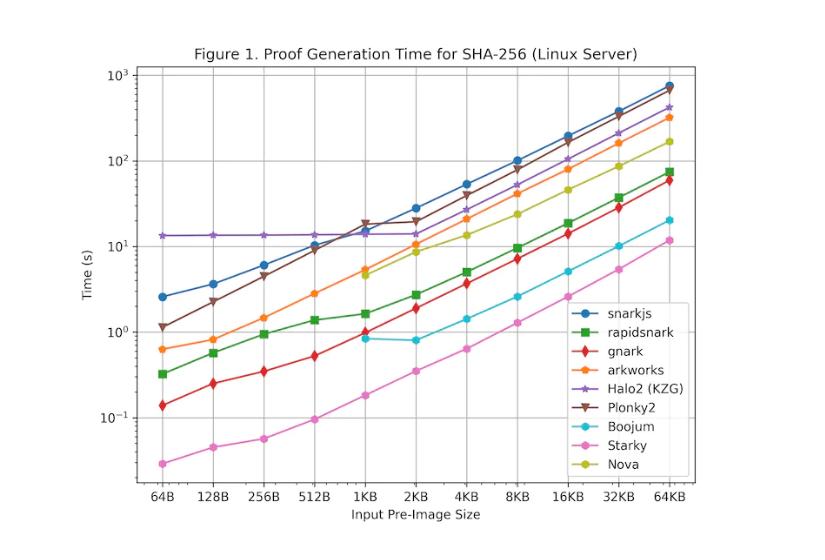
In this upgrade, zkSync is focusing on proven performance and hardware requirements to move towards a more advanced technology future. And the Boojum system has been practically verified by Celer as shown above.
Boojum Highlights
- Using zk technology should have high security.
- Incorporating STARK proofs and enabling parallel generation of proofs in the system improves proof efficiency, supporting speeds up to 100 TPS.
- Proof sent to Ethereum is still SNARK so data is light and fees are cheap.
- Improved code and reduced hardware requirements for validators make the network more decentralized.
Personal Projections About Boojum
Boojum is quite a necessary and important update to the zkSync network in the Hyperchain vision for the next cycle market. This is a huge improvement in zkSync's technology but it doesn't detract from the essence of the platform. Still using SNARK proof to send to Ethereum but still improving speed and decentralization.
This improvement is necessary to reduce the latency in transaction validation, especially the speed of communication and interaction through Hyperbridge. Hyperbridge is a bridge with Mint/Burn mechanism that makes asset transfer very flexible like Omnichain. The scalability and application of this model are very high, but the key point of the Bridge is still security.
Optimism 's Superchain and zkSync's Hyperbridge are forward-looking technologies. Supperchain has a high level of structural refinement, especially connecting the original platform like Ethereum or BNB Chain, Bitcoin, etc. Hyperchain has a Bridge connecting Hyperchains as well as Hyperchain can switch from Layer 2 to Layer 3 or vice versa.
Ethereum and Layer 2 are still the most attractive and active places in the market today. Layer 2 development technologies such as Hyperchain, Superchain, Appchains are all keywords to mine in the next cycle.
However, on Layer 2 there is very high competition, gathering a lot of big projects such as Optimism, Arbitrum, zkSync, Starknet, Base, opBNB, Linea, Taiko, Scroll,... But technology and infrastructure are not enough for a successful project, but a very important factor is the ecosystem. Is the generation system or dApps built on top really good, attracting and retaining users? From the need to use, it brings a lot of value to the Layer 2 platform below.
Summary
So I made it clear what Boojum is? Highlights of Boojum. Hope the article brings a lot of information and knowledge to you!
The post What is Boojum? zkSync Network Upgrade With New Transaction Proof appeared first on HakResearch .