Interview: Sunny
Edit: Min
background introduction
The debate over whether DEPIN is simply a bear market narrative has intensified since crypto research organization Messari released an industry report on DEPIN in January of this year. According to the report, the Decentralized Hardware Infrastructure Network, or DEPIN for short, refers to the use of token rewards to incentivize people to crowdsource and build real-world physical infrastructure networks.
In order to gain a deeper understanding of the development and value of DEPIN since 2017, we specially invited Raullen, a veteran in this field, to discuss it.
Raullen is the founder and CEO of IoTeX. Before founding IoTeX, he served as the leader of Uber's encryption R&D department, the technical director (Tech Lead) of software engineering at Google headquarters, and an engineer at Oracle. As early as 2012, Raullen began to get involved in the field of encrypted Internet of things, working as a researcher in cryptography and Internet of things privacy and security at the University of Waterloo in Canada.
In the conversation, Raullen shared IoTeX's experience of finding a development strategy through trial and error over the past few years, and its efforts to define the direction of the industry with other industry leaders. As IoTeX, which builds an intermediate layer between the encrypted world and the real world, the development of IoTeX has actually shaped the entire industry, and the words including DEPIN are derived from its achievements.
Highlights
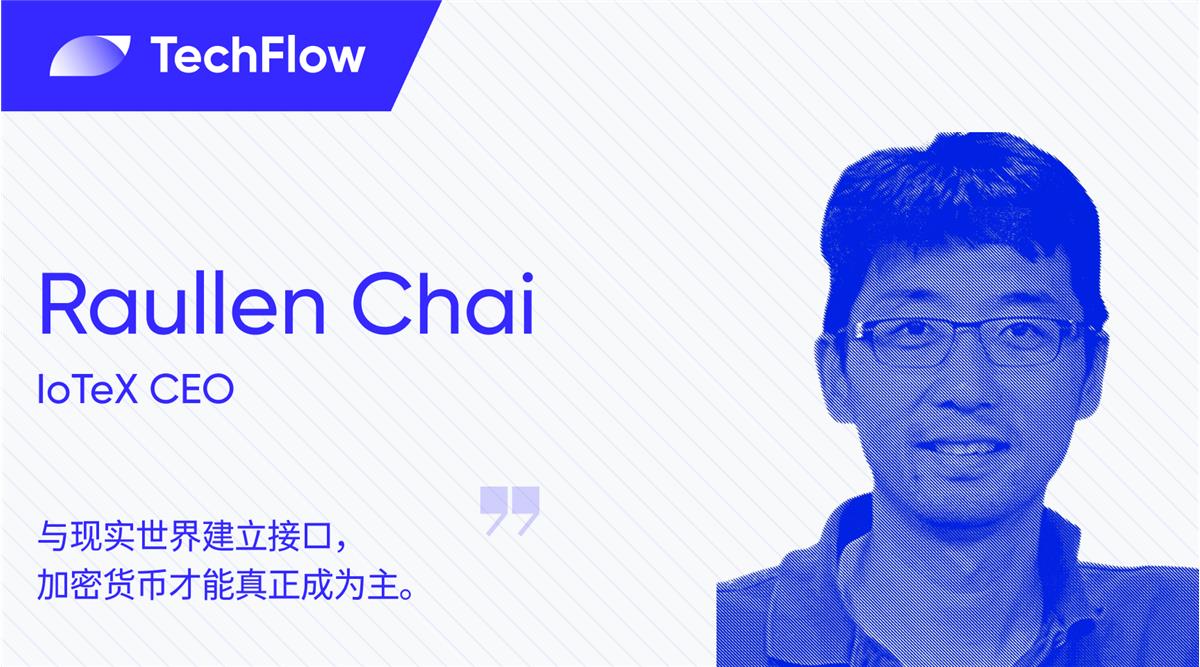
If cryptocurrency is to truly become a mainstream technology, it needs to interface with the real world. IoTeX aims to build this interface to seamlessly connect cryptocurrencies with the real world.
The threshold of DEPIN is quite different from that of DeFi . For DEPIN, you not only need to simply fork an open source DeFi protocol, but also need to develop hardware equipment, communication technology, blockchain and mobile APP, etc. These aspects are very complicated. Unless you can raise a lot of money and build a decent team, it's hard to make a satisfying project.
DEPIN may eventually take on the form that it is buried in a certain layer of the entire technology stack. For most ordinary users, there may be several layers in the middle that they don't need to perceive at all.
My personal thought and philosophy is that we should pay more attention to the construction of infrastructure, and try to lower the threshold for developers, so that more developers can participate in it, try different tracks or ideas, and eventually there may emerge some Disruptive new things .
For upgrading Web2.5 products to Web3, we can ensure the transparency, reliability and decentralization of the intermediate calculation process, help project parties solve this problem, and enable their calculation logic to be better applied.
We want to make the world a better place: and DEPIN and distributed technology may be a very good entry point.
Looking at the development history of DEPIN from IoTeX
TechFlow: Please describe to us the history of IoTeX, including the past, present and future development direction.
Raullen: IoTeX is actually an old project. At the end of 2017, our three co-founders, me, Jing, and Qevan from Facebook, started IoTeX together. Our main goal is to build an IoT blockchain at the technical level, but more importantly, how to better connect cryptocurrencies to the real world. We realized that if cryptocurrency was to truly become a mainstream technology, it needed to interface with the real world. Therefore, we are committed to building this interface to achieve a seamless connection between cryptocurrency and the real world.
At the beginning of 2018, IoTeX successfully raised $30 million in funding from top venture capital institutions at the time. We then formed a team, wrote our own white paper and vision, and set about building our Layer1 blockchain.
At the time, there were many uncertainties about where IoTeX and the blockchain would meet, so we decided to start with the lowest level blockchain. We chose Layer1 because this field is relatively mature and is regarded as the cornerstone of building the foundation of the entire blockchain.
In the next three years, that is, from 2017 to 2019, we will focus on developing our Layer 1, POS-based EVM public chain. The development of this chain has been completed, and many DeFi and NFT projects have been bred on it, and the number is about 200.
In 2020, we started to think seriously about how blockchain and the Internet of Things (IoT) could come together. Because IOTA came up with this concept earlier, but they had some problems with micropayment. Therefore, we decided to re-examine the combination of IoT and blockchain. In the process, we conducted two vertical experiments to find better solutions.
The first experiment is about the combination of IoT and blockchain for privacy. We realize that data generated by devices can be owned by users through decentralized identities (DIDs) on the blockchain and monetize data in the future. So we started our first experiment with a smart home camera product called Ucam. This camera is fully integrated with our own blockchain, allowing users to own all the data captured by the camera.
However, when we brought this product to market, we found that the feedback was relatively lukewarm.
Because we found that, especially ordinary users, are more concerned about the cost of the camera. For them, the difference between paying 40 bucks and paying 50 bucks for a webcam is huge. So then we found out that for these users, privacy protection is not very attractive . For example, if a camera is priced at 40 yuan, and privacy protection costs 50 yuan, they may not feel that privacy protection is really worth the extra 10 yuan.
Therefore, although this camera experiment has sold tens of thousands, it is not our main business. However, this experiment shows us that, at least for now , privacy protection is not a special focus of IoT users.
Then, we started a second experiment with a product called "Pebble Tracker". This is a very small open source hardware GPS tracker with a few other sensors attached to it to monitor speed, bearing, air quality, humidity, light, and more.
Then, we promised that this tracker can be used for DEPIN and token mining, so we put this product on CrowdSupply, the largest hardware crowdfunding website in the United States.
In just two weeks, we sold 2,000 and made $200,000. Actually, money was not the main concern for us, but it gave us a good inspiration. We realize what users really care about: users hope to contribute some data by purchasing this device, and get mining benefits from it,
The concept of achieving passive income is very attractive to users.
Helium was also doing very well at the time, and they were selling equipment for building LoraWAN networks. At that time, several other companies proposed similar ideas, such as Borderless's Hi-Fi and Multicoin's Proof of Physical Word, which were very similar concepts.
At that time, we thought that this concept should be called "MachineFi", because "Machine" provides practicality, plus the DeFi (distributed finance) system. Therefore, we call it "MachineFi", which is now the industry-defined DEPIN.
This actually laid the foundation for our work ideas for the next few years, and we will continue to move forward in this direction.
TechFlow: For DEPIN at that time, what was the most scarce link in it?
We have visited many DEPIN projects, and we found that there are actually many pain points in it, because DEPIN is not the same as DeFi.
DeFi is relatively simple. For DeFi, a developer, even an ordinary and relatively junior developer, can fork a contract, such as a Compound or Uniswap contract, modify it slightly, and do some front-end work to release a project, which is very Simple. As a result, a lot of innovation has sprung up in the DeFi space.
However, for DEPIN, the situation is more difficult. You need hardware equipment, communication technology, blockchain and mobile APP, etc. These aspects are very complicated. Unless you can raise a lot of money and build a decent team, it's hard to make a satisfying project.
Therefore, we believe that one of the key missing links is how to let the data enter the system to be calculated, generate a proof, and then provide this proof to the smart contract, so that the smart contract can perform certain operations, such as rewarding users with tokens or NFT.
This link is very missing. Therefore, we decided to make this infrastructure Infra to help these DEPIN developers. If they succeed, we will too. This is my line of thinking.
Therefore, starting in 2021, we started to develop the W3bStream project.
At present, W3bStream has cooperated or is cooperating with more than a dozen DEPIN project parties to provide them with infrastructure support and help them be more successful and more scalable. This is where IoTeX is going from past to present to future.
For the future, we hope that W3bStream will become the standard for the entire industry.
For all developers who have gone deep into the DEPIN field, you can see that there are not many projects involving DEPIN, about twenty or thirty or thirty or fifty, that's all. But I hope that if our work is done well, hundreds of similar DEPIN projects will emerge in the future.
The Ideal, Current Situation and Ways to Acquire Users of DEPIN Track
TechFlow: Many domestic readers, even most of them, may not know much about the concept of DEPIN. Without the incentive of excess returns , it seems that few people will delve into what IoTeX does.
Therefore, I would like to know why you chose to become the founder of the DEPIN project with a very high threshold, and why you are willing to embark on this difficult IoTeX entrepreneurial road? As a pioneer in the industry, as an earlier pioneer, are there any difficulties?
Raullen:
My goal with our two other co-founders was to do something that would change the world. We want to make the world a better place: and DEPIN and distributed technology may be a very good entry point.
If we can truly realize a distributed Uber, Airbnb, or a distributed 5G network, or other similar machine networks that can make people live a happier life, it will be very meaningful. For example, if you take a taxi, your cost can be reduced by 50%; or if you rent a house on Airbnb, your cost of using a mobile phone can also be reduced by 50%.
My previous experience at Uber gave me a solid understanding of why a company like Uber has such high overhead. In fact, most of the work revolves around how to optimize the matching of drivers and passengers, plan routes, and control risks.
Another example is telecommunications companies. They need to deploy 5G base stations, and they need to send people to maintain them after the deployment. This is a very large cost, but this part of the cost can be apportioned to everyone.
For example, if you as an individual can contract the operation and maintenance of a 5G base station, then you will have a strong motivation to do this well, because all the money you earn belongs to you. Such a cost-effective model will better allocate resources and reduce waste, resulting in better prices for consumers.
If the DEPIN network can succeed, it will have a profound impact on the entire human society.
In fact, I think from a public point of view, DEPIN is very similar to a sharing economy 2.0 . It is actually a more thorough reform of the sharing economy.
TechFlow: Returning from ideal to reality, how many DEPIN hardware manufacturers are actively doing this? Raullen:
The market structure of the DEPIN industry is as follows:
(1) First, there is a need, such as 5G technology, energy storage or solar panels, etc.
(2) Then, a DEPIN project enters to match demand and supply through some tokens or other methods. For example, if you have solar panels, you will generate electricity, and I need electricity, such as air conditioners need electricity supply, then the matching mechanism connects us together.
(3) Then, a third-party supplier will join, and this company has launched a solar panel, and it may cooperate or produce with the project to provide us with solar panels.
(4) At the same time, there may also be a fourth party entering the market, specializing in hardware sales.
This is a fairly common pattern we see.
TechFlow: At present, the challenges we see on the demand side are still great. For example, many people have never really been exposed to Crypto, or the current Crypto infrastructure has not kept up, and smart wallets are not very smart. Raullen:
In fact, don’t worry too much about this. I used a metaphor here, that is, Crypto is like lithium in a lithium battery. For example, if you drive a Tesla, you don't really need to care about the internal working principle of the lithium battery. All you care about is that you want to drive the car. Just charge it when it's out of power, and continue to drive it when it's fully charged, that's all.
I think DEPIN may eventually take on such a form, that is, it is buried in a certain layer of the entire technology stack. For most ordinary users, there may be several layers in the middle that they don't need to perceive at all.
Just like the example of buying electricity I mentioned before, as an ordinary user, I may not understand what Crypto is. But I only need to pay a small electricity bill every month, and all I will feel is that my electricity bill is cheaper.
That's it, I don't need to understand how the token works at all, and I don't need to care whether it is issued by a certain company, these are irrelevant to ordinary users.
Such a design is actually conducive to the promotion and popularization of the DEPIN industry, because it simplifies the level of user perception and contact, making the whole process more friendly and easy to use.
TechFlow: So what is currently the most mature in decentralized IT infrastructure? Raullen:
I think that in the DEPIN industry, IoTeX and Helium are relatively cutting-edge representatives, but our positioning is different. Helium mainly focuses on the vertical field. They have built a LoraWan network. LoraWan is a wireless network with a wide coverage. A base station can cover more than ten kilometers of communication. But its disadvantage is that the speed is very slow, which cannot meet the needs of the mobile phones we use now.
They do have some uses in certain areas, such as agriculture and industry, but the amount of data from these sensors is small. They have done a good job on the supply side, deploying hundreds of thousands of devices, mainly in the United States and some in China, but their demand side has not been well developed . In other words, end users don't have enough demand to support this network, so they fail in this respect.
Later, they began to transition to the second project, which is 5G. Of course, everyone is using mobile phones, so 5G does not face too many challenges on the demand side. But there are still some challenges on the supply side, such as the construction of 5G base stations you just mentioned, you can't just buy a device and put it at home, because you need to install it on the roof and need to connect to a high-speed network and so on.
In contrast, our philosophy is not the same as that of Helium . They pay more attention to deep cultivation in the field of wireless connection.
My personal thought and philosophy is that we should pay more attention to the construction of infrastructure, and try to lower the threshold for developers, so that more developers can participate in it, try different tracks or ideas, and some may emerge in the end. Disruptive new things.
We live in an age where we may not be able to predict what future innovations will look like. This is like a smart contract. Before the smart contract was created, it was hard for us to imagine that it would be used for Defi, prediction markets, etc.
I think innovation emerges, and what we can do is to lower the threshold for innovation very low . Just like Defi is a good example. There may be tens of thousands or even hundreds of thousands of DeFi applications in the world, some of which are serious and some of which are very basic. But as long as the base is large enough, some better projects can always emerge.
The problem with the DEPIN industry is that the base is too small, with only seventy or eighty projects, less than 100, so it is difficult for particularly successful projects to emerge. Therefore, our goal is to continuously promote the development of the industry so that more innovations can emerge.
TechFlow: What is the best way to cooperate for IoTeX?
Raullen:
Now our Infra already has the first version, which is basically perfect. But now we are interacting more with developers, with builders, founders and entrepreneurs in the DEPIN industry.
We chat with them about a lot of things. For example, we ask them what their opinion or suggestion is about our Infra? What kind of functionality do they need? What are their current pain points? How can we help them? Do you need to add other features and so on.
This interaction allows us to better understand their needs, and at the same time helps them make better use of our Infra and make their projects run smoothly.
Through conversations with developers, we are constantly optimizing our Infra to make sure it meets their needs. We also hope that through this interaction, more developers will be inspired to participate and the DEPIN industry will develop better.
Our goal is to provide an excellent platform for developers to build and advance their projects more easily. In this way, the entire DEPIN industry can flourish more.
TechFlow: As mentioned above, we need a moment like "Tipping Point" to let more people know about DEPIN. So what are the decentralized hardware that everyone can access now, and what products can they generate passive income ?
Raullen:
Now there are many projects involving different tracks, including traditional server storage network and GPU network projects.
Another type of project is the sensor network. For example, they provide local weather data collection services, allowing users to place devices in the backyard, collect local weather data, and then realize these data.
There are also projects like DIMO, which monetize the data after collecting vehicle data. There are also sensitive data processing projects, such as dashcam, they draw street view patterns at work, collect perspective information, and then present address data to users, which is also an application point.
There are also projects that focus on Wireless connectivity, such as Helium Wifi Maps and a company that provides GPS correction services.
GPS correction services are a relatively niche but meaningful market. It solves the problem that the GPS signal may be inaccurate after receiving the satellite signal, especially when there are clouds, cloudy days or twilight, there will be signal refraction and reflection. These companies will arrange some base stations on the roof of the building, perform GPS signal correction, and then make the mobile phone receive more accurate positioning information through the compensation signal, which is indeed an interesting application field.
TechFlow: From the perspective of the project side, how does IoTeX help them transform from a Web 2.5-like project to a Web3 project? At present, some projects may still use centralized servers to build products . Many Web3 venture capital companies will ask how to decentralize when examining project parties .
Raullen: The point you made is very interesting, and we have noticed similar situations when communicating with many project parties.
This middle layer plays a crucial role in the system architecture: it connects many devices or data, and then computes . Since the data cannot be directly uploaded to the chain, it needs an intermediate place to calculate and get some results, such as Helium's Proof of Coverage (POC) or dimo's vehicle driving route. These calculation results will eventually be uploaded to the chain and trigger actions such as some tokens or NFTs.
Building a simple centralized middleware may be ok at the beginning of a project, since the primary goal is proof of concept (POC) and prototyping. However, this middleware will become a bottleneck when the project party wants to actually push it to the market and show it to investors, token holders and more users. Because no one will fully trust the results calculated by the middleware.
You're right, why do they think this intermediate calculation is correct? Is there bias? At this time, transparency, decentralization and reliability become very important.
That's why we think WebStream can play an important role in this space. We can ensure the transparency, reliability and decentralization of the intermediate calculation process, help project parties solve this problem, and allow their calculation logic to be better applied.
The important position of ZK in DEPIN
TechFlow: Are some technologies of ZK also used in DEPIN ? How do you view the role of ZK? Raullen: It is not difficult to do off-chain calculations in the project itself, and write programs to achieve this. But for this kind of off-chain calculation, the difficulty is that you need to generate a zero-knowledge proof (ZK proof), and then submit the calculation result together with the ZK proof to the smart contract. Smart contracts need to verify whether your calculation results are consistent with what you claim, which is a relatively complicated process.
The key to this process is to ensure the transparency and verifiability of the calculation, because on the blockchain, trust is built on the basis of verifiability. Only when the smart contract can verify the correctness of the calculation results and ensure that there is no cheating or tampering, investors, token holders and users will trust the reliability of the system.
Ensuring the transparency and verifiability of such special-purpose off-chain computations is therefore a very important task, which is what our W3bStream project aims to solve. Our goal is to build a reliable middle layer to ensure that the off-chain calculation process is transparent, safe, and reliable, and to provide better support for project parties so that their calculation logic can be more widely used.
TechFlow: So on the underlying DEPIN track, what do you think about ZK's use in privacy applications?
Raullen:
In fact, some time ago, Vitalik wrote an article about the three strategic directions of Ethereum, one is user abstraction (AA), one is privacy, and the other is technical development. Each of these three directions has its own intentions.
The goal of AA is to better attract users, especially institutions, because the authentication methods used by institutions are very different from the login methods of ordinary users. Institutions often have complex accreditation systems, and the AA's goal is to monitor these accreditations.
The direction of privacy is more like how to protect the privacy of funds on the Ethereum chain. Like in a big bank, if you have a lot of money in there, you don't want everyone to be able to see where your money is going.
So I think the direction of privacy may be more difficult in the short term, especially under regulatory pressure, but in the long run, the direction of privacy has comprehensive value. However, there are still many challenges in the process of realizing privacy, and some projects even require custom smart contract languages to write ZK contracts.
As for the third direction, Layer 2, the main concern is how to use these funds. For example, DEPIN, DeFi or Gaming on Layer 2. I think the logic of Ethereum is to plan the development direction according to the TVL (Total Value Locked) of these funds.
Application Scenario Limitations of DEPIN
TechFlow: For the founders of Web3 and AI , they feel that the efficiency of startups is the most important. But the current experience of decentralized storage is not good. How do you think the combination of decentralization and centralization can improve application efficiency?
Raullen:
In fact, there is a small branch in DEPIN, they focus on decentralized computing, such as decentralized GPU network and decentralized storage, etc.
I think for artificial intelligence (AI), especially when you want to do model training or inference, inference is relatively computationally light, but model training is actually quite complicated.
What really needs a lot of GPU computing resources is the training phase of the model, especially in the Pre-training (pre-training) phase. This stage not only requires a lot of computing power, but also requires high bandwidth and communication between GPUs.
Such a decentralized network is very difficult to achieve, because you can imagine that if you place a GPU at home and he also places a GPU at home, the communication between these two devices will be very slow. But some applications can be done. For example, after the large model has been pre-trained, it may be feasible to perform some fine-tuning on it and deploy some small models.
TechFlow: So DEPIN is not suitable for the application scenario of building a large model by yourself ? Raullen: I think it should be very difficult at present. If you want to make a model like ChatGPT, I think it is very difficult to use a decentralized GPU. And the cost is not necessarily much lower than AWS.
Data, the entry point for DEPIN to serve AI
TechFlow: What role do you think DEPIN plays in the fusion of AI and Crypto?
Raullen:
In fact, I think there are several key points in this field.
Fields such as data, computing power , and energy are places where DEPIN can serve AI , and of course there are places where AI can serve DEPIN.
But for DEPIN to serve AI, compared to computing power, I think data may be a very good entry point. Because the field of encryption and Web3 is very good at crowdfunding, such as crowdfunding data, crowdfunding funds, and so on.
If your AI model needs specific data, such as the engine speed of a specific model and other very specific data, then these requirements can actually be handed over to the DEPIN network to complete, and then the results are fed back to the AI model for training.
In contrast, the problem of decentralized computing power may be more complicated.
TechFlow: Throughout the interview, are there any important things about IoTeX that you would like the audience to know in particular?
Raullen:
Yes, take IoTeX as an example. As an old project, we realize that in the field of cryptocurrency, people tend to pay more attention to new projects, and may not pay enough attention to valuable old projects.
But I want everyone to know that IoTeX has been continuously empowering our tokens, promoting our projects, and constantly exploring new directions on the basis of stable DEPIN.
We have become the leading project in the DEPIN field, and more DEPIN projects will join IoTeX in the future, especially in terms of implementing infrastructure.
We plan to work closely with all DEPIN project parties, including investors and media, to jointly promote the development of this field. Our goal is to make the DEPIN track develop better and make the world a better place.