"Crypto games must be playable", and the crypto game team that still regards this as the only creed will inevitably die, because they cannot understand the game nature of Crypto users, or in other words, do not understand the "gambling" when you start Before starting a new crypto game project, or planning to pay for a project, please learn Crypto Game 101 - the GGR model of the gaming industry.
GGR, the full name of Gross Gaming Revenue (gaming gross profit), is the most common performance indicator of the gaming industry. It refers to the total amount of bets lost by players within a period of time, that is, the casino's gross profit, calculated as: total bets - total payouts (money won by players).
There is also an algorithm called NGR - net gaming profit, which is calculated as: total bets - total allocations - total bonus allocations (chips for additional activities) - total gaming tax allocations.
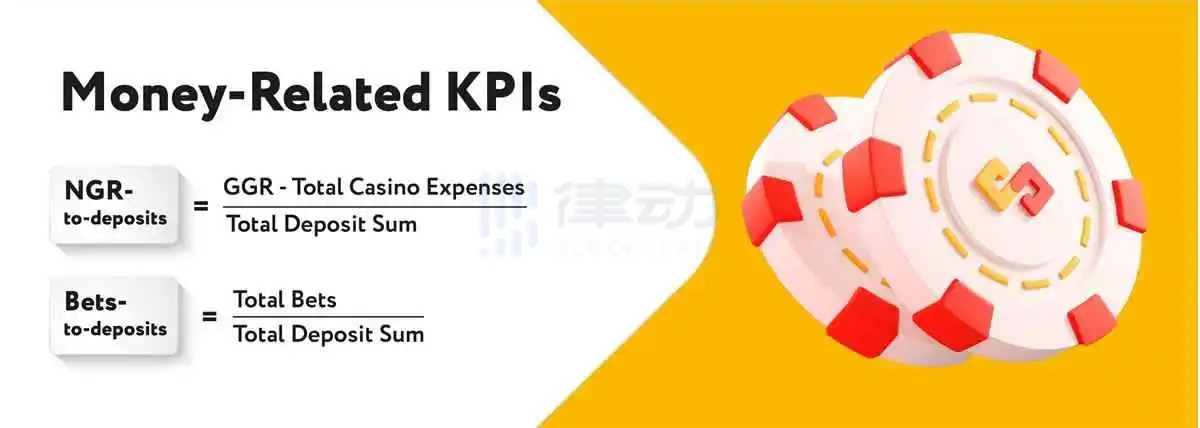
Sound easy?
Then let me tell you, GGR has another algorithm: total number of bets X kill rate The so-called kill rate is the percentage of the total number of bets that will be lost.
We all know that gambling is not a fair game even if the dealer does not cheat. Even according to the standard gameplay theory, relatively fair games such as blackjack, baccarat and even sieve throwing still have a house edge ranging from 0.5% to 20%.
Leaving aside the "unlimited money bug", the dealer wants players to:
- keep betting
- The bet is bigger (the turnover is bigger), so the casino will control the actual House Edge, especially in online gambling, where there is more room for manipulation.
The result is that the kill rate is too small to make money, and if it is too large, no one will play. You can't let the client lose all the time, and you can't let the client win all the time, and you need to give the client certainty in the odds, and the client must have a consensus on this certainty.

Speaking of which, we can look at the Crypto Game and even the crypto trading market as an example. I would like to start with @Mulan0x's interesting quote:
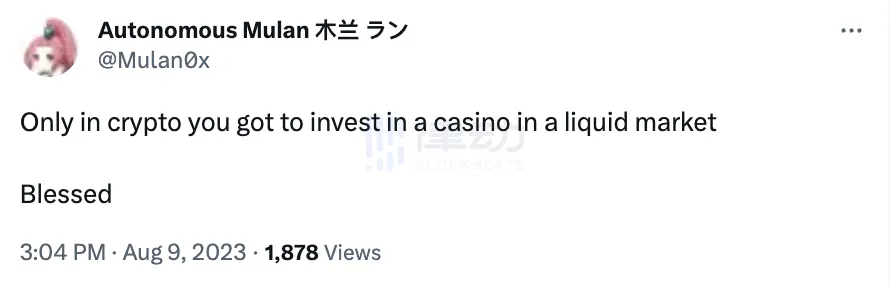
I agree with her statement, but the casino here should refer to a gaming place in a broad sense, rather than gambling in a strict sense.
The biggest difference between gambling and crypto games is whether players can accept variable odds.
Regardless of the final kill rate of a gambling game, its odds have a framework; and Uniswap has different odds for every local dog, even if every Altcoin of @binance has different odds at different times.
This explains why there is almost no difference between GambleFi products from @rollbitcom to @Stake products. They are all game halls and then there are sports quiz, baccarat, fishing, and roulette. rate frame. What his audience thinks is how to get edge in the fixed rules. And the portrait of this group of people does not completely coincide with that of degen or trader.
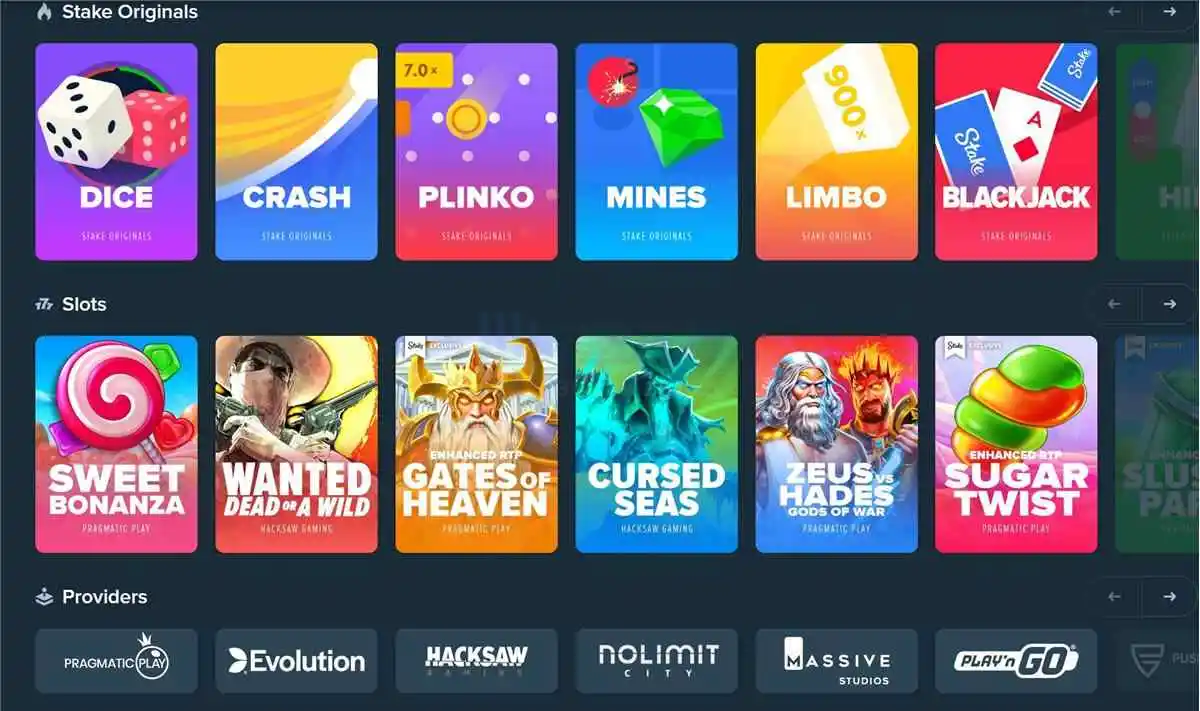
Gambling doesn't need 10,000 games, it needs a mechanism to be used by 10,000 agents or cash nets.
Most of the online gambling is based on the agency system, and the game provider and the cash network share the GGR. If there are too many games, it will cost a lot of money, which is why most of the NGR is around 3%. Second, there is the issue of kill rate. Or fundamentally speaking, it is a question of how to make the kill rate controllable. Here are three kinds of logic: gambling, contracts, and local dogs.
The fundamental difference is in mobility:
Gambling: the odds are fixed, there is no liquidity, and the killing rate is absolutely controllable;
Contract: the odds are relatively fixed (big currency), there is a certain degree of liquidity (close at any time), the flow model or kill rate is relatively controllable (that is, the logic of "customer loss");
Earth Dog CEX/DEX: Odds are not fixed at all, absolute liquidity (unless Pixiu), kill rate is almost uncontrollable (unless CEX cuts off the project party), the less fixed the odds, the greater the liquidity of chips, the more uncontrollable the kill rate.
This is why, whether it is a gambling game or not, almost never uses absolute true randomness.
Because the kill rate is uncontrollable, once the kill rate is too high, players will be lost.
In online poker games, the method of "sexy dealers, online card dealing" is often adopted, because the pure algorithm pseudo-random is easily cracked by a stronger algorithm, resulting in a loss of cash net. This is a game with the theme of "balance and pull". game.
The kill rate directly affects the GGR of the player's unit life cycle. Going back to the above three products, from gambling to Tugou, the stickiness of users is decreasing, which directly affects the logic of user growth and conversion.
The most profitable gambling is the VIP room, which can account for more than 80% of the total profit of the casino. And the VIP room relies on casino intermediaries commonly known as "Jackpot Boys" to grow and transform. How do casinos share profits with Junket Boys, and how do they know whose customers have gambled how much?
This is about how the casino makes codes.
There are two types of chips, cash chips and mud chips. Cash codes can be redeemed in both directions, while mud codes are only used for betting.
Cash codes are won after placing bets. Every time you place a bet, you are washing the codes. Junket Boy can get rebates, and even gamblers can get rebates.
Deja vu? The contract exchange rebate system adopts a similar form. The contract experience fee is equivalent to a mud code, and the advantage is that the incentive does not cost real money.
The takeaway here is:
- Mud code locks liquidity and directly promotes betting (transaction);
- Code washing and rebates essentially form the consistency of key growth node interests. The greater the turnover, the greater the profit (even for gamblers, it is the turnover to earn), which actually further ensures that the kill rate is controllable and improves unit life Cycle GGR So far, we have discussed the three cores of gambling :
fixed odds framework;
Controllable kill rate;
growth transformation;
Let’s take a case: @0xMJM, which recently announced financing, is a chain reform of the classic real money mahjong game, which is worth studying.
Since the function has not been fully opened and the experience time is limited, the following is an incomplete analysis (with some accommodation) to issue codes: MJU - a 10-cent equivalent stable currency, which can be obtained by charging U.
Equivalent to cash codes, the GGR, kill rate, and growth conversion logic of redeemable games are very interesting and worth pondering carefully.

First of all, let’s look at GGR and kill rate. This game currently has three fee-based game modes: Ladder, Spiritual War, and Private Ladder. The ladder is the PVP mode, and the game only draws a maximum of 6% of the table fee.
Spiritual warfare is similar to automated card games. Users need to bet on the table, so the odds are fixed according to the mahjong rules. Theoretically, the project side of these two models can directly play the role of House as the user's opponent by arranging "operation" and direct regulation to control the kill rate.

In this process, GGR = 6% station fee (no operation intervention) + ladder/spirit war users lose money (operation intervention) - users win money (operation intervention) What’s interesting is the sparrow mode, which is the core of this game Casino logic:
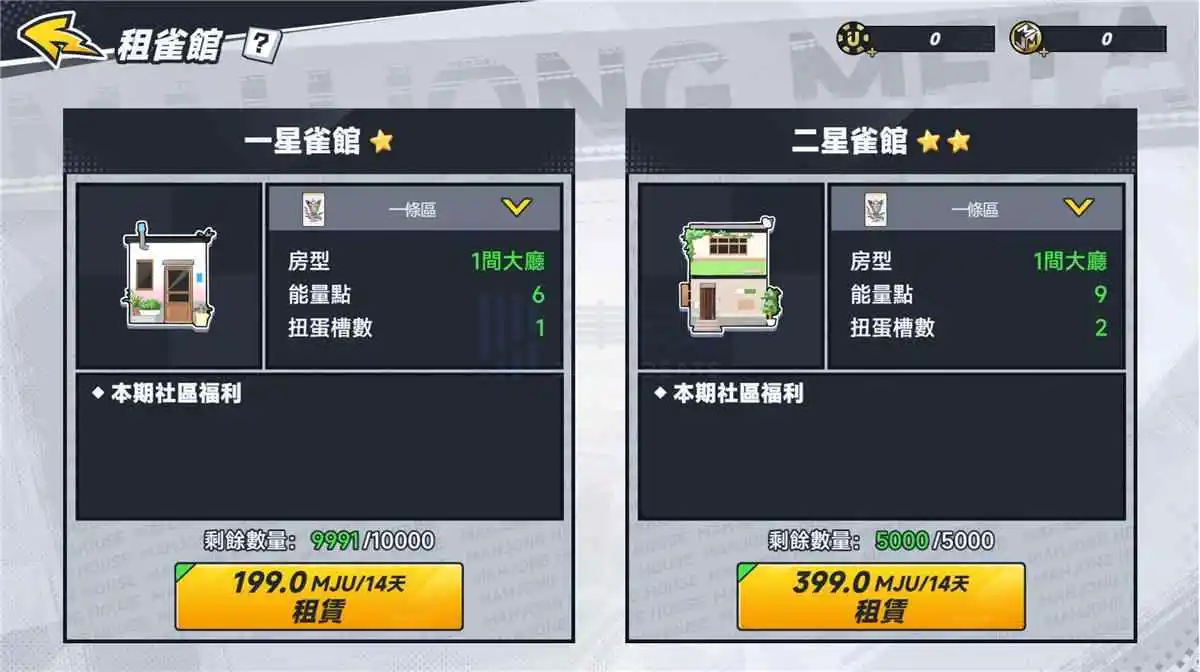
- Users can rent NFTs to open private games. The higher the level of the NFT, the higher the cost (rent or buy);
- Customization of expected betting rules in private games;
- The private bureau draws 30-70% of the Taiwan fee according to the level of the bird house;
The difference from the code washing discussed before is:
- It is the hall owner who gets the bird house, and the hall owner has a pre-sunk cost;
- The hall master makes the opponent's hand by himself;
- The interests of the hall owner are consistent with the official, that is, to increase the turnover, and to expand the life cycle of the unit GGR. The hall owner needs to calculate NGR, that is, the total number of bets + the total turnover;
- Total allocation-total cost of the house, there is an obvious bug here;
- The hall master is not the banker in the mahjong game, there is no clear edge, and the kill rate cannot be controlled;
In terms of rake alone, compared with the traditional Macau code laundering points, the hall owner’s rake is quite considerable. But first, there is a pre-sunk cost (the hall owner has to pay a fee to open the hall), second, if you can’t control the killing, you may lose money, and third, there is no mud code, which means that the player can leave at any time. If I understand the game mechanism correctly, the cost-effectiveness of renting and buying the NFT of the Sparrow Pavilion is a question mark. Of course, if the price of the NFT secondary market can be hyped up, that is another matter.
Let's look at @rollbitcom's classic code-washing model:
Ordinary level: for each account that is registered and issued codes, 10% of the banker's advantage (the banker's winning money) will be returned to the inviter;
Advanced level: 100 accounts registered and coded out, with a total coded amount of $100,000 or more, 20% house edge rebate;
Red stick level: 500 accounts that registered and issued codes, and the total amount of codes issued is more than $1,00,000, and rebates are negotiable.
It can be seen here that Rollbit actually adopts the classic horizontal and vertical stacking model, and the promoters have no risk, no upfront cost and no need to be an opponent. Its competitors, such as Stake.com, basically adopt the same strategy (the highest rebate house advantage is 45%). Therefore, it is also an agent, and the competitiveness of the @0xMJM Hall Master mechanism is questionable.
Of course, there is also an additional unpopular opinion here: all on-chain gambling or chess and card games are essentially using growth data as a meme to allow casinos to quickly capitalize, rather than making money like Web2's predecessors. After all, AG or iGaming may not have the same appeal.

Implications for the Crypto game team:
- First of all, understand that crypto players are not consumers of traditional games, and they will not pay for your "ROI participants" without asking for returns: the first thing is "gambling" and not just fun;
- Using the gaming model, is GGR suitable for your project, what is your revenue model, and how to control it?
- Learn from Junket Operator how to engage in CX Macau. Don't cross the river by feeling the stones.