The introduction of EigenLayer brings new opportunities to its local token design. This article compares EigenDA and Celestia to show that the latter requires tokens to operate as a POS chain, while EigenDA uses Ethereum to pledge without POS foundation, and its tokens may serve community negotiation and data Payment for services.
Written by: Vending Machine
Compiled by: Vernacular Blockchain
The introduction of EigenLayer and the resulting Active Validation Service (AVS') brought new design considerations and requirements to its native token system. This article explores these design considerations by comparing EigenDA, a data availability AVS, with Celestia, an external modular data availability solution. This comparison aims to highlight the changes in token responsibility between AVS' and their equivalent standalone solutions. Although both protocols are solving the same problem, their architecture needs to meet different requirements from their native tokens.
1. Introduction to EigenLayer
EigenLayer is a universal decentralized trust market built on Ethereum, the largest programmable decentralized trust network. It decouples Ethereum's trust layer so that components of the network can be used for other purposes. In order for AVS' to take advantage of the security already built into the Ethereum network, stakers will need to "re-stake" their staked ETH (or liquidity staked ETH), opting in to additional reduction conditions unique to each AVS. In this sense, EigenLayer is a marketplace that leverages Ethereum's validator network, allowing it to be reused in other protocols.
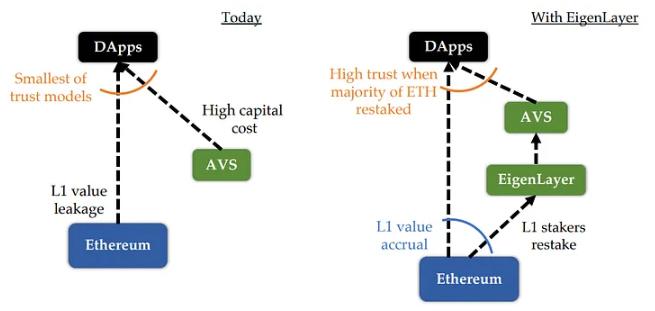
Source: EigenLayer White Paper
The seemingly simple feature of re-staking provides efficiencies for protocols currently within the Ethereum ecosystem, as well as those outside the ecosystem:
1) Current Ethereum-based applications that decided to outsource security to Eigenlayer achieve cost-efficiency by integrating with the protocol and reusing Ethereum capital staking to secure their dAPP/network. At the same time, it also achieves higher throughput and scalability.
2) Applications that are not economically viable within the Ethereum network due to scalability limitations may now outsource the security/trust aspects of the system to Ethereum "re-stakeholders", thereby obtaining Ethereum validators themselves security and decentralization. Some of these include: consensus protocols, data availability layers, virtual machines, management networks, oracle networks, bridging, threshold cryptographic schemes, and trusted execution environments.
3) Rollups built on EigenLayer have specific advantages. New virtual machines customized for Rollup can be implemented while still leveraging Ethereum's trust guarantees. Additionally, since the full L1 state is available natively, it inherits the full security and liveness properties obtained from Ethereum via Eigenlayer. Rollups simplify the application development and integration process, making them easy to build and deploy. However, it is worth noting that there is currently no "default" security bridge to Ethereum, which may pose some challenges.
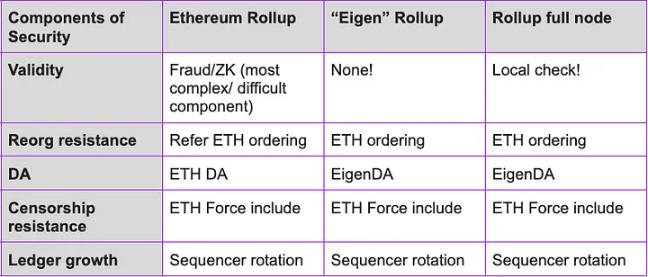
Source: How to use EigenDA to build new virtual machines and Rollups
EigenLayer brings many advantages to applications and networks by gaining access to Ethereum's security while removing limitations caused by its network congestion. However, in the crypto market, protocol tokens are a key tool for protocols to launch and incentivize their own validator network and economic security layer, which begs the question: What is the role of protocol tokens in AVS built on EigenLayer?
This article compares AVS (EigenDA) with its independent equivalent DA solution (Celestia), aiming to establish a framework to begin interpreting AVS-specific token design requirements.
2. Data availability issues on Ethereum
To illustrate the design differences between external network tokens and Eigenlayer AVSToken, we can examine two Ethereum data availability solutions, both within and outside the Eigenlayer protocol.
The “data availability problem” on Ethereum refers to the challenge of proving that transaction details exist and are available without actually downloading the records. This has become even more important due to the increasing number of "layer 2" networks. As these networks increase, the amount of transaction data on the mainnet also increases, exacerbating the data availability congestion on the mainnet.
The four main solutions to data availability problems currently being developed are:
1) EIP 4844 (Proto-Danksharding) This is a proposed Ethereum network update that aims to reduce transaction fees and increase throughput by introducing a new transaction type called "transactions carrying blobs". This transaction type holds large, fixed-size data blobs, providing a framework for future implementations of sharding on the Ethereum blockchain.
2) Modular DA-focused blockchain is similar to Celestia’s DA-focused blockchain, which introduces a modular blockchain architecture and focuses on data availability. Celestia simplifies blockchain deployment and maintenance and provides customization options designed to improve the scalability of Web3 applications. It ensures data availability through a technique called data availability sampling, which allows users to verify large chunks of data. It enables anyone to power their own blockchain without having to launch proprietary consensus and DA. Additionally, Celestia works with existing Rollups to promote a collaborative environment with interconnected chains, thereby creating value for the entire modular ecosystem.
3) Second layer chain (Rollups) Second layer solutions, such as Arbitrum, Optimism and zk Rollups, reduce the cost of data availability by processing transactions off-chain and publishing compressed batches of these transactions to Ethereum. This approach reduces congestion on the base layer and lowers fees. However, to ensure trust, proposed state changes must be independently verifiable, requiring transaction data to be available.
4) EigenDA Developed by EigenLayer and based on the core technology of Proto-Danksharding, EigenDA is the data availability (DA) layer of Ethereum, acting as middleware to ensure that data is accessible to nodes. It works by breaking calldata (an important cost factor for Rollups) into small pieces. The system uses a zero-knowledge proof concept that allows each node to download only small chunks of data, and even if half of the nodes leave, the system is not affected because the complete data state can still be reconstructed.
EigenDA and Celestia both provide consensus and DA frameworks specifically for modular components, but there are key design differences that change the role of native tokens in their respective ecosystems.
3. Celestia
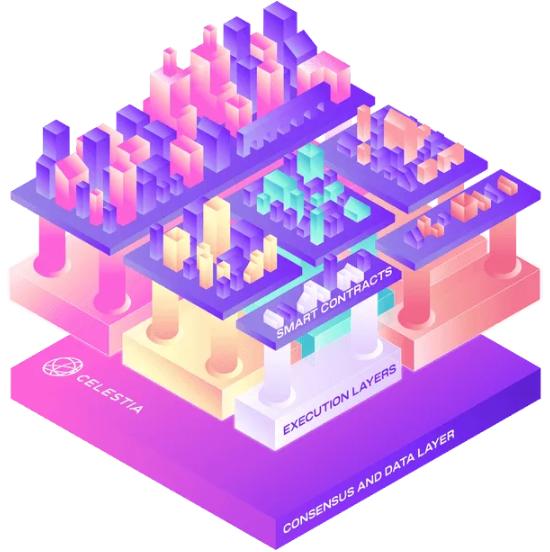
Celestia is designed as a scalable blockchain geared toward data availability. It uses proof of data availability with erasure coding; a mathematical primitive that makes sharding secure. This enables Celestia’s data availability layer to perform block validation like a sharded blockchain and achieve scale.
Source: Celestia
Celestia can be defined by two main components:
A. Local consensus mechanism: composed of full nodes and light nodes, using a highly scalable POS architecture.
B. Light Nodes: Celestia light nodes use a block encoding scheme called Data Availability Sampling (DAS), which allows them to verify with high probability that the rest of the blocks have been published by sampling only small random samples of the block data. It does this by having light nodes perform multiple rounds of random sampling of small segments of block data. Once this process is repeated until the light node reaches a predetermined confidence interval, it considers the block data to be available. Multiple light nodes doing this allows the system to prove consensus without downloading the entire blockchain and still maintain a high level of security.
C. If any full node detects an anomaly, they can notify the light client through a data availability fraud proof. Additionally, light clients do not verify transaction data, as Celestia only verifies consensus and data availability. Light nodes play a fundamental role in the security and scalability of the entire network. As the number of light clients increases, the size of each block can also increase without affecting the security or decentralization of the network. This results in greater data throughput and higher scalability.
D. Modular data availability layer: Celestia is designed to help build a blockchain ecosystem with a modular data availability layer and executable engine, which can be integrated. This is considered the next generation of scalable blockchain architecture. It works by reducing the block verification problem to data availability verification, which can be accomplished efficiently and at sublinear cost using data availability proofs. This leads to an interesting consequence: the higher the number of clients in the network, the larger the block size can safely be had (and thus higher throughput).
Because Celestia is a completely independent blockchain from the Ethereum mainnet to provide a modular data availability scaling solution, it requires its own infrastructure, including a distributed set of validators.
4.Eigen DA
To solve the data availability issues mentioned above, the EigenLabs team developed EigenDA. It is a middleware implementation that ensures data is available to nodes. There are multiple data availability tiers, and re-stakeholders can choose to join whichever tier they wish (by opting in, they are responsible for ensuring the validity of their data). These re-stakeholders will then attest to the state of the data.
EigenDA's architecture consists of two main components:
A. Eigenlayer consensus mechanism: ETH pledgers can choose to join the verification EigenDA network and accept EigenDA's specific stake reduction conditions. These "Eigen pods" then act as POS validators, attesting to the state of the network.
B. Data availability layer: EigenDA decomposes calldata (one of the main costs of Rollups) into small blocks, and performs erasure coding and KCG polynomial commitment (the basic core of zk proof) on these blocks to motivate each node in the system Only small chunks of data are downloaded. Even if half of the nodes leave, it will not affect the system because they will still be able to reconstruct the complete data state. It is able to achieve this because erasure coding allows the complete data state to be reconstructed even if some blocks are lost, while KCG proofs ensure that the block received by the node is the same block claimed by the node.
1) Performance
Source: How to use EigenDA to build new virtual machines and Rollups
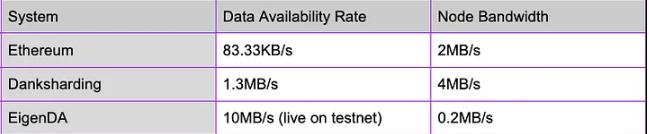
EigenDA is built on the basic concept of danksharding originally developed by the Ethereum team as the core technology. Because EigenDA is not subject to the inherent limitations of Ethereum itself, it can process data 200 times faster than the mainnet. EigenDA is able to do this because it does not have to host its own consensus and security.
2) EigenDA Advantages
There is a different set of challenges that need to be addressed between building with EigenDA versus traditional Rollups using mainnet data availability. Traditional Rollups face several challenges when competing with Layer 1 solutions (L1s). There are several reasons for this. First, the primary cost factor for Rollups is the data availability (DA) component. Additionally, when Rollups leverage the DA layer of L1s, the DA cost becomes uncertain since they share a common DA layer with other providers. Additionally, Rollups require upfront costs, whereas L1s have the advantage that their costs are paid for in Tokens that they have local control over.
Instead, EigenDA solutions offer a different approach. It provides an extremely low-cost solution as there is almost no capital cost in the network boot process and only a fraction of the complete data state is downloaded. Additionally, EigenDA makes it possible to reserve DA in advance if an application or network will require a large amount of DA. Long-term DA reservations provide cost certainty. In this solution, it is also possible to use local tokens to pay DA fees, provided that the EigenLayer validator accepts it. This enables better financial management and control over incentives, including addressing inflation.
3) EigenDA vs Celestia Token comparison
Although EigenDA and Celestia have proposed solutions to the same problem, their architecture and design are very different in implementation, so they have different needs for native tokens.
A. Celestia
Celestia provides a DA and consensus foundation for a modular execution and settlement environment to use its infrastructure. It is a POS system with some innovations around novel Data Availability Sampling (DAS) technology, allowing its light nodes to prove consensus without downloading the entire blockchain and maintaining security. Still, it requires collateral capital and fees in the form of native tokens.
This Token is likely to have similar functions to the familiar POSToken (such as Ethereum). They adopt a fee burning mechanism similar to EIP-1559, so the fees burned will offset the issuance of new tokens as the network increases adoption. The token is also likely to be used for governance, for decisions about major changes to the network and for achieving consensus in community decisions.
B. EigenDA
EigenDA leverages the capital collateral of Ethereum stakers, repurposing shared security for its own purposes, so it alleviates many of the capital issues experienced by Celestia. However, this also eliminates the need for native tokens required for the core functionality of traditional POS platforms. Nonetheless, EigenDAToken likely adds a lot of value in the following areas:
EigenLayer must have attributable, objective reduction conditions to avoid what Vitalik Buterin calls "overloading Ethereum's consensus," which means that EigenDA-specific social consensus must be overridden by some mechanism other than Ethereum capital staking. . This creates the opportunity for EigenDAToken to achieve network-specific social consensus.
Payment Token: The native Token can be used as DA payment Token if the EigenLayer validator accepts it. This would allow for greater financial management of incentives and reduce concerns about inflation. It can also be used in terms of DA reservation, either as a fixed price or an auction mechanism, giving applications certainty of access to DA during periods of high traffic.
If EigenDAToken is used for social consensus, EigenDAToken can be implemented as a "dual-criteria" dual-staking system, as mentioned in a recent EigenDA article, if the stakers are willing to accept native Tokens as rewards.
For EigenLayer AVS (Attributable Virtual Server) networks, shared security and attributable guarantees provide the best security solution. AVS built on EigenLayer requires a shared orchestration layer to track the capital staked to each application and network. This way, if capital collateral is slashed, there is a process to track down affected applications. Insurance bonds can then be issued to specific applications and services on EigenLayer, achieving both of these benefits. If a cut occurs, AVS guarantees a certain return on the bonds being cut. One caveat, however, is that the value of the insurance bond must remain below the total Ethereum capital collateral value to avoid unhealthy debt. Consider integrating native tokens into the maintenance of these insurance bonds.
EigenDA compounds the earnings of Ethereum stakers. This may lead to concentration risks in the re-hypothecation of liquid staking tokens, as they are able to obtain high returns with low entry barriers. In order to maintain a healthy balance of independent staking and re-staking, it may be worth considering specifically incentivizing “independent staking” users.
5 Conclusion
Celestia and EigenDA provide scalable improvements to modular DA performance, and they approach the challenge in different ways. When designing Tokens, the structural differences of each platform need to be taken into consideration. Celestia has made progress with DAS technology, allowing its light nodes to scale the blockchain more efficiently, but it is still a POS blockchain that requires POSTokens for fees and staking rewards. EigenDA does not require native POS infrastructure, so there is no need for standard POSToken. Instead, it faces unique practical challenges such as independent local social consensus and attributable slash insurance, as well as opportunities related to DA reservations and native payment tokens. AVS (Attributable Virtual Server) provides new opportunities and challenges, which should be considered when designing Tokens. As the number of AVS increases and its areas of expertise expand, the sharing platform looks forward to exploring and contributing to Token designs that are most effectively integrated into its unique ecosystem.