Solana DeFi Deep Dive – Everything you need to know about Solana DeFi. 100+ noteworthy projects and trends.
Original text: State of Solana DeFi 2024 (The Superteam Blog)
Author: YASH AGARWAL
Compiled by: LlamaC
Cover: Photo by GuerrillaBuzz on Unsplash
"Recommended message: Everyone is dancing on the grave of Solana DeFi in 2023. In 2024, Solana will come back with the craze of memes and airdrops. Everything will take a big step forward. This article deeply explores the current status of all categories of Solana DeFi. and trends, covering 100+ noteworthy projects. Enjoy.”
$3.8 billion +TVL. $2.5 billion + daily trading volume. Fueled by memecoin mania and airdrop mania, Solana DeFi is back!
While 2023 seems to be a quiet year for Solana DeFi, this year is crucial. The year started with many people dancing on its grave, declaring the death of Solana DeFi. However, Solana DEX ended up surpassing Ethereum DEX in weekly trading volume!
This was achieved by around 50 top teams, led by blue chip protocols such as Marinade, Phoenix, Jito, MarginFi, Kamino, BlazeStake, Solend, Jupiter, Meteora, Orca, Raydia, Lifinity and Drift, who performed during the bear market construction. Now, Solana DeFi has more than 100 high-quality projects.
Last year, at one of the lowest points (SOL was $20), we wrote an article titled “Solana DeFi in 2023” and many of the arguments we made in that article came to fruition and were highly regarded by the community Appreciated. Inspired by the previous article, I wrote the same article for 2024 – dividing it into two parts:
1. Current status of Solana DeFi.
2. What to build for Solana DeFi?
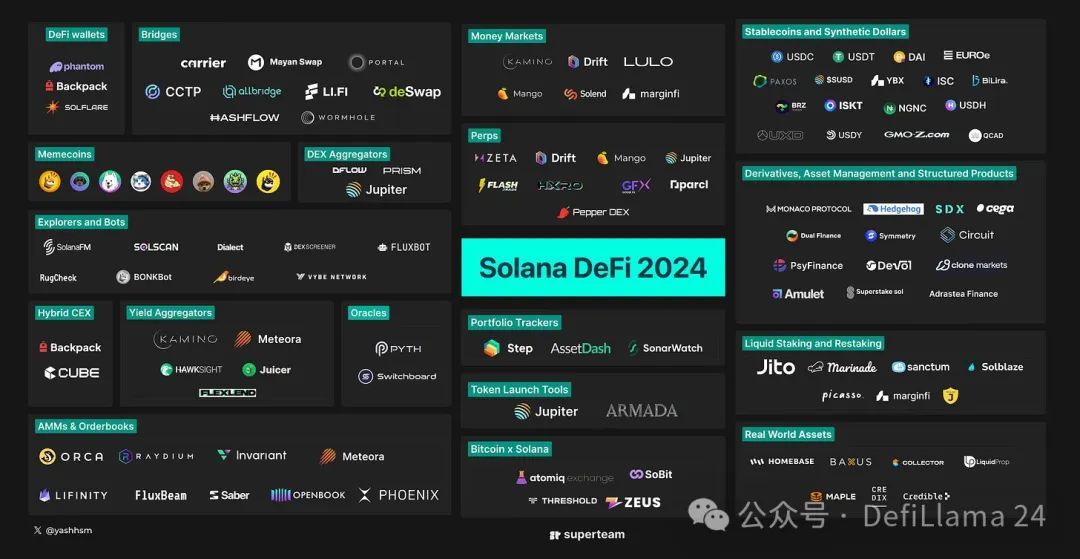
In Part 1 of this article, we will give a brief overview of Solana DeFi, learn about the various DeFi categories, briefly discuss various Solana projects, and finally summarize what will follow. After reading this article, you will get all the necessary insights about Solana DeFi.
If anyone asks about what’s going on with Solana or the top Solana DeFi projects, please forward this article to them. Only insights, no bubbles.
Solana DeFi Overview
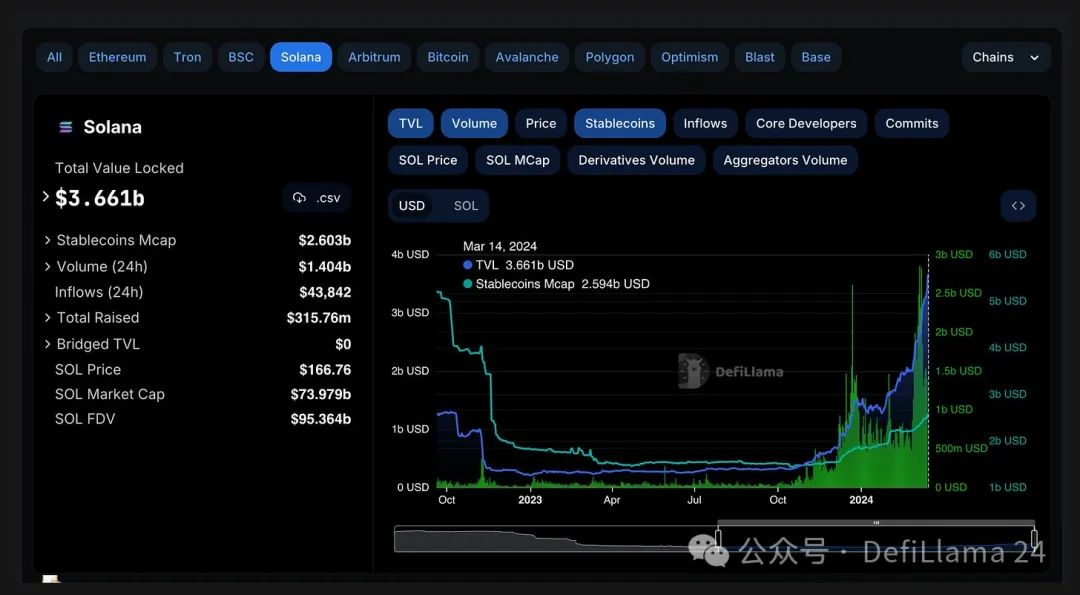
While the entire DeFi ecosystem was devastated by the FTX collapse, Solana DeFi in particular was declared “dead” in early 2023 when it plummeted to a measly $200 million in TVL. Its TVL remained around $300 million until SOL prices started to rise again to $200 million. End of October. Over the past four months, TVL has soared to an impressive $3.3 billion, driven primarily by SOL prices. A healthy stablecoin market cap of around $2.5 billion is also a good indication of the liquidity available in the ecosystem.
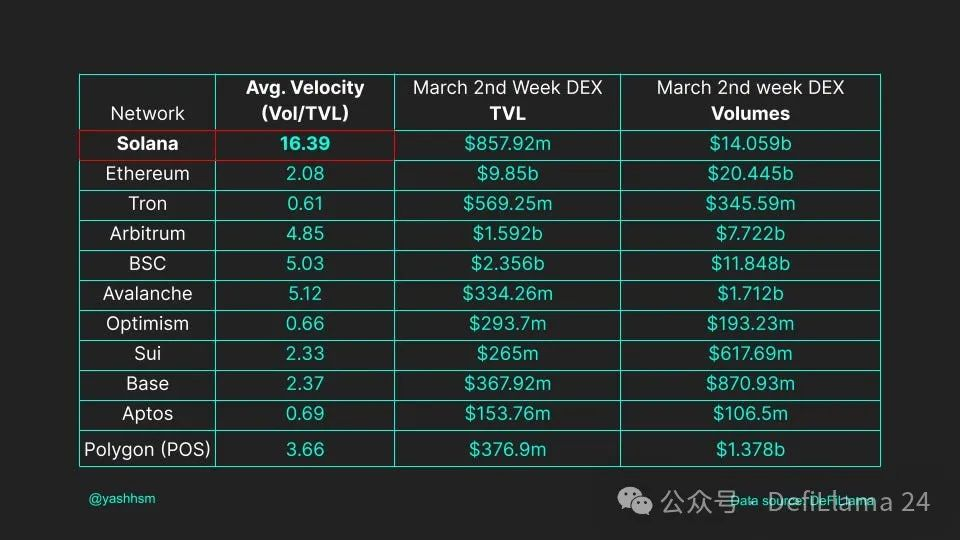
The most capital efficient chain stores:
Popular since last year, while TVL may be a vanity metric; DeFi velocity (daily DEX trading volume/chain’s TVL) is the one metric where Solana DEX truly dominates.
Is Solana DeFi really OPOS?
During the bear market, the phrase “Only possible on Solana” (OPOS) became a widespread rallying cry within the community, but what exactly makes Solana worthy of this title? The simple answer lies in its low fees and high throughput.
Low fees and high throughput make OPOS possible, such as:
1. On-chain order books : Two order books consistently handle over $150 million in transaction volume, a feat not feasible on Ethereum or even Layer 2 due to the frequency with which orders are placed and canceled. Additionally, perpetual order books like Zeta exemplify OPOS.
2. DEX aggregators such as Jupiter : A $100 order on Jupiter is split, passed through 4-5 DEXs, and then recombined. On a Layer 2 platform like Arbitrum, this process would incur a fee of over $20, making it impractical.
3. Anything high frequency : like rebalancing, faster liquidation, etc.
While Move chains like Aptos and Sui also offer high throughput and low fees, as layer 2 solutions become more affordable and parallel EVMs like Monad emerge, these advantages may no longer be exclusive. However, Solana's vibrant community and its highly qualified builders really set it apart.
The memecoin phenomenon is a perfect example of the combined power of community/culture and high throughput/low fees. Think about it: if you buy $1,000 of CatCoin, are you willing to pay a $100 fee per transaction? Solana enables users to do so for as low as $1, supported by fast transaction speeds, seamless bridging front-ends like Jupiter, efficient DEX, and ample liquidity.
Why is the Solana airdrop so hyped? This is because Solana is home to a group of talented builders, and who wouldn’t want to take a chance on farming their potentially high FDV tokens?
Solana DeFi Category
Just like any other DeFi ecosystem, Solana has a wide range of forks, with most TVL contributions coming from LST, DEX, lending platforms, and Perps.
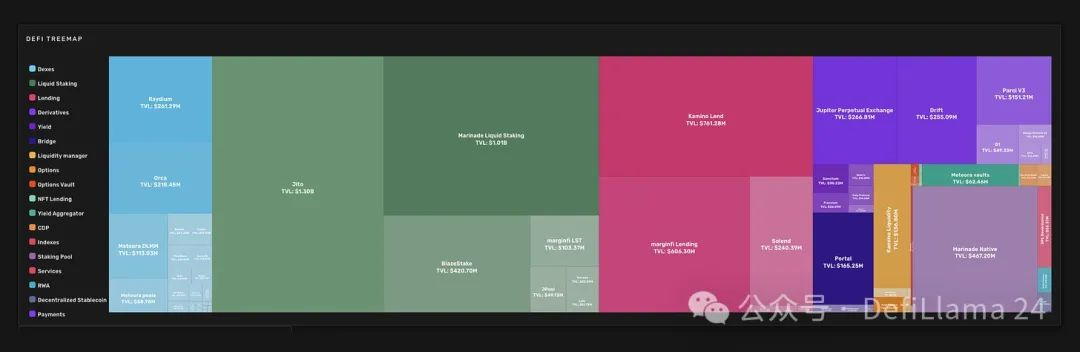
Just like any other DeFi ecosystem, Solana has a wide range of forks, with most TVL contributions coming from LST, DEX, lending platforms, and Perps.
Let’s delve into each DeFi category and analyze their strengths, limitations, and opportunities that exist. We'll try to go chronologically, following the typical DeFi user journey - from beginner to advanced; and also provide some alpha tips.
Wallets and Bridges:
Starting with the wallets, the wallet war has now focused on the three most DeFi-friendly wallets, each equipped with all the features required for DeFi: Backpack , Phantom , and Solflare . Phantom's browser functionality is an excellent discovery tool for DeFi applications and tokens.
In the area of interoperability, Wormhole stands out as the dominant messaging layer, supporting messaging between Solana and over 25 other chains. Wormhole supports several major bridges:
Portal Bridge (developed by Wormhole team) - one of the oldest bridges with a historical value of more than 40 billion US dollars, but the user experience is very poor.
Mayan Finance — One of the fastest growing bridges with a cross-chain exchange protocol built on Solana, allowing native asset exchange between chains such as Arbitrum, Polygon, Optimism, Avalanche, and BSC.
Allbridge — Another liquidity pool-based bridge that facilitates connections between Solana and Ethereum, Ethereum L2, BNB Chain, and Tron.
Bridge aggregator LiFi has also made its way to Solana, providing support for Phantom’s cross-chain exchange while integrating Solana into its bridge aggregator frontend – Jumper. Currently, the system is powered by Allbridge, with plans to incorporate more bridges.
deBridge is one of the fastest bridges with an intent-based architecture powered by its own messaging layer. Hashflow and Carrier are two other bridges, although they are used less frequently.
Circle's CCTP is also scheduled to launch in late March 2024, with some of the above bridges as launch partners. This will enable anyone to bridge any amount of USDC for a very low fixed fee, significantly increasing bridging liquidity. The launch of LayerZero in Q2 is also highly anticipated; this may change cross-chain applications on Solana, as LayerZero has a larger ecosystem and community than Wormhole.
Jupiter has also developed a bridge comparator to help users select the best bridge. However, it only facilitates transfers from Ethereum to Solana and does not include all bridges.
User Tip—Bridges to Solana: For Ethereum, Sui, and Aptos, use the Portal bridge. For Ethereum L2, compare Jumper, deBridge and Mayan.
Spot DEX:
Solana's DEX peaked at $2-3 billion in daily trading volume, $12 billion in weekly trading volume, and $28 billion in monthly trading volume - a seismic shift for Ethereum on good days and weeks The change. About 60% of total DEX trading volume is provided by Jupiter, the leading DEX aggregator on Solana and the largest DeFi project on the platform. Use Jupiter as a case to analyze DEX trading activities in February:
1. The top 10 tokens by trading volume are mainly:
a. About 82% of blue chip tokens – SOL, USDC and USDT.
b. ~10% of meme coins – WIF, MYRO, SILLY and BONK.
c. ~6% LST — JitoSOL, mSOL, and bSOL.
2. Unique wallets: over 840K | Total transaction volume: over 29 million.
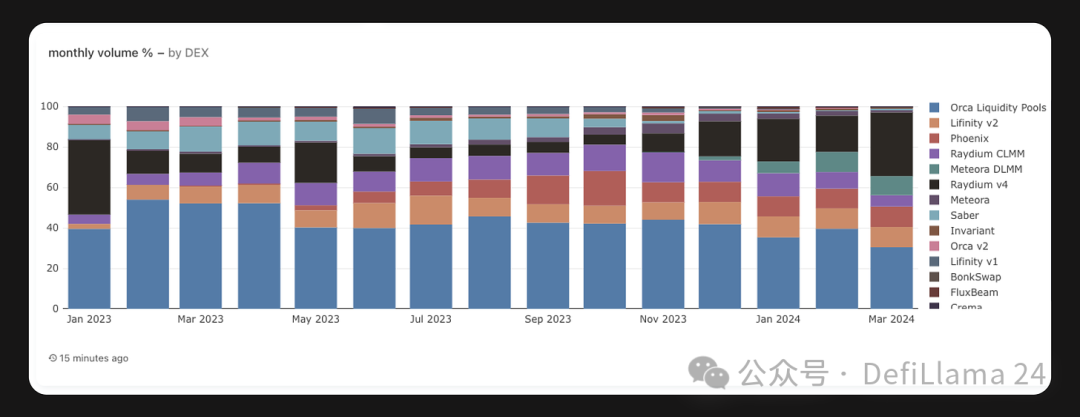
Unlike the EVM ecosystem where Uniswap dominates, Solana's spot DEX remains highly competitive, with top DEXs fiercely competing for market share. Orca held over 50% of the market share at the beginning of the year, and despite a slight decline in market share, remains the leading DEX. Sales of Raydium and Openbook have been impressive, especially during the meme coin boom.
DEX aggregator:
Jupiter is the undisputed leader not only within Solana, but in the entire cryptocurrency space, surpassing EVM peers such as 1inch and Matcha . Jupiter is the premier Solana aggregator, managing approximately 80% of trade flows (after excluding bot activity). This is in sharp contrast to the Ethereum mainnet, where a large portion of transactions still occur through DEX frontends, and multiple aggregators share approximately 40-50% of order flow.
Jupiter utilizes its sophisticated routing algorithm (Metis) to determine the best price among more than 30 integrated DEXs, and it also provides the following features:
1. Limit order – buy/sell at a predetermined price by using fill bots.
2. Cost Averaging — Facilitates the regular purchase or sale of tokens over a set period.
For developers, Jupiter provides a payments API (allowing merchants to accept payments in any token while receiving the final amount in USDC) and terminal functionality (enabling any dApp to incorporate exchange functionality into its interface). Jupiter has facilitated over $100 billion in transaction volume to date.
Prism is an OG protocol in the space, also featuring a DEX aggregator (with negligible trading volumes compared to Jupiter) as well as Prism Pro (a front-end for Openbook trading). It plans to open source its aggregator.
Dflow emerged as a potential competitor to Jupiter, and it was created by a strong team (it received $5.5 million in funding last year, with more likely to follow). Dflow has developed a routing algorithm similar to Jupiter, called Segmenter, with significant product differences:
1. Mobile-first approach and integrated non-custodial wallet.
2. A mechanism for liquidity venues such as AMMs to identify toxic order flow (such as bot activity and high-frequency trading firms) and apply higher rates to it.
Although not yet fully operational, Dflow has activated deposits and is running a points program, hinting that the token may be launched soon. It would be exciting if they could take any significant share away from Jupiter.
CLOB (Central Limit Order Book):
CLOB represents the first iteration of the On-Chain Order Positioning System (OPOS). One of the first major DeFi projects on Solana was Project Serum, launched by FTX, which launched the first fully on-chain order book with unified liquidity across the entire ecosystem. Project Serum (along with FTX) played a key role in sparking the initial momentum in the Solana DeFi space, attracting numerous projects to the platform that are now considered blue chips in the Solana ecosystem. It’s important to give recognition and praise where it’s due.
After the FTX crash, the DeFi community forked the Serum code, turned it into a public asset, and renamed it OpenBook. OpenBook is quite possibly Solana's most underrated public resource, sustaining $50-100 million in daily transaction volume, charging no transaction fees, and allowing the creation of markets without permission. For more information about Openbook, please read an article I wrote previously.
Portal: https://tinyurl.com/24paeccr
However, the most famous order currently on Solana is Phoenix , built by a strong team, with a daily trading volume between $100-150 million. Currently, it operates a permissioned market (with plans to transition to a permissionless model), with the majority of its trading volume coming from trading pairs such as SOL/USDC (~70%), SOL/USDT (~10%), and BONK/USDC (~ 10%).
Compared to OpenBook, Phoenix offers:
1. Instant settlement (i.e. no crank required).
2. More streamlined on-chain data, such as market events (such as placement and cancellation of limit orders, order executions) and more compact on-chain account size.
Root Exchange is another user interface built on Phoenix that provides enhanced functionality for limit orders.
AMM:
Despite continued innovation in the order book, the top four Solana AMMs still dominate the majority of trading volume.
Orca — Inspired by Uni v3, Orca has become a centralized liquidity automated market maker (CLAMM). It is currently the main DEX on Solana and focuses on developing the basic liquidity of the ecosystem. Orca has facilitated more than $26 billion in deal volume and generated more than $40 million in limited partner fees so far in 2024. It strives to be the most user-friendly liquidity integration platform with open source and proven smart contract deployment.
Raydium - Unlike other CLAMMs, Raydium also utilizes CLOB (i.e. Openbook), adopting a hybrid model. Additionally, it supports permissionless farming, allowing anyone to create a pool and bootstrap the token’s liquidity. This feature has enabled thousands of meme coins to be launched on Solana, making Raydium the DEX of choice for meme coin issuance.
Meteora — Meteora's DLMM (Dynamic Liquidity Market Maker) system is modeled after Trader Joe's Liquidity Manual, which arranges the liquidity of asset pairs into different price ranges. Each bin is defined by a specific price and liquidity amount, eliminating swap slippage that occurs within that bin.
Meteora's DLMM can be seen as a hybrid between an order book and an AMM, thus requiring proactive provision of liquidity and allowing for different flows based on strategies such as spot (uniform distribution), curve (concentrated approach to low volatility), and buy and sell Sexual distribution (inverse curve distribution with high volatility). This is particularly helpful for dynamic fee capture by limited partners. That is, limited partners earn more in fees during periods of high volatility.
In addition to DLMM, Meteora also offers AMM pools (formerly Mercurial pools), which include dynamic pools, multi-token pools, and FX and LST pools.
Lifinity — This platform runs as an Oracle-based AMM. Unlike other DEXs that rely on arbitrageurs for price adjustments and use pool asset balances for pricing, Lifinity hires its own market maker. Furthermore, it does not rely on the liquidity of LP, but utilizes the liquidity owned by the protocol (PoL) to distribute the generated revenue to its token holders. For example, in the last monthly cycle, it generated approximately $550,000 in revenue. Among all AMMs, Lifinity stands out as the most OPOS and capital efficient DEX, with a daily trading volume of $100-200 million and a TVL of only about $800,000 (total TVL of about $7.5 million, including market makers).
Fluxbeam , the only AMM specializing in token scaling, is about to launch its launchpad. Other AMMs such as Invariant and Saber (now SaberDAO ) may not be as actively developed, but still have a large presence.
Mixed exchange:
Backpack Exchange – A centralized exchange developed by the team behind Backpack and Mad Lads. It is regulated by Dubai VARA and is about to receive additional licenses. The exchange currently offers spot trading and plans to launch margin trading, derivatives and cross-collateral options soon. It has managed to attract more than $70 million in deposits, spurred by anticipation of the potential snapshot.
Cube Exchange — Another centralized exchange founded by former members of the Solana Labs team. Its latency is only 0.2 milliseconds, which is lower than Binance (5 milliseconds). The exchange maintains an off-chain order book, while settlements are performed on CubeNet, a meta-L2 blockchain that is reportedly a fork of SVM.
My prediction:
1. Order books will continue to gain market share, especially blue chip asset pairs.
2. As the trading front-end becomes more social (such as Bonkbot , Fluxbot or Dialect ), the specialization of DEX will increase.
Given the token issuance boom, the Solana ecosystem has two token issuance tools:
1. Armada - This platform provides a set of open source protocols covering three key aspects of token issuance: token issuance (customizable auctions and pool-based issuance), liquidity provision (via CLMM vaults) and Tokenomics ( Automated protocol reward distribution and token staking). Projects like Flowmatic and Pepper were among the first to be launched through Armada.
Jupiter’s LFG Launchpad — The top DeFi project on Solana has also built a Launchpad leveraging its existing ecosystem and community:
1.Has customizable boot pool powered by MeteoraAG DLMM.
2. Provide complete trading functions, focusing on pre-order process and price discovery.
3. Includes a voting mechanism for projects launched through JUP DAO.
Projects like Zeus and Sharky were among the first to be launched through Jupiter.
Solana Assets:
Assets (or tokens) on Solana can be broadly divided into:
1. SOL and LST
2. Project tokens such as JUP and RNDR
3.memecoin
4. Stablecoins and RWA
MemeCoins:
Memecoin is a culture on financial steroids. They are the lifeblood of DEX on Solana and have attracted a lot of attention. Many have speculated that we may be experiencing a Memecoin supercycle, and that Solana will lead the charge.
Solana has become synonymous with memecoin because:
1. A fun community that champions a unified meme culture, led by influencers like Ansem.
2. Low-cost and fast transactions promote inclusivity, eliminating the need to mentally consider gas fees before transactions.
3. Seamless user experience for memecoin trading through aggregators such as Jupiter, supported by strong liquidity of DEX.
This is a typical journey for memecoin enthusiasts:
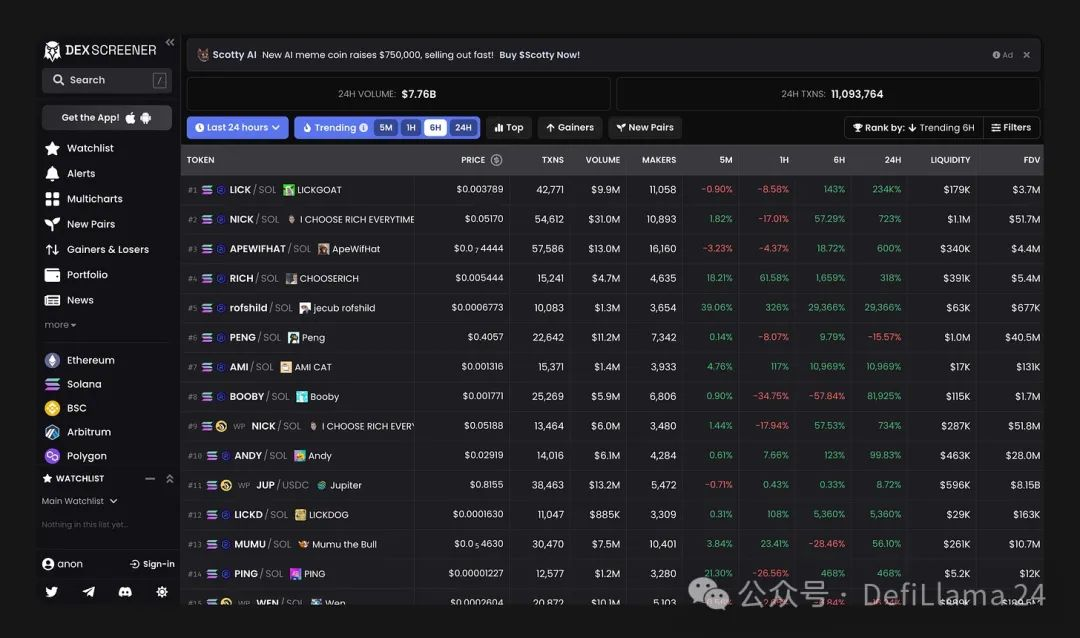
1. Discover newly listed mining pools on Orca or Raydium, learn about memecoin from friends or Twitter, or get insights from the Ansem team.
2. View memecoin charts and statistics using DEXScreener and Birdeye – The best part is that both platforms integrate Jupiter into their interface, allowing users to directly invest in memecoin. One can also use Rugcheck to perform a quick check on a coin’s risk parameters.
3. Continuously monitor your portfolio and share your findings with friends!
The adage "bet on retail" rings true - and that's where retail stands with Solana.
My prediction:
1. Culture will become more fungible - I believe that memecoin, as a "tokenized culture", provides greater liquidity and inclusivity than NFTs, giving them significant advantages.
2. Vertical memecoin platforms will emerge; for example, a political platform containing all politically related meme coins such as Tremp and Boden. Memecoin will lead us into the promised “metaverse”.
User Tips – Portfolio Tracker:
Solana supports three main portfolio trackers (or address trackers): Step Finance , Sonar Watch , and Asset Dash . While Sonar Watch excels in DeFi integration, Asset Dash and Step Finance are more popular for those looking for mobile-friendly options and better NFT support. For analyzing or monitoring any wallet, these portfolio trackers, along with Phantom’s watch wallet feature, are very useful. Compared to the two major browsers Solscan and SolanaFM , SolanaFM is much more advanced in transaction analysis.
Stablecoins:
Solana now has a variety of fiat-backed stablecoins.
🇺🇸 USD – USDC, USDT, USDP, USDY, ZUSD
🇪🇺 Euro – EURC, EUROe, VEUR
🇯🇵 GYEN, 🇨🇦 QCAD, 🇨🇭 VCHF, 🇹🇷 TRYB, 🇮🇸 ISKT, 🇧🇷 BRZ, 🇲🇽 Etherfuse CETES, 🇳🇬 NGNC
Currently, Solana's stablecoin market value is approximately US$2.5 billion, with USDC (67.5%) and USDT (31.5%) occupying the majority of the market share, followed by other long-tail stablecoins with market values below US$10 million. Although many fiat-backed stablecoins have been launched recently, with the exception of USDT and USDC, most other stablecoins face the challenges of low liquidity and limited DeFi integration. To solve this problem, Meteora has launched a FX pool (currently only available on the EURC – USDC pool with a TVL of $20,000) which is still in its early stages but represents a step in the right direction.
UXD (backed by over-collateralized positions, real-world assets, and delta-neutral positions) and USDH (backed by CDP) are two decentralized stablecoins on Solana.
On-chain foreign exchange (FX) market case
The foreign exchange market is huge, with daily trading volume exceeding $6 trillion. The availability of fiat-backed stablecoins with ample liquidity could pave the way for the establishment of on-chain spot FX markets through order books and AMMs. Imagine a scenario where merchants can accept USDX payments and instantly convert them to YENX, while Jupiter routes transactions through multiple liquidity venues. Sooner or later someone will build a spot FX trading platform on Solana.
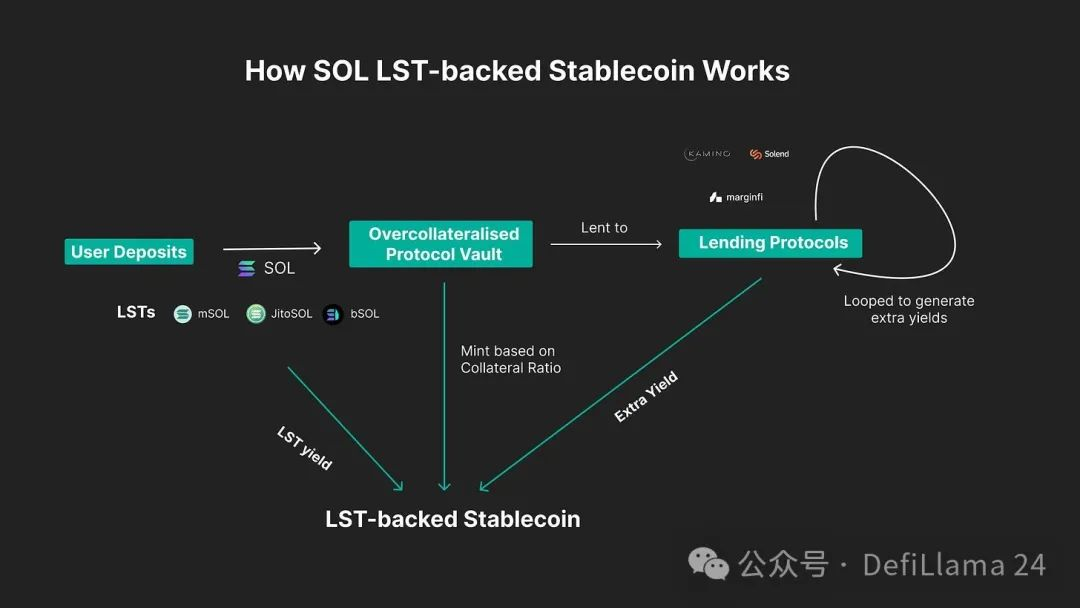
Two stablecoins powered by LST will also be launched on Solana – MarginFi’s YBX and Jupiter’s SUSD . These are essentially CDP stablecoins but utilize LST as collateral (equivalent to Lybra ’s Ethereum eUSD and Prisma ’s mkUSD ).
My prediction:
1. Inspired by Ethena, someone will develop UXD v2 (mirroring the previous model of UXD, similar to Ethena).
2. DeFi stablecoin mechanisms will become increasingly innovative in seeking to provide yields to holders and enhance liquidity in lending positions.
User Tip – Not all stablecoins are created equal. Fiat-backed stablecoins are generally the most secure, while other DeFi stablecoins (often referred to as “synthetic dollars”) carry inherent DeFi risks and are best suited for DeFi applications. Always verify liquidity and redeemability before holding any large amounts of stablecoins.
Bitcoin Solana
In recent efforts to expand Bitcoin, multiple projects have begun creating Bitcoin <> Solana interoperability solutions to enable seamless use of Bitcoin through Solana:
1. Atomiq — A cross-chain DEX that facilitates the exchange of Solana assets (SOL and USDC) with Bitcoin (on-chain and on the Lightning Network). Their payment demo is very innovative, showcasing Solana to Bitcoin transactions in stores that accept BTC.
2. Zeus Network — an open communication layer connecting Solana and Bitcoin. It introduced zBTC, a wrapped version of BTC, allowing users to stake or lend on Solana to earn yield. The project has ambitious plans, including deeply integrating BTC into Solana’s DeFi ecosystem, providing BTC-backed stablecoins, cross-chain lending between Solana and Bitcoin, layer 2 integrations such as Stacks, and more.
3. Sobit Bridge — SoBit acts as a token bridge and users can initiate the bridging process by depositing BRC20 tokens to a SoBit specific address. The platform verifies these deposits and then mints tokens of equal value on Solana.
These initiatives are still in their infancy and have not yet been fully launched. Threshold Network ’s tBTC also offers a tokenized version of Bitcoin on Solana, powered by Wormhole Crypto.
For more insights and predictions, check out my post on the Bitcoin x Solana paper!
Portal: https://twitter.com/yashhsm/status/1739658770941129094?s=20
Real World Assets (RWA):
Tokenized RWA (Real World Assets) brings off-chain financial assets onto the chain. For example, real estate, private credit, treasury bills, green bonds, gold and other commodities.
In addition to stablecoins, Solana has a wide range of RWAs, including:
1. Tokenized Treasury Bills ( Ondo and Maple Finance )
2. Real Estate ( Homebase and Liquidprop )
3. Physical Goods ( BAXUS and CollectorCrypt )
4. Private Credit ( Credix and Credible )
My prediction:
1. DeFi Composability: For example, holders can earn higher returns by tokenizing U.S. Treasury bonds, using them as collateral in the DeFi lending market, borrowing stablecoins, buying more Treasury bonds, and repeating the cycle Rate. This scenario is just one example: integrating real-world assets (RWA) into the Solana DeFi ecosystem opens the door to the creation of valuable new products, some of which are only possible through crypto-native mechanisms.
2. Expanding more assets and markets will introduce more high-quality tokenized assets to DeFi.
I wrote a comprehensive article on real world assets outlining all RWA on Solana as well as my thesis.
Portal: https://tinyurl.com/2dae28ts
LST (Liquid Staked Token)
On Solana, approximately 400,000 wallets have staked their SOL. As an asset class, Liquid Staked Tokens (LST) contribute the most to the protocol’s total value locked (TVL). Take any lending protocol and you will see LST dominate TVL. However, Solana's LST adoption rate remains low at 4-5% of the total SOL supply compared to Ethereum, which has an impressive staking rate of 24%. While most LSTs offer similar yields, it’s the higher secondary market liquidity and broader utility in DeFi that make them stand out. Currency markets dominate when it comes to DeFi integration, with platforms such as Solend, Kamino and Marginfi becoming central hubs for LST activity, partly in anticipation of the airdrop.
On Solana, all LSTs generate revenue, meaning their value increases as their revenue increases. In comparison, popular Ethereum LSTs like Lido's stETH are rebased every day (meaning the amount of stETH in your wallet keeps increasing while the price is roughly the same as ETH).
1. Marinade [mSOL] : Marinade is the pioneer of the Solana LST protocol. It was founded in 2021 and was formed by the merger of two teams at the Solana Hackathon. The project launched the MNDE token in November 2021 and transitioned to an on-chain DAO in April 2022. Its TVL is distributed in:
a. Native pledge (35% at 3.5 SOL)
b. Liquid pledge (75% at 6.72 SOL)
Marinade Native stands out because it offers institutions the option to stake directly to a decentralized selection of top-performing validators without exposing smart contracts, which appeals to those hesitant to participate in DeFi.
2. BlazeStake (bSOL) : Launched by an anonymous developer named solblaze, driven by token incentive rewards and extensive DeFi integration, BlazeStake quickly gained attention and accumulated 270 million in less than a year. million SOL (approximately US$400 million) of TVL. This approach provides bSOL holders with additional income opportunities.
3. Jito (JitoSOL) : While Marinade initially led the way, Jito has become a formidable competitor by the end of 2023, in part due to its effective use of points and airdrops to increase visibility. JitoSOL stands out for its focus on MEV, entrusting SOL to high-quality validators that support MEV. These validators are equipped with Jito Labs' software to earn additional MEV rewards by auctioning block space, which Jito redistributes to users as additional APY.
Jito increased income = standard staking income + MEV reward
Jito’s Stakenet : When we stake SOL using any LST solution, the staking process is operated by a hot wallet managed by an off-chain bot that decides:
– Add or remove validators – Delegate or undelegate stakes
This introduces centralization risk. Stakenet solves this problem by moving all delegation logic on-chain, transforming a previously trusted and opaque system into a transparent one.
Recently, due to the increase in sandwich attacks, Jito Labs suspended the mempool service provided by Jito Block Engine. The decision sparked mixed reactions within the community, with some appreciating Jito's positive stance, while critics believed it could lead to private transactions and the possible development of a new private mempool in response.
While LST represents one use case, StakeNet is particularly interesting for restaking networks, liquid restaking protocols, oracle networks, etc. In these cases, StakeNet can autonomously allocate assets across a decentralized network of Active Validation Services (AVS) and high-performance node operators. It combines the best of both worlds: automation (by moving processes on-chain) and governance (allowing configuration parameters to be set through governance).
Many other LSTs exist, operated by separate validators, some of which try to differentiate themselves. For example, LaineSOL and CompassSOL have been offering higher staking rewards with the help of MEV. To compare APY and active benefits, check out this list.
Portal: https://solanacompass.com/stake-pools
LSTs on Solana face liquidity challenges, which is why there are only three main LSTs (JitoSOL, mSOL, and bSOL). The smaller LST faces the problem of fragmented liquidity, while sainttum solves this problem.
Sanctum – Unified LST Liquidity:
An interesting project by one of the OG teams helped Solana Labs build the SPL stake pool plan and launch the first SPL stake pool Socean.
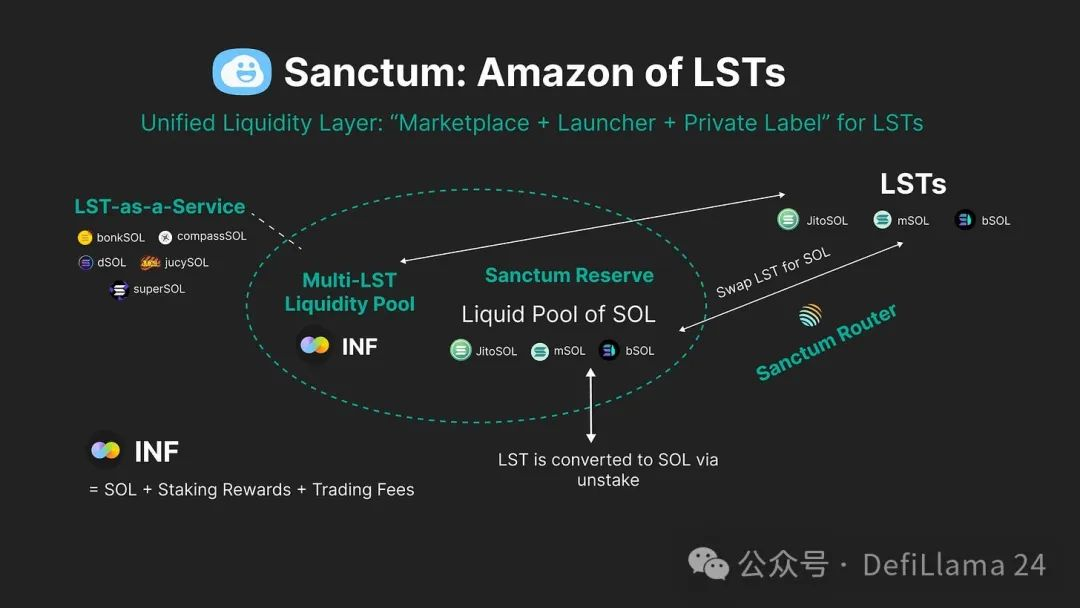
In order to solve liquidity, Sanctum has created two major products:
1. Sanctum Reserve – A pool of liquid SOL used as a reserve. This makes all LST immediately unstakeable, regardless of size. So far, 60k SOL has been withdrawn from Sanctum Reserve for instant unstaking or LST-SOL swap!
2. Sanctum Route - Built with Jupiter, it allows transition from one LST to another even if there is usually no route between the two LSTs. This unifies LST liquidity by allowing smaller LSTs to use the Sanctum reserve pool to access the liquidity of larger LSTs. It has facilitated more than $380 million in historical transaction volume.
But how does it exchange LST? It simply assumes that all LST can be redeemed for SOL in the next epoch, and that the price of LST is derived from the blockchain itself (based on its accumulated yield).
Sanctum also launched two other products:
a. Sanctum LST — Validators can now launch their own LST, in fact, 6 new validators have joined: bonkSOL, compassSOL, dSOL, jucySOL, pwrSOL and superSOL.
Why would a validator choose LST instead of normal staking?
‧Through Sanctum, these LSTs have zero deposit, withdrawal and management fees.
‧More DeFi integrations may increase stakeholder benefits and potentially launch tokens and kick-start the entire ecosystem.
Benefits to the Solana ecosystem:
‧When LST is integrated into DeFi, TVL can be significantly increased.
‧This also reduces the risk of contagion in Solana because no one LST will monopolize the market.
b. Sanctum Infinity — a multi-LST liquidity pool (automated market maker or AMM) that allows swaps between all LSTs in the pool. Here's how it works:
‧Users deposit any (whitelisted) LST into Infinity.
‧They receive INF tokens (representing LST itself), staking rewards and transaction fees from the mining pool.
‧All LSTs can share the liquidity of INF-USDC and INF-SOL, or obtain liquidity from any other LST pair through INF.
For example, JitoSOL can be first converted into INF through on-chain yield calculation, and then converted into USD or SOL. In this way, INF may become one of the most liquid LSTs on Solana. Think of INF as LST, but with transaction fees added from the pool.
Think of Sanctum as the Amazon of LST, like:
1) You can buy/sell products on Amazon – You can buy/sell LST of SOL (Sanctum Reserve and Router)
2) Launch your own product on Amazon, and Amazon takes care of end-to-end delivery - you can launch your own LST, and Sanctum takes care of the liquidity (Sanctum LST)
3) Amazon’s own brand – Sanctum launched its own LST (Sanctum Infinity)
My prediction:
1. More LSTs : Many LSTs will appear in the coming months, with the help of solutions like Sanctum or standalone solutions; with differentiation such as dual-token models (like Frax) or better MEV/tip sharing.
2. Deeper LST integration in DeFi : I am particularly passionate about developing LST yield tokenization on Solana.
Will there be SOL Restaking?
Restaking on Ethereum is huge, mainly due to the need for economic security for AVS (rollups/appchains/bridges), and the same does not apply to Solana - because it does not have a modular paper yet.
However, Solana can still have AVS (Active Verification Service) since anything that requires distributed verification can use it:
‧ Clockwork-type Keeper networks
‧ Python-style appchains
An early team called Cambrian is also exploring this direction. Picaso is another solution exploring SOL LST re-staking to secure the cross-chain intent settlement protocol Mantis. Beyond that, Jito is another team that's perfect for building anything around Restake through the Staking Network.
Loan:
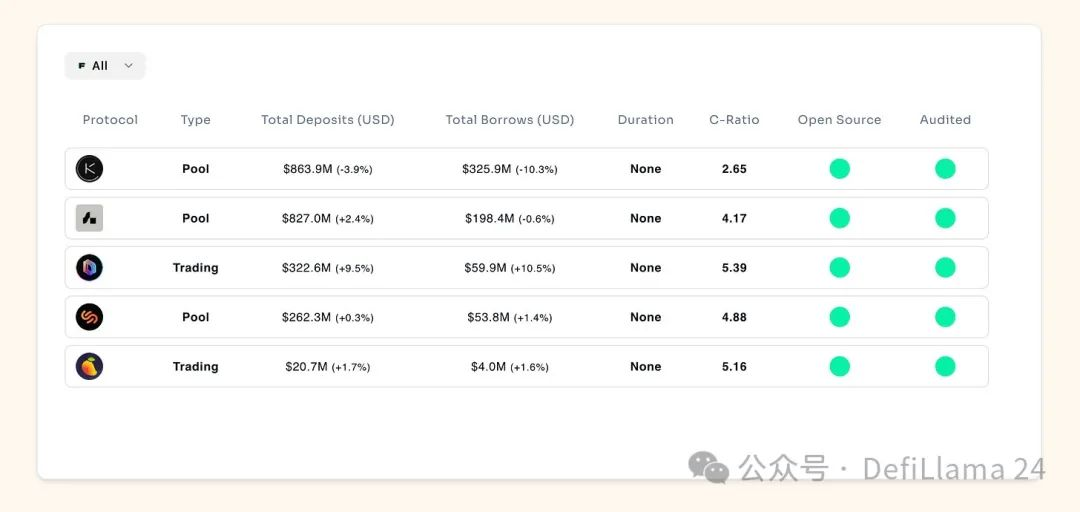
Solana utilizes a peer-to-peer model to host three major currency markets, following floating (variable) interest rates and similar interest rate mechanisms. They operate on a utilization-based interest rate model, where the rate of return depends on utilization (the proportion of supply capital lent) with the formula: Supply Rate = Borrowing Rate * Utilization * (1 – Reserve Factor). The “reserve factor” represents the percentage of capital provided by the lender that does not earn interest; on the contrary, this mechanism favors the agreement. Utilization depends heavily on the system's need for leverage.
All three markets have active points programs, and MarginFi and Kamino plan to launch tokens soon:
1. Kamino Lend : Currently the largest Solana lending platform, it has upgraded from 0 to 700 million US dollars in just 5 months. Similar to Aave v3, Kamino also introduces E-Mode, which enables users to borrow highly correlated assets (such as LST or stablecoins) with a higher capital efficiency LTV ratio. Additionally, it allows some LP tokens to be used as collateral.
Kamino develops products such as Multiply and Long/Short, which are one-click treasury products designed to leverage returns through cycles. Kamino has a comprehensive risk dashboard for examining all types of risks as well as various scenario analyses. Uniquely, Kamino implements automatic deleveraging, where borrowers deleverage (i.e. partially liquidate) their positions based on market conditions to prevent bad debts.
2. MarginFi : One of the first DeFi protocols to launch a points program on Solana, it has soared from US$3 million to more than US$600 million in less than a year. In addition to its lending protocol, it also launched its own LST-backed stablecoin – YBX.
3. Solend : The original protocol on Solana, Solend currently has about $200 million in TVL. In terms of SOL, it has fluctuated between 1-2 million SOL in the past 1.5 years (after the FTX crisis and the Solend whale liquidation incident). It is based on the spl-token-lending scheme (Solana Lab's reference implementation) and also provides profitable deposit receipts, called "cTokens", for every deposit.
While all protocols employ similar lending mechanisms, they each employ different approaches to risk management parameters such as price oracles, liquidation, risk engines, etc. Given the high demand for leverage, interest rates have surged, with USDC currently yielding 30-40%!
On the trading side, there are two Perps – Drift and Mango – that have lending capabilities and can also be used as trading margin.
Revenue aggregator:
Revenue aggregators typically aggregate two types of revenue:
1. Borrow/loan , for example:
‧ Automatic : Meteora offers dynamic vaults that automatically rebalance between top lending protocols every minute to optimize returns.
‧ Machine Gun : Flexlend is similar to Jupiter, but for lending, summarizing the best interest rates for assets such as USDC on five lending platforms - Mango, Drift, Mango (listed twice, assuming the importance is emphasized or the spelling should be corrected Error), MarginFi, Solend and Kamino. It automatically rebalances deposits to the protocol that offers the highest APY at any given time. Flexlend features a unique Homebase where users can set a minimum desired interest rate and if requirements are not met, funds will be restored to the wallet or designated protocol.
‧ JuicerFi acts as another revenue maximizer by aggregating different lending protocols and strategies to maximize points.
2. LP in DEX , for example:
‧ Kamino enables users to earn cryptocurrency returns by providing liquidity to CLMMs such as Meteora, Orca and Raydium. It issues kToken as receipt tokens representing the value deposited into Kamino vaults and allows users to create their own DIY automated strategy vaults.
‧ Hawksight is a centralized liquidity return optimizer for active limited partners on Solana, providing self-custody and automated market making strategies. It is similar to Kamino Liquidity but has launched its token, achieving a TVL of $10-12 million.
My prediction:
1. Driven by leverage demand and high trading volume, yields will go higher, attracting large amounts of capital.
2. Experiments with yield derivatives will be conducted, such as yield stripping, fixed rate loans, interest rate swaps, etc. (more on this in Part 2).
Notes on oracles:
Oracles not only bring off-chain data on-chain, but are also critical to DeFi infrastructure because all calculations rely on oracle price feeds. Pyth (licensed – only verified publishers can publish) is the integration of choice for most players, while Switchboard (permissionless – price feeds can be customized) is another player that acts as a backup or backup oracle for most DeFi players.
Perp DEX:
Perps are the highest PMF derivatives in cryptocurrencies, and like every chain, Solana has an extensive Perp protocol:
1. Peer-to-peer pool Perp DEX : Jupiter, Flash Trade, Parcl
2. Perp DEX based on order book : Drift, GooseFX, Zeta, HXRO, Pepper, Mango
Most of the Perp DEXs on Solana have active points programs, which has resulted in a huge spike in trading volume.
Peer-to-peer pool:
Solana draws significant inspiration from GMX and has two permanent DEXs that can be run: Jupiter and Flash . Both are based on novel LP-to-trader models and offer up to 100x leverage. They utilize LP pool liquidity (Flash’s FLP and Jupiter’s JLP) and oracles to ensure zero price impact, zero slippage, and deep liquidity. Users can open and close positions in one simple step, with no additional account opening or deposit required. However, there are significant differences:
1. Jupiter only supports 3 assets, while Flash provides a wider range of assets, including commodities such as gold and silver.
2. Flash introduces a unique NFT x DeFi gameplay with built-in gamification.
3. Jupiter aggregates all fees (trading, swaps, and liquidity) into the LP pool, while Flash separates transaction fees and allocates them to the USDC-collateralized FLP pool.
Nonetheless, the network effect is powerful, as Jupiter Criminal is integrated into the Jupiter front-end, the most visited DeFi site, giving Jupiter Criminal a significant advantage – the numbers speak for themselves. Jupiter achieves more transaction volume than all other Perps on Solana combined, proving that crypto frontends can cross-sell anything (which might not even be the best product) – generating fees, which generates value!
Parcl – An interesting permanent decentralized exchange that allows people to long or short on real estate indices in cities like Las Vegas and Paris. The price feed oracle for this permanent decentralized exchange is Parcl Labs, the company behind the Parcl platform. Although it attracted a lot of TVL, its organic sales were very few.
Order Book Perp DEX:
As one of the other features of OPOS, Solana is the only chain that runs an order book entirely on-chain, while most other chains have off-chain order books (as a sidechain/app chain/rollup).
Drift Protocol — Drift v2 was originally built on the Virtual Automated Market Maker (vAMM) model pioneered by Perp Protocol and now follows a unique mechanism "Liquidity Trifecta", consisting of 3 mechanisms:
‧Just -in-time (JIT) auction (5-second Dutch auction for market makers to fill)
‧Order book (the administrator robot tracks open orders in the off-chain order book)
‧If the market order is not filled, the AMM mining pool will act as a liquidity backing provider.
Drift's launch of a pre-release token could be an interesting marketing strategy, but, as we've seen from Hyperliquid and Aevo's pre-launch markets, trading volumes remain low.
Fully on-chain order book, such as:
1. Zeta Markets – Zeta v2 uses a fully on-chain order book and matching engine that operates similarly to the Open Book DEX on Solana. It has managed to drive a recent surge in trading volume due to the upcoming launch of the coin.
2. Mango Markets – Once the largest DeFi protocol on Solana, it struggled to even crack the top 5 after the hack.
3. GooseFX – Another CLOB-based DEX with incentives built around its native token.
4. HXRO — The Hxro network is a shared liquidity layer for derivatives that any Perp DEX can leverage. It has two core protocols, Dexterity (which helps connect and build CLOB-based derivatives) and SPANDEX (a risk engine). Anyone can build their own UI/UX and compose it using the Hxro network protocol – Pepper DEX is one such upcoming project that builds a sleek UI while leveraging Dexterity (a global order book for shared liquidity).
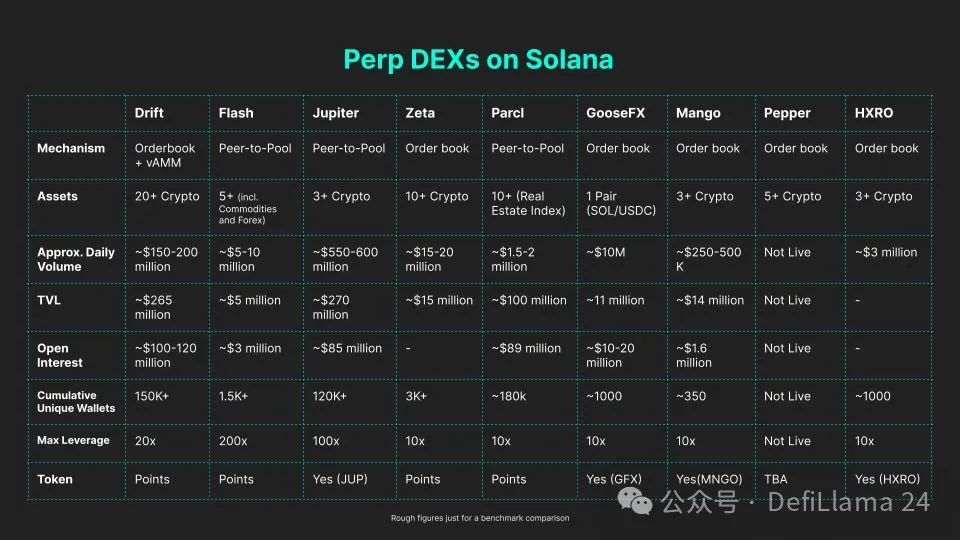
Solana Perp DEX still lags significantly behind its Ethereum counterparts, especially hybrid DEXs (off-chain order books matched with on-chain settlement) such as Aevo, Hyperliquid, Vertex and dYdX, which are consistently among the top 4 Perp DEXs. However, Jupiter has seen high trading volume recently, ranking among the top 5 on good days.
My prediction:
1. Perps as Solana application chain : In the EVM world, most Perp DEXs, especially those based on order books such as Aevo and Hyperliquid, are transitioning to their own application chains. In the future, Solana perp DEX can also build its own chain, which can bring the following benefits:
‧Is protected from any mainnet congestion.
‧Enhance users’ trading experience (transactions can be free for traders).
‧In fact, Zeta has already begun to move in this direction.
2. Perp aggregators : Just as we have lending and spot DEX aggregators, we may soon see Perp aggregators as well, although the different design mechanisms pose challenges. With the emergence of Perp aggregators such as Rage Trade and MUX, a similar trend may emerge on Solana – especially for designs similar to Flash and Jupiter.
3. Driven by the excitement surrounding off-chain order books and token issuance, Backpack and Cube began to gain market share and surpass on-chain transaction volume.
Structured products and options:
Structured products and on-chain derivatives (except Perps) were all the rage during the last bull market, with many innovative products such as DeFi Option Vault (Katana and Friktion) launched on Solana. As we are on the cusp of a bull market, we can expect similar manias to return.
Options:
On-chain options are challenging; however, they are making a comeback in a big way, with projects like Aevo recently seeing a surge in premium volume of around $500,000, and notional volume reaching $1-2 billion. Projects such as Lyra, Typus and Premia followed closely behind.
On Solana, there are two very strong teams building on-chain options:
1. SDX Market – Developed by the OG team – PsyFi, an options AMM that supports fully collateralized, cash-settled European options, including calls, puts and vertical spread strategies. It utilizes an AMM rather than an order book (most 2021 options platforms primarily use order books), offering:
‧Passive limited partners and better risk-adjusted returns due to options sold at a premium.
‧ SDX provides quotes at various price levels and option terms, providing a wider range of options.
‧The platform automatically adjusts the bid-ask spread to encourage transactions that maintain the best liquidity pool composition.
It is still in its early stages, but has a historical trading volume of over $8 million, with a peak daily trading volume of $450,000, and available assets include SOL, ETH, BTC, and mSOL.
PsyFi also offers vault products with standard strategies such as whETH-covered calls, BTC-backed PUT, and SOL-covered calls.
2. DeVol – Similar to SDX Market, it is also a fully collateralized European options AMM. However, it is underpinned by a unique pricing methodology based on basic units called Standard Risk Blocks (SRBs). The SRB is used to comprehensively price and settle the proceeds of any derivatives, including those of traditional options.
Regarding structured vaults, Cega is another OG product that offers multiple types of vaults, such as pure option strategies, bond + option strategies, leveraged option strategies, and dual-currency vaults. It supports Solana deposits and withdrawals with a TVL of approximately $13 million and a transaction volume of over $380 million.
Perp-based Vault:
1. Circuit Trade – a vault for depositing market making strategies on Perp DEX (currently only Drift). They help increase passive liquidity and take advantage of high-yield MM strategies. For example, Supercharger Vault is a completely on-chain delta neutral market making strategy.
2. Adrastea Finance — allows you to earn leverage or a high fixed APR. Inspired by the GMX/GLP ecosystem, its initial strategy allows you to earn leveraged returns on JLP or stable APY on USDC.
Yield enhancers like Superstake SOL — Help earn leveraged returns on LST through SOL recursive borrowing/lending powered by Drift.
Dual Finance - Provides options infrastructure, but is not intended for speculative use cases; instead, it serves as an incentivized liquidity infrastructure for the Web3 community. By using Stake Options, projects can provide staking rewards in the form of options. Dual Finance Allow projects to reward participation in their ecosystem (e.g. using their protocol or providing liquidity) by granting users options on their native tokens. For example, BONK has staking options (staking rewards in the form of options) to incentivize long-term token holding and community participation.
Amulet — is a Solana-powered revenue/insurance protocol with various products including AmuVaults, AmuShield, and AmuVerse. Symmetry is another platform for creating, automating, managing and tracking on-chain funds.
My prediction:
1. Structured products and derivatives, especially order-based products and derivatives, will make a comeback on Solana.
2. Options will see a resurgence – Bull markets require additional speculative products. If used correctly, options can provide leverage without the risk of liquidation.
User Tip – Options are risky and should only be explored after fully understanding them. Still, since most projects are still in their early stages and do not have tokens, they are worth considering if you are an options trader.
Conclusion: The road to $10 billion in both TVL and daily trading volume
Overall, I expect the following trends in DeFi:
1. The demand for leverage will increase significantly, leading to higher annualized returns and, in turn, a wider range of income products.
2. Speculation and velocity of money will reach unprecedented levels – We will witness an unprecedented wave of speculative products (e.g., Power Perps and Everternity Options).
3. Permissionless real-world assets (RWA), AI and DePIN tokens will start to take a large share of DeFi.
As both ends of the Solana DeFi barbell develop, we will see even more innovation happen in the middle! Large-scale unlocking is about to happen, mainly to meet the utilization of revenue assets and revenue transactions within the ecosystem.
The Solana DeFi ecosystem is growing rapidly; blue chips have made huge efforts in bringing Solana DeFi to its current state – now it’s time for new DeFi protocols to emerge. Solana’s biggest advantage is its composability. While composability is a double-edged sword from a risk perspective, it provides early DeFi protocols with tremendous leverage to stand on the shoulders of giants and grow.
Focus on innovation and design mechanics "only possible with Solana"! The infrastructure is finally reaching a level that can sustain large-scale activity – many DeFi innovations that previously failed too early are now viable again.
Disclaimer: As a blockchain information platform, the articles published on this site only represent the personal opinions of the author and guests, and have nothing to do with the position of Web3Caff. The information in the article is for reference only and does not constitute any investment advice or offer. Please comply with the relevant laws and regulations of the country or region where you are located.