Original|Odaily Odaily
Author|LiaoLiao
On March 19, the full-stack zero-knowledge proof protocol Polyhedra Network officially launched its protocol token ZK and provided ZK airdrop rewards to early users and community contributors.
As the latest project of OKX Jumpstart, ZK was listed on many first-tier exchanges such as OKX, Bitget, Gate, etc. on the day of TGE. As of the time of writing, ZK is temporarily reported at 3.55 USDT, and has shown a relatively steady growth trend after surviving the short-term airdrop selling pressure.
A week before TGE, Polyhedra Network announced that it had completed a $20 million strategic round of financing at a valuation of $1 billion, led by Polychain Capital, with participation from Animoca Brands, Emirates Consortium, Arkstream Capital, Mapleblock Capital, Hashkey Capital, UoB Ventures, Symbolic Capital, Longhash Ventures, MH Ventures and Web3Port Foundation.
Public information shows that this is the fourth round of financing completed by Polyhedra Network in the past year.
In February 2023, Polyhedra Network completed a US$10 million financing round, led by Binance Labs and Polychain Capital, with participation from Animoca Brands, Dao 5, ABCDE Capital and others.
In April 2023, Polyhedra Network once again completed a $15 million PreA round of financing, led by Polychain Capital, with participation from ABCDE Capital, Sparkle Ventures, HashKey Capital, Foresight Ventures, Kucoin Ventures, NGC Ventures and Arcane Group.
In January 2024, Polyhedra Network also completed its Series A financing, the specific amount of which was not disclosed.
Including the latest strategic round of financing, Polyhedra Network's total disclosed historical financing has reached US$45 million.
Why is Polyhedra Network favored by so many star VCs? Why does its valuation continue to rise? In addition to the zkBridge that users are more familiar with, in what areas can Polyhedra Network's comprehensive zero-knowledge proof technology achieve breakthroughs? In the following, we will gradually answer these questions by disassembling Polyhedra Network's existing and potential businesses.
Current landscape: starting from the interoperability field
Polyhedra Network is positioned as a full-stack zero-knowledge proof protocol. This positioning determines that Polyhedra Network's vision is to use the disruptive potential of zero-knowledge proof in terms of trustlessness, interoperability, and scalability to optimize various fields and components in the Web3 ecosystem.
Interoperability between multiple chains is the first area that Polyhedra Network is targeting. In April 2023, Polyhedra Network officially launched the mainnet Alpha version of zkBridge.
zkBridge is the industry's first trustless, efficient, secure and universal cross-chain interoperability protocol built with zero-knowledge proof technology. Unlike the common cross-chain bridges in the industry that rely on multi-signature contracts, zkBridge uses a zero-knowledge proof algorithm to replace the third-party trust assumption of traditional cross-chain bridges, and performs rigorous proof and verification based on mathematics and cryptography, so that the prover can safely and effectively allow the receiving link to receive a state transition that occurs on the sending chain without relying on any external security assumptions.
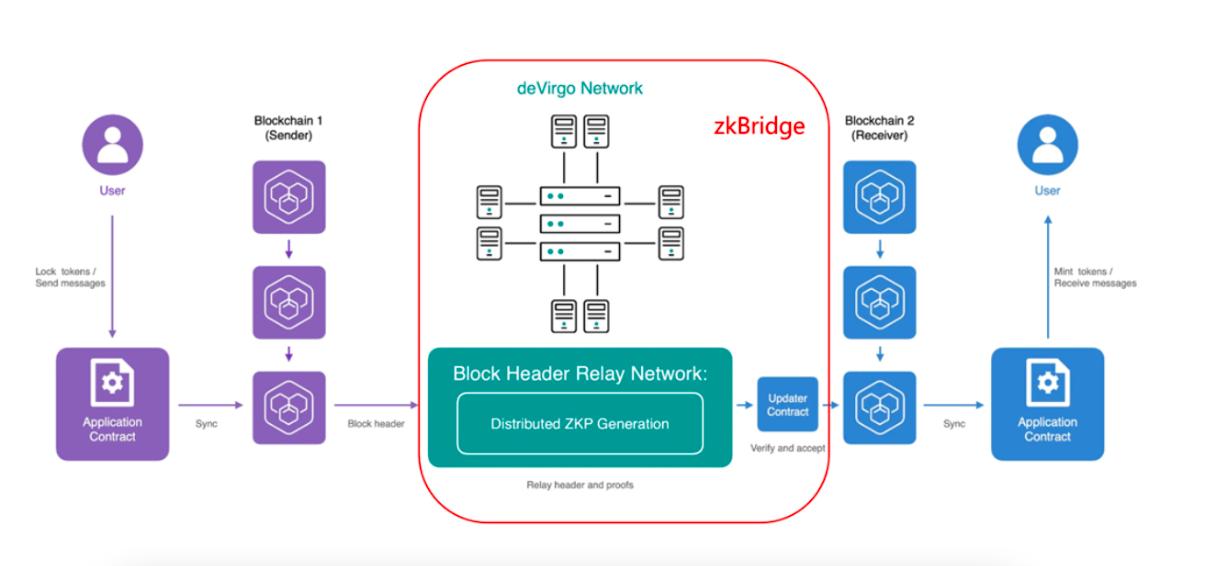
Official data shows that as of the time of writing, zkBridge now covers 25 Layer 1 and Layer 2, has processed more than 20 million cross-chain transactions, and has reached cooperation with more than 80 projects in multiple fields such as DeFi, GameFi, and infrastructure.
In addition to providing regular cross-chain transfers of homogeneous tokens, zkBridge also supports cross-chain transfers of NFTs, and plans to implement cross-chain support for Ordinals assets on the Bitcoin network in the second quarter.
In addition to its main product zkBridge, Polyhedra Network's current business portfolio also includes the zero-knowledge proof-based light client zkLightClient, a variety of zero-knowledge proof algorithms including devirgo, and user exchange reserve proof zkPoR, etc.
What needs to be emphasized here is zkLightClient, which is a cross-chain infrastructure built on the LayerZero protocol. zkLightClient can be fully integrated with LayerZero's message transmission protocol, which means that application developers can use Polyhedra Network's zero-knowledge proof technology to easily build cross-chain applications on LayerZero by simply modifying its integration configuration.
From a deeper perspective, the technical principle demonstrated by zkLightClient as a product result is even more groundbreaking - using zero-knowledge proof to optimize the batch verification of BLS signatures, thereby significantly reducing the size of communication data between verification nodes and full nodes.
In the case of zkLightClient, the client can verify 512 BLS signatures through a single zk-proof, which only requires 200-300 bytes of communication data, allowing the verification node to sign each block, thereby significantly reducing the time required for the Ethereum network to reach "finality" - from one epoch (32 slots) to one slot (12 seconds) - providing a potential path for further expansion of Ethereum.
Recent Developments: Towards the Bitcoin Network
As its existing business lines mature, Polyhedra Network has begun to turn its attention to other fields, trying to use its zero-knowledge proof technology advantages to bring more innovative results, and the Bitcoin ecosystem, which has attracted increasing market attention, has become the latest choice of Polyhedra Network.
At the end of March, Polyhedra Network has reached a cooperation with Renzo to provide $1.8 billion in cryptoeconomic security for its Bitcoin interoperability protocol by integrating Renzo's Liquid Restaking Token (LRT) and ZK token dual staking mechanism to achieve trust-minimized Bitcoin interoperability. Polyhedra Network also revealed that ZK token stakers will benefit from cross-chain messages in the Bitcoin ecosystem in the future.
In addition, Polyhedra Network officials recently announced a new method to directly verify ZK proofs on the Bitcoin network.
With recent developments such as the approval of the Bitcoin ETF and the upcoming halving event, the market's interest in Bitcoin research is at an all-time high, but the Polyhedra Network team has found that existing Bitcoin network expansion solutions such as Layer 2 currently have key flaws in their verification methods - especially the flaws highlighted in the BitVM white paper - The main problem is that there may be collusion between the prover and the challenger, which threatens the integrity of the proof and leads to the malicious creation of invalid proofs.
To solve the above problems, the Polyhedra Network team has introduced an alternative solution, which is to use FRI (Fast Reed-Solomon Interactive oracle proofs of proximity)-based ZK proofs as the last layer of on-chain verification. Compared with other ZK proof systems such as Groth 16 or Plonk, FRI proofs have better efficiency and lower computing requirements. Considering the high cost of operations on the Bitcoin blockchain, this efficiency improvement is crucial.
Polyhedra Network explained that in the future, the Bitcoin ecosystem will be similar to Ethereum, with a large number of Layer 2 expansion plans emerging. However, the current Layer 2 of the Bitcoin network faces the problem of lack of native ZK proof verification. Making up for this shortcoming is crucial to fully realizing the potential of the Bitcoin network. The solution proposed by Polyhedra Network is expected to solve the above problem and then realize universal programmability on the Bitcoin network, fully unleashing the potential of Bitcoin.
Long-term planning: Scaling Computing
Earlier this month, Polyhedra Network detailed the project’s ultimate vision – Scaling Computing – in an official article.
In summary, Polyhedra Network hopes to accelerate the application of Web3 by eliminating the obstacles caused by the limitations of traditional computing methods with the exponential computing power provided by zero-knowledge proofs. More specifically, Polyhedra Network hopes to make the process of developing with zero-knowledge proofs as easy as launching a website through the various solutions it provides, helping developers to efficiently tap the full potential of zero-knowledge proofs.
Looking ahead, Polyhedra Network will gradually improve infrastructure such as the compiler zkCompiler and proof generation service. zkCompiler aims to simplify the process of writing high-performance ZK proof circuits, while its proof generation service allows developers to deploy their zk circuits or codes to the Polyhedra Network's infrastructure. In terms of applications, Polyhedra Network plans to expand its services beyond the interoperability field to cover multiple fields such as zkVM, zkEVM, and zkML.
According to the roadmap, Polyhedra Network is expected to deliver a number of relevant results in 2024, including but not limited to:
Launch of Polyhedra zero-knowledge proof generation service in Q2 2024;
Enable basic smart contracts on Bitcoin using zero-knowledge proofs in Q3 2023, release the zkVM compiler and zkVM instruction set architecture (ISA);
Integrate PWS with existing zkEVM in Q4 2023…
New story, new beginning
Back to our original question, why is Polyhedra Network favored by so many star VCs? Why has its valuation continued to rise, and even reached more than $3 billion after ZK went public?
In short, the vision of Polyhedra Network is not limited to zkBridge, so its value cannot be measured by cross-chain interoperability protocols. Its value should come from the optimization potential of zero-knowledge proof for various fields in the Web3 world.
In the long run, after ZK TGE, Polyhedra Network is moving towards a new narrative and opening a new chapter. In this process, all parties operating around ZK and the Polyhedra Network ecosystem are expected to receive continuous value returns.