The U.S. Department of Labor released the latest CPI (Consumer Price Index) data on the evening of the 10th this week, showing that the annual growth rate of U.S. CPI in March (year-on-year) climbed to 3.5%, higher than the expected 3.4%.
After excluding volatile food and energy prices, the U.S. core consumer price index in March increased by 3.8% year-on-year, which was also higher than the expected 3.7%. It can be seen that inflation did not decline in March, deepening the Fed's This may lead to expectations that interest rates will remain high for longer.

But are you curious, apart from judging whether it is higher or lower than expected from the data, what exactly is the composition of CPI? How to calculate it, its impact on the stock market, and what is the difference with the core CPI... The following will give you a complete clarification.
What is CPI?
CPI refers to the Consumer Price Index, which is a commonly used indicator to measure a country's price level. The CPI is usually published regularly by the government or an agency authorized by the government. By surveying the prices of a certain number of representative consumer goods and services, it calculates the percentage change in the cost for consumers to purchase these goods and services.
For example: last year you bought a cup of coffee for 30 yuan, but today it has been raised to 35 yuan. CPI calculates such changes.
Typically, CPI is calculated based on the average price over a certain period of time, which can be a month, a quarter, or a year. Since the CPI is one of the important indicators for assessing the inflation rate of an economy, it has received particular attention at a time when US Express has reached a new high.
CPI calculation formula?
The simple calculation formula of CPI is as follows:
CPI = (The sum of the prices of consumer goods and services in the current time ÷ The sum of the prices of consumer goods and services in the base period) × 100
Among them, the base period is the time point used as the basis for comparison, usually set to 100. The result of CPI represents the percentage change in the price of consumer goods and services at the current time compared with the base period.
Specifically, the CPI calculation process requires selecting a basket of representative goods and services, covering the prices of consumer goods and services such as food, housing, transportation, health care, education, entertainment, etc., and performing weighted calculations according to their respective weights. The CPI formula and methodology may vary from country to country, but the basic principles remain the same.
What is the annual growth rate of CPI?
As the name suggests, the annual CPI growth rate refers to whether the current data has increased or decreased compared with the CPI 12 months ago, so it is used as a measure of price changes. The calculation method is: (this year’s CPI – last year’s CPI) / last year’s CPI.
The latest weight changes in the US CPI
The U.S. Department of Labor announced in early 2023 that starting in January of that year, the CPI weight calculation rules would undergo major adjustments (the CPI weight was originally updated every two years, but now it has been changed to update the CPI weight every year). The changes in the CPI weight of the United States in 2023 are as follows:
Houses: 44.38% (+2%)
Entertainment: 5.38% (+0.3%)
Diet: 14.37% (+0.1%)
Clothing: 2.47% (unchanged)
Other goods and services: 2.67% (-0.1%)
Medical: 8.1% (-0.4%)
Education and communications: 5.84% (-0.6%)
Transportation: 16.74% (-1.4%)
Generally speaking, it is not meaningful to simply focus on the CPI index itself. What should be paid attention to is the annual growth rate of CPI. Therefore, the annual growth rate of CPI is also regarded as the inflation rate and serves as an important reference for the government.
A closer look at U.S. consumer prices
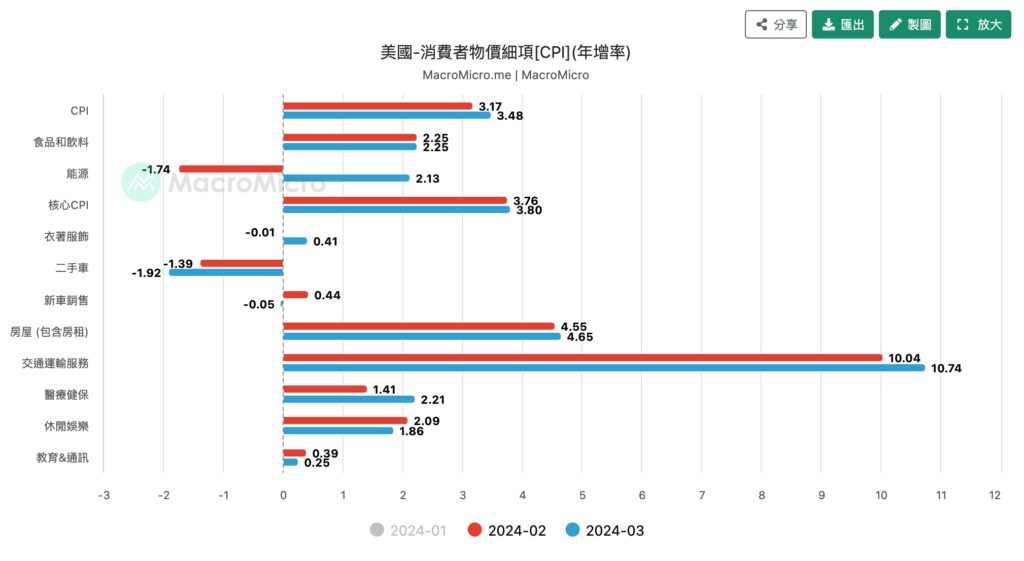
According to financial M-squared data , you can see from the consumer price index details in the figure below that housing, transportation, and medical care indexes are still the largest contributors to monthly price growth, and the energy index has also plummeted from -1.74% in February. increased to 2.13% in March.
The decline was more obvious in the sales of new and second-hand cars, as well as the leisure, entertainment, and education indexes which fell slightly. But overall, there is not much progress in inflation falling back to March 2024.
What is core CPI?
Readers will usually see another index called Core CPI (Core CPI, Core Consumer Price Index). It refers to the consumer price index obtained after deducting volatile energy and food prices.
The reason for this design is that food and energy price fluctuations are usually more susceptible to seasonal factors or emergencies (such as wars). Therefore, in order to more accurately observe the actual changes in prices, core CPI is usually used as a priority reference indicator for most national governments.
What is the impact of CPI on the stock market?
The CPI index is one of the economic indicators that the market attaches great importance to, especially in the current context of the Federal Reserve (Fed)'s efforts to combat high inflation. If the CPI can continue to decline, it means that the Fed's deflationary policy is effective and prices continue to decline.
On the contrary, if the CPI index remains high, it means that the Fed may need to further tighten monetary policy. If it chooses to further raise interest rates, funds may flow out of the venture capital market more quickly. For cryptocurrency and the stock market, this is usually not the case. Happy to see.
Generally speaking, when the CPI index rises, the market usually expects inflation to rise in the future, which may have a negative impact on the stock market.
Because inflation may lead to a decrease in consumer purchasing power and an increase in business costs, which may reduce consumption and investment, lead to a slowdown in economic growth, and in turn affect the stock market. In addition, high inflation rates may also lead the central bank to take interest rate hikes to curb inflation, which may cause interest rates to rise, making the stock market relatively unfavorable.
On the contrary, when the CPI index declines, the market may have positive expectations about future economic growth and interest rate trends, thus having a positive impact on the stock market. Because deflation may cause the central bank to take measures to relax monetary policy, thereby lowering interest rates, promoting consumption and investment, and benefiting the stock market.
However, changes in the CPI index are not the only factors that affect the market. Prices will be affected by corporate performance, government policies, geopolitical risks, etc. Therefore, investors need to consider various factors comprehensively to formulate investment strategies.