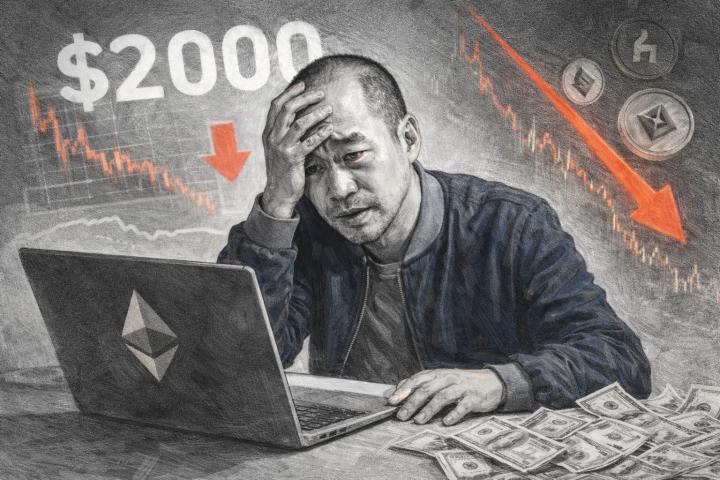
A reader asked why the risk aversion caused by the Middle East war caused funds to flee crypto assets.
I have discussed this issue with you before.
I think the main reason for this situation is that in the eyes of the forces that dominate the rise and fall of crypto assets, crypto assets are risky assets rather than safe-haven assets.
Before 2021, crypto assets were basically on the margins of the entire financial ecosystem. At that time, the main players in this ecosystem were retail investors. At that time, many retail investors were still influenced by the ideal description of Bitcoin by Bitcoin predecessors, and regarded it as a safe-haven asset, especially a safe-haven asset to hedge against fiat currency risks.
But starting from 2021, traditional capital, led by Wall Street capital, began to enter this ecosystem and gradually became the dominant force in the market.
In the view of Wall Street capital, the characteristics of crypto assets are similar to those of traditional stocks. Therefore, the factors that affect the stock market and how they are affected are also transmitted to the crypto market at the same time. This phenomenon has become increasingly obvious in the several simultaneous rise and fall of U.S. stocks and crypto assets since 2021.
Therefore, as early as the last bull market, we gradually classified crypto assets as risky assets similar to U.S. stocks.
However, as geopolitical interference and the East-West divide have intensified in recent years, I feel that another characteristic of crypto assets has begun to become increasingly apparent - that is, its barrier-free global communication capabilities make it increasingly likely to become a potential, default universal asset in an environment of human interference.
Its versatility is not inferior to gold, but its convenience and transaction efficiency are far higher than gold.
Recently, an international news report said that nearly $20 billion of crypto assets were transferred to Russia. However, because the transaction was conducted through a centralized exchange, it was eventually frozen.
But if the two parties to the transaction transfer money directly, the result is likely to be another one - which will fully reflect the convenience and efficiency of encrypted assets.
So I am also wondering, if crypto assets are increasingly used in international activities under the East-West divide in the future, will its "bridge role" become an important factor supporting its price?
A reader asked whether to buy or not since CRV, ARB and MAGIC have all fallen within the fixed investment range?
I have not made regular investments in the ARB coin. I just bought some when the price was low before and exchanged some with Matic.
I have not made any more fixed investments in the coins I have previously invested in. The main reason for doing this is that I want to keep some funds to participate in new projects that may appear in the future, and to get some benefits from some projects.
When it comes to discovering new projects, even though it’s very difficult and often disappointing, curiosity always makes us want to explore around.
I mentioned the app farcaster.xyz in an article a while ago. It gave me a very average first impression, but I still patiently tossed around for a long time, endured its many inexplicable operations, and finally registered an account with it.
After entering this ecosystem and experiencing it for a while, I gradually felt that this ecosystem was different from existing social applications:
It's geekier and has a bit more of an "elite" feel.
It is not so noisy, but it is not lacking in enthusiasm or hot spots.
Its members have relatively strong cohesion. Once a new thing or a new topic forms a new consensus, a new community and network will soon be formed.
It feels more like a social application customized for the crypto ecosystem.
In the last round of bull market, we have also seen some typical social applications: such as Mask. However, many of those applications just forcibly implanted tokens in traditional social applications, and the applications themselves did not have many characteristics of the crypto ecosystem.
Farcaster is much better in this respect. Will some interesting new projects and applications be born from Farcaster?