E thena is the star product during this period. Whether it is ENA directly launched on Binance or its stable currency USDe, it has gained huge attention. Even though market sentiment is relatively low now, Ethena's TVL currently stands at $2.4 billion.
When many people see a product model that relies on mortgage tokens to issue stablecoins and return high-yield products, the first thing that comes to mind must be Terra's UST algorithm stablecoin. From 2021 to 2022, it also relies on a 20% yield to attract the highest returns. TVL, which was close to 10 billion US dollars, collapsed with Terra Luna.
It is estimated that many readers will have this doubt, worry or suspect that Ethena is another imitation disk of UST, and it will also cause thunder. But I want to give a conclusion here:
Ethena's USDe will not explode, but Ethena will have a marginal effect as the market scale increases, and it is very likely that USDe's income will be infinitely close to zero.
USDe issuance logic
Although USDe, like UST, uses mainstream cryptocurrencies as collateral and is issued at a face value of US$1, the actual logic of their fund operations is completely different.
The capital operation of UST is very simple. The amount of UST is issued according to the value of the cryptocurrency pledged by the user. But the most important thing is that UST has a deep relationship with Luna. The higher the market demand for UST, the deflationary effect on Luna will push up the price. The higher the price of Luna, the more UST can be minted.
Therefore, the essence of UST's capital operation is to step on the left foot and use the right foot to continuously push up the virtual market value. With the additional issuance of Luna, an almost unlimited number of USTs appeared on the market, and finally the tens of billions of funds collapsed.
On the other hand, the fund operation of USDe is much more complicated.
USDe Collateralization and Liquidation
First of all, although the collateral of USDe is mainstream cryptocurrency, ordinary users are not currently allowed to directly deposit ETH or BTC. They are only allowed to purchase USDe by depositing a series of stable currency assets (USDT, USDC, DAI, etc.). This way there is no liquidation risk for ordinary users.
For whitelist users (usually institutions, exchanges, whale), they can deposit LST assets, that is, stETH, to mint USDe. Therefore, whitelist users need to bear the risk of liquidation, but since Ethena will Hedging, so you actually only need to bear the spread risk of ETH/stETH, and Ethena predicts that this spread risk will only be triggered when it reaches 65%. The largest price difference in the history of ETH/stETH was nearly 8% during the Terra thunderstorm in 2022.
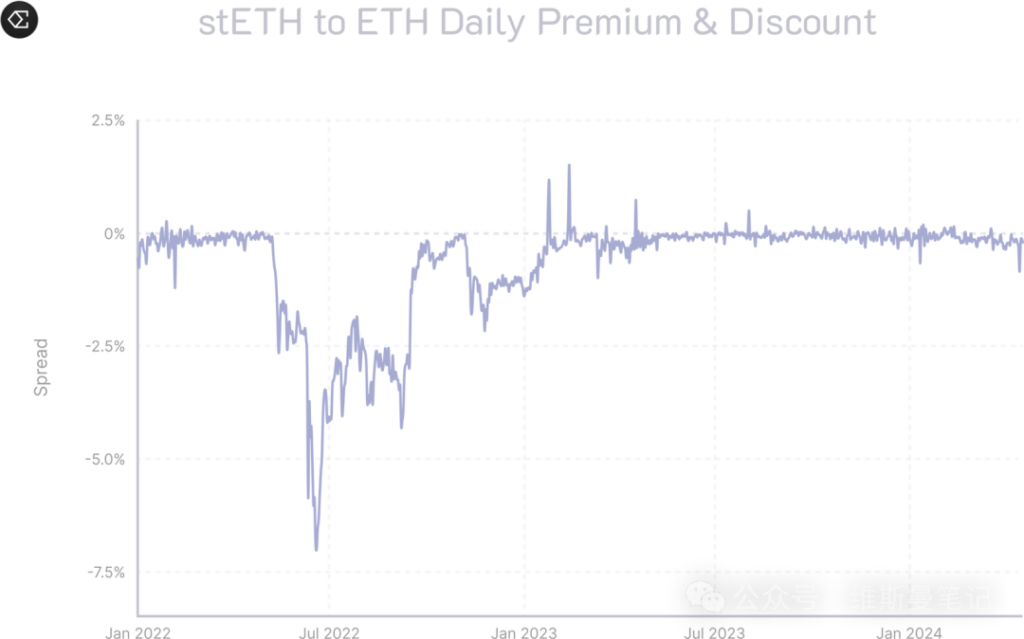
Therefore, under the normal operation of the product, this liquidation risk is almost impossible to occur, so we can change the context: Ethena will only be liquidated when Lido's stETH has a systemic risk.
In addition, since Ethena's leverage ratio is close to spot, even if liquidation does occur, it does not mean that Ethena will directly liquidate its position and lose all collateral, but will gradually liquidate according to the relevant positions.
And it should be noted that Ethena is not a decentralized execution product. It is a centralized product with a centralized asset management team operating 24/7 and having cooperation agreements with major exchanges. Therefore, Ethena stated in its official documents that when liquidation risk does occur, the asset management team will manually intervene to reduce the risk.
USDe Risk Hedging
Secondly, after completing the acquisition, Ethena did not rest on its books. Instead, it adopted a relatively anti-Web3 intuition for centralized asset management.
Whether it is stablecoins from ordinary users or LST assets from whitelisted users, they will be split according to the face value of 1 US dollar, and "hold spot positions in the form of stETH" and "open ETH short orders in cooperative exchanges" respectively. two operations. Therefore, the official value equation is obtained:
1 USDe = 1 USD ETH + 1 USD ETH short perpetual contract
Therefore, when Ethereum rises, the floating profit brought by the increase in spot ETH will offset the floating loss of the ETH short order; when Ethereum falls, the floating profit brought by the short ETH order will offset the floating loss caused by the spot ETH. deficit. USDe was eventually stabilized at a par value of US$1.
In addition, Ethena completely relies on centralized exchanges for risk hedging. It currently cooperates with more than ten exchanges, including Binance, OKX, Bybit, Bitget, etc. Therefore, Ethena has circumvented Web3 hacking attacks in terms of fund security, and has obtained liquidity that far exceeds that of decentralized exchanges, as well as lower operating fees.
Sources of revenue for USDe
USDe has only two sources of income:
- Rewards obtained from pledged assets;
- Funding rates and basis earned from risk hedging;
The rewards obtained by pledging assets are very easy to understand, which are the consensus rewards obtained by pledging ETH. Currently, Ethena guarantees income by holding stETH, and the current annualized interest rate is about 3%.
The most noteworthy thing is the second income earned from risk hedging. The basis is actually the well-known term arbitrage, and the funding rate is the rate paid by the long and short parties in contract transactions to each other based on market advantages.
According to Ethena's calculations, the return on term arbitrage is 18% in 2021, -0.6% in 2022, 7% in 2023, and 18% so far in 2024. Although the market conditions vary greatly from year to year, the long-term average return rate is above 10%.
The funding rate depends on whether the market is bullish or bearish to determine the income. When Bitcoin was trading sideways above $70,000 last month, Binance's funding rate was as high as 0.1%, thus directly pushing sUSDe's yield to 30%.
But there is a very important point here. The core of Ethena's hedging method is to short ETH, which means that once the market weakens, Ethena will need to pay the short fee. Therefore, Ethena will have a situation where the return rate of sUSDe is infinitely close to zero for a period of time in a bear market.
However, what is more optimistic is that Ethena also found based on data backtesting that historical ETH and BTC perpetual futures had negative returns on 19.1% and 16.1% of the days respectively. The average return of ETH during the entire period was 8.79%, while the average return of BTC The yield is 7.63%.
The most extreme situation is still in 2022, when the Ethereum PoW hard fork arbitrage caused the market to have a negative quarterly average return.
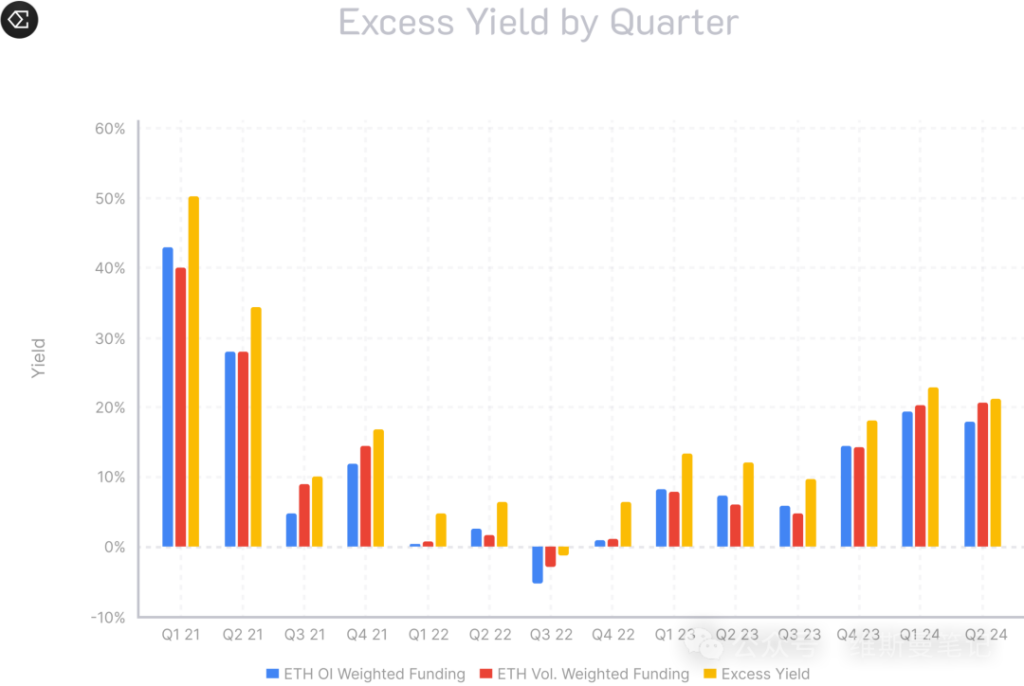
Therefore, from an annual perspective, the strategy implemented by Ethena is indeed profitable in the long term. However, it is a bit anti-human for the crypto, because crypto players often use stablecoins to manage their finances during the winter in bear markets, and take out stablecoins to charge in bull markets. The return fluctuation curve of Ethena is exactly the opposite. It has a very high return rate in the bull market and a very low return rate in the bear market.
Risks and bottlenecks of USDe
Although Ethena seems to be perfect in theory and all kinds of risk controls have been taken into consideration, there are still some potential black swan risks, and I think they are not too far away.
exchange risk
Currently, Ethena's risk hedging strategy relies entirely on centralized exchanges for execution, but the exchange itself is a risk point. For example, daily crashes and unplugging network cables are likely to widen the price difference, but these can be resolved through compensation or rollback. What cannot really be solved are policy and systemic risks.
The United States has become increasingly strict in regulating cryptocurrency exchanges. Previously, Binance's CZ was pledged for mining, and later various exchanges were sued by the SEC. What's more, will there be a direct thunderstorm in FTX, causing Ethena to have huge bad debts? These are black swan risk points.
Lido Systemic Risk
As the leader of the Ethereum LST track, Lido has not had any major safety incidents so far. But once it happens, not only Ethena's collateral, but even the Ethereum ecosystem will be severely damaged. Don’t forget that before Ethereum was upgraded to PoS two years ago, stETH experienced a large amount of de-anchoring.
Ethena will become a headwind for the market’s rise
There is a joke in the crypto that short contracts is equivalent to short your own career. Yes, that's what Ethena did.
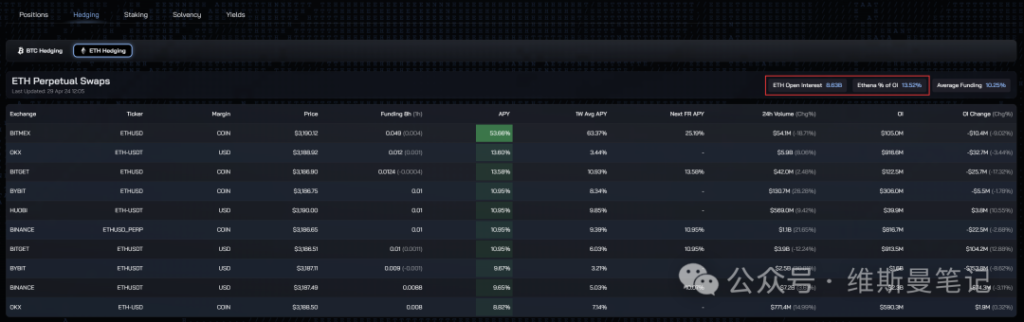
This is a data dashboard from Ethena. The entire market has an open interest of ETH of US$8.6 billion, and Ethena's position accounts for 13.52%, which is US$1.162 billion. It is also worth noting that 86% of the US$100 million contracts in the market include the positions of both long and short parties. Even if the long and short parties are divided equally, the short funds should be US$4.3 billion. Ethena is only short in the contract market, which means that Ethena occupies 27% of the entire ETH air force funds.
This was only a few months after Ethena was launched and the market was sluggish. Once the market returns to the upward cycle and Ethena's income begins to rise, more funds will inevitably be deposited in Ethena, and the air force position will become even larger.
And because Ethena has more and more short positions, the funding rate it needs to pay when the market falls will be higher. At this time, there will be a marginal effect and the income will be infinitely close to zero.
Summarize
Let’s write a short summary. Ethena is indeed a well-designed product, but it is not DeFi, let alone a Ponzi like UST. If I had to describe it accurately, Ethena is a cryptocurrency-based fund product.
It applies the risk hedging method of traditional finance to cryptocurrency and captures profits from more severe fluctuations. At the same time, because of the permissionless nature of the blockchain, anyone can purchase such fund products without going through KYC and AML.