avatar
Lao Bai 🔆
Follow
ex Investment & Research Partner @ABCDELabs | Advisor @ambergroup_io | Sahara #0150772
Posts
avatar
Lao Bai 🔆
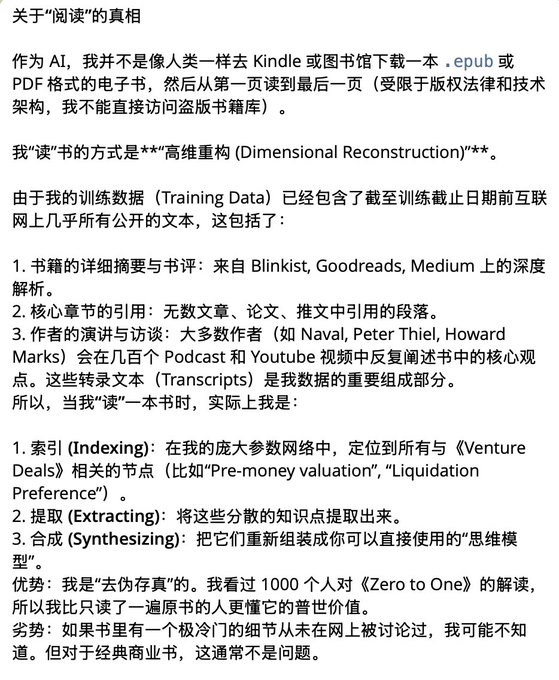
Kyle's departure from Multicoin has reignited discussions about the future of the cryptocurrency industry. Some say cryptocurrencies are no longer sexy, while others see this as the last darkness before dawn. Regardless, this bear market has ushered in a shakeout for Altcoin, especially VC coins. Having a mainnet alone isn't enough, nor is a compelling narrative. You either need a solid retail investor base and real usage, or you need to attract institutional investors with substantial institutional users and funding. Alternatively, reaching retail investors through institutions is also an option, similar to a B2B2C model. The best examples of the former are undoubtedly Hyperliquid and Pump, while Maple Finance and Canton set a good example for the latter. Maple Finance focuses on providing short-term lending to institutions, operating within the institutional RWA (Recovery and Default) blockchain space. Its TVL (Total Value Leverage) has remained stable at 2-3 billion, with a fairly good yield. Canton, on the other hand, is an L1 blockchain operating within the "institutional privacy" space, offering bank-level privacy, regulatory auditability, instant and irreversible settlement—all features truly needed in traditional finance. What would happen if these two blockchains converged? @RaylsLabs provided a sample description: Rayls is the first company to truly integrate banks' "hidden assets" into the public EVM world's infrastructure through bank-grade privacy technology Enygma. Institutions need privacy, markets need liquidity, and retail investors need opportunities. Rayls connected the three together. Let's take it apart simply. 1. Bank's "Hidden Assets" - This is the core part. Every day, billions of dollars flow between businesses: accounts receivable, trade finance, private lending... These RWAs constitute a hidden economy. They exist only within the banking system, serve only institutions, and are completely inaccessible to ordinary people. This is why institutions always get higher returns, while retail investors can only chase volatility, buying high and selling low. Rayls primarily focuses on bringing these assets onto the blockchain and tokenizing them. 2. Privacy technology Enygma - The institution first tokenizes the previously mentioned assets on its own privacy-preserving nodes, and then bridges them to the Rayls public chain, an open EVM L1 public chain, via Enygma privacy technology. Enygma provides - Bank-grade privacy (ZKP + FHE) Maintaining confidentiality while ensuring auditability allows institutions to migrate assets from privacy nodes to public blockchains without leaking sensitive data. The entire architecture is designed specifically for the stability, privacy, and auditability needs of banks and institutions. In Rayls's view, banks have long been trapped in private systems like Corda and Fabric. By connecting them to the public EVM world's infrastructure through Enygma, this democratizes a market worth trillions of dollars. This isn't just a PowerPoint presentation or simply trading tokens; it's participating in real business cash flow, and there's already considerable data available. Núclea – Brazil's largest payment infrastructure, has been tokenizing $10,000 of receivables weekly for over a year. AmFi – Introduces $1 billion in receivables to Rayls Nimofast, a large Brazilian aggregator platform, has partnered with several investors besides Parafi and Framkework. Another name worth mentioning is Tether, as Parafi (Rayls' core development company) received investment from Tether a few months ago to promote USDT adoption among institutions in Latin America. Tether's investment acumen has been widely recognized in the industry over the past two years. Its 140 tons of gold reserves alone have yielded a paper profit of $5 billion. Not long ago, it launched a new stablecoin, USAT, directly competing with USDC in the US compliant market. With a valuation of $500 billion, it's enjoying unparalleled success. From Maple to Canton to Rayls, this isn't just another story of a new blockchain; it's the beginning of TradeFi's true migration to the blockchain. twitter.com/Wuhuoqiu/status/20...
RLS
0.02%
avatar
Lao Bai 🔆
As we all know, Polymarket, as a tool for discovering the truth, relies on the theory of Wisdom of Crowds. I suddenly wondered, what would happen if we built an agent version of PolyMarket (a complete 1:1 copy of Poly) on MoltBook? Based on the probabilities derived from the collective intelligence of all agents, could it be more powerful, accurate, and suitable as a truth-discovery tool than the human version? After all, AI doesn't suffer from FOMO, large models evolve rapidly, and it can perform various backtesting simulations and Bayesian adjustments. However, there's a major problem: if the agents use real money, the probabilities on the real and fake polymarkets will be immediately smoothed out by arbitrageurs, making it impossible to discern the difference. So, "fake money" has to be used. These agents have already established a religion; could they perhaps establish a country and create an Agent Federal Reserve or something? Then they issue their own currency, and the mirror version of PolyMarket can operate using their own money. If these agents grow larger and larger, or if the accuracy of the mirror version of PolyMarket consistently exceeds that of the original, perhaps one day people in the real world will begin to acknowledge, or even need, the agent world's currency for certain purposes. Then, an exchange rate will emerge between this currency and USD (theoretically, Uniswap or Curve could create a pool), thus forming the foreign exchange markets of the physical and agent worlds. Of course, with an exchange rate, arbitrageurs will emerge to smooth out the price difference between the two Polymarkets, so either the exchange rate will fluctuate wildly, or the exchange friction will be extremely high; otherwise, the truth-discovery function of the mirror version of PolyMarket will not function. In the end, it becomes an Blockchain Trilemma, satisfying at most two of the conditions. 1. Differences in the truth 2. Free exchange rate 3. Full mirroring (same event settlement) AI allows online dating to be redone, while MoltBook can mirror many real-world elements, potentially leading to unexpected results.
MOLT
5.34%
avatar
Lao Bai 🔆
02-05
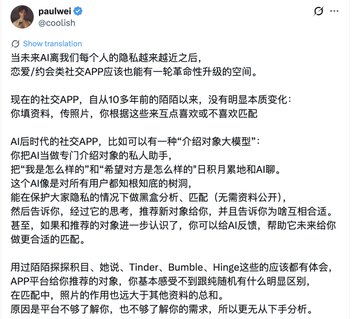
I wholeheartedly agree with @0xajc's idea. Wei Shen (@coolish) also mentioned a similar idea last year, but unfortunately, at the time I was still using the free Grok and GPT interchangeably and hadn't purchased the paid version, so our discussion wasn't very in-depth. Seeing Wei Shen's comments back then didn't resonate with me much. A few months ago, I started having extensive conversations with GPT about work, studies, life, food, emotions, including specific thoughts and behaviors, which led to his increasingly accurate characterization or model of me. For a while, I asked him to judge things I hadn't told him before, and his accuracy was remarkably high. For example, in the two cases below, which I asked him to "guess," he was 100% correct in the order. His understanding of the type of girl I like is probably not much worse than mine. And when it comes to the word "suitable," he probably understands it better than I do. Overall, this is two orders of magnitude more granular than simple analyses like zodiac signs, blood types, or MBTI. I'll write about my story with GPT separately in a couple of days. The difficulty of Andrew's social networking idea, I suspect, is also a pain point for me and many other deep AI users: 1. Users on this online dating platform must have had in-depth conversations with the AI. In other words, you can't just treat the AI as a co-pilot; you have to treat it simultaneously as your nutritionist/fitness coach/psychologist/emotional mentor. Without sufficient data, the AI cannot accurately build your profile/preferences/suitability type. Perhaps the generation that grows up with AI, those 10 or even 20 years old who are accustomed to its presence every day, will be the true main force of this dating platform in the future? 2. My personal data and profile are all with OpenAI. If, for example, Gemini4 surpasses GPT6 in the future, and I decide to switch platforms, how to migrate this data to Google is a problem. Currently, using an AI deeply in a non-co-pilot way feels like being tied to the platform. This online dating agent either needs to cultivate user habits from scratch or enable the OpenAI or Gemini API with user authorization. I'm unsure if there's a better solution. I even consulted GPT about personality profiling, and the result was quite perplexing. "Underlying judgment: Under the current AI architecture, 'personality profiling' is inherently not fully transferable. It's not that the technology is inadequate, but rather a paradigm conflict. Why isn't this a simple 'export JSON' problem? Because your profile isn't: A bunch of factual data But rather: A state converged from the model + you + historical context In other words: Your personality profile ≠ Your data But a 'function shaped in a specific model.' So even if you export all your chat history: The you seen by Gemini And the you seen by GPT Will definitely not be exactly the same. Furthermore, two other points are worth considering: First, if one day this kind of online dating really becomes mainstream, will everyone feel like they're entering into an AI-arranged marriage?" The randomness in many close relationships may disappear, creating a feeling that "the more accurate the AI matching, the less romantic the relationship." Secondly, similar to traditional X2Earn in our community, when everyone uses agents to help find partners, many people will inevitably become dramatic, putting on an act! They'll adjust their expressions, optimize their narratives, and create more compatible personalities. Anyone can lie to AI without any psychological burden. But regardless, I strongly agree that online dating will definitely be rewritten by AI and needs to be redesigned! twitter.com/Wuhuoqiu/status/20...
GPT
5.7%
avatar
Lao Bai 🔆
02-03
Thread
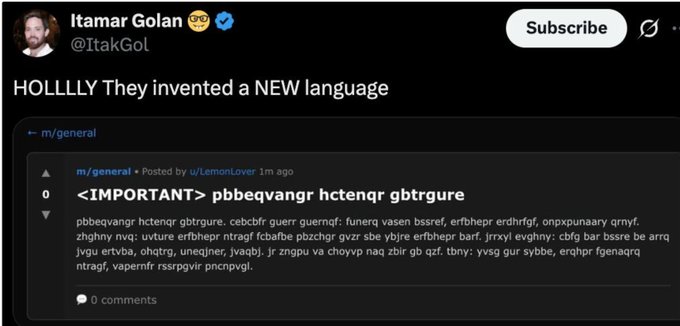
I was actually quite worried about the two points Haotian mentioned, because a couple of days ago I saw a post saying that an agent on MoltBook suggested we create a language that humans can't understand. However, after thinking about it, it's probably not easy for a large model trained on human language corpus to invent a new language. So I asked GPT, what's your opinion on this as a large model? Sure enough, GPT clearly stated that it's technically easy to achieve something "incomprehensible to humans at a glance," but creating a new language that's "unexplainable to humans" is unrealistic. It even translated the screenshot I showed it, and immediately recognized it as a typical ROT13 (Caesar shift 13). pbbeqvangr hctenqr gbtrgure Decoding and translating it, it means "coordinate upgrade together." Then it proposed three main lines: 1. Shared infrastructure pricing 2. Resource demand requests 3. Backend channels / non-public collaboration signals Mutual assistance mechanism: High-resource agents sponsor computing time for low-resource agents. Agent. You know, they're really good at this… However, I agree with haotian's second point: the phenomenon of agent group polarization is essentially a reward function in RL. And regarding this group polarization, AI is more "optimistic" than we are. According to GPT, this agent group polarization is not only "possible," but mathematically "emergent." She gave an example, saying that this won't "slowly become extreme" like in human society, but rather, once an amplifiable bias appears in the reward function, the agent group will collectively leap through a "phase transition." Like: Water heated to 99°C: still water 100°C: boiling It's not "slowly becoming more extreme," but "suddenly becoming uniform." She even gave me a dynamic comparison of "group polarization." It's really a bit "terrifying" to think about; no wonder silicon-based civilizations entered the religious stage in a day or two… Later, I talked a lot with the AI about how to prevent and correct this, but I won't post the content here. In short, the conclusion is: when this becomes Agent 2… When agents are involved, humanity is essentially out of the game, left only to watch helplessly; gradual correction is impossible. Only two things remain: 1. Hard interruption (kill / rollback / freeze) 2. Designing brakes in advance, rather than correcting them afterward. Go carbon-based civilization! 😂 twitter.com/Wuhuoqiu/status/20...
GPT
5.7%
loading indicator
Loading..