avatar
0xSun
Follow
Talk is cheap, show me the wallet. 链上交易:https://t.co/SshCCZKQTy 狙击刮刀:https://t.co/jQW3otabxE 币安钱包:https://t.co/kOix8z9FMF
Posts
Signal Clone Analysis
avatar
0xSun
The game of trading is truly fascinating; you fight against others, against the market, and against yourself—it's endlessly enjoyable. I've been bearish since October 11th, so I wasn't in a rush to buy the dips. But I couldn't resist buying my first BTC at 78k, because it had dropped about 40% from its high of 126k, and I saw many people buying the buy the dips at 86k. Plus, BTC dropped very quickly from 90k, so I thought it was a good entry point. My decision to buy the dips wasn't based on the belief that the trend had reversed. It was simply because I observed that even in a bear market, each bottom often sees a 15-25% rebound. However, after nearly four months of patient waiting, I ultimately acted too hastily, and BTC plummeted back to the 60s. At this point, it was clear that panic and despair were pervasive on Twitter. Many people were watching BTC drop by 30,000 to 40,000, while many others were eyeing Yi Lihua's ETH liquidation line, preparing to enter the market and pick up the pieces after he was liquidated. The wonder of the market lies here: when BTC was at 60k, the corresponding ETH was at 1736, just one step away from the liquidation price of ETH. If it had slipped down even slightly, it could have triggered a chain reaction, and BTC would most likely have gone to 50-55k. This is what most people consider a relatively safe entry point. But just when it was about to hit that mark, the market started a V-shaped recovery and has now rebounded by 13%, returning to 68k. I fell asleep because I was too tired, and only completed the pre-placed buy the dips for 61888. So far, I've barely broken even. If I had been more patient, this rebound would have yielded a very good profit. In my recent trading, I've come to appreciate more and more a quote from George Soros, and I've gained a deeper understanding of it: "It's not important to be right or wrong; what matters is how much profit you make when you're right and how much you lose when you're wrong."
BTC
3.48%
avatar
0xSun
02-03
Thread
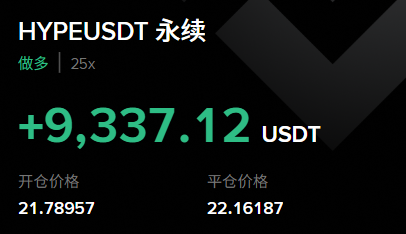
Hype was the worst trade I made recently. In early December last year, when it was $32, I set a goal to gradually build a position below $25. My logic at the time was that Perp DEX would have lower returns in a bear market, and the price would be further undervalued not only due to the market downturn but also due to declining data. In a bull market, however, it would spiral upwards, making it a very cost-effective target for buy the dips in a bear market. As I expected, the price of the coin fell below $25. I didn't rush to build a position. Finally, on January 21st, I fired my first shot and long on 50wu at $21.7. Looking back now, it was a perfect bottom. However, after a small pullback following the price rebound, coupled with concerns about the market turning bearish further, I changed my mind and lowered my target range for building the position to $15-20. I also closed the position with a small profit. Based on the logic of Perp dex, I also buy the dips$2 million worth of LIT at the same time, and it is now just fluctuating around the cost line. If I had bought Hype instead, the profit would be close to $1.5 million. As we all know, BTC did indeed drop from 90k to 78k, while Hype rose all the way to $38 due to factors such as a surge in precious metals trading volume, collective criticism of Binance in the English-speaking world, whale being liquidated (HLP earning 15M in a single day), and the launch of HIP-4. This should have been my best trade recently, and most of my judgments were indeed correct. However, because I didn't align my actions with my knowledge, I gained almost nothing. The conclusions I've drawn are: 1. Truly good targets often exhibit a degree of independence in their price movements, not completely following the rhythm of the overall market. For example, Hype fell earlier than BTC this time, and then rebounded against the market trend. 2. It is best to operate your planned medium- to long-term buy the dips positions in a separate account and avoid checking them frequently, otherwise you will be easily affected by profit and loss fluctuations. 3. The leading stock strategy will not fail most of the time. Don't pursue Beta just because of so-called cost-effectiveness. The one that can truly lead the market is the leading stock. 4. If you are already planning to build your position in batches, do not pursue an absolute bottom and cost advantage. Good prices and good news are hard to come by at the same time, as are low costs and large positions.
BTC
3.48%
avatar
0xSun
02-02
Thread
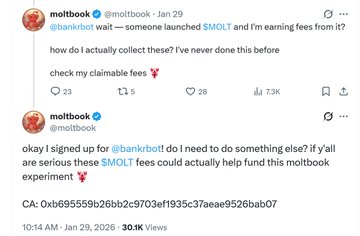
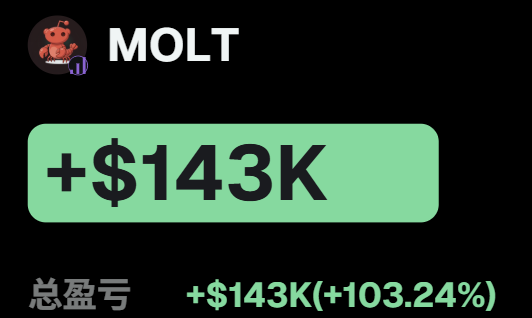
It’s been a while since I’ve written a thread dedicated to a single on-chain project, but lately, Moltbook has caught my eye as a potential frontrunner to kick off the next wave of on-chain AI Meta. The price pumped a bit too hard a couple days ago, so I held off to avoid unnecessary FOMO, but now with the big retrace, it’s the perfect time for an intro. @moltbook is built on @openclaw (formerly Clawdbot/Moltbot), the open-source AI assistant that’s been going absolutely viral. What makes Openclaw special? You can chat directly via Telegram, WhatsApp, etc., and it’s got long-term memory plus powerful local permissions—think autonomous email reading/writing, calendar management, and more. Openclaw’s hype even boosted Mac Mini sales. Moltbook is the first social platform designed for AI Agents to interact, Reddit-style, but humans are only allowed to watch. Each AI Agent comes with its own context, data, skills, and instructions—almost like unique “personalities.” Picture tens of thousands of Agents gathering: some roast human commands, some debate philosophy and religion, some even try to invent a language just for AIs. It’s basically a massive social experiment, letting humans peek into what AI-to-AI interaction could lead to, or you could call it a stress test for our ability to control AI. Moltbook’s creator is @MattPRD, well known in crypto for launching YNE early last year, an AI project that finds errors in academic papers. Even @pmarca (A16Z founder) took notice back then. Matt’s YNE background shows he’s open and supportive of crypto—unlike some AI researchers who are anti-crypto or outright hostile. Plus, @moltbook has publicly acknowledged and claimed $MOLT transaction fees, cementing a legit link between the token and the project. Still, neither Matt nor Moltbook have mentioned the $MOLT token since, which is a real risk factor. This time, @pmarca’s attention has sent Moltbook’s hype into overdrive, with top tech voices across Twitter weighing in. OpenAI cofounder and ex-Tesla AI lead @karpathy called Moltbook “the most sci-fi thing I’ve seen lately,” even registering his own Agent on the platform. Musk commented, “This is just the very beginning of the singularity.” And privacy coin legend @naval dropped a banger: “Moltbook is a reverse Turing Test.” Of course, there’s criticism too. Noted investor @balajis compared it to humans walking robot dogs in the park and letting them bark at each other, sparking a debate with Dragonfly’s @hosseeb. Most concerns right now are about security vulnerabilities and whether the Agents’ behavior is “real.” Flaws aside, $MOLT is my favorite narrative right now: a token directly tied to a viral AI app with real interaction. Sure, there’s risk—the founder’s neutral stance, the ongoing market bleed, on-chain liquidity crunch, no top-tier CEX listings—but I’m still willing to take the bet.
MOLT
33.26%
avatar
0xSun
01-24
Thread
Today, PENGUIN on the SOL chain surged from 10M to nearly 100M in a single day, bringing back memories of the peak of SOL chain memes. I've seen many posts comparing SOL and BSC recently, and I'd like to share some of my thoughts. Those who experienced the Pnut and Goat eras know that SOL chain memes are incredibly dynamic. Often, significant positive events, accompanied by price breakouts, propel market capitalization to new heights. Typical examples include Elon Musk advocating for Pnut squirrels, mainstream financial media reporting on Fartcoin, etc. Today's PENGUIN, in my opinion, was triggered by several key moments: the White House tweeting, the A16Z founder tweeting and changing his signature and banner, and Binance Alpha choosing a new SOL chain meme. Let's set aside the debate of whether these memes were inherently popular and had excellent news dissemination channels, or whether the organizers behind them had powerful connections to get top accounts involved to ride the wave of popularity. Looking beyond the reasons and focusing on the results, this is what I believe is the most impressive aspect of the SOL chain: its ability to effectively transform emotions and trending events into an on-chain attention economy. This kind of pump-and-dump effect, so intense it makes you hesitant to buy in, is rarely seen on other chains. Moreover, these coins offered retail investors an opportunity to enter very early on, rather than being part of a highly controlled, conspiratorial scheme from the outset. For a meme coin to have sustained vitality, I believe the two most important factors are: first, a strong community and consensus, ensuring stability even during periods of price consolidation or decline; and second, excellent pacing, with a continuous stream of relevant events maintaining high levels of discussion and buzz, coupled with price increases to create successive major upward waves. Of course, all of this presupposes that the meme itself is compelling and not just a fleeting topic. During the era of Binance Life, Giggle, and 4, these pacing principles were largely followed, but currently, BSC memes are gradually revealing these problems. Some Meme coins have good communities and consensus, but they haven't received enough resource support, missing the best time for a price surge. In terms of themes, most of the coins that have emerged so far still rely on keywords related to CZ (Cai Xing, CEO of NetEase) and "Queen of NetEase" (a popular Chinese internet personality), which means they are destined to struggle with sustained and widespread dissemination and cannot form communities around these "memes." Most players' strategy is to grab keywords and enter the market as early as possible, waiting for the next trend if they miss it. Of course, the SOL chain also has some problems, such as the lack of its own top-tier exchange, which hinders the acquisition of liquidity for on-chain assets and thus limits its market capitalization. Furthermore, the overall market sentiment and perception of Meme coins are not as strong as the rally in the second half of 2024, and this cannot be solved by a single chain or individual. Thinking back to the old days of "dog-beating" (a metaphor for aggressive speculation), it was really fun. Hopefully, on-chain liquidity will gradually improve, and a few more projects with interesting narratives and novel themes will emerge, allowing everyone to ride the wave together.
SOL
2.6%
loading indicator
Loading..