Amazon & Google: Projected Spending on South Korean Giants (Samsung/SK Hynix) (2026F)
1. Estimated Spending Data
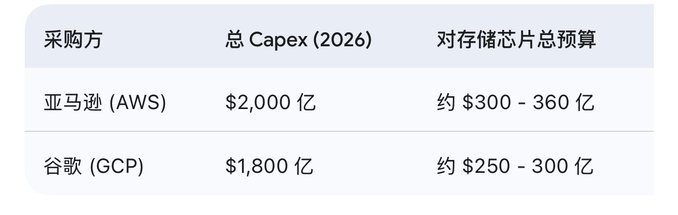
Based on the assumption that the value of storage in the cost structure of AI servers will double, the estimated procurement scale of the two giants in 2026 is as follows:
Amazon Storage Spending: $30-36 billion
Google Storage Spending: $25-30 billion.
Key Variable: In early 2026, due to an extreme shortage of HBM capacity, procurement executives from Amazon and Google were reportedly "renting hotels in South Korea" to seek 3-5 year long-term supply agreements (LTAs), which could lead to actual spending exceeding the budget.
2. Segment Breakdown
SK Hynix: The Absolute Beneficiary of AI Premium
Google's Logic: Google's TPU v7 architecture has extremely high bandwidth requirements for HBM. Hynix, as the primary supplier of HBM3E, accounts for over 60% of the storage demand for Google's AI accelerator.
Amazon's logic: Amazon's Trainium 2 chips are ramping up production, and Hynix has customized a dedicated HBM for them.
Profit quality: Hynix raised its HBM3E price by 20% in January 2026, and both giants accepted almost the entire increase to "maintain volume."
Samsung: All-round complement and NAND dominance
NAND/SSD demand: A large portion of Amazon's $200 billion spending is for data center expansion. Samsung's dominance in the enterprise-grade SSD (eSSD) field is irreplaceable, and it is expected to secure over 50% of the flash memory orders from both companies.
HBM catching up: Although Samsung is slightly slower than Hynix in HBM3E progress, its huge production capacity reserves have made it a backup supplier for both giants during the "general-purpose DRAM (DDR5)" shortage.
3. Supply Chain Game: The Strategic Shift in 2026
From "Buy-on-Demand" to "Long-Term Leasing for Supplies": In previous years, storage was a cyclical commodity, and giants tended to drive down prices. However, in 2026, due to HBMs crowding out general-purpose DRAM capacity, traditional server memory prices surged (Q1 prices rose 60%-70% in a single quarter).
The Strategic Shift: Of Amazon's $200 billion in spending, the funds originally allocated to storage may face an overspending shortfall of over $5 billion. This portion of profits will directly flow from Amazon's financial statements to SK Hynix and Samsung.
The Impact of Self-Developed Chips: Google and Amazon are both increasing their investment in self-developed ASICs (TPU/Trainium). This means their requirements for storage are no longer "standardized" but "customized." Through this deep integration, SK Hynix is transforming from a "supplier" into a "co-developer."
4. Summary: Logical Basis for Bullish/Bearish Views
Bullish on Storage (Samsung/SK Hynix):
The giants' combined Capex of 380 billion is a strong support for the storage industry. As long as the AI arms race continues, storage chips will remain the hardest currency.
Bearish on Expenditure (Amazon/Google):
Such massive chip spending means that these two giants will face significant pressure on their gross margins in 2026. A surge in depreciation expenses could lead to a sequential decline in their GAAP profits in the second half of the year.
Conclusion: In 2026, Amazon and Google will contribute approximately $50-65 billion in revenue to these two South Korean giants.
The above is Gemini's AI conclusion. I personally favor SK Hynix and Samsung, but also Google, and not Amazon. Google's closed-loop business model between its AI, servers, and existing products creates an AI flywheel.
twitter.com/xiaomucrypto/statu...