avatar
brucexu.eth ❤️🐼🦇🔊
3,248 Twitter followers
Follow
Web3 & CyberSocialism Buidler | Cypherpunk & Regen | INTJ | Initiator @LXDAO_Official @EIPFun | Member @ethpanda_org @PlanckerDAO @GCCofCommons @theNextDAO
Posts
avatar
brucexu.eth ❤️🐼🦇🔊
03-19
Thread
I'm excited to share that I've officially joined LI.FI as an APAC DevRel! For over three years, I've been researching a single question in Web3: how to improve UX and truly enable mass adoption in this industry? From NFTs, Meme Coins, and DAOs to wallets, cross-chain bridges, and the Ethereum protocol—from the application layer to the protocol layer—I've looked at it all and personally encountered numerous pitfalls. My biggest conclusion is that the two most critical infrastructure bottlenecks restricting the Web3 user experience are wallets and Bridge/Swap (especially the infrastructure that makes DeFi truly usable for enterprises). Everyone knows the importance of wallets. But Bridge/Swap and DeFi orchestration seem to be severely underestimated. Almost every Web3 user needs them, and everyone has been burned—transaction failures, confusing paths, high fees, slow speeds, and constant security issues. Many people don't lack the desire to use Web3 and Blockchain; they're simply stopped at this step. After in-depth research, I discovered LI.FI. In simple terms, LI.FI is an infrastructure protocol that provides a unified market access point for the digital asset space—it's a liquidity connection and orchestration layer for the multi-chain world. In layman's terms, you only need one endpoint or interface to submit your requirements, and LI.FI will handle the rest automatically. You don't need to know unnecessary knowledge about cross-chain, liquidity, different chain characteristics, etc. From Swap, Bridge, and cross-chain execution to higher-level capabilities such as LI.FI Composer and Intents, LI.FI is using technology to solve real-world user experience problems and is already serving a large number of real clients. What excites me even more is the larger trend behind it: users shouldn't be separated by chains and assets—they only need to express their intentions (Intents), and everything will work seamlessly. Developers also shouldn't have to piece together cross-chain bridges, DEXs, DeFi protocols, and routes themselves time and time again. Whether it's wallets, DeFi, payments, or AI agents, the demand for unified orchestration infrastructure will only increase. http:/LI.FI [This last part is a separate, unrelated comment:] ... My focus going forward will be on promoting awareness, adoption, and integration of LI.FI within the Asia-Pacific developer ecosystem—especially the Chinese community. I will provide technical support, developer events, and ecosystem collaborations, continuing to build strong relationships with the community. If you are developing wallets, DeFi products, payment applications, arbitrage, Neobank, AI Agents, or any project requiring cross-chain and on-chain execution capabilities, feel free to contact me—I can help you assess whether LI.FI is suitable for your scenario and assist you with integration. DM open, Telegram: brucexu_eth, WeChat: brucexu-eth. The QR code for the Chinese community is below; interested parties are welcome to join.
ETH
0.49%
avatar
brucexu.eth ❤️🐼🦇🔊
03-10
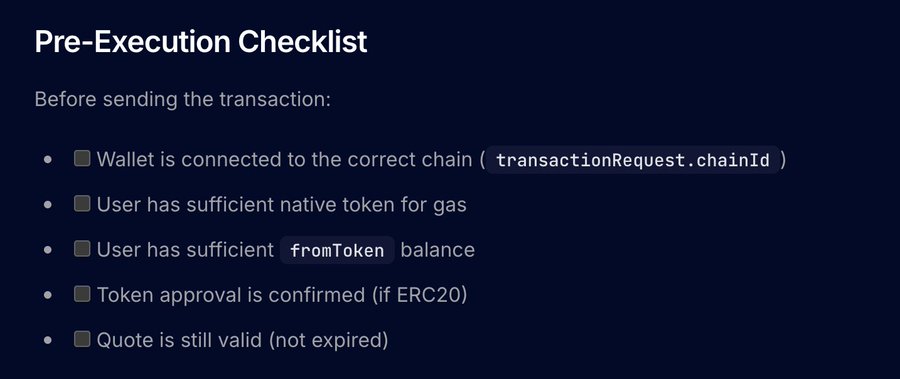
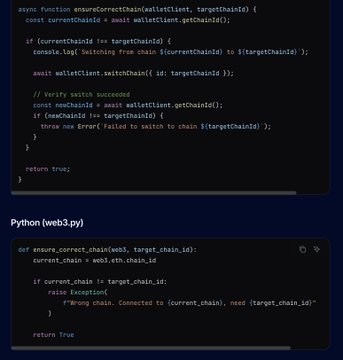
More and more Web3 infrastructures are beginning to integrate with or provide interfaces, documentation, and methods for AI use. LIFI's new API and Agent Integration are particularly interesting and offer some insights. First, LIFI is a multi-chain aggregator. A single codebase and interface makes integration very convenient, enabling automatic pricing and supporting cross-chain and swap functionality across many chains. The underlying swap functionality used in many wallets or Dexes may already be integrated with LIFI's routing and SDK. Therefore, integrating AI with LIFI is a natural progression. Looking at the documentation, it currently primarily assists developers, but in the future, it can easily be expanded to allow AI agents to directly manipulate LIFI to complete swaps. The latest documentation provides: - MCP Server: The interface for AI to interact with the API, currently supporting 20 tools, enabling AI to automatically query prices, on-chain information, optimal routes, etc., facilitating the AI ​​to find and recommend the best solutions. - Agent skills: Instructs Vibe Coding agents how to integrate the SDK. I think these two are essentially standard features that any infrastructure and product should provide. What's particularly inspiring is the agent-native documentation; I find it very interesting that it's written for AI, not humans. For example, this document docs.li.fi/agents/workflows/ex...…: 1. Clearly outlines checklists and constraints in an imperative manner. 2. Provides two sets of reference code in both Python and JavaScript for each core function. 3. Also includes a diagrammatic Decision Matrix, clearly written in the concise and clearest language for AI. 4. The last page header includes a copy of the entire page in Markdown and llm.txt, making it very convenient for AI to read itself. This seems to be the future trend; technical documentation doesn't need to be read by humans. Returning to LIFI itself, I welcome everyone to pay attention. If your project (wallet, Dex, arbitrage, AI Agents, etc.) needs to integrate Bridge, Swap, Intents, etc., you can integrate them directly for free. twitter.com/brucexu_eth/status...
ETH
0.49%
loading indicator
Loading..